After a few more tries, I got overflow mode to work flawlessly.
In this post I will summarise the build process, as well as what I've learned from building and testing nearly 10 versions. I apologise for perhaps too much detail, but I try to bring over as much of my experience as I can for interested readers.
The tools are pretty standard, perhaps the only one that is not part of a standard toolbox is a drill for cutting two 1 inch holes in the plastic box. I use silicon for glueing the CO2 and gas purge pipes, and PVC glue for the white piping.
On the right all materials for one reactor, altogether bought for 6 USD.
View attachment 4529
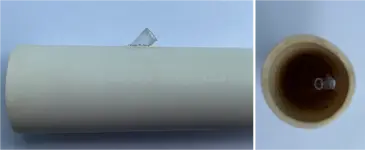
First I would drill the holes in the box, and glue the gas pipes with silicon and let that cure overnight. Then, pictures below, on the left the machining I did on the PVC, on the right the assembly as seen from below.
Optimising the pipe for overflow mode I started cutting open the top. This has two objectives. First, the top of the pipe is not longer obstructing the water/CO2 interface and we have a more constant and predictable reactor power in overflow mode. Second, the flow of water in the pipe will agitate the water surface, make it move, create some turbulence that will from time to time suck small 1 mm bubbles of gas into the overflow for making overflow mode work. In one of my attempts I made this top opening broader, about half of the pipe, but that gave too much turbulence in the reactor. The opening could be a bit narrower than in the picture, but not too much as it will then not have enough interaction with the water surface and stop sucking gas as necessary for the overflow function.
In the bottom of the pipe I drilled three large holes, so that there is always a good interaction between the water flow in the pipe and the water in the box. I also want to be sure, based on what I've seen, that we don't create a modern version of a Roman aqueduct, where water flows through the pipe and has no longer interaction with the water in the box.
The end pieces I adapted so the I could insert them first through the drilled holes in the box, and after that have the pipe fit in from the top. Also, I want the top as skinny as possible, as I don't want any plastic to change the water/CO2 surface area.
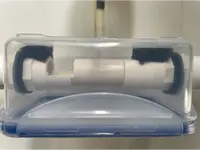
In the right picture below I use plastic tie wraps to hold the pipe in its position. This is not yet mechanically as strong as a glued connection, but makes it easier to do small adjustments until tests are fully successful. The final version will be glued, so that the pipe work gives mechanical stability.
View attachment 4530
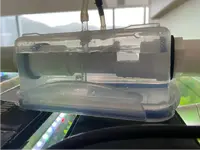
Below is the reactor seen in overflow operation. No plastic parts are sticking through the water surface, so reactor power around overflow stable position is pretty constant. A few times per minute I see some <1 mm bubbles blown into my tank, that's how we like it and as per my post #156 the optimum for stability with less than 10-15% efficiency loss on CO2 consumption.
My reactor in overflow mode has now 11.400 mm2, this ratio of 38 to my 431.000 mm2 tank surface. My drop checker is a bit beyond lime green, with clearly some hints of yellow, so I expect to be around 1.2 - 1.3 pH drop. And of course the whole purpose of overflow mode is that my CO2 is stabilised by the reactor and I don't depend anymore on CO2 regulator stability, CO2/pH controller and water chemistry.
View attachment 4531
Overall this reactor now works perfectly. What we need to discover is how easy it will be for new users to get overflow mode right, as I needed nearly 10 tries before I got fully successful. There are many many different ways to cut holes in the pipe, it is not so easy to predict what the water will do, and it is quite likely that someone finds smarter solutions than I did, perhaps more robust or easier to machine.












 can you explain what you mean by ".. there are many many different ways to cut holes.. is not so easy to predict what the water will do" ?
 for this . Have you acquaintences who set aside recommendations for you yet?


