Welcome to ScapeCrunch

We are ScapeCrunch, the place where planted aquarium hobbyists come to build relationships and support each other. When you're tired of doom scrolling, you've found your home here.

Horizontal CO2 Reactor - Yugang 鱼缸 Reactor

  • Thread starter Thread starter Yugang
  • Start date Start date
  • Tagged users Tagged users None
When optimising overflow mode it may be useful to remind that the premise is that bubbles escaping from the reactor will reach the tank and be released to ambient air without ever being dissolved in water. So these bubbles from the overflow do not contribute to the tanks CO2 ppm. In this case it is the reactor geometry that controls the CO2 injection rate rather than CO2 regulator or controller.

I have now seen several examples of suboptimal overflow mode setup, one of these is that I have been using a 4 meter long Fluval FX4/6 hose for testing the reactor V2. My tank is only 1 meter long, so this hose has been curled up behind my cabinet. This situation is not ideal, as bubbles from my reactor have a long way to travel, and get potentially dissolved in the hose and may even form small CO2 gas pockets in the top the curls. I have now replaced this long hose by a short 1 meter hose that goes straight up to the water outflow of the tank, and from time to time I hear a quiet trickle sound from overflow bubbles reaching the tank.

It is useful to check every overflow setup and make sure that bubbles escaping from the overflow reach the tank without being absorbed in the water or caught up in small CO2 pockets in the system. With this, CO2 in the tank should be very stable, independent of the rate of injection from the regulator.
 
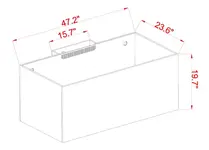
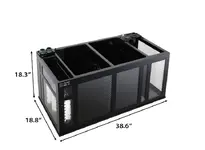
@Yugang , it's on buddy. They (Aqua Rocks Colorado) are sending me a prototype to try on the new tank. I fear it will be underpowered with the addition of a sump. So let's talk surface area and design for a sumped tank. I asked them for the specs, but you may already have them, so you may have some insight on the probability of the things going on. Here's the tank and sump dimensions,Screenshot 2024-05-06 194856.pngScreenshot 2024-05-06 195052.png
What is the formula for this scenario?
I'll add, the sump is partially covered and may be able to add additional covering for those open areas.
 
Congratulations @Unexpected !

If I understand correctly Aquarocks Colorado is planning various reactor sizes, so you may want to let them know your requirement.

Here are my calculations. The 17.7 ratio that we all use, targets a maximum 1.5-1.6 pH drop in an open tank. Just in case you would prefer a 1.2 pH drop as target, this is 50% less CO2 ppm than 1.5, I also included these in the calculation with a 35 ratio between tank and reactor active surface area. An open sump is expected to have a similar outgassing as an open tank, while a covered sump will add to the volume and ramp time in the morning, but would not contribute to the CO2 outgassing in steady state.

1715073186098.png
 
Congratulations @Unexpected !

If I understand correctly Aquarocks Colorado is planning various reactor sizes, so you may want to let them know your requirement.

Here are my calculations. The 17.7 ratio that we all use, targets a maximum 1.5-1.6 pH drop in an open tank. Just in case you would prefer a 1.2 pH drop as target, this is 50% less CO2 ppm than 1.5, I also included these in the calculation with a 35 ratio between tank and reactor active surface area. An open sump is expected to have a similar outgassing as an open tank, while a covered sump will add to the volume and ramp time in the morning, but would not contribute to the CO2 outgassing in steady state.

View attachment 4947
Thank you! Here are the available sizes.
IMG_0101.webp
 
If the reactor design allows the gas pocket to reach the center of the tube, maximizing the gas/water surface, then:

Area [mm²] = D [mm] x L [mm]

80mm diameter with 80 cm length looks close enough.
 
Thank you! Here are the available sizes.
View attachment 4948
@Unexpected do you have pictures of the product that Auqarocks Colorado sells? What's meant with "right inlet and left outlet but near the bottom area"? Degas valve? Bypass?

I have no doubt that their reactor will work, but it would be useful to review the design and make sure it can even be used in overflow mode as that can bring CO2 stability and safety like no other reactor does.


-----------------------------------------------------------------------------------------------------------------------

I hope it is helpful to evaluate the three reactor options with the standard ADA tank dimensions.

1715125637241.png

From @Unexpected info it looks like Aquarocks Colorado offers three reactor options:
- 75mm * 700 mm = 52500 mm2.
- 80mm * 800 mm = 64000 mm2.
- 100mm *950 mm = 95000 mm2

We see that the smallest reactor version, 52500 will easily push the 156 gallon tank to 1.2 pH drop. For this large tank the medium size reactor would be sufficient for a 1.5 pH drop. The largest reactor will work but it will be a beast and livestock is definitely at risk if too much CO2 gets injected.

All the tanks, from 45-P (9 gallons) up to 120-P (58 gallons) can easily be pushed to 1.5 pH drop with the smallest version of the reactor. Again be careful as too much CO2 injection can lead to dangerous CO2 levels.

1715125697787.png

Of course all the above are estimations based on the testing we have so far, and there may be some variations depending on the tank, covering lids, flow, etcetera.
 
Last edited:
@Unexpected do you have pictures of the product that Auqarocks Colorado sells? What's meant with "right inlet and left outlet but near the bottom area"? Degas valve? Bypass?

I have no doubt that their reactor will work, but it would be useful to review the design and make sure it can even be used in overflow mode as that can bring CO2 stability and safety like no other reactor does.


-----------------------------------------------------------------------------------------------------------------------

I hope it is helpful to evaluate the three reactor options with the standard ADA tank dimensions.

View attachment 4949

From @Unexpected info it looks like Aquarocks Colorado offers three reactor options:
- 75mm * 700 mm = 52500 mm2.
- 80mm * 800 mm = 64000 mm2.
- 100mm *950 mm = 95000 mm2

We see that the smallest reactor version, 52500 will easily push the 156 gallon tank to 1.2 pH drop. For this large tank the medium size reactor would be sufficient for a 1.5 pH drop. The largest reactor will workout it will be a beast and livestock is definitely at risk if too much CO2 gets injected.

All the tanks, from 45-P (9 gallons) up to 120-P (58 gallons) can easily be pushed to 1.5 pH drop with the smallest version of the reactor. Again be careful as too much CO2 injection can lead to dangerous CO2 levels.

View attachment 4950

Of course all the above are estimations based on the testing we have so far, and there may be some variations depending on the tank, covering lids, flow, etcetera.
I don’t have a picture. I’ll have some when it arrives. I will ask them to send the middle one.
 
I will ask them to send the middle one.
This makes sense, right-size the reactor for the tank/sump combination and your target pH drop. Having an oversized reactor, like the biggest version may feel like a luxury, but it actually takes away the inherent safety that the reactor can guarantee (the middle version is unlikely to gas your fish, but the large version will not limit injection to an acceptable level when your pH controller or regulator fails The other advantage with right-sizing is that you may use the reactor in overflow mode, let the reactor stabilise CO2, as I a few others are now doing.

The other observation from my previous post is that the three versions from Aquarocks Colorado are all a good fit for large tanks. For hobbyists with 15-50 gallon tanks it may be useful to have versions that are 10.000-25.000 mm2, much less than the 52.000-95.000 versions offered now. But yes I understand, go big or go home is the saying.
 
LOL when I got banned from a site that's exactly what Tom told me.
This site deleted my first post, a warm welcome. Someone is setting up a 1100 gallon tank, asked advice and I felt I had to reach out as I don't really see how you do that with a battery of bubble CO2 reactors.

1715298342202.png

1715298606311.png

I checked the forum rules, but found no reference to "self promotion". I have no plan to post anymore on that forum, even after having received the trophy for my deleted message. Hope that other members will consider to mention our new solution when that is appropriate, so that other hobbyists can benefit and don't need to try running a bubble reactor for a 1100 gallon tank.
 
It looks to me like Aquarocks Colorado designed this really well. I like the clean looks, quality and robust build and see some nice benefits as compared to DIY.

The feature I like most is the asymmetric water inlet and outlets. This is not easy to build DIY and has some clear benefits, especially for high water flow rate or overflow mode. As the reactor has been designed, we can also easily adjust this depending on what we want to do.
  • With the water inlet as low as possible, we minimise water splashing and noise, even at high flow rates. As this particular version is also quite long, I expect it works with nearly every pump flow rate, without the need for a bypass.
  • When the height of the outflow can be adjusted, we can control when the reactor will start to overflow and it will be straightforward to set up overflow mode, or the inherent safety when used with precision regulator or pH controller. I would personally prefer to have the top of the outflow centred at half of the reactor tube height, this will give the reactor its maximum capacity in overflow mode and we would expect around 1.5 pH drop for your tank + sump combination.
The CO2 inlet positioned just next to the water inlet in the end piece will give a very robust build. With the transparent tube we can see the CO2 bubbles coming in, and with that have an indication of the injection rate.

A suggestion to Aquarocks Colorado would be to sell an optional bracket for mounting on the rear panel of the cabinet.

What seems to be missing is a degas valve. As explained before the reactor can purge itself and you can do without the degas valve, but I find it easier to do a quick manual purge after my weekly maintenance when my FX4 has blown some air in my reactor.

Your tank plus sump totals 150 gallon @Unexpected , 47 inch long. I could imagine you would prefer to have your reactor built with 100 mm diameter rather than 80, so that you could have it 20% shorter?

Overall I am quite impressed seeing this prototype, and look forward to your testing results @Unexpected . Thank you for posting this. If you would consider running it in overflow mode, I am of course happy to help with that.
 
Last edited:
1 pH drop in 39 minutes with the ARC reactor. This has been a very crude test, but tomorrow I will continue after a probe calibration and taking a sample to degas.

Perhaps it is useful to share my observations after seeing this video, not for @Unexpected but for the less experienced visitors of this thread.

1 pH drop in 39 minutes with the ARC reactor.
This is on a 578 liter tank + sump, and the reactor is not even working at its full capacity as the gas pocket is less then half of the reactor tube. As @Unexpected has his sump covered, therefore less CO2 outgassing than we calculated for, I would expect that ultimately the reactor power will have to be reduced so as not to exceed safe limits for livestock. With the asymmetric water exit design in this prototype this can easy be accomplished.

The gentle water flow with just a little surface ripple is how I like to see my reactor as I am sure there is no noise from splashing, no bubbles created, but also it allows for the best possible overflow mode with just a few tiny bubbles escaping from time to time from the exit. @Unexpected uses no bypass, but injecting the water low in the reactor will help to avoid any unwanted drama. As long as the water is not stagnant, at least a little flow, the reactor will work independent of the water flow rate.

For those who are still confused when we mention overflow mode, be reminded that the rate of CO2 absorption in the water is proportional to the surface area between water and CO2. When we have just a few CO2 bubbles escaping through the exit, the gas pocket in the reactor is constant in size and the surface area therefore constant as well - we have a constant CO2 injection rate set by the dimensions of the reactor. When we accidentally inject too much CO2 (faulty regulator or controller) bubbles will escape and the CO2 ppm is unaffected, and this makes this reactor inherently safe for livestock.

With the transparent tube we can easily observe how fast CO2 absorps in water, I typically see the gas pocket disappear in about 20-30 minutes after CO2 turned off. So don't worry about wasting the gas in this pocket, as it is just a small fraction of the total volume that we inject in one day. After a full days reactor work, solenoid off, the gas pocket will shrink fast, but not totally disappear. The volume of the remaining gas is in interesting indicator how well overflow mode has been set up as I will illustrate again later.
 
If Unexpected would want to reduce the effective surface area to create a safety limit and prevent overgasing, it could be done by simply tilting the reactor very slightly, raising the exit side by maybe 1 or 2 mm.

My own experiment is a little stuck because I haven't had time to go scavenging for parts. I did buy a plastic tupperware thing with rubber sealing and mostly flat sides which looks perfect for it. I was imagining it more square shaped, but the one I found is very long and narrow. I suppose that is fine. Internal dimensions are 19x9 cm, or 171 cm², very close to the 162 cm² that I was aiming for.

Right now I'm stuck thinking of a way to connect the canister hoses without sacrificing the internal diameter. I'm sure that I'm overthinking this and I should just use the standard barbed connectors, the loss in internal diameter is probably minor for such a small tube length. Anyways, I know of a part used for electric stuff which could work, but I don't know if it is made in a larger size to fit my tubes. I also don't know if it would be completely watertight at the usual working pressure.

pg25-branco_1.jpg
 
As long as the water is not stagnant, at least a little flow, the reactor will work independent of the water flow rate.
Let me try to be a bit more specific, and please note that the below is only really relevant for use in overflow mode where we want a constant absorption rate that is only dependent on reactor size, but not on water flow or stability of the CO2 regulator.

The key statement here is that CO2 absorption in water is proportional to the surface area of the CO2 gas / water interface. Why is this a reasonable assumption, and when should we start worrying about a too slow water flow, or what I called loosely "stagnant"?

The below is the solubility of CO2 in water

1715771440015.webp
There are some parameter at play, including temperature, pressure and salinity, but we can take 0.15 gram CO2 per 100 gram water as a reference, this is 1500 ppm. So what is important here is that a typical 30 ppm CO2 in our tank is just 2% of CO2 solubility. So when we expose our 30 ppm tank water to a pure CO2 gas bubble, as in our reactor, it is safe to assume that the molecules in the gas will not be shy seeing this tiny bit CO2 already in the water and easily be absorbed in the reactor as if nothing were there already. We can assume that this will only change when the CO2 ppm in the water increases to a significant portion of the maximum 1500 ppm solubility.

Unfortunately I don't have accurate data on the CO2 consumption of my 50 gallon tank at say 30ppm, as my notes are a bit of a mix with different experiments and conditions. But I believe 20 gram CO2 per day is a reasonable reference, at around 30 ppm. It could be double, but for the argument below we don't care too much about this uncertainty.

My tank runs at 20 grams CO2 consumption during a 10 hrs day, ie 2 grams CO2 per hour. We could make a rather conservative assumption, again as we want stability in overflow mode that is independent of water flow, that we do not want to exceed 10% of CO2 solubility -- 150 ppm maximum in the reactor. (To keep it simple, I assume that water enters the reactor with 0 ppm). We can then calculate that to inject 2 grams per hour, with a 150 ppm water flow, we need 2/0.00015 = 13.000 gram, ie 13 liter water per hour.

The above is just a rough estimation. First, I have not documented accurately my tanks CO2 consumption per day. Second, we take an extremely cautious assumption that we do not want to exceed 10% of solubility. But it gives a benchmark that if I keep my water flow in the reactor above 13 liter per hour (less than 1% if my FX4 rated 2650 flow) I can safely assume that the reactor in overflow will work independent of flow rate. What I called "stagnant" would be less than 13 liter per hour and could start giving some saturation effects and dependencies on the water flow rate.
 

Top 10 Trending Threads

Back
Top