Ok. I did the hard work.
I did a water change and determined flows.
My Oase Biomaster 350s are marketed as maximum flow of 300 gallons per hour. I am calling that a bold face lie. It is never going to flow 300 gallons per hour.
With 1 foot stubs and hose and stock filter media in the filter is flows 150 gallons per hour.
But wait you say, companies post ratings without media because they dont know what you will be using for media!
No dice. I took out the sponge prefilters, the prefilter housing and all the trays and media. Just a powerhead and a canister full of water.
180 gallons per hour flow….
So maybe the pump itself if not in the canister can flow 300 gph but as fitted to the canister its never going to get close.
I am getting 120 gallons per hour at the oulet where it flows into the spray bar….
150 gph out of canister and media reducing to 120 gph through system plumbing is not extreme loss. There just is not a lot to be gained by going to larger size pipe and better fittings…
Running. 2 Oase Biomasters I am getting 240 gallons per hour flowing into the spray bar.
,
Pretty sad that I am burning through 32 watts to do this when 8 watts of power blowing air into my uplift tubes in my UGF filter is pushing 200 gallons per hour.
The optimax 285 pump is rated at 285 gallons per hour for 10 watts…. I am thinking there are significant flow restrictions through the Oase canisters themselves…
Using an inline pump to push more flow through an oase biomaster and removing the impeller is likely going to be dissapointing…
Resizing the hose isnt likely to improve things substantially either.
What would probably work best is plumbing the pumps as primary secondary plumbing.
In essence your intake comes down to an inline pump that then goes back to the outlet. This pump determines the flow through your tank.
You ten install two Tees very close to each other in that line, and plumbing your intake and outflow from you canister i to the tees. This completely isolates the flow from the two pumps.
You main flow pump is not working to flow water through the filter. It is simply circulating water through the tank and across the inlet and outlet of your canister filter. Your canister filter is not pushing water around the tank or through all of the hose and fittings. It is only pulling water out of the loop, through the filter and back into the loop.
If you have slack in your hoses, you should be able to simply cut them and use them largely as they are installing the inline pump and some fittings.
I plan on taking one of my Biomasters out of service reserving it for another tank. I primarily got it for the added flow more than for extra filtration. It will give me more cabinet space back as well.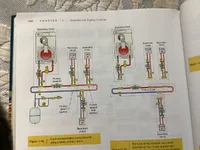
This page out of my Modern Hydronic Heating textbook describes the concept. In our case the primary circulator pipe and aquarium will be the primary circuit and the canister filter will be the secondary circuit. You are not trying to pass all of the flow through the filter. The goal is 5 to 10 times flow through the aquarium. There really isnt need for all of that flow to go through the filter…
I did a water change and determined flows.
My Oase Biomaster 350s are marketed as maximum flow of 300 gallons per hour. I am calling that a bold face lie. It is never going to flow 300 gallons per hour.
With 1 foot stubs and hose and stock filter media in the filter is flows 150 gallons per hour.
But wait you say, companies post ratings without media because they dont know what you will be using for media!
No dice. I took out the sponge prefilters, the prefilter housing and all the trays and media. Just a powerhead and a canister full of water.
180 gallons per hour flow….
So maybe the pump itself if not in the canister can flow 300 gph but as fitted to the canister its never going to get close.
I am getting 120 gallons per hour at the oulet where it flows into the spray bar….
150 gph out of canister and media reducing to 120 gph through system plumbing is not extreme loss. There just is not a lot to be gained by going to larger size pipe and better fittings…
Running. 2 Oase Biomasters I am getting 240 gallons per hour flowing into the spray bar.
,
Pretty sad that I am burning through 32 watts to do this when 8 watts of power blowing air into my uplift tubes in my UGF filter is pushing 200 gallons per hour.
The optimax 285 pump is rated at 285 gallons per hour for 10 watts…. I am thinking there are significant flow restrictions through the Oase canisters themselves…
Using an inline pump to push more flow through an oase biomaster and removing the impeller is likely going to be dissapointing…
Resizing the hose isnt likely to improve things substantially either.
What would probably work best is plumbing the pumps as primary secondary plumbing.
In essence your intake comes down to an inline pump that then goes back to the outlet. This pump determines the flow through your tank.
You ten install two Tees very close to each other in that line, and plumbing your intake and outflow from you canister i to the tees. This completely isolates the flow from the two pumps.
You main flow pump is not working to flow water through the filter. It is simply circulating water through the tank and across the inlet and outlet of your canister filter. Your canister filter is not pushing water around the tank or through all of the hose and fittings. It is only pulling water out of the loop, through the filter and back into the loop.
If you have slack in your hoses, you should be able to simply cut them and use them largely as they are installing the inline pump and some fittings.
I plan on taking one of my Biomasters out of service reserving it for another tank. I primarily got it for the added flow more than for extra filtration. It will give me more cabinet space back as well.
This page out of my Modern Hydronic Heating textbook describes the concept. In our case the primary circulator pipe and aquarium will be the primary circuit and the canister filter will be the secondary circuit. You are not trying to pass all of the flow through the filter. The goal is 5 to 10 times flow through the aquarium. There really isnt need for all of that flow to go through the filter…
Last edited: