Welcome to ScapeCrunch

We are ScapeCrunch, the place where planted aquarium hobbyists come to build relationships and support each other. When you're tired of doom scrolling, you've found your home here.

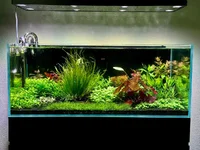
Journal Experiment Tank || 90x50x36cm, 39gal, Horizontal Reactor High-energy Aquascape Journal

I just can't stop messing with this tank's parameters. I just love tweaking my dosing and finding out how plants react!

I like to aim for less than 10ppm NO3 swings per week, and similarly I try to maintain 1-2ppm PO4 swings per week. My macros solution added 0.3ppm PO4 for every 1ppm NO3, which meant that with daily dosing, my PO4 levels were fluctuating quite a lot through the week. I recently decided to reduce my daily PO4 dosing from 0.3-0.6ppm PO4, to 0.1-0.2ppm PO4. To account for the lesser daily dose, I'm now front-loading some KH2PO4.

Separately, I've been having pale growth despite dosing 25-30ppm NO3 each week, and continuing to see some signs of trace toxicity. I was interested in how pH affects nutrient availability, because in my tank with 40-45ppm CO2 I'm consistently sitting at ~5.2pH during the photoperiod due to how acidic my water is from CO2.

Before anyone gets angry: YES I know these charts don't always track to our ionic water column scenario, but at least in soil, my macros wouldn't be very available at 5.2pH:

View attachment 16796
I've been curious as to whether my super low pH has made it a bit more difficult for plants to get my macros, and specifically Mo as traces.
Mo is a paired nutrient with NO3 for creating green growth, so maybe all of it combines to make it difficult for plants to get all of what they need at my super low pH?

Also, my substrate has ZERO cation/anion exchange capacity, unlike aquasoil. Even 'spent' aquasoil will help plant roots "grab" nutrients from the water column, so I suspect users running zero dKH with aquasoil (or less than 40ppm CO2) wouldn't see the issues I've been having.


So I'm experimenting with raising the KH of the incoming fresh water to 3dKH via KHCO3 and NaHCO3 (baking soda).
So far so good, it appears after only a few days of raising my pH/KH via these carbonate sources that certain deficiencies are improving??


View attachment 16797
Daily CO2 rate/min is the same, which is reflected by the similar height from max to min of all peaks (I have a ~1pH drop from the early morning to late afternoon. If it were a degassed sample, it would probably be a 1.5 drop).

Point is, same CO2 injection, but instead of happening between 6.3pH to 5.3pH every day (probably a 1.5 "pH drop", remember), it's happening at/around 6.7 to 5.7pH.

Pearling is crazy strong after raising the tank's KH from <1 to ~3. It's too soon to tell anything, but I think I'll hang here at 3KH for a few weeks and see how the plants fare.

View attachment 16795View attachment 16794
Things are starting to look lush!


Tank info:

New 67% WC dosing​

(actual tank volume is 34 gal, I change 22.7gal aka 2/3rds, or 67% each week)
  • Macros solution:
    • 30mL after WC
      • Front loads incoming 22.7gal water to 22.5-2.25-15, then daily 2mL dose adds 1-0.1-0.67 every day to full 34 gal tank volume each day.
  • GH, KH, K, PO4 (to incoming 22.7gal):
    • 10g CaSO4*2H2O (27ppm Ca),
    • 7.8g MgSO4*7H2O (9ppm Mg, 3:1 ratio),
    • 0.708g KH2PO4 (5.75ppm PO4 (total 8ppm), 2.38ppm K (tot. 17.38ppm K)),
    • 2.78g KHCO3 (0.9dKH, 12.62ppm K (tot. 30ppm K)),
    • 5.4g NaHCO3 (2.1dKH (tot. 3dKH), 17ppm Na),
  • Micros solution:
    • 6mL after WC
      • Then 7mL/day (0.07ppm Fe, then 0.07ppm Fe daily)
  • Total weekly front load:

    NO3 - 22.5 ppm
    PO4 - 8.0 ppm
    K - 30.0 ppm
    Ca - 27 ppm
    Mg - 9 ppm
    KH - 3.0 dKH
    Na - 17 ppm
    Fe - 0.07ppm
Keep the experiments coming!
 
27 days of growth:

1778511807451.webp


1778511757776.webp
Plants are taking off! Everyone seems to have not only survived the jump to 3dKH, but enjoyed it.Pearling is way up again.
iPhone colors/pics just don't do it justice. I'll have to break out the good camera soon.

Also added Lysimachia nummularia 'aurea' (Golden Creeping Jenny). Really beautiful light colored plant.
 
Yeah just experimenting. I knew I wanted to keep it under 4dKH for some of the more sensitive plants, but I wanted it to be high enough to raise my pH levels into a range I wanted to test. I settled on 3dKH for pH reasons, so we'll see how it goes. Seems to barely change the system, but maybe it will make a difference over time!
 
More to test some ideas regarding pH, inert vs CEC -rich/aquasoil, etc:

1778533535286.webp

Having a inert substrate with zero CEC sit at a pH of 5.2 for the entire photoperiod might be causing some issues for me, despite 40-45ppm CO2 injection minimum, so I want to test raising the pH a bit to see if it can improve things.

It's only been 8 days, but so far so good. Things do indeed seem improved at this point. The biggest change is the reduction of GSA. GSA tends to be connected to PO4 issues, notably low PO4. Well, PO4 isn't very available at pH 5.2, so even though I'm dosing ~9ppm PO4 per week, maybe it wasn't readily absorbed?

My theory is that super low KH/pH tanks with aquasoil might not suffer from this because the CEC of aquasoil helps prevent nutrient-related issues, both from the nutrient-rich aquasoil itself, but also from the CEC -ability to pull ions from the water, and allow plant roots to capture them and use them more efficiently. Also, hobbyists running inert BDBS and 20-30ppm CO2 might not run into this, because the ppm CO2 doesn't drive the pH low enough.

Either way, even with 3dKH, my pH still sits at 5.8pH due to CO2 injection:
1778533809020.webp


Previously, at 0dKH:
1778533935713.webp
I had issues with chlorosis and GSA, despite dosing TONS of Fe, Mg, and PO4. Maybe these ions aren't as available to my plants at this low pH?


New 3dKH setup:
1778534134372.webp
Still plenty of trace availability at this pH, but far more availability of primary and secondary macros.

Maybe all of this is true; maybe some of it, maybe none of it! But I'm gonna test it and report my findings here 😁
 
View attachment 16953

Well, PO4 isn't very available at pH 5.2, so even though I'm dosing ~9ppm PO4 per week, maybe it wasn't readily absorbed?
This table was used in a presentation at the AGA, and you also posted it about a week ago. Funny, because I didn't bother applying it to my tank until you mentioned this. Duh... this is why I struggle. Anyway, my pH is very low also, and I think I've commented in my journal it seems I have to dose PO4 more than most people. Well, there you go. I could raise my pH, but I have to have a ton of CO2 for the Erio quinguangulare. I wonder how others like Dennis who have aquasoil, 50ppm CO2, and low KH are able to dose so little?
 
Previously, at 0dKH:
View attachment 16955
I had issues with chlorosis and GSA, despite dosing TONS of Fe, Mg, and PO4. Maybe these ions aren't as available to my plants at this low pH?


New 3dKH setup:
View attachment 16956
Still plenty of trace availability at this pH, but far more availability of primary and secondary macros.
I find threads like this fascinating. I will be interested to see what your KH/pH experiment yields.

I have spent my career dealing with nutrition, but on the animal end of the spectrum, in ruminants specifically, and they are highly physiologically complex creatures. While animal and plant physiology are not the same, and I am by no means a botanist, they are perhaps not as dissimilar as it may appear on the surface. Ruminants (especially dwarf goats) are complex mineral metabolizers, easy to throw off balance, and the rumen is a relatively acidic environment (not unlike my 150U at present), so little goats are frequently presenting with nutritional deficiencies and toxicities in regards to mineral metabolism.

You mentioned you were dosing “TONS of Fe, Mg, and PO4”, so my mind immediately goes to Mulder’s chart, as something to overlay mentally with this nutrient availability at low pH graphic. While Mulder’s is not a solely de facto clinical tool for me per se, it does help me explain to clients why more of one thing is not necessarily better when we are trying to correct a problem. Mulder’s was obviously developed for horticulture, but similar synergism/antagonism mineral metabolism principles apply nutritionally to animal agriculture, too (assuming an absence of underlying pathology).

My personal nemeses in practice are copper and zinc, as small ruminants are very sensitive to imbalances of both. It’s an oversimplification, but for example iron in some well water inhibits (animal) absorption of copper, and deficiencies, or even animal death, may result in severe cases. But supplementing excess copper to solve the high iron problem can rapidly lead to copper toxicity, because it takes A LOT of copper to overcome the antagonism by Fe, and copper toxicity is frequently fatal. It is safer to find a method to limit dietary iron intake (i.e. filter the well water). Similarly, excess dietary calcium impedes zinc metabolism, stunting growth, and restricting wound healing, but excessive zinc supplementation results in organ failure, and you guessed it, death from zinc toxicosis in extreme cases. Decreasing dietary calcium can improve clinical health, due to the reduction of zinc antagonism by calcium, and is typically safer for the animal in extreme cases (simply adding a water softener to bind the calcium can solve the problem without adding more dietary zinc and risking toxicity). The goal, of course, is balance, but attaining balance from herd to herd (or tank to tank) is much more difficult in practice, than in theory, and sometimes it is safer to ride with some level of minor deficiency, than toxicity, depending on the herd situation. But I digress.

Back to plants. While I know that plant and animal physiology are not the same, the concept of attaining nutrient balance does apply to both systems, so I totally understand the goal here of raising KH to strive to put the nutrients on more even-footing in regards to bioavailability. Looking at both charts together for a low pH environ:

1778533935713.webp

mulders-chart.webp

“I had issues with chlorosis and GSA, despite dosing TONS of Fe, Mg, and PO4”. Seeing that phosphate absorption is more limited at low pH from your chart depicted here, and overlaying Mulder’s mutual antagonism of PO4 and Fe, adding more Fe would seem to be counterintuitive. Now we have restricted PO4 availability at low pH, but enhanced Fe availability. So adding MORE Fe with enhanced availability relative to phosphate's limited availability, would to my mind at least, enhance iron’s antagonistic potential of PO4, as the ratio of Fe to PO4 would increase unless you were adding substantially more PO4 than Fe. Low phosphate, either due to bioavailabilty, or antagonsim, drives GSA. You added tons of PO4, but I question the plant’s ability to utilize it in the presence of even more iron. Can you set up a third tank, please, and just decrease iron concentration in the low pH environment and see if the GSA goes away? :ROFLMAO: :ROFLMAO: :ROFLMAO: Enquiring minds want to know. Again, an oversimplification, but it’s why I find topics like this fascinating, they are never simple.

I agree, raising KH should put the nutrient availability in more ‘balance’ overall, at least in regards to bioavailability at higher pH, but now I want to know what reducing Fe, proportional to Phosphate would do in an acidic environment for GSA. Especially as raising KH in a new aquasoil environment isn’t easy without a lot of Seriyu stone (incidentally, as Seiryu is a popular choice for Iwagumi, do we see much GSA in Iwagumi setups using that rock?).
 

Top 10 Trending Threads

Back
Top