Welcome to ScapeCrunch

We are ScapeCrunch, the place where planted aquarium hobbyists come to build relationships and support each other. When you're tired of doom scrolling, you've found your home here.

Question of the Day CO2 regulators - let's see them!

I have been without CO2 on my tanks for nearly a year now. With so much happening in life I just could not find the time. Another issues I was facing is my Aquatek regulator solenoid was not shutting off. I tried replacing it and still had issues. This regulator also experienced EOTD, which would not be an issue typically since I run a pH controller that could shut off the CO2, but with solenoids not working became a HUGE pain. That led me to dial back my CO2 quite a bit, and ultimate shut it down when we moved earlier in 2022 (tank is still running with some java ferns and absolutely no added ferts).

As I read though this and am thinking of starting CO2 back up, it is great to see what people are using. I have been thinking of going GLA. @Art are there any issues you have experienced with that regulator? I typically run the pH controller, DIY cerges reactor, and even have used the good ole Dwyer flow meter.

Looking forward to hopefully diving back into this side of the hobby after some time out of high tech hard driven plants!
 
I have been thinking of going GLA. @Art are there any issues you have experienced with that regulator? I typically run the pH controller, DIY cerges reactor, and even have used the good ole Dwyer flow meter.
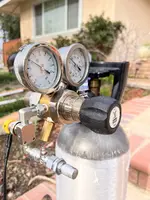
Hey Greg I have been using a GLA regulator for many years now. My experience has been rock solid. I never have to think about it which to me means it was a good investment.
 
As Gregg mentioned, mine has been rock solid for many years without a problem. Normally, I see the bubble counters crack or otherwise fail. Mine did but was quickly replaced by GLA.
 
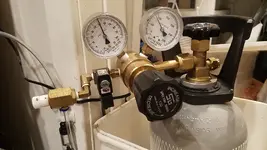
20230110_022320.jpg
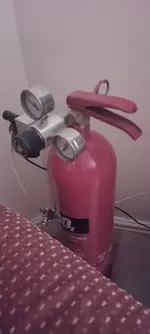
Here's one I purchased on ebay prebuilt with a Fabco Air NV-55-18 metering valve.

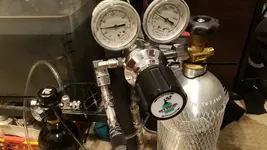
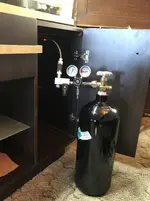
This one I'm really proud of:
20230110_023011.jpg
I slowly purchased the necessary parts from ebay, Amazon and swagelok.

Concoa 2123301 chrome-plated brass dual stage regulator
Swagelok SS-SS4-A metering valve with a Nupro S series Vernier Handle that I installed
And a solenoid I salvaged off of a Aquatek regulator (model A2A?)

I constructed it about a month ago and I'm finally leak testing it, via bettatails thread on TPT.

I eventually want to replace the solenoid with a clippard mouse but have no clue how to wire them or what to purchase. I also want to replace the cga 320 nipple to be a bit longer, but for now it works. It will eventually replace the Fzone paintball regulator next to it :)
 
Last edited:
I am reading through every thread here on ScapeCrunch (the beauty of joining a brand new forum) and finding wisdom and learning opportunities in every one, so I hope nobody minds when I bump up an older one like this.

Regarding C02 regulators - Being new to high tech planted tanks in 2020, I bought a standard C02Art Pro Elite Dual Stage, since it was a reasonably priced package with easy instructions on how to put it together. My frustrtations with it have mostly revolved around the needle valve and bubble counter. It seemed that even with the slightest touch, the adjustment to the needle valve was either too much or too little and I was always fiddling with it, it was hard to get just right while trying to tweak my c02 levels. I tried reading those various long TPT threads about needle valves, ph controllers and flow meters and, honestly, I don’t think I have enough brain power to understand how all the pieces work and fit together, lol!

I have since switched my tanks to low tech, for different reasons, but partly from not being able to dial in c02 satisfactorily enough. My c02 equipment is just sitting there, not hooked up, but I am reconsidering that. I got some advice by corresponding with Karen Randall, who wrote the book ”Sunken Gardens” that a good compromise between low and high tech would be to add C02 at a much lower, but consistant rate than is usual for a high tech tank, and she has switched many of her tanks over to this regime. The ideal appeals to me, but there are still the old problems.

Through the reading I’ve done over the past couple of years, I may be getting closer to understanding the equipment a little better. I *think* I could put a Dwyer flow meter in line and use my existing needle valve plus the dial on the flow meter to get some better accuracy. I found a Canadian source for the Dwyer RMA 151 SSV (another difficulty is finding stuff in Canada), and can add a second C02Art manifold to the regulator to feed both my tanks. Just procrastinating about it all before committing to the expense. I may start another “please hold my hand through all this” thread before I do!F0F5A6B1-77C0-4C52-A601-E65B2968DCC6.webp
 
@*Ci* - I can certainly help you out with CO2 questions. If you spent enough time thumbing thru the "various long TPT threads about needle valves, ph controllers and flow meters" you will probably see my name more than a few times, LOL.

Anyway, yes, you are correct that a Dwyer flow meter would be a worthwhile investment. Bubble counters can be useful, but I feel it is simply much easier to look at a gauge (flow meter) and see that the bubble is where it should be. Also, with a bigger tank the amount of bubbles in a bubble counter are typically un readable.

Utilizing the built in valve of the flow meter, in combination with your existing metering valve, will be an improvement. Oddly enough, in my setup I actually have 3 metering valve between the regulator and the CO2 reactor. Extremely precise - yes. Excessive, also yes.

Anyway, let me know if you need any advice.

Linn
 
@*Ci* - I can certainly help you out with CO2 questions. If you spent enough time thumbing thru the "various long TPT threads about needle valves, ph controllers and flow meters" you will probably see my name more than a few times, LOL.

Anyway, yes, you are correct that a Dwyer flow meter would be a worthwhile investment. Bubble counters can be useful, but I feel it is simply much easier to look at a gauge (flow meter) and see that the bubble is where it should be. Also, with a bigger tank the amount of bubbles in a bubble counter are typically un readable.

Utilizing the built in valve of the flow meter, in combination with your existing metering valve, will be an improvement. Oddly enough, in my setup I actually have 3 metering valve between the regulator and the CO2 reactor. Extremely precise - yes. Excessive, also yes.

Anyway, let me know if you need any advice.

Linn
Thank you for the offer @Immortal1 ! I am getting inspired : )
I do have 2 questions at this point:

1. I will be using one c02 tank with two C02Art manifold blocks on the regulator to feed two aquariums. I am assuming that I would need a separate flow meter for each manifold?

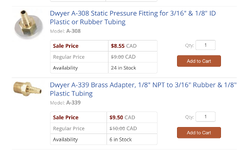
2. I think I will need some kind of hose barb to go from the meter to the c02 tubing (2 of them, one in and one out?) … would it be these? LTWFITTING Brass Barb Fitting Coupler 3/16-Inch Hose ID x 1/8-Inch Male NPT Fuel Gas Water(Pack of 5) : Amazon.ca: Tools & Home Improvement
or one of these from the same place that carries the flow meters:
 

Attachments

  • IMG_0736.webp
    IMG_0736.webp
    151.2 KB · Views: 4
Last edited:
@*Ci*
1. Yes, you would need separate flow meters.
2. The Amazon fittings should work just fine. 1/8" National Pipe Thread (NPT) is universal.

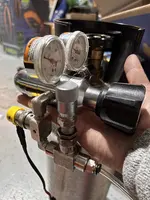
Interesting similarity - I also am running a single 10# CO2 tank, 1 regulator split between 2 systems (post #20 and #2 of this thread).
 
Back
Top