We are ScapeCrunch, the place where planted aquarium hobbyists come to build relationships and support each other. When you're tired of doom scrolling, you've found your home here.
I had a really hard time initiating the reset because I didn't anyone to think I was ignoring their advice. You need to make the hard call based on what you're seeing day to day though and that's why I moved forward with the reset. I still don't think the pictures I post show how bad the algae truly is in the tank. Hopefully round 2 goes smoother and I can have some nice pictures to post over the next couple months.
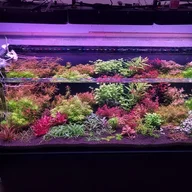
Replanting took a long time since I had to clean every individual stem. It is done though and the tank isn't looking bad. The plants generally seem happy outside of the algae. It's still puzzling me why the algae is so aggressive. I forgot how nice it is to plant in BDBS . I always have stray roots poking up when planting in soil, but with BDBS you can just tweeze them into the substrate without issue. Having a uniformly colored substrate is nice as well. Overall, I'm happy with the switch to BDBS just for the planting and substrate color.
Following the replanting I dosed NPK, trace, and remineralized to get the water in a good place for the plants as outlined below.
30 PPM Ca from Calcium sulfate dihydrate
10 PPM Mg from Magnesium sulfate Heptahydrate
20 PPM NO3 from potassium nitrate
6 PPM PO4 from potassium phosphate monobasic
26 PPM K from potassium sulfate and the other potassium salts.
0.225 PPM Fe+micros from an old trace mix that I have on hand from an older Burr740 recipe
I'll maintain the daily dosing of NPK+trace using the dosing pump resulting in weekly totals of 34NO3-10PO4-44K , but I'm considering adjusting down or switching back to larger water changes since I feel like the current dosing is a little aggressive.
I added the third light onto the tank again since I want to give the plants solid lighting and lower light didn't seem to make a difference with respect to algae growth. The settings are the lowest setting on one channel and 30% on the blue channel. With these settings the tank looks less yellow and it's my preferred spectrum. I also turned up my CO2 a little bit to make sure it's solid. The drop checkers in the front left and right corners were turning yellow right when the lights normally turn on, so it should be sufficient.
Everything should be in order now. I'm expecting a short cycle and some algae growth since the substrate is completely new, but we'll see soon enough how it goes. Wish me luck!
It looks good! I'd say keep the lights at ~50 PAR for the first week or so, just so plants can establish roots and bacteria can get a foothold before algae.
Nutrient levels look great to start a tank. With rich water column dosing, stable good CO2, and medium light, you should be algae-free
I've never used root tabs with BDBS before and have had some pretty stellar growth from most plants. That includes stems, carpets, crypts, swords, Eriocaulons, etc. As long as the water column has what it needs, most plants can make do. I'm happy to share some pics of my old BDBS tanks so you can get an idea of what plants are okay with no substrate fertilization. You can also check out the journals from Naturescapes_Rocco, Greggz (you might have to go back to his plantedtank.net journal since he's using soil at the moment), and Burr740. I don't think they use root tabs with their BDBS and grow really nice plants.
This is a situation where it would be nice to have a PAR meter. I have no idea what my light level is and it would be helpful to know where I am. I still have my lights raised 28" over the substrate, so the light is much lower than it was when I first cycled the tank. If I see anything out of the ordinary happening, light will be the first thing I modify.
I used the Photone app for iOS with full spectrum led profiles unlocked (~$7 lifetime) to do a rough par map of my tank pre-flood at a few different power levels.
Did a good bit of reading and consensus seems that it’s around +-10 par vs a meter so I figured it was better than not doing one at all. Followed their directions to make a diy diffuser.
Only problem being you’d have to ziplock bag your phone to get substrate measurements.
I'm happy to share some pics of my old BDBS tanks so you can get an idea of what plants are okay with no substrate fertilization. You can also check out the journals from Naturescapes_Rocco, Greggz (you might have to go back to his plantedtank.net journal since he's using soil at the moment), and Burr740
Oh yeah, I'm well aware of their tanks and especially how @Naturescapes_Rocco doses. I was just curious if you were using them for the mental note as I watch how things go for you. I think we all get a bit invested in following other's journals.
I wonder how well the app works for Android given that there is so much more diversity in Android phone cameras. Maybe I can give it a try and compare to my wife's iPhone just to see. If I never update my journal again, it's because my wife saw me sticking her iPhone in my tank.
Interesting new blog post about the Photone app update available for Android with a new method of utilizing the camera sensor (as opposed to the built-in ambient light sensor). They claim far greater accuracy.
It is helpful to stress the importance of the diffuser again, as this is probably the most important contributor to measurement errors using a phone camera for PAR measurement.
I am also referring to the other forum, where posts on PAR apps nearly all focus on spectrum but do not address the more important issue of the optical paths of radiation.
Anyone use an app to measure PAR? Or been thinking about trying one out? https://migrolight.com/blogs/grow-light-news/par-meter-apps-compared-for-accuracy#:~:text=The%20PAR%20meter%20app%20by,for%20this%20grow%20light%20spectrum.
I wonder how well the app works for Android given that there is so much more diversity in Android phone cameras. Maybe I can give it a try and compare to my wife's iPhone just to see. If I never update my journal again, it's because my wife saw me sticking her iPhone in my tank.
Actually, a couple of us tested it. @Yugang started a great thread and then I did some comparisons with my Galaxy S23+ at post #55 HERE It works pretty good. Use a filter.
Well; contrary to the results of others with Android phones, my attempts at using the Photone app on my Google Pixel were less than stellar (and I didn't like putting my phone in the aquarium either) so I took a chance on this inexpensive (relatively) Aquarium Par Meter and have been happy with it so far.
I also have a Google Pixel and I thought it would work poorly because it's a relatively uncommon phone. My results were okayish using a paper diffuser. My lights are on 1%/30% at 28" from substrate and the Photone app said 95 PAR at substrate. The published PAR data suggests 75 PAR at 30" for 1%/1%, so the data looks somewhat reasonable at first glance. The PAR measurements at other distances seemed okay as well. The issue for me is that I have 3 lights in a row and the published PAR data is for 1 light. I have a strong feeling the Photone app is underestimating by a decent margin. I think the values from the app can serve as a baseline for future adjustment, but I shouldn't go around telling people the PAR values in the tank are what the app says.
Just asking,.... did you also calibrate your phone for the plastic bag?
If you're that curious, you can always go online and rent one for a few days like I did. I rented it for like 4 days because I thought I'd do different things. I also didn't know when I'd get to use it, but honestly, as soon as it came in, I was on it. It only takes a second. While you have it, you could also test it next to your phone. If they are similar, you know you can rely on your phone in the future.
This site uses cookies to help personalise content, tailor your experience and to keep you logged in if you register.
By continuing to use this site, you are consenting to our use of cookies.