




Let me add that there's a lot of merit to the other suggestions and input too. And lowering light will definitely slow things down, might be all thats needed. If so who cares if more macros will fix it! Right? lol. Its just that when I look at these pics, even without reading, I dont see plants overpowered by too much light. I see plants that need more macros. Other opinions are valid too however
Navigation
Install the app
How to install the app on iOS
Follow along with the video below to see how to install our site as a web app on your home screen.
Note: This feature may not be available in some browsers.
More options
Style variation
Welcome to ScapeCrunch
We are ScapeCrunch, the place where planted aquarium hobbyists come to build relationships and support each other. When you're tired of doom scrolling, you've found your home here.
You are using an out of date browser. It may not display this or other websites correctly.
You should upgrade or use an alternative browser.
You should upgrade or use an alternative browser.
Journal Recovering from disaster: My 120P journey.
- Thread starter bradquade
- Start date
- Featured


Man, I did all that. Maybe it was my execution or general messing it up. I had the water nutrients up damn high. I'm actually doing the double single single as of now. I never expected it was caused by micros. The double single single on micros has never changed. My best guess is the new aqua soil, not doing the necessary early and often water changes and pumping light like I had an old well established tank. Boom, the algae comes full throttle with all the extra ammonia and no bacteria in the sub. Then starting over with the BDBS extended the problem. Interesting thing, both tanks just hit the 6 month mark and things are looking good. Yes, I lowered light, but I swear the plants are acting more like I expect to see. But again, I'm a beginner, and this is all speculation from me.Let me add that there's a lot of merit to the other suggestions and input too. And lowering light will definitely slow things down, might be all thats needed. If so who cares if more macros will fix it! Right? lol. Its just that when I look at these pics, even without reading, I dont see plants overpowered by too much light. I see plants that need more macros. Other opinions are valid too however
- Thread starter
- #43
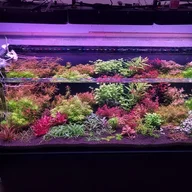
Thanks Joe. I've read this same comment from you on multiple peoples journals/threads and I appreciate the suggestion. I agree with you that the plants have the look of needing more macros. It's just very difficult for me to accept this as the root cause because I've never had to exceed 30 PPM NO3, 7.5 PPM PO4, and 31 PPM K weekly even in densely planted tanks that had BDBS as the substrate. Maybe the tap water in Texas had more macros than I realized or I was doing smaller water changes than I thought and this combination of factors tricked me into thinking the levels I've traditionally dosed are the most that are needed. It's also really tough for me to see the need for more macros because the tank is not super densely planted and at its worst the plants were growing sooooooo slowly that they should not have that high of macro requirements. This all had me arguing with myself that the NPK levels should be sufficient even if the plant behavior says others.
Some of the suggestions that I've received since starting the journal are pretty solid and seem to have helped without an increase in macros. Especially making the switch from tap to RO. I was very skeptical at first and was glad to have made the switch. I'm also going to continue with lower light for some time until the algae is under control. This has the benefit of lowering macro needs and providing less fuel for the algae. I'll also switch to 50% water changes to save myself some work and increase the steady state macro levels. You're right that the levels are much higher when the water change percentage is reduced to 50%. When the tank is back in shape and I'm ready to turn the lights up, don't be surprised if I tag you to revisit the macro levels. I want to have a couple hundred PAR at substrate to bring out the best in all of the plants.

Some of the suggestions that I've received since starting the journal are pretty solid and seem to have helped without an increase in macros. Especially making the switch from tap to RO. I was very skeptical at first and was glad to have made the switch. I'm also going to continue with lower light for some time until the algae is under control. This has the benefit of lowering macro needs and providing less fuel for the algae. I'll also switch to 50% water changes to save myself some work and increase the steady state macro levels. You're right that the levels are much higher when the water change percentage is reduced to 50%. When the tank is back in shape and I'm ready to turn the lights up, don't be surprised if I tag you to revisit the macro levels. I want to have a couple hundred PAR at substrate to bring out the best in all of the plants.
I totally get that. In fact you have no idea how much I get it. I actually went through a couple of rough years back in the day by always ruling out macros because the numbers were so high already. Two years playing whack a mole with literally everything else. Turns out a little more macros was all that was ever needed.It's just very difficult for me to accept this as the root cause because I've never had to exceed 30 PPM NO3, 7.5 PPM PO4, and 31 PPM K weekly even in densely planted tanks that had BDBS as the substrate.
I dont mean to sound like this is all you ever needed. But now that youve fixed those other things, it might be
One thing to remember is the concentration of macros incl Ca and Mg all have a strong affect on each other with the end result being how easy a plant can get the very few ppm it needs of something. Ie its easier for a plant to get 2-3 ppm NO3 if there's 30 in the water vs only 5. So just because theres 15 ppm of something present doesnt mean the plants can get it
My point here is dont let numbers on a page tell you something is good when the plants are saying that its not. Another thing is after doing 70-80% water changes religiously for 3-4 years, I can say without a doubt that doing 50% works better, and requires a whole lot less ferts
I do understand that all these other things have helped, and and were a big part of it. Just dont be shy about raising macros just because your numbers are already high. Unless youre growing a tank full of Ammania varieties that all hate water column ferts, raising macros even astronomically will hurt absolutely nothing. The worst thing itll do is cause some gda on the glass and even that will go away when the bio population adjusts. It will only help plants. All of them, except Ammania



Curious to see if you have checked your ammonia level


What do you like about the Chihiros vs Jebao? I'm still using my cheapskate Jebao doser.Chihiros did a very good job with this and it's significantly better than the Jebao dosing pump I used back in 2018. Because I got the dosing pump, I decided to settle into a "final" dosing strategy. For macros, I'm going to dose 28NO3-8PO4-36K weekly with half of this front loaded on water change day. The remaining amount will be distributed throughout the week in 2PPM NO3 doses.
Curious if you have checked the calibration of your doser. If you are dosing tiny ml of macros/micros per day, maybe doser accuracy could be playing a part in your algea nightmare.
- Thread starter
- #47
I just gave my very old ammonia test kit a try in the 120P and my low tech shrimp tank. Both showed 0.25 PPM ammonia. I'm a little skeptical of the result because the shrimp tank has a bunch of houseplants growing out of the filtration system and there should be zero ammonia just based on plant mass. I will probably need to get a new test kit to get a conclusive answer. If ammonia is the issue, what would the solution be? The tank has no fish, two large filters, old soil, frequent water changes, and has been setup for nearly 2.5 years.Curious to see if you have checked your ammonia level
The calibration and programming on the Chihiros dosing pump is much more straightforward because you do it through an app and it's just a few button presses to make changes. I also really like that the app tracks how much solution is remaining in your bottle (makes it easy to check if the volume being dosed is consistent with the programming) and it allows easy manual dosing for front loading. The Jebao isn't bad when it's setup, but the setup process is very clunky. I also don't like that programming requires access to the pump itself because my cabinets are usually somewhat messy and its hard sticking my head in there.What do you like about the Chihiros vs Jebao?
The doser has only been setup since Thursday and the dosing volumes so far have been accurate using 5-10 ml doses. I'll have to see how it works long term and will keep an eye on it. Recently I have been dosing by weighing out macros to the tenth of a gram, so I'm certain I am not overdosing or underdosing based on my targets to the point it would cause an algae nightmare. When this issue started I was dry dosing using teaspoons (1 tsp KNO3, 0.5 tsp K2SO4, 0.25 tsp KH2PO4 frontloaded and half this on Wednesday) and that's also fairly solid based on some tests where I checked the weight of the powders in each teaspoon multiple times.Curious if you have checked the calibration of your doser.
Thanks for checking! I am not sure, I just think it is an interesting observation. I ran into similar issue which you can read about in my journal with lean dosing.If ammonia is the issue, what would the solution be
Would you agree though that with such good filtration and an established set up, having ammonia is strange ?
- Thread starter
- #49
I do agree with that and find it very strange. It makes me want to get a new test kit to see if the results are legit. It just doesn't seem worth it though without a clear path toward eliminating the issue.Would you agree though that with such good filtration and an established set up, having ammonia is strange ?
- Thread starter
- #50
I know it's not my normal weekly update time, but I thought this was a fun comparison. The first picture is how the tank has grown in the last two weeks and the second is two week progress in December. Both were after a trim and replant session for the majority of the tank, so they should be reasonable comparisons. It's very clear that the tank is growing much faster now than it was in December and the quality of the growth is much higher even though the only significant change was a switch from tap to RO water. I threw 10 PPM NO3 and 5 PPM PO4 into the tank based on Joe's feedback from over the weekend and hopefully the next 2 weeks show even better progress along with a reduction in algae growth. I also need to trim the tank and make space for a few plant groups.

1/11-1/26
 (
(
12/15-12/28
1/11-1/26
(12/15-12/28

TRyan
Active Member
Wow, big difference in growth. Looking good.
- Thread starter
- #52
Another weekly water change down and I was unable to water change only 50% since I pulled up some plant groups and had to do some vacuuming. It was great being able to toss a lot of old and algae infested growth and it was encouraging to see that the newest growth is actually fairly clean. It seems like the algae is primarily feeding on old unadapted growth and that's causing the spread of long filaments around the tank that make the tops look so dirty. The fastest growing groups aren't perfect, but they were a lot better looking than I expected after washing them off. So in total this weeks water change was ~60% followed by front loading with 20NO3-6PO4-26K in addition to the daily dosing that adds a total of 14NO3-4PO4-18K every 7 days. It seems crazy to dose 34NO3-10PO4-26K weekly, but maybe higher macros will help the tank get into a good state.


I didn't pull the golden myrio or Staurogyne 'Porto Velho' and both need to be cleaned up. I also need to figure out why a few of the Hygrophila 'Compact' bunches have lost a lot of leaves. It's very unusual because this plant is so easy to keep.

Didiplis diandra and Eriocaulon parkeri are both pretty dirty and need to be pulled up. That'll happen in the next water change.

Penthorum sedoides and Limnophila aromatica mini need to be pulled up and cleaned, but neither is that bad. Penthorum's issue is mostly degradation of old leaves and I've been working on pulling those.

As I was moving things around I noticed the old growth on the Syngonanthus 'Rio Negro Giant' was very yellow while the new growth looks good. It does seem like I was dosing low on Fe during the 2x weekly water change period and I wonder if this contributed to the poor health of a few species noted in the previous update. I'm still dosing 0.06 PPM Fe+micros daily for a weekly total of 0.42 PPM and that should be a reasonable enough target for the tank.
I didn't pull the golden myrio or Staurogyne 'Porto Velho' and both need to be cleaned up. I also need to figure out why a few of the Hygrophila 'Compact' bunches have lost a lot of leaves. It's very unusual because this plant is so easy to keep.
Didiplis diandra and Eriocaulon parkeri are both pretty dirty and need to be pulled up. That'll happen in the next water change.
Penthorum sedoides and Limnophila aromatica mini need to be pulled up and cleaned, but neither is that bad. Penthorum's issue is mostly degradation of old leaves and I've been working on pulling those.
As I was moving things around I noticed the old growth on the Syngonanthus 'Rio Negro Giant' was very yellow while the new growth looks good. It does seem like I was dosing low on Fe during the 2x weekly water change period and I wonder if this contributed to the poor health of a few species noted in the previous update. I'm still dosing 0.06 PPM Fe+micros daily for a weekly total of 0.42 PPM and that should be a reasonable enough target for the tank.
- Thread starter
- #53
Switching dosing strategies is always annoying and that was the case with the change in macros. Multiple plant groups got wrinkly on the growing tips, there was a little bit of melt in some leaves, and the algae started growing very fast everywhere including relatively health portions of plants that I had recently propagated. This is all expected because the plants need to reprogram to deal with the change in conditions, but it's still very frustrating to go through. All of the plant groups that got wrinkly appear to be growing normally again and color seems to be a little better in some plant groups, so maybe higher macros are what I need. Even though the time between pictures is short, you can also see some groups have noticeably grown (mainly Rotala 'Singapore', Rotala macrandra 'mini pink', and Limnophila wilsonii). Decent plant progess, but there's still a ton of algae that is not very visible in tank shots.

The reason I'm making this post is not to discuss the plants, but to discuss how annoying this algae is. I've never dealt with an algae as stubborn as this one and it's crazy that it's so hard to get rid of. Every time I water change I turkey baste the substrate to clean up mulm and I literally never did this in the past. I gently vacuum every single plant group to dislodge algae. I clean my filter media in RO water every month (rotating between filters to prevent major disruption of the biofilter) and previously I cleaned them once every 6 months. I clean the prefilter in the Oase canister every week or two and also never did this previously. I used to dose by dumping dry powders into the tank and never worried about exactly what's getting added. I always ran my lights at max settings right on the rim of the tank and never worried about lighting because I could always fix a problem by cleaning the tank or trimming the plants. I'm spending more time with my arms in this tank manually cleaning out algae than I spent each week on aquarium maintenance when I had 30 tanks running simultaneously. This algae is super difficult to beat and the below images of various treatments illustrate why.
Algaecide
The algae is completely resistant to treatment from standard algaecide. I've tried APT Fix, Excel, AlgaeFix, Hydrogen peroxide, and bleach. Bleach is the only thing that kills it, but the bleach is so hard on plants that the algae just comes back in 2 weeks. To illustrate how resistant the algae truly is, I removed some clumps and then put them in nearly 100% algaecide for a day. In my experience, it takes 1 day for algae to start looking worse after getting treated and I figured this was a decent amount of time when the algae is placed in pure algaecide. One day in AlgaeFix and APT Fix made it a little clumpier, but it's still green. Pure hydrogen peroxide didn't do anything for the first 8 hours of treatment (8 hour time point not shown since it looked just like 3), but you can see the algae started dying at 24 hours. That's great, but can I stick regular plants in PURE H2O2 for a day? No. Some people might suggest combination treatment would help, but I tried that in tank for 3-4 consecutive days and nothing happened to the algae.

Blackout
I've been told to blackout the tank for 4-7 days just so the algae gets weaker and the plants can outcompete the algae afterwards. I've taken a few clumps of algae infested soil out of the tank over the last 4-6 weeks and have been storing them in a little container that gets no light outside of the ambient light in my basement, which is minimal. The algae is green, healthy, and doing fine. This container even dried out multiple times and it's still good. Very low levels of lighting don't seem to impact this algae and that might explain why low light isn't helping decrease the growth rate.

Manual Removal
So far, manual removal has been the only viable option. It has it's downsides though. Below is a picture of Rotala sp. 'Singapore' as of this morning. This plant seems fairly healthy (outside of being a little pale in color), grows a few inches a week (notice how much the bush expanded in the 4 days between pictures above), and should be able to fight off the algae reasonably well. Notice the strands growing off the leaves? I cleaned this plant by vacuuming and manually removing the algae less than 24 hours before the picture. The growth rate is ridiculous and if I don't clean out the algae 1-2 times daily it grows enough to smother the plants. It's also impossible to not dislodge the algae and have it spread to other plant groups, where it colonizes what appears to be healthy growth. I've found that taking out plants and washing them under running water is helpful, but the algae is always noticeably growing back within 2 days. I don't think the plants would grow very well if I was removing them constantly to clean them off.

Moving plants to other tanks
When I had 30 tanks, one solution to unhealthy plants or algae was move healthy plants to the bad tank and move unhealthy plants to a good tank. This was always very effective and restored the balance. I don't have other tanks now outside of a small shrimp cube and two 10 gallons that are going through cycling. Since there isn't a lot of room in the shrimp cube, I moved some HC that was algae infested into the tank and within 12 hours it was 100% clean. I didn't really see shrimp messing with the algae, so I don't think they cleaned it and the snails in the tank are present in the 120P. The implication is that something in the 120P is off enough that it's feeding the algae and if I can figure out what that is, it'll be possible to fix it. I have no idea what it is though.

The takeaway
The only thing I can do is spend hours each week manually removing the algae and focus on growing the plants the best I can. There does appear to be less aggressive algae colonization on the newest growth from the last couple weeks, so that's positive and it implies that with some additional time I'll be able to fix this. I just need to keep at it and see what happens.
The reason I'm making this post is not to discuss the plants, but to discuss how annoying this algae is. I've never dealt with an algae as stubborn as this one and it's crazy that it's so hard to get rid of. Every time I water change I turkey baste the substrate to clean up mulm and I literally never did this in the past. I gently vacuum every single plant group to dislodge algae. I clean my filter media in RO water every month (rotating between filters to prevent major disruption of the biofilter) and previously I cleaned them once every 6 months. I clean the prefilter in the Oase canister every week or two and also never did this previously. I used to dose by dumping dry powders into the tank and never worried about exactly what's getting added. I always ran my lights at max settings right on the rim of the tank and never worried about lighting because I could always fix a problem by cleaning the tank or trimming the plants. I'm spending more time with my arms in this tank manually cleaning out algae than I spent each week on aquarium maintenance when I had 30 tanks running simultaneously. This algae is super difficult to beat and the below images of various treatments illustrate why.
Algaecide
The algae is completely resistant to treatment from standard algaecide. I've tried APT Fix, Excel, AlgaeFix, Hydrogen peroxide, and bleach. Bleach is the only thing that kills it, but the bleach is so hard on plants that the algae just comes back in 2 weeks. To illustrate how resistant the algae truly is, I removed some clumps and then put them in nearly 100% algaecide for a day. In my experience, it takes 1 day for algae to start looking worse after getting treated and I figured this was a decent amount of time when the algae is placed in pure algaecide. One day in AlgaeFix and APT Fix made it a little clumpier, but it's still green. Pure hydrogen peroxide didn't do anything for the first 8 hours of treatment (8 hour time point not shown since it looked just like 3), but you can see the algae started dying at 24 hours. That's great, but can I stick regular plants in PURE H2O2 for a day? No. Some people might suggest combination treatment would help, but I tried that in tank for 3-4 consecutive days and nothing happened to the algae.
Blackout
I've been told to blackout the tank for 4-7 days just so the algae gets weaker and the plants can outcompete the algae afterwards. I've taken a few clumps of algae infested soil out of the tank over the last 4-6 weeks and have been storing them in a little container that gets no light outside of the ambient light in my basement, which is minimal. The algae is green, healthy, and doing fine. This container even dried out multiple times and it's still good. Very low levels of lighting don't seem to impact this algae and that might explain why low light isn't helping decrease the growth rate.
Manual Removal
So far, manual removal has been the only viable option. It has it's downsides though. Below is a picture of Rotala sp. 'Singapore' as of this morning. This plant seems fairly healthy (outside of being a little pale in color), grows a few inches a week (notice how much the bush expanded in the 4 days between pictures above), and should be able to fight off the algae reasonably well. Notice the strands growing off the leaves? I cleaned this plant by vacuuming and manually removing the algae less than 24 hours before the picture. The growth rate is ridiculous and if I don't clean out the algae 1-2 times daily it grows enough to smother the plants. It's also impossible to not dislodge the algae and have it spread to other plant groups, where it colonizes what appears to be healthy growth. I've found that taking out plants and washing them under running water is helpful, but the algae is always noticeably growing back within 2 days. I don't think the plants would grow very well if I was removing them constantly to clean them off.
Moving plants to other tanks
When I had 30 tanks, one solution to unhealthy plants or algae was move healthy plants to the bad tank and move unhealthy plants to a good tank. This was always very effective and restored the balance. I don't have other tanks now outside of a small shrimp cube and two 10 gallons that are going through cycling. Since there isn't a lot of room in the shrimp cube, I moved some HC that was algae infested into the tank and within 12 hours it was 100% clean. I didn't really see shrimp messing with the algae, so I don't think they cleaned it and the snails in the tank are present in the 120P. The implication is that something in the 120P is off enough that it's feeding the algae and if I can figure out what that is, it'll be possible to fix it. I have no idea what it is though.
The takeaway
The only thing I can do is spend hours each week manually removing the algae and focus on growing the plants the best I can. There does appear to be less aggressive algae colonization on the newest growth from the last couple weeks, so that's positive and it implies that with some additional time I'll be able to fix this. I just need to keep at it and see what happens.

Sorry it's such a difficult algae. Have you considered saving healthy cuttings/growth, and doing a full reset?
I've had tanks in the past that, once the algal mass got too large, were frustrating to fix. Sometimes a full reset, if most other things fail, is the best use of your time. What do you think?
I've had tanks in the past that, once the algal mass got too large, were frustrating to fix. Sometimes a full reset, if most other things fail, is the best use of your time. What do you think?
- Thread starter
- #55
I hate to admit defeat, but I'm already planning for a full reset. I started moving stems into the new 10 gallon tanks and have been considering setting up an emersed bin to propagate what I have now. I even looked up the directions to the nearest tractor supply so I know I have access to BDBS . I really want to figure out what's feeding such aggressive algae growth though. I agree with the hypothesis that the old growth on the plants is compromised and it's attracting the algae and I need to fix that. Why does the algae grow so aggressively on the glass and on the substrate where there are no plants though? The substrate growth happens even with a ton of gravel vacuuming. Are the plants really so unhealthy that they're releasing massive quantities of algae food into the water column? I'm so confused by this phenomenon that I bought Purigen just to see how quickly it would discolor. In my tanks in Texas it would take a few months for it to be slightly dirty and I eventually stopped using it because it was never dirty enough to be necessary. In the 120P it turned fairly brown in just over 12 hours (12 hours in the tank on left vs new on the right). I put Purigen in the two new tanks at the same time and even though the tanks are still in the early algae days, the Purigen is almost completely white. Why is the 120P so dirty? I'm going to give the higher macros another 4-6 weeks and if I don't see a large reduction in algae growth I'll do a hard reset. I'm going away for 2-3 weeks during the summer and I guarantee the tank will die from the algae growth if it's not fixed before then.


I can't help but keep thinking that there are a few of us now dealing with this and if we don't figure it out, its just going to come back. So for now, I plan on sticking with it.I really want to figure out what's feeding such aggressive algae growth though. I agree with the hypothesis that the old growth on the plants is compromised.
I know they both absorb stuff, but maybe an aggressive carbon treatment might be worth a try? @Art has a good article about carbon somewhere, but I think it is more about debunking the notion that it is constantly needed. It might be worth looking into though. Wait, I found it. HEREPurigen
Last edited:
- Thread starter
- #57
I water change every 3-7 days so I don't think Purigen/carbon will make a big difference with respect to algae growth. Water changes should export the majority of the bad stuff out of the tank. In this case, I added Purigen just to have a visual indicator of dissolved waste since something unusual is going on and I've used it in the past in healthy tanks. Having something that binds waste is also not making any difference whatsoever. Check out the algae growth over the last 24 hours and then imagine this happening across the substrate, glass, and every plant group in a 4 ft tank.

If you're willing to try a host of things before a big reset, I'd recommend trying reducing your lights to ~20% strength for a few weeks. During that time, provide all of your nutrients and CO2 in full. Plants do a REALLY good job of making use of low-light, nonlimiting fert scenarios, whereas algae doesn't.
It's fixed many tanks for me before with minimal cost to the plant health.
It's fixed many tanks for me before with minimal cost to the plant health.
- Thread starter
- #59
Reading through Unexpected's journal gave me that idea a couple weeks back. I was previously running my lights at 10% on one channel and 30% on the other channel with the lights raised 21-22" over the substrate. I'm now at 27" over the substrate since ~January 22nd. This should be a roughly 35% decrease in light intensity assuming the light intensity follows the inverse square law like it should. Given the PAR data for the lights I use, this should be a fairly manageable level. Do you think it would be beneficial to go even lower? I could raise the lights the remaining 2-3" before hitting the ceiling or I could just turn off 1 of the 3 lights for some time. I've been wary of going even lower because the algae grows on the substrate in completely shaded areas and on the glass behind groups of plants. I also haven't adjusted CO2 (still 60-70PPM by the Hanna CO2 Test kit) and my macros are increased based on Joe's feedback.


Hello.
I have the same problem. I've been dealing with this algae for a very long time.
No chemicals have any effect.
I've tried everything you've suggested.
Unlike you, my NPK levels are much lower.
NO3: 6 PPM, PO4: 0.6 PPM, K: 4 PPM
I've tried lower and higher levels many times. There have been times when I've given a lot of fertilizer, times when I've given little or no fertilizer at all.
I even blacked out the area, but nothing changed.
I've used my own homemade fertilizers, APT, Masterlina, Neo, etc., 5-6 different fertilizers.
The current situation hasn't changed in any of them. There have been decreases and increases, of course. But I haven't been able to find a definite cause.
When I tested with photometers, I saw that there's a problem between phosphate and iron. Either the iron or the phosphate is depleted.
As far as I understand, NPK appears when it's below the iron level. Or it appears when iron is present but cannot be used. Then phosphate feeds it.
I've always experienced this problem with EDTA Fe and EDTA Micro.
This improves with DTPA Fe.
The situation gets worse with EDDHA Fe.
Iron gluconate works well for the first 4-5 days, then it degrades. Also, increasing CO2 increases the water content. However, if you reduce the CO2 level to around 20 ppm, growth stops.
I also suspect manganese. I'll test that separately.
I've done ammonia tests many times and found no connection. Even changing 80% of the water daily doesn't affect anything.
What is your iron and micronutrient formula? What brand of fertilizer are you using?
If you make it yourself, how do you do it?
Perhaps the problem is EDTA?
I have the same problem. I've been dealing with this algae for a very long time.
No chemicals have any effect.
I've tried everything you've suggested.
Unlike you, my NPK levels are much lower.
NO3: 6 PPM, PO4: 0.6 PPM, K: 4 PPM
I've tried lower and higher levels many times. There have been times when I've given a lot of fertilizer, times when I've given little or no fertilizer at all.
I even blacked out the area, but nothing changed.
I've used my own homemade fertilizers, APT, Masterlina, Neo, etc., 5-6 different fertilizers.
The current situation hasn't changed in any of them. There have been decreases and increases, of course. But I haven't been able to find a definite cause.
When I tested with photometers, I saw that there's a problem between phosphate and iron. Either the iron or the phosphate is depleted.
As far as I understand, NPK appears when it's below the iron level. Or it appears when iron is present but cannot be used. Then phosphate feeds it.
I've always experienced this problem with EDTA Fe and EDTA Micro.
This improves with DTPA Fe.
The situation gets worse with EDDHA Fe.
Iron gluconate works well for the first 4-5 days, then it degrades. Also, increasing CO2 increases the water content. However, if you reduce the CO2 level to around 20 ppm, growth stops.
I also suspect manganese. I'll test that separately.
I've done ammonia tests many times and found no connection. Even changing 80% of the water daily doesn't affect anything.
What is your iron and micronutrient formula? What brand of fertilizer are you using?
If you make it yourself, how do you do it?
Perhaps the problem is EDTA?
Similar threads


- Replies
- 17
- Views
- 1K


Top 10 Trending Threads
-

-

-

-
-
 Thread 'Lets build some trees and stumps etc amazon woods show me your builds!'
- artandsoul
Replies: 18 -

-

-

