Welcome to ScapeCrunch

We are ScapeCrunch, the place where planted aquarium hobbyists come to build relationships and support each other. When you're tired of doom scrolling, you've found your home here.

Journal Recovering from disaster: My 120P journey.

  • Thread starter Thread starter bradquade
  • Start date Start date
  • Featured
  • Tagged users Tagged users None
3) The green algae in the tank is a beast and chemical treatment is a no go. I tried spot dosing with APT Fix for 2 days and then did 2 days of H2O2 treatment. Four consecutive days of spot dosing did absolutely nothing. I'm going to have to let the tank grow out to get rid of it.
I have found for presistant GDA like the kind that covers the glass, plants sufficating all life altering the N source stops it in its tracts. For example if your dosing 7.5ppm NO3 from KNO3 which is all NO3 and K Lowering that to say 5ppm from KNO3 and 2.5ppm From Urea CO(NH2)2 or even Ammonium Nitrate NO3NH4. My assumption or tinkering around with this, is that it boosts the bacteria count of the oposite bacteria thus doing something to the GDA. Most of our plants uptake NH4 from the root coloumn so I do not think its a water coloumn dosing issue. NH2 is converted by bacteria into NO3.
Nitrosomonas bacteria which converts ammonia to nitrite and Nitrobacter which convert nitrite into nitrate.
This is just my observations and has worked every time for me.

Edit: Back when I dosed full EI used to have major GDA issues. They say leave it alone and itll go away, wrong. It gets so bad it blocks light from the plants and they start dying so I started playing with fertz.
 
The snails are thriving in the tank now even with ~60 PPM CO2 and very low pH.
Did your GH and KH change when you switched to RO? Curious because I've also had snails die off in the past, and they do better once I realized my low GH was also very low in CA, and started remineralizing with more Ca.
 
Your plants are clearly starting to take off, but where you are with your dosing might be where you need to be.
I'm definitely planning to keep the macros/micros somewhat consistent in the short term. For macros, I'm thinking about adding a half dose midway through the week just to see how it goes (meaning 25N-7.5P-34.5K in total throughout the week). I've basically just been front loading with all of the water changes and that was definitely okay last week, but as the plants grow in I'm sure I will need more NPK. For the micros, I added a second dose today (0.3 PPM Fe total) since the Ludwigia sp. 'red' got that same twisty look after Saturday's water change. I'll leave it here for the remainder of the week and keep an eye on how things go.

It could be that now that your plants are getting back on their feet, they are absorbing more nutrients?
I make the TDS measurements the evening of water change day after remineralizing and dosing. I don't think plant uptake would be causing a measurable change on that time scale unless my tank had super high residual NPK from months of dosing with minimal growth and that's now getting taken care of. The pattern isn't what I would expect from plant uptake though. I'll keep an eye on the levels throughout this week to see if I can get an estimate of plant uptake.

Dibs when you get it all back going and get ready to sell some.
I prefer trading plants. If your quins keep doing well, maybe we could swap when the weather gets better. Quin is one of my favorite plants and I'd love to get it again. I definitely think it would grow in my tank since I'm already seeing growth on the new Syngonanthus 'Rio Negro Giant'.

For example if your dosing 7.5ppm NO3 from KNO3 which is all NO3 and K Lowering that to say 5ppm from KNO3 and 2.5ppm From Urea CO(NH2)2 or even Ammonium Nitrate NO3NH4.
I spent a lot of time playing around with urea and ammonium nitrate in the past and the positive effect on plant growth isn't worth the downsides. Since I run my tanks with such a large amount of light, urea and ammonium nitrate always cause green water. GDA is never an issue for me since it grows so slow when the tank is healthy and grown in. Once a month glass cleaning is no big deal.

Did your GH and KH change when you switched to RO? Curious because I've also had snails die off in the past, and they do better once I realized my low GH was also very low in CA, and started remineralizing with more Ca.
My tap water has extremely low GH (~3 PPM Ca and <1 PPM Mg), so I've always remineralized GH as if the water is RO. The KH has decreased from ~2 to 0 though. After seeing how dramatically the plants changed after switching to RO, I'm inclined to believe the issue is something in the tap. Maybe the high levels of sodium were having a greater impact than I thought.
 
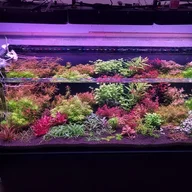
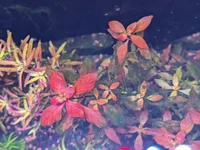
It's looking like the tank is continuing to improve and grow well week to week. Plant growth rates are speeding up and the width of certain stems has increased tremendously. This is most apparent on the Ludwigia sp. 'Meta' and Rotala sp. 'Singapore'. I pulled up a few stems and I can see decent rooting on the majority of the plants and I can also see side shoots and aerial roots forming on the new growth. All good signs that I wasn't seeing before the switch to RO. The pearling in the tank is also significantly better than at the start of this month implying that the plants are growing much faster. If I knew how to post a video, I would show off the pearling in the tank because it's getting pretty fun to watch. I did have a few stems melt back in some groups (Rotala macrandra 'green' and Ludwigia arcuata) and this is something I'll need to keep an eye on. If the tank continues growing at this rate it should be be full of healthy plant mass soon.
1769280033926.webp
1769279561991.webp
1769279590564.webp

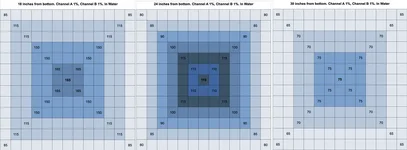
Despite the solid plant growth and the constant trimming of old growth, the green thread algae continues growing quite aggressively. I spend far too much time pulling it out each week and cleaning up the plants is making water changes extremely time consuming. I was reading the tank journal by Unexpected, who seemed to have similar issues for a long period of time, and he commented that lowering light was the key to getting over the algae. I tried lowering my lights to the lowest setting and it didn't seem to help that much, so I've thought my light level was reasonable. I revisited this by searching for PAR data for Prizms and realized my lights, even on the lowest setting, are extremely bright. Below are the measurements for a single Prizm on the lowest settings over a 13" by 13" square at 18", 24", and 30" height. I have three 16" Prizms over my 48" tank hanging 21" over the substrate. When you account for the spread from the adjacent lights, I've been running extremely high PAR and this is probably why its been so hard to get over this algae phase. I raised the lights from 21" to 28" over substrate hoping that would get me right around 100 PAR, which is a reasonable level for everything that's growing in my tanks. I'll definitely lose a little bit on color, but that's worth it if it helps the plants outcompete the algae.
1769277069826.webp

I made three other significant changes to the tank this week even though I said I'd keep it consistent.

1) I changed out the in tank heater for an inline Chihiros Heater Pro. This cleaned up the look of the tank quite a lot, but it also seems to heat much more efficiently. I'm really happy with the quality of the heater and find that its very convenient being able to change the power as needed. When I water changed yesterday the water temp dropped to 65F and I was able to get it back to 72F in ~1 hour by temporarily changing the heater power from 400W to 800W. The plants underneath the in tank heater also grew angled and I'm hoping they can grow upright now that they have unrestricted light access.

2) The Ludwigia arcuata and Rotala macrandra green that melted a little bit are both in the same region of the tank and it's possible that with more dense plant groups the CO2 distribution has become suboptimal. I changed out the stainless steel filter outlet in the right hand side of the tank with a spray bar to make sure the entire tank gets solid flow with CO2 rich water. I had to design a couple 3D printed connectors to setup the spray bar, but it was all done pretty quickly and has been functional for a few days. I printed the parts in grey, which doesn't match well with the black used for the majority of the connectors, and I will need to reprint in black at some point to clean up the look.

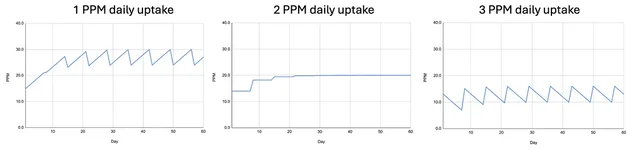
3) I sometimes get very busy and forget to dose my tanks, so I got the Chihiros dosing pump to help with consistency. Chihiros did a very good job with this and it's significantly better than the Jebao dosing pump I used back in 2018. Because I got the dosing pump, I decided to settle into a "final" dosing strategy. For macros, I'm going to dose 28NO3-8PO4-36K weekly with half of this front loaded on water change day. The remaining amount will be distributed throughout the week in 2PPM NO3 doses. I settled on this dosing scheme because it provides reasonable stability over a range of daily uptake values (based on Rocco's awesome nutrient accumulation calculator) and it'll allow the plant uptake rate to dictate growth rate. When the tank is really grown in and using a lot of nutrients, the steady state values will be lower and growth will be limited. When the tank is freshly trimmed and needs some help growing in, the steady state values are higher and will allow for faster growth. I've almost always done EI dosing in high tech tanks with 3 doses per week, so I'm not concerned about the total weekly dosing levels. It'll be interesting to see if this strategy helps with consistency and reduces stunting in sensitive species though.
1769278357799.webp

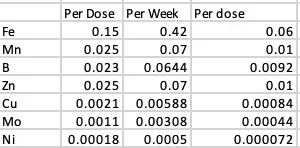
For micros, I'm settling on 0.42 PPM Fe weekly (with the corresponding amounts of micros based on the recipe from Burr740 shown below) dosed at 0.06 PPM Fe daily. I picked to dose 0.42 PPM weekly because that's cleanly divisible by 7 and made the math look better (notice I did the same for NO3). I mentioned last week that I wasn't planning to change micros this quickly, but the plant growth has been better since running 0.3 PPM Fe+micros weekly and I've never had bad luck with 0.45 PPM Fe+micros dosed weekly. Since I'm doing daily dosing I'll pay close attention to how the plants look at the end of the week to see if I need to dose down. I have enough micro and macro solution made for 1-2 months and will stick with this until they run out unless something goes wildly wrong.
1769278831193.webp
 
If I knew how to post a video, I would

1000046059-webp.13650
 

Attachments

  • 1000046059.webp
    1000046059.webp
    63.3 KB · Views: 63
Success! Thanks! Solid pearling, but it's also much more obvious in the video how widespread the algae is.

PS-Sorry for the background noise! I have a shelf of tupperwares for water propagating houseplants and I run airstones in each container to have a higher probability of successful propagation.

View attachment PXL_20260124_015119484.mp4
 
I'm not sure how I missed your journal. I'm literally seeing the same situation and I have anxiety from looking through your pictures. Following along, if you have any questions, feel free to ask.

Would the plants grow healthy tops then algae would consume the lower portions and eventually the new growth, after a new portion popped up, start getting algae? Does the algae act like GDA, but it's actually some type of Filamentous algae?
 
@Unexpected I also have anxiety looking through my pictures, so we're in the same spot.

Your description of the algae is very accurate. The initial coating looks like green spot algae, but then over time it turns hairy. It adheres to plant leaves extremely tightly and washing doesn't remove it even if it looks clean. When the tufts get long enough they break off and spread through the tank, leaving a short coating on the original leaf that can only be removed by trimming off the offending growth. In my tank, it also grows on the glass and on the substrate (even in areas that are fully shaded by plants). When it gets really bad on small plants I can move them to my tiny shrimp tank and the algae disappears in a day or two (similar to what you described for your tank). It starts on the lower growth and progressively moves upwards even if the leaves or plant look healthy. Any tissue it attaches to rapidly degrades and if it catches up with the growing tip the growing tip is fully consumed. The stems usually seem fine and sprout new growth. Whatever it is, it is the worst algae I've ever encountered and the only thing that kills it is bleach. That damages the plants enough that the algae comes back even worse within 2 weeks. I've never dealt with anything like it and I'd be interested to know if you think you truly fixed it. I also attached a few close ups so you can see if its similar or not.

PXL_20260124_205424658.webpPXL_20260124_205434775.webpPXL_20260124_205511570.webpPXL_20260124_205539382.webpPXL_20260124_205622536.webp
 
@Unexpected I also have anxiety looking through my pictures, so we're in the same spot.

Your description of the algae is very accurate. The initial coating looks like green spot algae, but then over time it turns hairy. It adheres to plant leaves extremely tightly and washing doesn't remove it even if it looks clean. When the tufts get long enough they break off and spread through the tank, leaving a short coating on the original leaf that can only be removed by trimming off the offending growth. In my tank, it also grows on the glass and on the substrate (even in areas that are fully shaded by plants). When it gets really bad on small plants I can move them to my tiny shrimp tank and the algae disappears in a day or two (similar to what you described for your tank). It starts on the lower growth and progressively moves upwards even if the leaves or plant look healthy. Any tissue it attaches to rapidly degrades and if it catches up with the growing tip the growing tip is fully consumed. The stems usually seem fine and sprout new growth. Whatever it is, it is the worst algae I've ever encountered and the only thing that kills it is bleach. That damages the plants enough that the algae comes back even worse within 2 weeks. I've never dealt with anything like it and I'd be interested to know if you think you truly fixed it. I also attached a few close ups so you can see if its similar or not.

View attachment 13680View attachment 13681View attachment 13682View attachment 13683View attachment 13684
Yep, that's exactly what I have. Ugh ..
 
I have some of that exact looking algae, but it isn't causing me problems like you. Right now I'm doing pretty good.
I have some new plants that I'm worried about, and the symptoms are like y'all describe with the bottom part looking rough, but these are tc plants that I didn't get planted for a few days. One group of them died within 2 days. So it could just be tc plants in bad shape. The shipment came in and the box had obviously been open and one package seemed to have been open.

Good luck. Seems like both of you are getting on top of it regardless.
 
Hey mate, may I ask why you use EDTA?
I ordered DPTA from Nilocg, they sent the wrong one. Only not to waste money. My pH is well under 6, near 5 or below so it's fine in my case. Use DPTA though as it makes Fe available a bit longer.
 
Is there a chance you guys are using similar/same micros?
I've been wondering about this, as I also have this type of algae.
I use Burr Micros. I have very little of this, but I've had it off and on for awhile.
You can see a poor pic here on a leaf. Instead of individual straight treads, it's more like green cotton. When I was having more of it, it was like green globs on my Blood Vomit.

DSC09360a.webp
 
Is there a chance you guys are using similar/same micros?
I've been wondering about this, as I also have this type of algae.
I'm using Burr micros (exact recipe at the end of post #24). I started using Burr micros back in 2018 when I was in Texas and never saw this type of algae in my high tech tanks in the 5-6 years I was growing plants there. I've been wondering if it is a combination of soft water and high light levels that makes it really tough to kill. The one time I got this in Texas was a low tech tank that had too much light, ADA aquasoil, and remineralized RO. I ended up fixing it in a short period of time by turning the light down super low and that wasn't a problem because the tank just had rhizome plants. If I had to guess, we're all running very low kH water, very low pH, and very high light. I think that is the combination that causes this and makes it hard to kill.
 
If I had to guess, we're all running very low kH water, very low pH, and very high light. I think that is the combination that causes this and makes it hard to kill.
That would be me depending on what you'd consider very high light. My PAR is 124 at substrate under the light.
I consider that high light in the more normal light ranges. HERE But some people start there.
 
Great journal Bradley, not sure how Ive missed it until now. This chronic algae problem is because the plants are not entirely happy. Period. Thats the cause

Here's my thoughts on the whole situation. Tl/dr at bottom for anyone that wants to skip all this :p


Your substrate is fine as long as its not breaking down. Personally I love old aquasoils, better than new. The high cec is great but its basically inert as far as providing any meaningful macros. Do I understand right that you do 70% water changes still? Big water changes + inert substrate needs a lot more macros than you think ( @Unexpected you listening?)

Your macro numbers on paper say "damn that should be plenty!" right?? But the plants say theres not enough to support their existing growth and still make new. They all have the same problem coming from older mature leaves. Those leaves arent happy, thats why they have algae. Theyre not happy because the plants have to pull mobile macro nutrients to fuel new growth. New growth is always priority number one

This then degrades the older leaves even if its not immediately noticeable. Then those leaves not only get algae, they leech what algae eats into the stystem.

It sounds like your maintenance is good, co2 is good, micros are good, Ca and Mg is good, RO in place of tap, substrate is fine. Whats left? Macros. Plant symptoms back this up with the sucky old growth, common across all affected species

Personally in your shoes I would keep the same macro numbers and go to 50% water changes, 1x per week. Front load half of the weeks total right after the water change. Split the other half in two doses through the week. This will be a richer water column and more consistent

If youre dead set on 70% water changes, front load 70% of the weeks total right after. Split the rest in two doses. I'd also raise the totals overall by 25-30% if youre gonna stay at 70% wc

This first time I'd even add an extra 10 NO3 and 5 PO4 right after the wc, in addition to the front loaded amount. Just to catch things up and make it easy for plants to get. Thats the two they are most likely in need of

So forget what the numbers look like on paper. Inert sub, especially with big water changes does not relate the same to low dosing routines with rich sub. 5 ppm in one method isnt the same as 5 in the other

Tl/dr: Raise macros until the plants get happy. Keep doing what youre doing maintenance-wise in the mean time
 
Last edited:

Top 10 Trending Threads

Back
Top