Welcome to ScapeCrunch

We are ScapeCrunch, the place where planted aquarium hobbyists come to build relationships and support each other. When you're tired of doom scrolling, you've found your home here.

Horizontal CO2 Reactor - Yugang 鱼缸 Reactor

  • Thread starter Thread starter Yugang
  • Start date Start date
  • Tagged users Tagged users None
Sorry, new as well, just checking my math here...

My tank is a 60p, so 60x30x36cm. So my surface area would be, in inches, 24x12" = 288. So then my Reactor Surface Area would be about 16 for the 1.5ph drop, or 8 for the 1.2ph drop.

It just seems quite small, to do potentially an 8" long 2" diameter tube. Would my filter's flow (biomaster 250, set to like 50% flow power) be too much?
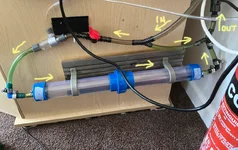
Your math is correct, and yes, for tanks this size, the reactors will be small. For example The reactor I built (pictured below) for my 25g (60X40) is 3.5"X6". This is why I personally wouldn't bother to build a reactor for anything less than 20g, although, some have built in-tank reactors for smaller aquariums and there are threads here describing those.

Here's where you run into an issue though, the smaller diameter the tube, the more turbulent your flow will be, regardless of how you turn it down, because you can only turn it down so much before you have too little flow in the tank and thus poor CO2 circulation around the tank and not enough surface agitation for off-gassing. I first tested a 2" diameter pipe on the 25g and it was quite noisy. I recommend at least 3.5 " diameter, but again, the shorter length causes turbulence, just not as bad. This is where I am now, because of the fast turbulent flow through the short reactor, it's terribly inefficient. That's where the bypass comes in. Direct most of the flow around the reactor to give CO2 and water more time in the reactor to interact.

I also recommend designing a reactor with the input centered on one end but the output offset on the other. This way you can design the reactor a little larger than necessary and just rotate it to turn it down. If doing this place your CO2 input in an area of the input end that stays in the top quarter of the reactor regardless of where you have the output rotated to. This can help reduce CO2 bubble sounds if your tank is in a room you want to keep things quiet.

Reactor on my 49g tank.
WB3620 Yugang Reactor Rev 1.webp

Reactor on my 25g tank. It's mounted to the bottom of the stand top so this photo is taken by me lying on my back.
WB 25 Reactor.webp
 
it may not be worth digging into since my aquarium is pretty small by comparison (16-17gal)

Using a Yugang reactor has two benefits:
  • it removes fizzy bubbles from your tank if they bother you, and
  • has the ability to put a ceiling on your CO2 injection, so if you have a less than top-end needle valve you can still be sure your injection will stay consistent and below whatever maximum you set.

If you want one of these benefits for a small tank, Yugang also did an Open Flow reactor he calls a Spray Bar. It goes inside your tank, but it works for little tanks 👍👍

@*Ci* made a gorgeous one here:

1000048350.webp
IMG_0061.webp
1000048360.webp


If neither of these apply, there's always an inline diffuser. I use this diffuser on my little tanks,
1000048363.webp
1000048353.webp
1000048356.webp

It's in-line, but really it's a sideways version of a standard in-tank diffuser. The water goes past the diffuser disk, and your flow is not obstructed 👍
 
Last edited:
Probably not, but you have the option to build one and try it, or build one with a bypass and a ball valve
Can anyone explain why the valve must go on the bypass? Or is it specific to the design shown. If bypass was above, I assume valve would go on reactor side? I just think about the fluid dynamics of it and, if you were to fill it slowly, the head (height) is exactly the same between the two so in theory it’s 50/50 split between water flow. So if we want to slow down the reactor flow, why not have the valve on the reactor line to begin with? You’re essentially controlling 50-100% of your flow to go through reactor, rather than controlling 0-50% of flow going through reactor. Is my thought process wrong here?
 
Can anyone explain why the valve must go on the bypass? Or is it specific to the design shown. If bypass was above, I assume valve would go on reactor side? I just think about the fluid dynamics of it and, if you were to fill it slowly, the head (height) is exactly the same between the two so in theory it’s 50/50 split between water flow. So if we want to slow down the reactor flow, why not have the valve on the reactor line to begin with? You’re essentially controlling 50-100% of your flow to go through reactor, rather than controlling 0-50% of flow going through reactor. Is my thought process wrong here?

It doesn't have to go on the bypass. I have my valve on the reactor part of the circuit for the very reasons you state.
 
Hello 🙂 I'd like to build a horizontal reactor for my aquarium. The aquarium is 150cm x 60cm x 60cm. From what I've read here, the reactor length should be about 51cm (150x60/17.7). However, I'm not sure what diameter pipe I should use. Will a 5cm pipe be sufficient?

So you did (150x60/17.7) which is right. That gives you 508.

Your length times diameter should equal this number. 51cm x 5cm is only 255, not 508. You would need a 10cm diameter pipe if you use 51cm length.

For your tank you can use any pipe that has length x diameter = 508
 
Hello 🙂 I'd like to build a horizontal reactor for my aquarium. The aquarium is 150cm x 60cm x 60cm. From what I've read here, the reactor length should be about 51cm (150x60/17.7). However, I'm not sure what diameter pipe I should use. Will a 5cm pipe be sufficient?

Check out my journal 1 and journal 2, both of which are 150x60x60cm and use an ARC Acrylic horizontal reactor!

The dimensions of this reactor are 65cm long by 10cm diameter. At this size, they were pretty overpowered at full strength for a 150x60x60cm tank -- so having an offset exit for the water so you can rotate your reactor to adjust the power was really nice. It's far better to oversize and be able to reduce the power, than to under-power it!
 
Having recently upgraded my filter from a Fluval 307 to a Biomaster 850, I need to change my reactor setup to handle the extra flow when I switch them over.
Currently I have a Cerges reactor that I made with the smaller 10” housing. Considering I already get some bubbles making their way into the tank in the afternoons with the 10”, I figure I need to upgrade and install a bypass.
I found an absolute bargain on Amazon, a 20” clear filter housing delivered for $22.
Can anyone help me with whether it would be worth setting this up as a horizontal reactor?
The tank is 135L, with a 80cm x 40cm (32”x40”) footprint, so my understanding is the housing will be far larger than I need if horizontal.
What would be the benefits to running it horizontally considering it is oversized for the tank anyway?
 
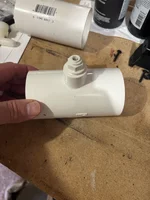
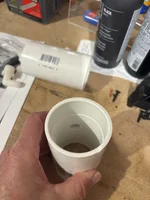
Hello, Scapers! Long time listener, first time caller. :) I've finally gotten to the point of building one of these. I bought the 2" clear PVC last year, but never followed thru because I was solely focused on the 1.5 ph drop which was going to require a very long reactor, or longer than I was prepared to create. Since the math was provided for 0.9 and 1.2 ph drop, I think I can pull this off. I also found @Unexpected YouTube video (at least that's who I think it was) which made this seem very simple. And that's what I keep hearing.. it's very simple. I just upgraded to a 120g tank,48x24x24. I'm not going to go into all the math as that has been discussed thoroughly, but what I've come away with is a reactor somewhere between 10.847" (0.9) and 21.7" (1.2). I'm certainly leaning more toward the 1.0 ph drop as much for the length of the reactor. I'm finally getting to the main question.. I found these nice T connectors with 3/4" fittings for "push to connect" connectors which would work perfectly for bleeding air as well as CO2 input. Will these be ok? There is a little area inside that will likely be difficult to completely purge.20260424_173144998_iOS.webp20260424_173150052_iOS.webp
 
Hello, Scapers! Long time listener, first time caller. :) I've finally gotten to the point of building one of these. I bought the 2" clear PVC last year, but never followed thru because I was solely focused on the 1.5 ph drop which was going to require a very long reactor, or longer than I was prepared to create. Since the math was provided for 0.9 and 1.2 ph drop, I think I can pull this off. I also found @Unexpected YouTube video (at least that's who I think it was) which made this seem very simple. And that's what I keep hearing.. it's very simple. I just upgraded to a 120g tank,48x24x24. I'm not going to go into all the math as that has been discussed thoroughly, but what I've come away with is a reactor somewhere between 10.847" (0.9) and 21.7" (1.2). I'm certainly leaning more toward the 1.0 ph drop as much for the length of the reactor. I'm finally getting to the main question.. I found these nice T connectors with 3/4" fittings for "push to connect" connectors which would work perfectly for bleeding air as well as CO2 input. Will these be ok? There is a little area inside that will likely be difficult to completely purge.View attachment 16468View attachment 16469
That would work just fine. Also, you can go with larger diameter pipe if you need the reactor shorter. Also, make sure to measure above the outlet for the correct diameter since the outlet is fixed with PVC.
 
Hello everyone, first-time posting here :)

I am assembling a parts list for 40g breeder reactor, and I believe I've done a pretty solid job, although the total is a little more expensive than I had anticipated. To address those who may suggest simply buying the small acrylic ARC reactor, that thing is massive and way too overpowered for my needs. I used the formula provided by yugang to calculate the reactor size for a 1.2 drop in ph for my tank and found that my reactor needs to have 18.3 in. of SA, which means I can get away with a 6 in. long piece of PVC using a 3 in. diameter.

Math is as follows: 36(L) x 18(W) = 648 / 35.4 (targetting 1.2 drop) = 18.3050847458 ≈ 18.3 in. SA

I've never done plumbing work before/have no experience with PVC and the various connectors. I know it's not rocket science, but I'm just trying to ensure that I get this right in as few tries as possible. The biggest thing stumping me at the moment is determining how to mount 45-degree elbows within the reducer coupling. Google Gemini gave me a suggestion utilizing the 3" x 1" reducer coupling listed in my spreadsheet; it said I could simply attach 1.5 in. - 2 in. of 1 in. diameter PVC inside the coupling and then the elbow to that, but I can't visually see how that works and have no idea if that was a straight AI hallucination or not, because I am unfamiliar with what it is advising. I would attach a quote of that, but it appears my Gemini chat history isn't loading lmao. I'm way more open to the advice of those in this thread anyway.

I'm aiming for something that looks pretty similar to yugangs build (attached an image below), the only change being that I would like to place the ball valve in front of the reactor as opposed to in front of the bypass tube, as per someone's suggestion in this thread. I also included a very crude drawing of what I want it to look like.

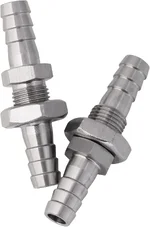
I've attached my spreadsheet, which contains a list of all the parts I believe I will need. Actually, now that I mention it, hose barbs are the only thing missing, but I still just wanted to get this posed to see if anyone had suggestions or if I'm insane for thinking it would work this way. Thank you so much to everyone here who inspired me.


Yugang's BuildMy very crude drawing
 

Attachments

Yup, all looks good as a general circuit design. I was a first time PVC gluer when I made my Yugang and I have to say that PVC cement is pretty amazing stuff. Just don't expect to ever undo any PVC you glue with it !
If you ensure that the actual reactor itself is attached into the circuit via hose/clamp attachments, and not cemented in, then you will be able to loosen and rotate it if you need. THis will give you much potential adjustability of surface area within the reactor. The 45 degree elbows you intend to include (only really need to be on the outlet side) are obviously the main components that will enable this adjustability. I am sure this is already your intention, it is just that your drawing of your plan does not seem to include any hose/clamp connections for the reactor.
You could choose to cement the reactor into the circuit and this will provide more potential leak-protection but at the expense of adjustability of surface area within the reactor.
 
If you ensure that the actual reactor itself is attached into the circuit via hose/clamp attachments, and not cemented in, then you will be able to loosen and rotate it if you need. THis will give you much potential adjustability of surface area within the reactor.
Oh wow. I was wondering why the Yugang version I posted a pic of in my original reply used hose/clamps, which makes a lot more sense.
I am sure this is already your intention
Yeah….. totally haha 1777997483044.webp
You could choose to cement the reactor into the circuit and this will provide more potential leak-protection but at the expense of adjustability of surface area within the reactor.
Thank you so much, hamfist. It’s funny because after reading the reactor guide and seeing all these builds, I guess it slipped my mind on how to actually implement adjustability in one of these. I was aware of how the ARC version tackles it because I saw Unexpected’s video on it, but up until your reply, I almost made a big mistake! What type of hose did Yugang use to bridge the PVC and reactor?

I do wonder, since my reactor will be exactly the size necessary to drop the pH by 1.2 at the stock configuration in overflow mode, do I really need that modularity?

Also, a week before stumbling onto this thread and discovering this wonderful reactor, I was planning on running CO2 in my tank using a ceramic diffuser as I did once before, except with a pH controller for stability this time around. I found a brand-new Milwaukee MC122 PRO for $125 on eBay and snagged it, only to find out that these reactors (when in overflow mode) essentially make pH controllers redundant/obsolete. I guess it will help me dial in the reactor, so that's good. I saved post #32 so that I could reference it when I get everything set up, and I also came across this advice on Reddit regarding pH controllers:
The ideal situation is to set the controller as a fail safe mechanism, in case you ever have CO2 levels exceeding the threshold you set. So, instead of just setting a pH of say 6.5 and then cranking the CO2, what you want to do is set your lower bound for shutoff and tune your CO2 injection rate so that you’re just above this threshold. Perhaps you want 6.5, tune the injection to 6.55 or 6.6. This way the solenoid isn’t constantly shutting off and pH doesn’t fluctuate. You will have the most efficient injection rate and will have protection from spikes (drops in pH beyond your determined safe limit). Most importantly, the pH will be stable 24/7 at the specific pH you want, which is a win = win = win for livestock, plants, and efficiency.

Here is my updated parts list:
1778001190979.webp
EXCEL_DezbW2iZhy.webp
 

Attachments

Last edited:

Top 10 Trending Threads

Back
Top