
Welcome to ScapeCrunch
We are ScapeCrunch, the place where planted aquarium hobbyists come to build relationships and support each other. When you're tired of doom scrolling, you've found your home here.
Social Feed

Journal 60P Garden tank
I’ve been wanting to do a tank for a while that focuses just on finnicky plants -erios, lud. panatal, tonina and the sorts. So this is my detailed journal of how I start my planting process all the way from cycling to planting, fertilizing, water changes and the pitsfalls, lighting and what processes work best for me.
Equipment:
Oase biomaster2- 350
Fluval Visi-white 60P tank
Fzone CO2 regulator and a 2.5lb CO2 tank
Week aqua L600Pro Series Light
Fzone Brite60 Light
Yugang reactor made using a 375 mm PC cooling reservoir - will post another journal detailing this.
CO2:
1.3 pH drop from a baseline of pH 6.8.
Aquasoil:
Three 5L bags of APT Feast
Cycling:
APT Feast being a high organic content soil - I like to cycle it for a full month at least using the dark start method before planting anything. This is even more important for me as I almost exclusively use tissue cultures for my plants. Because I will be injecting CO2, the tank was also getting injected with CO2 during its dark start. I know there’s opinion out there that it’s a waste and what not, but I think CO2 levels in the water might affect microbial ecosystem development in the long run, so I like to start off by exposing the microbial community of the tank to CO2 levels it will be seeing in the long run.
The water parameters 2 weeks after start dark cycle were as follows:
Total ammonia : 10 ppm+
Nitrite: 10 ppm+
Nitrate : unreadable as the nitrite levels were interfering with the API test. I eventually used a 25% dilution to read 30 ppm+ nitrates.
At this point I did a large (100%) water change to remove some ammonia and speed up the leaching process. The steeper the diffusion gradient between the soil and water the quicker the ammonia leaches, hence large water changes facilitates that.
After 4 weeks I did another water test and the parameters were similar as above. Proceeded to do another 100% water change.
After 5 weeks I did another water test and this time the parameters were:
Total Ammonia: 1 ppm
Nitrite: 2 ppm+
Nitrate: 40 ppm+
Decided to give it another week to see if the nitrites would drop to below 0.5 ppm.
One week later the nitrites had vanished. I did another 100% water change.
So it takes about 6 weeks to fully cycle a tank with APT Feast if you don’t use any old media or cycling aid.
Next step is to plant the tank. I wanted this tank to focus on mostly uncommon species:
1. Ludwigia Pantanal
2. Ludwigia Arcuata
3. Tonina fluviatilis
4. Rotala Macrandra
5. Macrandra Mini Red
6. Mayaca Fluviatilis
7. Rotala Florida
8. Rotala Bonsai
9. Ludwigia Cuba- white edge
10. Ludwigia Senegalensis
11. Lysimachia Parv. red
12. AR mini
13. Bacopa compacta white
14. Erio Vietnam
15. Erio Quinquangulare
16. Crypt Flamingo for my centre piece
Here’s a photo after planting. Not all the species listed above are present in the photo but I did eventually add them once I was able to acquire them.
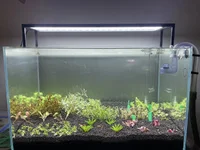
I’m also trying to make a carpet with buce needle leaf on the left side, we’ll see how that goes. I plant on planting clumps of ratnagiricum in the carpet once the carpet has settled in.
OK, so parameters after planting:
1. CO2: 1.3 pH drop from a baseline pH of 6.8. About 55-60 ppm possibly. The verify by making sure my drop checker is yellow before lights on. I turn on CO2 4 hours before lights on and turn it off 1 hour before lights off.
2. Lighting at 80% strength. I hadn’t hooked up the week aqua yet at that point so it’s just 80% on the fzone which would amount to about 60 umol of PAR at the substrate. After a week, I installed my weekaqua L series and increased the PAR to around 100 umol at the substrate. I’m a big fan of using high light (80-110) umol from day 1 of planting, I think this gives plants the best chance at fast growth. The faster the plants grow adapt and generate mass the higher my chances on skipping the diatom/GDA phase. Here’s an 8 gallon tank below where I used a 100W grow light from Day 1 of planting and you can see how the tank is algae free and growing rapidly at the 3 week mark.
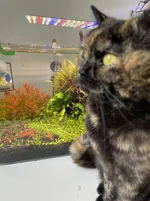
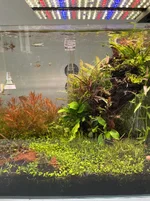
This method has worked really well for me, although the key to this method is to maintain very stable nitrate levels. Your nitrates could be anywhere between 0-30ppm, and it won’t matter as long as it is kept stable. A common mistake is to not replenish nitrates after a large water change.
3. Fertilizers:
APT 1 - 1.5 ml per day
4. Water parameters:
KH - 0dKH
Nitrate: 10 ppm
Phosphate: 0 ppm
Here’s the tank now after 4 weeks of growth:
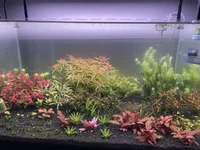
The macrandra on the left had been trimmed last week and replanted, they had almost reaching 80% of the tank height. The tonina at the back has settled in well, some diatoms on the lower leaves which I’m not worried about. Although I don’t think that’s where I’ll kepp the tonina long run. I might use it as a midground plant and maybe move the panatal where the tonina is. You can barely see the quinquangulare behind the AR mini, but they seemed to have settled down as well. I planted 6 crowns and lost 3 within the first 2 weeks. I suspect damage from transportation - they smelled like cooked spinach when I received them.
So as is evident from above, even though I’m supplying higher levels of lighting, diatoms and GDA haven’t really taken a hold yet. The key has been regular water changes to remove detritus produced by the ramshorns, keep a stable nitrate level of 10ppm, stable CO2 at 50+ppm and good plant husbandry. I always make a point of trimming away older and emersed leaves so they don’t attract algae. The ludwigia white is actually emersed. I have removed all of its emersed leaves except the ones from the top 2 internodes and as soon as I will see sideshoots grow and develop past the 2nd internode, I will trim them and replant them and uproot the emersed stem and toss it. The plant arrangment is a little “block-like” as of now, but this isn’t really the final arrangement. I prefer to grow the plants out in a rough layout before I arrange them once they’ve all taken off.
Thank you for taking the time to read this. I will add to it as the tank develops in the upcoming weeks.
Equipment:
Oase biomaster2- 350
Fluval Visi-white 60P tank
Fzone CO2 regulator and a 2.5lb CO2 tank
Week aqua L600Pro Series Light
Fzone Brite60 Light
Yugang reactor made using a 375 mm PC cooling reservoir - will post another journal detailing this.
CO2:
1.3 pH drop from a baseline of pH 6.8.
Aquasoil:
Three 5L bags of APT Feast
Cycling:
APT Feast being a high organic content soil - I like to cycle it for a full month at least using the dark start method before planting anything. This is even more important for me as I almost exclusively use tissue cultures for my plants. Because I will be injecting CO2, the tank was also getting injected with CO2 during its dark start. I know there’s opinion out there that it’s a waste and what not, but I think CO2 levels in the water might affect microbial ecosystem development in the long run, so I like to start off by exposing the microbial community of the tank to CO2 levels it will be seeing in the long run.
The water parameters 2 weeks after start dark cycle were as follows:
Total ammonia : 10 ppm+
Nitrite: 10 ppm+
Nitrate : unreadable as the nitrite levels were interfering with the API test. I eventually used a 25% dilution to read 30 ppm+ nitrates.
At this point I did a large (100%) water change to remove some ammonia and speed up the leaching process. The steeper the diffusion gradient between the soil and water the quicker the ammonia leaches, hence large water changes facilitates that.
After 4 weeks I did another water test and the parameters were similar as above. Proceeded to do another 100% water change.
After 5 weeks I did another water test and this time the parameters were:
Total Ammonia: 1 ppm
Nitrite: 2 ppm+
Nitrate: 40 ppm+
Decided to give it another week to see if the nitrites would drop to below 0.5 ppm.
One week later the nitrites had vanished. I did another 100% water change.
So it takes about 6 weeks to fully cycle a tank with APT Feast if you don’t use any old media or cycling aid.
Next step is to plant the tank. I wanted this tank to focus on mostly uncommon species:
1. Ludwigia Pantanal
2. Ludwigia Arcuata
3. Tonina fluviatilis
4. Rotala Macrandra
5. Macrandra Mini Red
6. Mayaca Fluviatilis
7. Rotala Florida
8. Rotala Bonsai
9. Ludwigia Cuba- white edge
10. Ludwigia Senegalensis
11. Lysimachia Parv. red
12. AR mini
13. Bacopa compacta white
14. Erio Vietnam
15. Erio Quinquangulare
16. Crypt Flamingo for my centre piece
Here’s a photo after planting. Not all the species listed above are present in the photo but I did eventually add them once I was able to acquire them.
I’m also trying to make a carpet with buce needle leaf on the left side, we’ll see how that goes. I plant on planting clumps of ratnagiricum in the carpet once the carpet has settled in.
OK, so parameters after planting:
1. CO2: 1.3 pH drop from a baseline pH of 6.8. About 55-60 ppm possibly. The verify by making sure my drop checker is yellow before lights on. I turn on CO2 4 hours before lights on and turn it off 1 hour before lights off.
2. Lighting at 80% strength. I hadn’t hooked up the week aqua yet at that point so it’s just 80% on the fzone which would amount to about 60 umol of PAR at the substrate. After a week, I installed my weekaqua L series and increased the PAR to around 100 umol at the substrate. I’m a big fan of using high light (80-110) umol from day 1 of planting, I think this gives plants the best chance at fast growth. The faster the plants grow adapt and generate mass the higher my chances on skipping the diatom/GDA phase. Here’s an 8 gallon tank below where I used a 100W grow light from Day 1 of planting and you can see how the tank is algae free and growing rapidly at the 3 week mark.
This method has worked really well for me, although the key to this method is to maintain very stable nitrate levels. Your nitrates could be anywhere between 0-30ppm, and it won’t matter as long as it is kept stable. A common mistake is to not replenish nitrates after a large water change.
3. Fertilizers:
APT 1 - 1.5 ml per day
4. Water parameters:
KH - 0dKH
Nitrate: 10 ppm
Phosphate: 0 ppm
Here’s the tank now after 4 weeks of growth:
The macrandra on the left had been trimmed last week and replanted, they had almost reaching 80% of the tank height. The tonina at the back has settled in well, some diatoms on the lower leaves which I’m not worried about. Although I don’t think that’s where I’ll kepp the tonina long run. I might use it as a midground plant and maybe move the panatal where the tonina is. You can barely see the quinquangulare behind the AR mini, but they seemed to have settled down as well. I planted 6 crowns and lost 3 within the first 2 weeks. I suspect damage from transportation - they smelled like cooked spinach when I received them.
So as is evident from above, even though I’m supplying higher levels of lighting, diatoms and GDA haven’t really taken a hold yet. The key has been regular water changes to remove detritus produced by the ramshorns, keep a stable nitrate level of 10ppm, stable CO2 at 50+ppm and good plant husbandry. I always make a point of trimming away older and emersed leaves so they don’t attract algae. The ludwigia white is actually emersed. I have removed all of its emersed leaves except the ones from the top 2 internodes and as soon as I will see sideshoots grow and develop past the 2nd internode, I will trim them and replant them and uproot the emersed stem and toss it. The plant arrangment is a little “block-like” as of now, but this isn’t really the final arrangement. I prefer to grow the plants out in a rough layout before I arrange them once they’ve all taken off.
Thank you for taking the time to read this. I will add to it as the tank develops in the upcoming weeks.

14 Replies
·
1634 views


Hey guys, needing some expert insight on my 90P build regarding the Yugang reactor. I’d like a sanity check on sizing.
System
What I measured

View attachment y2.mp4
System
- Display: 90 × 45 cm outside, 10 mm glass, so ~88 × 43 cm inside (~3,780 cm²), rimless, lidless.
- Sump: 20-gallon long (76 × 30 cm, ~2,280 cm²), 3 chambers, loose lid.
- About 220 L total water.
- Return enters below the surface; no deliberate surface agitation.
- BeanAnimal overflow, with the main draining underwater (no cascade).
- Currently cycling on tap water: KH 13, GH 12. The plan is RO remineralised to KH 3–4.
- Horizontal Yugang, 3" Sch40 PVC (ID 77.9 mm), 46 cm long.
- Outlet rotated to near the limit of what my plumbing allows, so the pocket is much smaller than half-full.
- CO₂ flow meter at about 9 mL/min. That’s slightly over what it dissolves, so it gives small occasional burps.
What I measured
- Plateau: pH 6.80 at KH 13 ~ 60 ppm (pH/KH estimate). Degassed baseline pH at 8.2.
- Overnight decay after CO₂ off: k ≈ 0.12/h (half-life ~5.7 h). That implies a CO₂ exchange rate of ~4–7 cm/h, i.e. a calm surface.
- Working the 1/17.7 rule backwards from my reactor area (~180–358 cm² depending on rotation), my effective loss area is ~1,100–2,200 cm², against ~6,060 cm² of real water surface (display + sump).
View attachment y2.mp4
2 Replies
·
23 views

Rockstar
Journal 22 gallon long bookshelf
Time to start a new thread.
I’ll fill in some details later, but I’m working on the hardscape now. Any and all criticism is appreciated. The vision is nothing more, and nothing less, than something appealing to the eye.
90cm x 30cm x 30cm Lifegard Aquatics ultra clear bookshelf tank. Buce and anubias on the hardscape, stems towards the back and center, mid to front carpet with some changes in shade and texture down to a flat grade on the right side of the tank.
Lily pipe inlet and skimmer will be in the back left corner with the outflow in the front left to hopefully achieve circular flow. I’ll be running an in-line diffuser. Light will be the P600 Pro that I regrettably did not upside to 900. Oh well. I’ll mount it high and hopefully it’ll have enough spread.
I have some dragon stone and red lava rock rubble I’ll use at the base to blend into the substrate, as well as some stratum I may or may not cap with.


I’ll fill in some details later, but I’m working on the hardscape now. Any and all criticism is appreciated. The vision is nothing more, and nothing less, than something appealing to the eye.
90cm x 30cm x 30cm Lifegard Aquatics ultra clear bookshelf tank. Buce and anubias on the hardscape, stems towards the back and center, mid to front carpet with some changes in shade and texture down to a flat grade on the right side of the tank.
Lily pipe inlet and skimmer will be in the back left corner with the outflow in the front left to hopefully achieve circular flow. I’ll be running an in-line diffuser. Light will be the P600 Pro that I regrettably did not upside to 900. Oh well. I’ll mount it high and hopefully it’ll have enough spread.
I have some dragon stone and red lava rock rubble I’ll use at the base to blend into the substrate, as well as some stratum I may or may not cap with.
309 Replies
·
35189 views

Supporting
I'm looking for recommendations for neocaridina retailers. I'd like to order them at the end of October, and have them shipped to Asheville NC.
Any recommendations?
Any recommendations?
17 Replies
·
985 views

Supporting
I Donated 2026
Rockstar
Journal Jay's 22 Long Iwagumi
I thought I would go ahead and get an early start on the journal for my next build. Still some prep work to complete but I was able to sneak some time in this evening to do some leak testing.
No need for a ton of media on this tank so I'll be using the "Temu" filters I recently talked about; one is a full foam prefilter and the other is part foam, part matrix. I failed to mention, when I posted my initial unboxing of the temu filters, that they do come in 2 sizes for each configuration, a 200 series, and the slightly larger 240 series. I think using the smaller 200 as the prefilter will work well in this setup. I was really surprised to see how much the foam expanded once it got wet. I may actually remove the top portion of foam in the filter with the matrix. Also, I confirmed the Netlea valves do work on the Temu filters.
I'm going with the MDP-2500 pump which may seem overkill for a 22g tank, but since it's 90cm in length, I want to make sure I have good flow end-to-end, and the 1500 pump I tried wasn't giving me quite what I wanted. I still also have to go through an inline heater as well, with several elbow fittings mixed in. I'll be able to adjust this pump down to just what I want. I'm also using the 3D printed barbs I modeled with the pump. I initially had issues with my elbow fittings leaking just as @renesis did on their high tech build. After seeing renesis's fix of coating the elbow with epoxy, I was about to try the same but realized I had a small can of spray-on Flex Seal so thought I'd give that a try. So far, it seems to be working fine on the elbow fitting. I do have a small leak on the output straight fitting but I think that's a different issue.
Otherwise, no other leaks which surprised me as I was expecting some on my DIY CO2 reactor which is a bit different design than my previous builds. It's working great and I want to give a shoutout to @Yugang for the idea of simply using some teflon sealing tape to seal the PVC caps to the Acrylic tube. You don't even need many wraps. I made the mistake of using too much on one end and when I tried to take it back off, it was quite a struggle, almost as if I had glued it, so trust me, as long as your cap I.D. matches your pipe O.D., a few wraps should do the trick.
More to come.
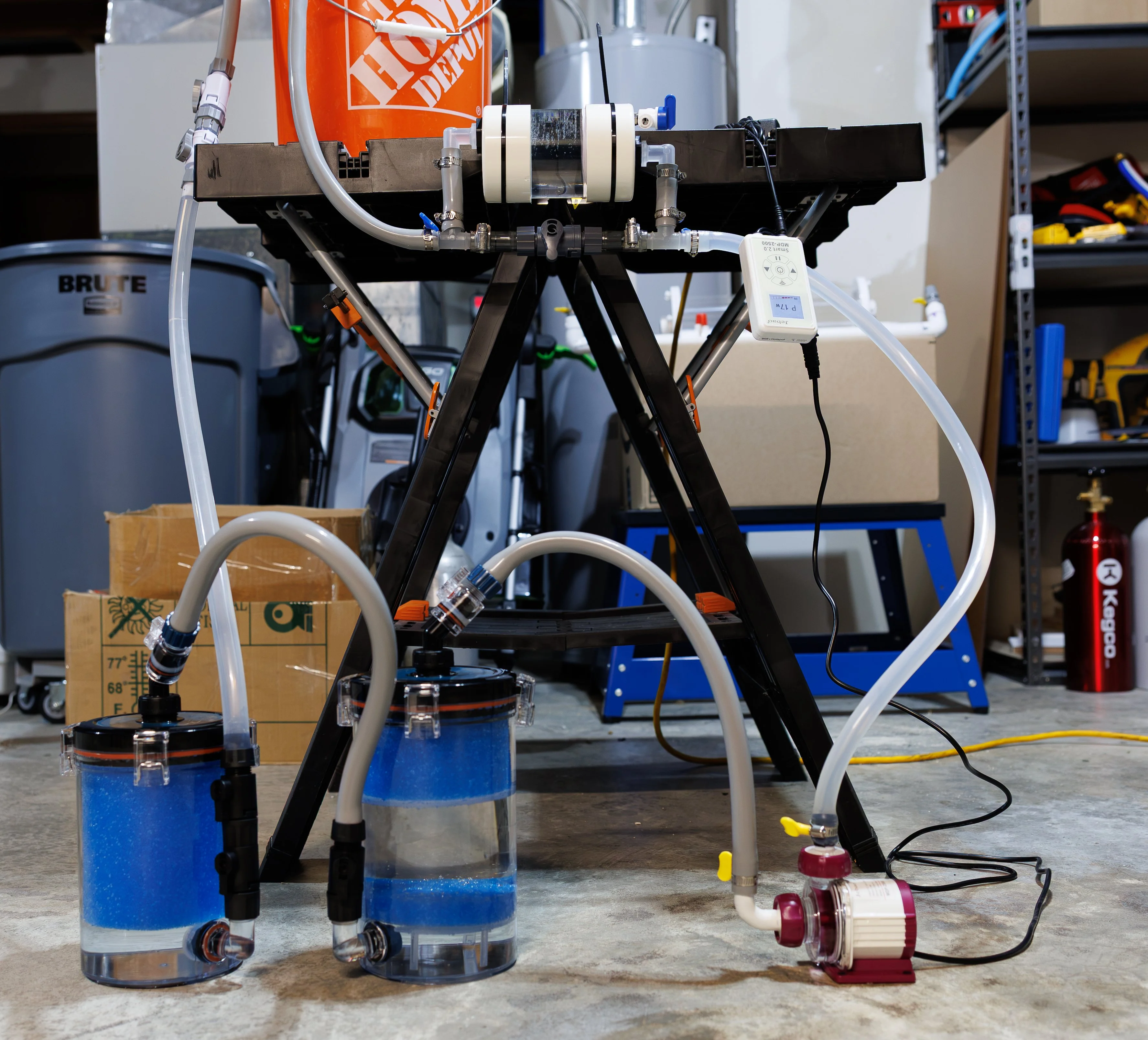
No need for a ton of media on this tank so I'll be using the "Temu" filters I recently talked about; one is a full foam prefilter and the other is part foam, part matrix. I failed to mention, when I posted my initial unboxing of the temu filters, that they do come in 2 sizes for each configuration, a 200 series, and the slightly larger 240 series. I think using the smaller 200 as the prefilter will work well in this setup. I was really surprised to see how much the foam expanded once it got wet. I may actually remove the top portion of foam in the filter with the matrix. Also, I confirmed the Netlea valves do work on the Temu filters.
I'm going with the MDP-2500 pump which may seem overkill for a 22g tank, but since it's 90cm in length, I want to make sure I have good flow end-to-end, and the 1500 pump I tried wasn't giving me quite what I wanted. I still also have to go through an inline heater as well, with several elbow fittings mixed in. I'll be able to adjust this pump down to just what I want. I'm also using the 3D printed barbs I modeled with the pump. I initially had issues with my elbow fittings leaking just as @renesis did on their high tech build. After seeing renesis's fix of coating the elbow with epoxy, I was about to try the same but realized I had a small can of spray-on Flex Seal so thought I'd give that a try. So far, it seems to be working fine on the elbow fitting. I do have a small leak on the output straight fitting but I think that's a different issue.
Otherwise, no other leaks which surprised me as I was expecting some on my DIY CO2 reactor which is a bit different design than my previous builds. It's working great and I want to give a shoutout to @Yugang for the idea of simply using some teflon sealing tape to seal the PVC caps to the Acrylic tube. You don't even need many wraps. I made the mistake of using too much on one end and when I tried to take it back off, it was quite a struggle, almost as if I had glued it, so trust me, as long as your cap I.D. matches your pipe O.D., a few wraps should do the trick.
More to come.
2 Replies
·
83 views


Staff member
I Donated 2026
Founding Member
Hello Welcome, kneeshg
Welcome to ScapeCrunch, @kneeshg!
We would love to get to know you. Please tell us about yourself. What tank do you have?
We would love to get to know you. Please tell us about yourself. What tank do you have?
0 Replies
·
10 views
Staff member
I Donated 2026
Founding Member
Hello Welcome, Ilja
Welcome to ScapeCrunch, @Ilja!
We would love to get to know you. Please tell us about yourself. What tank do you have?
We would love to get to know you. Please tell us about yourself. What tank do you have?
0 Replies
·
12 views
Staff member
I Donated 2026
Founding Member
Hello Welcome, Renuprajan
Welcome to ScapeCrunch, @Renuprajan!
We would love to get to know you. Please tell us about yourself. What tank do you have?
We would love to get to know you. Please tell us about yourself. What tank do you have?
1 Replies
·
84 views

Rockstar
These plants have been sitting in this container in the dark for 9 days. They are still wet, but the container isn't 100% air tight.
Plants look great. They are crispy and green. I removed them from the tank on Oct 11. It's Oct 20.
I haven't had a chance to do hardly any tank maintenance since my trip, but I needed to get some stuff out to make room for some tc plants I ordered.
I thought someone might want some of this, so I put it in this container, and was going to offer it all up if I thought I'd have time to ship. (Too late now)
I can't believe how long they've lasted.
So if you need a way to store some plants for a few days. This might be an option.
Note: Both things were pulled up roots and all. If I had cut stems, they might not have lasted?
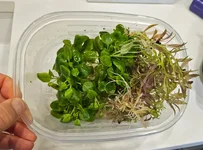
Plants look great. They are crispy and green. I removed them from the tank on Oct 11. It's Oct 20.
I haven't had a chance to do hardly any tank maintenance since my trip, but I needed to get some stuff out to make room for some tc plants I ordered.
I thought someone might want some of this, so I put it in this container, and was going to offer it all up if I thought I'd have time to ship. (Too late now)
I can't believe how long they've lasted.
So if you need a way to store some plants for a few days. This might be an option.
Note: Both things were pulled up roots and all. If I had cut stems, they might not have lasted?
2 Replies
·
54 views
Supporting
I Donated 2026
Rockstar
Browsed the Sreepadma booth at Aquashella briefly today. I'd not heard of them but they are the largest aquatic plant farm in India and have been selling their TC offerings in the US for about 2 years. I was actually impressed with the qualty I was seeing of their TC cups and wish I had room in a tank for some (and some ADA TC). Has anyone else purchased any of their plants. One of the first that I spotted was Red Tiger Crypt which was a coincidence since we have a thread discussing it.
17 Replies
·
743 views
Journal High-Tech 90P Build
Hi guys!
I'm new here, but not entirely new to planted tanks though I've been out of the hobby for the better part of the last decade between kids and moving a couple of times - but finally in a spot where I can do something again. I'm mostly going to be making things up as I go along, but plan on a lot of automation (I want to integrate everything into home assistant) and a lot of DIY as I love the challenge of building things out myself.
The starting point:
I picked up a 90P rimless, low-iron tank on a great deal.
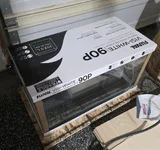
I have a rough idea in my head for a stand to be built from plywood - just have a couple other house projects to finish off before starting that built.
Wife says I can only have one aquarium, so for this tank, I want to go all out with a sump to allow for auto top off, and auto water changes, auto fertilizer dosing etc. etc. I have half a plan in my mind.
I've also started on the light fixture which I've modeled up in CAD, and plan on making out of an 8020 extrusion, and some 3D printed bits.
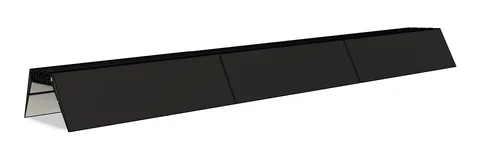
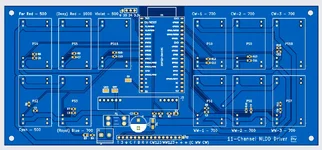
I'm using bridgelux gen 3 thrive CW (3000k) and WW (5000k) LED strips which have super high CRI at 98+ along with some specific XPE2 wavelengths that I'll solder onto some starboards. Far Red (730nm), Red (654nm), Cyan (495nm), Blue (455nm), Visible UV (415nm). Each segment of the white channels will be on its own driver so I can adjust left to right brightness in thirds, and each colour channel on its own driver so I can vary each channel on a time-based approach.
These will be run from a custom PCB board with Meanwell N-LDD drivers, and will run ESPHome on an ESP32 so it can link up with my Home Assistant installation.
That's it for now, this will probably be a very slow build so be warned if you follow along!
I'm new here, but not entirely new to planted tanks though I've been out of the hobby for the better part of the last decade between kids and moving a couple of times - but finally in a spot where I can do something again. I'm mostly going to be making things up as I go along, but plan on a lot of automation (I want to integrate everything into home assistant) and a lot of DIY as I love the challenge of building things out myself.
The starting point:
I picked up a 90P rimless, low-iron tank on a great deal.
I have a rough idea in my head for a stand to be built from plywood - just have a couple other house projects to finish off before starting that built.
Wife says I can only have one aquarium, so for this tank, I want to go all out with a sump to allow for auto top off, and auto water changes, auto fertilizer dosing etc. etc. I have half a plan in my mind.
I've also started on the light fixture which I've modeled up in CAD, and plan on making out of an 8020 extrusion, and some 3D printed bits.
I'm using bridgelux gen 3 thrive CW (3000k) and WW (5000k) LED strips which have super high CRI at 98+ along with some specific XPE2 wavelengths that I'll solder onto some starboards. Far Red (730nm), Red (654nm), Cyan (495nm), Blue (455nm), Visible UV (415nm). Each segment of the white channels will be on its own driver so I can adjust left to right brightness in thirds, and each colour channel on its own driver so I can vary each channel on a time-based approach.
These will be run from a custom PCB board with Meanwell N-LDD drivers, and will run ESPHome on an ESP32 so it can link up with my Home Assistant installation.
That's it for now, this will probably be a very slow build so be warned if you follow along!
87 Replies
·
6216 views