We are ScapeCrunch, the place where planted aquarium hobbyists come to build relationships and support each other. When you're tired of doom scrolling, you've found your home here.
Unfortunately I'm no help to you then. Mine is a DIY using the Atlas Scientific pH sensor, esp32 & home assistant.
I think a few here use the Apera pH meters which are ready to go and log data. Only problem is you have to hang them off your tank so not really a long term solution I think.
I just wonder if we mean the mean the same thing by “degassing.” After the inital 3 hours before lights on, my levels test within 5 ppm of each other all day long until lights and CO2 turn off. Of course it degasses some overnight, but to fully degas takes several days. Do you mean that your surface agitation is so high that the water fully degasses after only a few hours? I would think the agitation would have to be extremely high and the CO2 level rather low to accomplish that. Have you taken a sample and tested after 2 more days to see if it degassed any further? Just curious.
I know my tank does not literally degas CO2 completely 100% overnight, which is why I'd be looking for somewhere around 90% of degassing fairly quickly. My tank certainly at least 90% degasses within around 3-4 hrs - lights go off and a big old airstone kicks in. It all seems to work, and I expect a fair bit of the success is down to luck not judgement. The last few % of degassing will always take an age - its the nature of diffusion I guess.
Lots of excellent contribution in this thread BTW, from various folks. Great discussion.
Are you only using pH as a test? I'd consider a Hanna kit and also using drop checkers, too. The triple combination will help smooth out any potential testing-related issues.
I have a drop checker too that's been solid yellow pretty much since I first turned the gas on. I couldn't get my hands on a Hanna kit up here, but did get a Salifert CO2 test that has been no use - maybe due to my high KH interfering as it works on RO water fine. It has a brown->blue reaction, so not the same as the Hanna.
What I want to know is; what continuous ph monitor and software is everyone using to chart their ph over hours and days. I know @renesis has the custom DIY setup. I've considered getting a continuous monitor that has data output for charting like this but don't want to spend a lot and don't have the time right now for DIY.
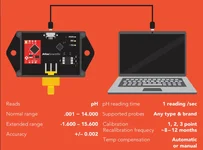
I'm using the same diy Atlas as @Aquajack , but Atlas also has a complete unit that will plug into a laptop via usb for a pretty reasonable price, and comes with software for logging. I would recommend the lab grade probe for the extra $27.
Introducing the EZO-Complete pH Kit, the ultimate all-in-one solution for seamless pH monitoring.
atlas-scientific.com
It won't temperature compensate automatically without a separate temperature probe, but if the tank temperature is relatively steady it should work well enough with manual compensation.
I know my tank does not literally degas CO2 completely 100% overnight, which is why I'd be looking for somewhere around 90% of degassing fairly quickly. My tank certainly at least 90% degasses within around 3-4 hrs - lights go off and a big old airstone kicks in. It all seems to work, and I expect a fair bit of the success is down to luck not judgement. The last few % of degassing will always take an age - its the nature of diffusion I guess.
Lots of excellent contribution in this thread BTW, from various folks. Great discussion.
How do you get degas so quick? Do you have a ton of agitation, or an airstone to help?
----
I measured my aerated tank sample pH last night at 8.5, so I am just trapping a ton of CO2 somehow. I am seeing some melt in the plants, so maybe some of that is contributing too. I turned the CO2 off yesterday and will keep it off today. I am just letting the tank degas to try and get a better idea. I plan on shrinking my Yugang reactor as well since its clear that its way too large and I vastly overestimated my sump loss.
Okay, well - feeling a bit dumb this evening but also happy I haven't shortened the reactor (yet).
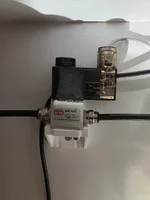
My solenoid is leaking. Not enough to register on the flow gauge, but enough to keep the co2 floor up. I noticed a gas pocket in the reactor when working on something unrelated in the sump this evening after having the solenoid shut off since yesterday. I've closed the valve on the tank and purged the reactor again to confirm and will check the readings in the morning. What I attributed to drift on my load cell for the co2 tank might have also been the leakage. I did also get the AFS01 flow sensor in yesterday and installed it - so I suppose I would have figured it out from that as well soon enough.
I think the one thing that hadn't been discussed in your journal, is what regulator you are using. For a build this high-tech, a nice "Bettatail" DIY regulator seems like not too much extra effort.
.. before CO2art, FZone, Green Leaf Aquatics or UNS were even a twinkle in an investor's eye..
...in a time without commercial planted tank regulators, not even ADA, when sugar-and-yeast DIY was the norm and treasured sources for Fabco needle-valves and the secret workings of the Clippard Mouse manifold were passed from hand to hand on forums like holy writ..
All of my regulators, including a backup extra, are all Bettatail and always will be. Worth every penny! Especially the amazing needle valves that he finds and uses in his builds. You don't know what you're missing in terms of tiny changes to CO2 per minute, until you try one of his needle valves.
I think the one thing that hadn't been discussed in your journal, is what regulator you are using. For a build this high-tech, a nice "Bettatail" DIY regulator seems like not too much extra effort.
Appreciate the recommendations, but I believe mine is pretty decent.
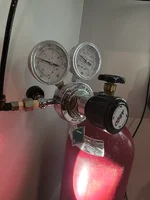
It's a lab grade dual stage regulator that I've rebuilt myself with new seals some years ago. I had a nice parker needle valve and solenoid but have pulled those as I wanted a 12V one for the controller to interface directly. I've now replaced the solenoid valve as well with a clippard rather than the Amazon one I had before, and confirmed no more leak so I can get back to tuning the co2 levels.
Will update the journal in a couple days with this and a couple other issues I ran into during commissioning once I sort those out as well. I still think my reactor is a bit oversized, but will see how it goes.
I take it the major downside of not using overflow mode is the potential to gas the livestock?
The biggest downside is that you will need to manually purge the gas within the reactor 1-2 times per week if you run it in regulator mode. You do guarantee 100% co2 injection with no loss, but it can get a bit annoying to manually purge. I ran two reactors in regulator mode for a year before switching to overflow mode, and I think I'll stick with overflow mode. Sure, I'll probably waste $15 worth of CO2 every 6 months, but I never have to touch my reactor AND it prevents gassing of my inhabitants! Give both a try and see which one you like the most.
That makes sense. What is the benefit of degassing so much overnight? I’m not suggesting you change anything, just curious. I know some people do that because they’re afraid of gassing their fish at night, but if the CO2 is set up right and stable, that shouldn’t be an issue, right?
That makes sense. What is the benefit of degassing so much overnight? I’m not suggesting you change anything, just curious. I know some people do that because they’re afraid of gassing their fish at night, but if the CO2 is set up right and stable, that shouldn’t be an issue, right?
Its a good question and my real answer is ..... "habit".
I have always aerated tanks well and it has always worked for me. This is a decades old habit and I have found no reason to change. I buy superquiet air pumps and all my tanks have lids so noise is not a great issue. This is my only CO2-injected tank so this is the one which only gets aerated at night only. I guess I also like the security of knowing dissolved O2 levels will stay excellent during the night phase with a planted tank where plants use up oxygen .
This site uses cookies to help personalise content, tailor your experience and to keep you logged in if you register.
By continuing to use this site, you are consenting to our use of cookies.