Welcome to ScapeCrunch

We are ScapeCrunch, the place where planted aquarium hobbyists come to build relationships and support each other. When you're tired of doom scrolling, you've found your home here.

RO system to control water parameters worth it?

  • Thread starter Thread starter Aquajack
  • Start date Start date
  • Featured
  • Tagged users Tagged users None
Finally received the booster pump (was on back order), so after this weekend will start kicking it into gear. First, just need to work out how all the connections hook up lol. With high pressure and low pressure switches built in, that have their own connections plus the usual inflow/outflow connections, it sounds like it will be a fun little project all on its own getting it up and running. The pressure switches are for the auto-shutoff when the water pressure reduces to a point but also they work with float valves etc at the other end.

I think once fully RO, that will be game changer no.
I had the same issue. My house pressure was sitting at 32 PSI on my initial RO test. Now with the booster pump it's running at 85 PSI and can make 150 gallons a day, with MUCH less waste water. I actually had to turn the pump pressure down a little as the system I am using can develop minor connection leaks if the PSI is 90 or higher. Once you get it set up, you will love it!
 
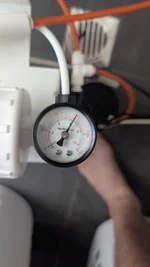
This number on the gauge is looking much better now, took it straight from 30 to 90 once I hooked the pump in.
Its only a 50GPD system so I'll run with that as its only for filling one tank but can always upgrade later to 100 if I feel is needed or for extra tanks.

The TDS is one coming out of the membrane filter and zero out of the final DI resin stage so the last stage doesn't have to work so hard lol.

The low pressure switch is hooked up so if the water stops or reduces sufficiently, it will turn the pump off which is nice. The high pressure switch I've not currently hooked up as that is used in conjunction with a float valve which I don't have yet. They mentioned and the manual also states that this pump isn't as compatible with a traditional float valve and would need to use an optical one. (which of course are way more expensive). Anyone had experience with those?
PXL_20260401_032010949.MP.webp
 
Last edited:
I'm going to install the electronic auto shut off valve today on the RODI.
Just wondering if anyone has had any experience with a combination of an RO system, booster pump with low and high pressure switches wired in and an electronic shut off valve. Wishful thinking but can't hurt asking lol.

Basically, for the booster pump, the low pressure switch which is currently in use in the RODI shuts off the pump when the water pressure reduces to a point or turns off. I haven't connected the high pressure switch yet to the RODI as I haven't had some type of float valve or shut off mechanism. The high pressure switch hooks into the production side of the RODI so when the reservoir is full, the pump shuts off.

I'm just trying to work out the point in the line where to install this thing.
I think I have it worked out but am happy for any opinions if you think it wont work out or a different solution.

Here is the sequence I plan to use.

Source water > Sediment filter > Solenoid for the ASOV > Low pressure switch (LPS) > pump > Carbon filter > Membrane > Di resin > High pressure switch > product water.

The pump and LPS as per that sequence are currently installed between the sediment and carbon filters.

The place that sells these things said to install it before the LPS/pump, but then he also said I don't need to hook up the high pressure switch but that is what turns the pump off when this is activated so I will be hooking that up.

See below the installation diagram of the product. Note, this diagram obviously doesn't take into account the pump and the associated switches.

Autoaqua installation diagram.webp
 
Yes, your auto shutoff is already acting as your pressure switch. Personally, I'm hesitant to rely on those level sensor switches over a simple float switch. If you haven't already, I'd also add a leak sensor to the setup as a little safety net.
Something like this: Leak sensor
 
Yes, your auto shutoff is already acting as your pressure switch. Personally, I'm hesitant to rely on those level sensor switches over a simple float switch. If you haven't already, I'd also add a leak sensor to the setup as a little safety net.
Something like this: Leak sensor
I think that's a good idea. Redundancy is never a bad thing. I'll add that in.

I was actually all set to look at a standard mechanical float switch but then found out the pump I have was not compatible with it for some reason. Don't ask me why.
 
See below the installation diagram of the product. Note, this diagram obviously doesn't take into account the pump and the associated switches.
View attachment 16722

In the diagram above, the booster pump would be installed in the feed water line ahead of the sediment and carbon filters. Shutting the flow with the solenoid valve in its current position would not shut the pump down.

I was actually all set to look at a standard mechanical float switch but then found out the pump I have was not compatible with it for some reason. Don't ask me why.
A mechanical float switch like the one below has a tendency to bounce, causing the pump to cycle on and off repeatedly.

dolphin-type-ro-float-valve.webp
 
In the diagram above, the booster pump would be installed in the feed water line ahead of the sediment and carbon filters. Shutting the flow with the solenoid valve in its current position would not shut the pump down.


A mechanical float switch like the one below has a tendency to bounce, causing the pump to cycle on and off repeatedly.

View attachment 16724
That makes sense regarding the float.
The pump was installed between the sediment and carbon filters so there would be an initial filtration before the water went through the pump.
This was the explanation why.

1777595611932.webp
 
In the diagram above, the booster pump would be installed in the feed water line ahead of the sediment and carbon filters. Shutting the flow with the solenoid valve in its current position would not shut the pump down.
The pump was installed between the sediment and carbon filters so there would be an initial filtration before the water went through the pump.
This was the explanation why.
I agree with gnatster here. I would expect the booster pump to be installed ahead of all filter stages. Unless you have super hard water, there shouldn't be enough TDS to cause any issues for a diaphragm pump.

Also to shut the pump down via pressure, you would need to install the high pressure switch inline just ahead of the solenoid, so when the solenoid closes, it's like a float valve closing which activates the high pressure switch turning off the pump. Nearly all diaphragm pumps used in RVs have the high pressure switch built in to the head of the pump, so simply opening or closing a faucet, turns the pump on or off.
 
Thanks so much guys for your input.

I think I'll leave the high pressure switch out so not to complicate things unnecessarily seen as it looks like the low pressure switch will do the job.


In the diagram above, the booster pump would be installed in the feed water line ahead of the sediment and carbon filters. Shutting the flow with the solenoid valve in its current position would not shut the pump down.

It wont be in exactly that position as per the diagram. But I see your point as the solenoid valve would be after the low pressure switch, therefore not activated.

I plan on installing the solenoid right before the low pressure switch, therefore, when the sensor is triggered, the solenoid will turn off the water, after which, as its before the low pressure switch, that will also then be triggered, turning off the pump. Well that's the theory anyways.

Oh my town water isn't a super high TDS but it isn't from a usual large reservoir. The water source is from a creek which oscillates a lot in terms of flow, volume etc so its more likely to get rubbish in the water than a normal water supply.
 

Top 10 Trending Threads

Back
Top