
This would explain my failure using it lol. I tried putting my iPhone in a plastic baggie and doing underwater tests. It failed miserably and I cursed paying $6 I can’t get back 

Follow along with the video below to see how to install our site as a web app on your home screen.
Note: This feature may not be available in some browsers.

Oohhhhh... that's an amazing idea!@BenB , since you are renting it anyway, why not get the app as well and check it against the (presumably) accurate meter, as some others have done and reported in this thread?
It’s always good to have more verification.


The diffuser paper is very important, for iPhones.I need to figure out that diffuser paper thing that was mentioned. I don't think it applied to Android phones

Android phones are assumed to work with a separate light intensity detector

*#0*# in the phone app, tap the 'Sensor' button, then tap the 'Light sensor' button and you can see your light measured in Lux. tap the back arrow twice)
OK. I didn't know if that could change with newer models or anything though.The reason they are not needed for Android, if I understand correctly, is that Android phones are assumed to work with a separate light intensity detector that basically already includes the functionality of the diffuser.
I couldn't get that to work. It says improper MIMI code.This app will tell you if your model phone has the light intensity sensor
If you have a Samsung Galaxy phone, dial*#0*#in the phone app, tap the 'Sensor' button, then tap the 'Light sensor' button and you can see your light measured in Lux.
(To then escape out of the Sensor mode

 I thought I was making a little progress, but I'm not sure. The green water is better but the other algae is full steam ahead. I'm playing with my fert levels though.
I used my app only once, and since then never again as the data will not change over time . So I looked back as I had forgotten, but no I have not bought the pro functions.I didn't have to pay for the app, but there are some pro functions I don't have without paying. I'm not sure if I need them. ePAR and "advanced reading" are two of them. @Yugang any idea if I need this?


Did you follow their underwater guide like I mentioned above? I agree seems weird open air gives the same reading as submergedHey everyone, I’m using the Photone PAR meter on my iPhone 15 Pro along with their diffuser and the Full spectrum LED source. My tank is 45cm tall and the light is suspended 11” above the water line. One of the nice things about my setup is that I can easily swing the lights out of the way and take PAR readings in air.
Here’s what I’m seeing:
I expected some reduction in PAR readings underwater due to refraction or absorption—even with clear water—but the numbers are basically the same. Am I missing something here? Is this typical for such a short water column with clean water, or could something else be effecting the results?
- In air: ~120 µmol/m²/s at the surface, ~60 at the substrate
- Underwater (using a Pelican waterproof pouch): also ~120 at the surface and ~60 at the bottom
If this is legit, it’s kind of great that I can just take quick PAR readings in air without always going underwater. But I wanted to sanity check this with others—any thoughts or similar experiences?
I did. It states to test the meter under a strong light source without and with the bag. If the two results are similar there is no need for calibration. Mine read 150 and 147. So that to me is similar and i did not do calibration.Did you follow their underwater guide like I mentioned above? I agree seems weird open air gives the same reading as submerged
When light strikes water perpendicular, due to refractive index difference, it reflects only a few percent and nearly all goes into the water. So this could be within your margin of error for the measurement. For non perpendicular light rays, reflection could be much more.Hey everyone, I’m using the Photone PAR meter on my iPhone 15 Pro along with their diffuser and the Full spectrum LED source. My tank is 45cm tall and the light is suspended 11” above the water line. One of the nice things about my setup is that I can easily swing the lights out of the way and take PAR readings in air.
Here’s what I’m seeing:
I expected some reduction in PAR readings underwater due to refraction or absorption—even with clear water—but the numbers are basically the same. Am I missing something here? Is this typical for such a short water column with clean water, or could something else be effecting the results?
- In air: ~120 µmol/m²/s at the surface, ~60 at the substrate
- Underwater (using a Pelican waterproof pouch): also ~120 at the surface and ~60 at the bottom
If this is legit, it’s kind of great that I can just take quick PAR readings in air without always going underwater. But I wanted to sanity check this with others—any thoughts or similar experiences?
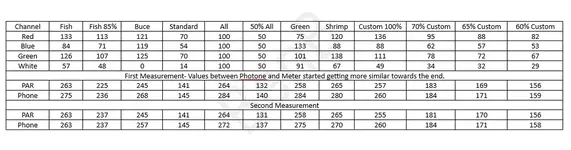
I'd prefer to look at the differences between PAR meter and Phone as a percentage. Your first measurements, not yet optimally executed, were better than 10% accuracy. Follow up measurements, while continuing to learn, were mostly within 5%. This I regard an amazing result.At the beginning, many of my readings between the app and the meter were far apart, but by the end of the first round and all the second round of testing, they are much more similar
I found the Photone App to be close enough to the PAR Meter

No because.....Did you find this was true both directly under the light, ie at midline, and at an angle as at the front and back glass?
It's a valid point. If we would really want to fully compare we would have to test its angular dependence, as well as spectral dependence.Did you find this was true both directly under the light, ie at midline, and at an angle as at the front and back glass?