Welcome to ScapeCrunch

We are ScapeCrunch, the place where planted aquarium hobbyists come to build relationships and support each other. When you're tired of doom scrolling, you've found your home here.

PAR meter using iPhone / Android APP - does it work?

  • Thread starter Thread starter Yugang
  • Start date Start date
  • Tagged users Tagged users None
app shows a warning that says "Diffuser Required," which could maybe improve the results.
I’m sorry for being late to the party on this one. I have this app and tried it a while ago (probably about 1 year ago) when I got my new T5HO light fixture. I used the app to determine how high to build my canopy. I wanted around 100 PAR at substrate and the app seemed to confirm that. I do not have a proper PAR meter to compare it too.

Anyway, @fablau did you try the app with the diffuser?

The app has (or did) instructions on how to make one. It’s just a strip of white printer paper over the front facing camera. At least that’s what the version of the app said to use on mine. I did the paper strip wrap and then sealed my iPhone in a ziplock bag trying to get all of the air out. The PAR reading it gave was pretty close to the PAR reading from rotalabutterfly from what I remember. It was not different enough that I was concerned.
 
I’m sorry for being late to the party on this one. I have this app and tried it a while ago (probably about 1 year ago) when I got my new T5HO light fixture. I used the app to determine how high to build my canopy. I wanted around 100 PAR at substrate and the app seemed to confirm that. I do not have a proper PAR meter to compare it too.

Anyway, @fablau did you try the app with the diffuser?

The app has (or did) instructions on how to make one. It’s just a strip of white printer paper over the front facing camera. At least that’s what the version of the app said to use on mine. I did the paper strip wrap and then sealed my iPhone in a ziplock bag trying to get all of the air out. The PAR reading it gave was pretty close to the PAR reading from rotalabutterfly from what I remember. It was not different enough that I was concerned.

Good point Frank, I didn't try that, I thought I had to buy a diffuser. I'll try as you suggested and report later today ;)
 
Wel, actually I don't see a way to edit my previous post, so I'll post here my new findings by using a simple paper diffuser on the iPhone camera.

Here are the new values I got:

Apogee: 50 PAR -----> App: 48
Apogee: 80 PAR (at my tank's substrate) -----> App: 76
Apogee: 100 PAR -----> App: 101
Apogee: 150 PAR -----> App: 148
Apogee: 200 PAR -----> App: 195

So, please forget what I wrote earlier, this app works very well!

I have also remeasured with different colors, and it looks like white light is the best measured, whereas the red light is the worst (measurements are skewed a great deal, I read almost half of what the PAR meter reads).

Blue light is measured correctly under 50 PAR, but over that, it gets skewed again.

I hope this helps, and sorry again for my mismeasurements at post #20

If I could edit it, I would update it with the correct findings ;)
 
For a light point source indeed the intensity goes down by the square of the distance between source and detector. But for a line source (long fluorescent tube or LED bar) this is NOT longer true, it goes down by the distance (rather than distance squared).
I hope it is helpful to elaborate on this again, as light and optics can be somewhat confusing, even counter intuitive and are often misunderstood. Take this thread on another forum where the OP asks:


Spoiler alert, the correct answer it NOT that we apply the inverse square law.

So let’s explore some basics of light sources and optics.

First, we observe a perfect point source as below


1710659887595.png


The point source radiates in all directions, and we have spherical symmetry. When we place light detectors, the cameras, at any position on a sphere the measured light intensity will be identical. All light from the source passes through the sphere, which has a surface area proportional to r squared. This means that the light intensity as measured by our detector, placed at the sphere’s surface must be inversely proportional to r squared.

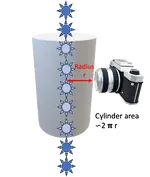
Now let’s have a look at a long line of light sources, similar to a luminescent tube or array of LED’s.

1710659934085.png


The symmetry has now changed to a long cylinder. The surface area of the cylinder is proportional to r, no longer r squared as in the point source, and we conclude that our light intensity as measured by a detector placed on the cylinder is inverse proportional to r. So the inverse r squared rule does not longer apply here, with the most commonly used sources for our hobby.

We can go one step further, we take a infinitely large flat plane filled with light sources.


1710659971219.png


In this case our symmetry will be represented by a box, and the light intensity hitting the detector at the surface of the box will not longer be dependent on the distance from light sources to detector.

Let’s now take the example of a 1 meter long tank, with an LED bar that measures 1 meter by 10 cm. Same holds for fluorescent tubes above the tank.
  • When we observe from a very large distance, perhaps 10-100 meter, our light source will look very small, almost as a nearly perfect point source. In this case our first scenario applies and we can estimate that light intensity will be roughly (indeed a very simplified model) proportional to the inverse of the distance squared. But of course, not many tanks are this big.
  • When we get closer, let’s say one meter or less, then our source look like a long line source, and following our second scenario we see the intensity roughly proportional to the inverse of the distance. Note, that this is the most relevant observation for our aquarium hobby.
  • When we get really close to our light source, say 0.1 meter or less, then the observer sees more like a large flat plane (in two directions) with light emitters, and according to the third scenario we have a constant light intensity that is no longer dependant of the position of our detector.
The above is all simplified, but it does illustrate that there is no easy answer to light intensity at different distances. The most satisfying answer for our hobby would be to assume inverse proportional to distance, rather than inverse proportional to the square of distance that is sometimes assumed.

@Tim Harrison , feel free to copy and paste in the relevant thread, we’re all here to help and share insights :)

How beautiful would it be if you let a university physics student code a Monte Carlo ray tracing program for you, include your proprietary optical data for the LED's of your products. Hobbyists can download your tool, set up their tank dimensions, adjust setting of RGB channels in the simulation software, and then let it calculate and display the PAR distribution and spectrum in their tanks?

It would not only be a great service to the hobbyists, but a great marketing tool for your products as well.

Just imagine, we could set up our LED channels to get to our target PAR, and know the spectrum and light distribution in our tank without the need for a PAR meter or any wet hands.
If only we would innovate...
 
My apologies to everyone! I made a simple paper diffuser per @FrankZ instructions, and the results are now correct!
It is helpful to stress the importance of the diffuser again, as this is probably the most important contributor to measurement errors using a phone camera for PAR measurement.

I am also referring to the other forum, where posts on PAR apps nearly all focus on spectrum but do not address the more important issue of the optical paths of radiation.

So let me explain.

Light that is projected perpendicular on a flat sensor can easily be measured, with or without a colour filters on the sensor pixels. So for this situation it is easy to get PAR measured and calculated correctly from the 3 colour channels of the sensor.

The challenge starts when light does not impact the sensor perpendicular, but at an increasingly grazing angle. In this case the measured intensity decreases with the cosine of the angle. So dedicated intensity measurement sensors apply a "cosine correction" to get it right, or use a complex shaped cone on the sensor, including some optical tricks, to correctly capture light rays from non perpendicular angles.

For an iPhone camera the situation is even a bit more complicated, as the cameras focal length and aperture will determine which light rays hit the sensor, and where, and which light rays will not be detected at all. If we take the extreme example of a telephoto lens, the lens will capture the bird but not the light rays from the forest where the bird sits.

The simple, and imperfect, trick that is used for the PAR apps on a smartphone is to use a piece of paper acts as a diffuser. Light from all possible angles are captured by the paper, the scattering in the paper breaks down all the directions that the light rays had, and some of this scattered light is then going through the camera optics to hit the sensor. When calibrated well, this simple trick appears to do the job quite well, but will of course never be as accurate as dedictated and sophisticated measurement techniques. Without a good diffuser, the measurement with an iPhone will be useless, as also @fablau found. Similar, different diffusers may give different results if the calculation is not recalibrated.

@Tim Harrison , as always, feel free to share with the UKAPS community :)
 
Last edited:
The Photone app specifies a particular weight paper to use, 22lb. I definitely got different readings with other weight papers.

The company that produces the Photone app, LightRay, also now has a clip on diffuser for phones for $26:
Diffuser & Cosine Corrector | Lightray

IMG_3050.webp
 
Sadly for IPhone / IPad only 🫤 no Android support for we heathens at this time
I would not worry too much, and just use the paper as diffuser on any phone.
  • The paper diffuser solution works quite well, at least when the sensor is not put under too unfavourable conditions (light from angles that are not even close to perpendicular). Several reviews and tests have been posted on internet, that demonstrate that phone apps come close to dedicated meters, but as often in our hobby there will always be voices that argue we need to spend big.
  • For our aquarium hobby one may argue that there is little need for really accurate PAR readings. I personally believe that a 10% accuracy is already great, and 25% accuracy still very acceptable. Anyway, considering basic optics, PAR readings across a tank are expected to show big variations (50% or even up to 100% depending where measurement is done in tank).
I believe the take away is that it is highly desirable to have some approximate data on PAR in a planted tank, as it is for most of us impossible to calculate it, and for all of us impossible to see it with the human eye. We don't need to invest in a dedicated and expensive PAR meter, and it seems pretty clear that cheap and simple measurements with iPhone/Android apps can do the job when we take care of the limitations of these solutions from an optics perspective (correct paper diffuser, hold the phone as perpendicular to the light source as possible, seal the phone in a transparent bag).

In the mean time our friends on the other forum are still concerned about the spectrum, which should not be the main concern as it is really total energy (intensity integrated over spectrum) that we want to know and it is therefore the optics (trajectory of photons, rather than their precise wavelength distribution) that is most relevant for an intensity meter. @Tim Harrison , any chance to facilitate some sharing across the pond?
 
Last edited:
"It's better to be part of the solution, than to be part of the problem". This quote says a lot about innovation and progress, versus .... the opposite. I am bumping this thread, because we don't see too many opportunities for innovation and I would be happy to see these few succeed, even against some headwinds.

We have plenty of evidence that at least to a reasonable extent affordable PAR apps on smartphone work for our hobby, just 2 examples from this thread:


1713072971120.png
Here are the new values I got:

Apogee: 50 PAR -----> App: 48
Apogee: 80 PAR (at my tank's substrate) -----> App: 76
Apogee: 100 PAR -----> App: 101
Apogee: 150 PAR -----> App: 148
Apogee: 200 PAR -----> App: 195

So, please forget what I wrote earlier, this app works very well!

I also checked the calibration procedures and accuracy of the gold standard professional PAR meters, and they are +/- 5% from NIST calibrated standards, ie about same bandwidth as between the Photone App and one Apogee meter that was used in the test. So formally it is not clear to decide who is right here, as the 5% deviation that we see in above comparison data may theoretically be caused by the Apogee and not by the Photone App.

We also addressed in this thread that for making an intensity measurement work it is important to focus on the optical path, and that detailed spectrum is a secondary consideration - especially when we don't go to crazy spectra (monochromatic) and stick close to the natural light spectrum as we usually do for our tanks. Indeed, when studying the specifications from Apogee and Licor detectors, we find data on cosine correction, azimuth and tilt (all geometrical/optics, not spectrum), but they don't even mention any wavelength or spectrum - which again illustrates that photon optics is more relevant than details of spectrum as long as spectrum is not too far off.

What is important here, is that comparisons are based on factual measurements, not just on qualitative argumentation or speculation.

So the bottom line is that as a hobby we have some exciting new opportunity, without having to invest in a professional PAR meter we can still have a reasonable measurement for about 6 USD investment. This I would consider being "part of the solution".

In the mean time our friends on the other forum are still concerned about the spectrum, which should not be the main concern as it is really total energy (intensity integrated over spectrum) that we want to know and it is therefore the optics (trajectory of photons, rather than their precise wavelength distribution) that is most relevant for an intensity meter. @Tim Harrison , any chance to facilitate some sharing across the pond?

Building a rather unbalanced case, not supported by measurements, data, calculations and/or evidence, why we can't use Apps seems not really "part of the solution", but more like "part of the problem" - stifles progress and innovation.
As a physicist I could post pages full of potential pitfalls, but what counts is how knowledgeable developers addressed these and if the end result shows acceptable comparison data. I can't blame @Tim Harrison for not sharing my input, I get it, but hope that more productive discussion on ScapeCrunch will spread the good news and solutions to members and guests.


The argument continues, in a new thread. From an incomplete understanding/presentation of the technical possibilities the case is made, again, that only expensive PAR meters work, preferably Apogee. These are not affordable for 95% of hobbyists, and as a consequence very few hobbyists have a reasonable understanding of PAR in their tank. I am sure Apogee and others are not fans of PAR apps, but that is a problem that is best addressed with affordable alternatives they could create for hobbyists.

If we as hobbyists want to see progress, it helps a lot if we and our discussions are part of the solution.
 
Last edited:
a diffuser is not required for Android phones.
This is because some Android phone use an ambient light intensity sensor that does not have the optics as in the camera of the iPhone.

As I mentioned before, when you have optics on an iPhone camera (ranging from tele to wide angle), a diffuser would be needed to 'incapacitate' the optics (think of the bird in the forest that I mentioned) and get a proper measurement through the high quality imaging sensor. The paper diffuser may be a bit unpredictable, but is cheap and readily available and generally it should work. We may expect the diffuser sold by Photone to give best results.

An ambient light sensor on Android phones may not have the optics, and collect all light from all directions (as a plant leaf does), but the downside is that the sensor is likely to be less accurate than the image sensor in a high quality iPhone.
 
Similar, different diffusers may give different results if the calculation is not recalibrated.
The photone app suggested using 22lbs paper as the diffuser material. I myself only has access to 20lbs papers and gave the app a try. Without comparing to the true numbers coming out of a professional equipment, how can we safely calculate the results so that it is slightly closer to the correct result? I would assume the 20lbs paper will yield higher numbers than the 22lbs, but how much higher? Is it as simple as knowing the different light transmission % of each paper(perhaps reading the production standards of papers) and account for their differences? Or can I simply do a ~40% reduction on each final results to get a somewhat safe assumption?
 
If your light manu
The photone app suggested using 22lbs paper as the diffuser material. I myself only has access to 20lbs papers and gave the app a try. Without comparing to the true numbers coming out of a professional equipment, how can we safely calculate the results so that it is slightly closer to the correct result? I would assume the 20lbs paper will yield higher numbers than the 22lbs, but how much higher? Is it as simple as knowing the different light transmission % of each paper(perhaps reading the production standards of papers) and account for their differences? Or can I simply do a ~40% reduction on each final results to get a somewhat safe assumption?
If your lights' manufacturer published their PAR levels, use the Photone App to measure the PAR at the published distances and do a comparison on the values. Should give you a reasonable approximation for hobby purposes. I've read that the published PAR values/charts are dry values, not in-tank under water values. So quite easy to set up over a table or floor with a couple of items to get the approximate heights.

When I first used the app, I thought I had to put a diffuser as well, but it turns out, it's only needed for iPhone. I'm using Pixel. That is from Photone's own documentation. You might want to read up and see which phones need the diffuser... Its been a while since I saw those documentation and there's quite a few versions of the apps and many new phones since then.
 
If your light manu

If your lights' manufacturer published their PAR levels, use the Photone App to measure the PAR at the published distances and do a comparison on the values. Should give you a reasonable approximation for hobby purposes. I've read that the published PAR values/charts are dry values, not in-tank under water values. So quite easy to set up over a table or floor with a couple of items to get the approximate heights.

When I first used the app, I thought I had to put a diffuser as well, but it turns out, it's only needed for iPhone. I'm using Pixel. That is from Photone's own documentation. You might want to read up and see which phones need the diffuser... It’s been a while since I saw those documentation and there's quite a few versions of the apps and many new phones since then.
Yeah I use iPhone so needed the diffuser. Unfortunately none of the lights that I have has any info on the PAR either from the manufacturer or online. I have a small tank so I think im getting good PAR on the substrate level anyways, but I just wanted to be sure of it.
 

Top 10 Trending Threads

Back
Top