Welcome to ScapeCrunch

We are ScapeCrunch, the place where planted aquarium hobbyists come to build relationships and support each other. When you're tired of doom scrolling, you've found your home here.

Journal Open for kind suggestions

I never thought of starting such a project, until on another forum I came across a nice guy which built a CO2 and oxygen monitor. His entire project and code is documented: GitHub - gaborturu/aqua-gas-monitor
Whaaaaaaaaat... this is a game changer!! I love when people combine their talents and hobbies. Super cool. Thanks for sharing.
 
I think tank looks pretty good. I think swapping the mi oya and flaccata might be the correct move. One note is the back right corner is very dark and I think a brighter color would be better there but then you probably won't want to swap the crypt and nymphoides.
Thanks. I won't swap it for now, as it would set back the growth on both. The plants are still recovering from some micro depletion this summer and in non CO2 tank it take quite a while.

For some green in the right back corner I've put in some Ludwigia repens from a (non CO2) farm tank.
 
Hi all,

Time for an update...

Three weeks ago I added a group of 10 Dario hysginon to the tank, as I find them awesome. So little and such a temperament. No picture taken yet, so grabbed a pic online. This is how they look:
1762786999110.webp

Yesterday I picked up a cheap 30 Watt led bar at the Vivarium 2025 fair to increase the light intensity a little.

This is a picture of three weeks ago:
1762787211886.webp

Cheers!
 
Hi all,

Time for an update...

Three weeks ago I added a group of 10 Dario hysginon to the tank, as I find them awesome. So little and such a temperament. No picture taken yet, so grabbed a pic online. This is how they look:
View attachment 11569

Yesterday I picked up a cheap 30 Watt led bar at the Vivarium 2025 fair to increase the light intensity a little.

This is a picture of three weeks ago:
View attachment 11570

Cheers!
Very nice. If you make your street taper behind the rotala and make it vanish a bit more it would give more depth. Also trip your rotala in a stepwise/gradual slope and it would look amazing. Just some suggestions.
 
Do you think that large tanks are actually easier to keep non-co2 than bigger ones?
I don’t think it matters at all. The bigger a tank gets, the more fish, plants, filters, water change volume, etc gets involved. It’s just more money and labour consuming.

It’s more like a yacht vs an oil tanker. Different in size, but you still need to steer it in the right direction.

Tank parameter wise I’m not experiencing any difference.

Just due to the volume/surface area ratio.
Much less surface area for co2 to degas and tank parameters tend to be rock stable.
I find it easier to forget to apply decent flow in a big tank. But CO2 degas wise I deliberately have huge diffusion (degas in your terminology) capacity by having two big air pumps and three wave makers positioned vertical.
 
Very nice. If you make your street taper behind the rotala and make it vanish a bit more it would give more depth.
🙏. The street actually ends at the back of the Rotala. But I see it could be sculpted a bit more narrow at the back. It needs trimming.1762847689292.webp

Also trip your rotala in a stepwise/gradual slope and it would look amazing.
Apologies, not sure what you mean by this. Do you have an example?
 
Last edited:
🙏. The street actually ends at the back of the Rotala. But I see it could be sculpted a bit more narrow at the back. It needs trimming.View attachment 11626


Apologies, not sure what you mean by this. Do you have an example?
sorry autocorrect: To trim in a way for it not look like a broad uniform wall. Basically smaller stems in the front and gradually to get longer towards the back.
 
🙏. The street actually ends at the back of the Rotala. But I see it could be sculpted a bit more narrow at the back. It needs trimming.View attachment 11626


Apologies, not sure what you mean by this. Do you have an example?
 

Attachments

  • 1762787211886.webp
    1762787211886.webp
    60.6 KB · Views: 11
Hi all, time for an update as it was a year ago. The first half of this year I made the mistake not to change water but continued dosing micros. Because of this a ICP(-MS) test confirmed the death of my entire Neocaridina colony: a toxic range of Copper and Zinc. So I stopped using my csmb+tenso+Fe dtpa cocktail and it was time to open a bought diy kit with all individual micros. I’ve started this summer just dosing Fe and Mn (4:1 weight ratio) and left out all the others, and after 3/4 months still no visible deficiency spotted, even the floaters are growing just as fast and healthy. So in my system there is/was enough Zn, Cu, Mo and B available.

Nasty thread algae is there since January both the soft version (Rhizoclonium?) as well as the single strained rough version (Cladophora?).
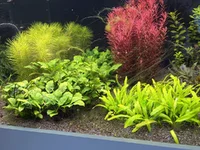
IMG_8204.webp
I've been doing major substrate cleaning. Tomorrow I will send a new water sample to Oceamo to rerun the ICP(-MS) test. Hopefully Cu and Zn values are way less toxic than they were last summer. I introduced some Neocaridina again and they are still alive, so that's a good thing!

Plants growth of some species isn't great as well. Anubias is suffering and Crypt spiralis and balansae are nearly gone...
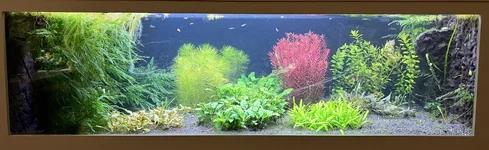
IMG_8192.webp

I'm doing one more experiment before moving on with this tank: Does the CO2 level increase on average when I turn down the heavy aeration on the tank, and just rely on flow of the wavemakers?
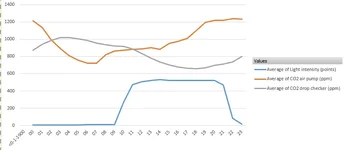
With the aeration enabled (like always for the last years) my equipment measured a baseline for two weeks. When I calculate the average day it looks like this:
1794509966089.webp
Yesterday I've disabled the air pumps and my assumption would be the CO2 level at the end of the night would be a lot higher, as current aeration forces CO2 out of the water.
The CO2 level would drop when light come on, but I'm curious if CO2 level drops faster and if the level bottoms out at roughly 600-800 ppm in the afternoon like my tank did. And I'm curious when the four of us are at home, whether CO2 would increase again like it does currently. I assume not. There will be no increased diffusion by the aeration. Lets see what happened with the data after two weeks.

Don't get me wrong, the average CO2 level of nearly 1000 ppm in the drop checker converts to the low value of 1.6 ppm of CO2 in the water. I think the best step for healthier plant growth with my current species would be to increase the average CO2 level and make sure it doesn't bottom out.

Cheers!
 
The first half of this year I made the mistake not to change water but continued dosing micros. Because of this a ICP(-MS) test confirmed the death of my entire Neocaridina colony: a toxic range of Copper and Zinc. So I stopped using my csmb+tenso+Fe dtpa cocktail and it was time to open a bought diy kit with all individual micros. I’ve started this summer just dosing Fe and Mn (4:1 weight ratio) and left out all the others, and after 3/4 months still no visible deficiency spotted, even the floaters are growing just as fast and healthy.
I think I might try something like this when I know I won't be able to do a water change for an extended period of time (like if I'm on a long trip away from home). Keep dosing Fe and Mn a few times a week, but not dosing the rest of the micro bits.

Sorry you lost your shrimps, but glad to see an update on your tank.
 

Top 10 Trending Threads

Back
Top