Welcome to ScapeCrunch

We are ScapeCrunch, the place where planted aquarium hobbyists come to build relationships and support each other. When you're tired of doom scrolling, you've found your home here.

Horizontal CO2 Reactor - Yugang 鱼缸 Reactor

  • Thread starter Thread starter Yugang
  • Start date Start date
  • Tagged users Tagged users None
One of our friends is going to set up a reactor in overflow mode for his 125 gallon tank. I am really looking forward to his experiences, and get confirmation if this overflow method is as easy and useful as I personally believe it is. Having other users jumping in will also help to further clarify if my tests/posts have been clear and complete enough, or that I need to do some more work.

It can be a bit challenging to find all information while reading through this rather long thread, so it I hope it helps when copy one post from our PM conversation that may be useful for others as well.


----------------------------------------------------------

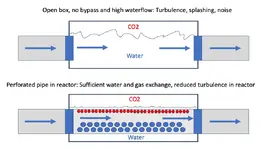
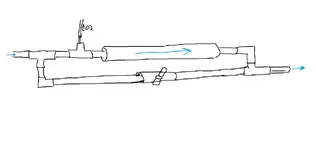
Proposed design:
1707965246364.webp

In this picture it is better to reverse the flow direction from right towards left (and inject CO2 before the reactor). Bubbles that purge from the reactor can then easily be picked up by the flow from the bypass, and do not need to travel down first. This is especially so because in overflow I like using the reactor with just a little flow so that I have no waves and only tiny bubbles escape when overflowing. When I hear from time to time (one or two times per minute) a quiet trickling noise (not gurgling by bigger bubbles) I know that my reactor works well.

When setting up for overflow mode, as said I prefer a slow flow in the reactor, that means that the bypass valve is nearly completely open. If you have a transparent reactor tube (which I recommend for various reasons) you will see a slight movement of the water, but no significant waves. I then purge air first, and then let the reactor fill itself with pure CO2 until it starts to purge. I then dial back until nearly no CO2 purges anymore, and I only from time to time hear some trickling, and see a few tiny bubbles escape into the tank. CO2 losses are then minimal, and we know that the reactor will be stable and purge itself from then onwards. As I described in a post, it is also interesting to observe through a transparent reactor tube how much gas remains after CO2 has been turned off at night. This is an indicator how well the reactor has been set up, and I am happy to explain that further if you like.
 
Last edited:
1708078647583.jpeg

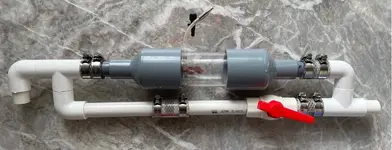
This is my reactor, that I use for overflow mode in my 50 gallon tank. I reduced the size and power quite a bit, as I am not convinced that I need the full 1.5 pH drop for my tank. My plants are doing fine, and in a few weeks or so I may give it another small reduction in CO2 injection to see how that works:

1708078687262.jpeg

I believe most users of the reactor use non-transparent PVC pipes, but my experience especially for overflow mode is that a transparent reactor makes it all a little easier to observe, understand and adjust. I can elaborate later on this.

Finding transparent pipes may not be the easiest, especially when the size needs to be matched with the PVC pipes. Then, with he puzzle solved, I was not really happy how long my total assembly had become and had hoped for a more compact build.

Going forward, I will probably not work with transparent acrylic pipe anymore. Even though I will probably not build my next reactor soon, I hope this post is useful for others who consider to build a reactor and want it to be compact, transparent and cheap.


1708078797336.png


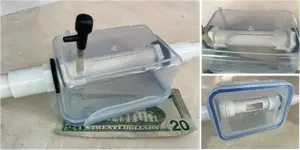
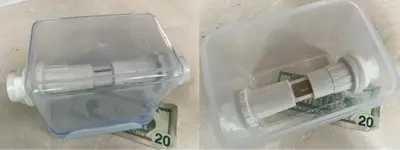
This little box (compare it to the banknote) provides enough reactor power to achieve around 1.1-1.2 pH drop on my 50 gallon tank. It is transparent, made of very sturdy plastic. I paid 3.5 USD for it.

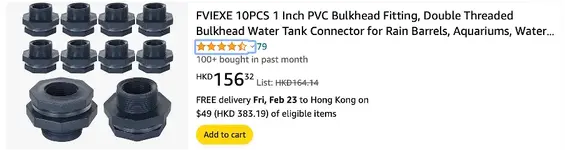
Then we may search on Amazon for 1 inch (compatible with my FX4 tube size) PVC bulkheads, we can buy for around 2 USD each.

1708078832600.png


We can also connect CO2 tubing and purge valve using the 1/4" bulkheads, 1.5 USD each on Amazon.

So the reactor box, plus 2 * 1” bulkheads and 2 * ¼” gas bulkheads would cost around 10.5 USD altogether.

Do we still need a bypass?

What is still missing is the bypass, that we prefer to use so that the waterflow in the reactor is slow and gentle, and won’t make any splashing noise or bubbles. I see some good solutions for the future to avoid using a bypass, and have the full reactor assembly packed in this small box. I have not tried and tested it yet, but hope it is still useful for anyone who is building and likes to give is a try.

The idea is that we add a pipe with drilled holes inside the reactor. This pipe will guide most of the water directly to the outflow, basically as an internal bypass. The bigger holes drilled in the lower half of the pipe will create sufficient exchange of water with the reactor cavity, while the smaller holes drilled in the top half will start purging CO2 in overflow mode when the CO2 pocket reaches down to the level of the internal pipe.

1708078972059.png

I expect with this we can easily find and assemble components, the reactor will be very small, does not need a bypass, can handle high water flow, will cost less than 15 USD, and will handle CO2 stability independent of injected CO2 rate and CO2 regulator drift.
 
Last edited:
So you would pump co2 right into this box? And that would be the co2 reactor?
The physics of the reactor is super simple. CO2 will be dissolved in water when we create an interface between a pocket of pure CO2 and water. So we may chose a vertical bubble reactor, but it is quite hard to juggle bubbles so that they do what we want. In our case we use a gas pocket above flowing water, and that could be in a long pipe or just in a square box. So yes, pump CO2 in a box with water flow and you have your reactor. And in fact a small box will be more powerful and easier to manage than a bubble reactor as I illustrated in an earlier post.

Would you even need a regulator then? Or could you just use the one built into the cylinder?
You would need some basic regulator to adjust the gas flow, but you don't really need regulator precision or stability when using the reactor in overflow mode. The absorption of CO2 gas in water is a function of the reactor size (area or gas/water interface), and that's it. As long as we keep the size of our gas/ water interface, ie reactor geometry, constant we will have a well controlled CO2 injection and don't need expensive tools to manage the CO2 flow.
 
hello, freshly installed since yesterday, I adjusted it today, the drop checker turns green quickly. I have not yet taken a Ph reading, but the ease of use and the room for error obviously make it the best possible reactor. That said, I wonder if the green couldn't be a little lighter, and therefore the ratio of 17.7 a little underestimated. Thanks to the two offset inlets and outlets, I can reduce or increase the Co2 level simply by turning the reactor a quarter turn. thank you yugang, it’s great! and cheaper than the first price reactor!
 
hello, freshly installed since yesterday, I adjusted it today, the drop checker turns green quickly. I have not yet taken a Ph reading, but the ease of use and the room for error obviously make it the best possible reactor. That said, I wonder if the green couldn't be a little lighter, and therefore the ratio of 17.7 a little underestimated. Thanks to the two offset inlets and outlets, I can reduce or increase the Co2 level simply by turning the reactor a quarter turn. thank you yugang, it’s great! and cheaper than the first price reactor!
Really happy it works well for you @Patterson , and hope to hear more about your method of adjusting with turning the reactor. It sounds really promising and a new approach.

Regarding the drop checker, this is a bit surprising but hope you can validate later with a pH reading.
 
Good morning, I spoke too quickly, switching on the light after 2 hours of filling with co2, ph5.7 and drop checker almost in the yellow. I'm going to turn on my CO2 just an hour before to see. as much for me, perfect ratio 17.7. Regarding the design, it's great. No noise, only when the overflow takes effect, so by ear I know if I need to reduce the Co2 intake. I can turn the pipe/reactor like a knob (10cm 😅) to adjust the water outlet level, which has the consequence of modifying the number of cm2 of water in contact with the co2. Or in other words to reduce the pocket of Co2 in the tube. If ever the 17.7 ratio was too high I could simply reduce it. no need for workaround in this configuration, I think it's the best solution! ps: I can't upload my photos, they weigh more than 1000kb and so it doesn't work. That's why I host them.

 
Good morning, I spoke too quickly, switching on the light after 2 hours of filling with co2, ph5.7 and drop checker almost in the yellow. I'm going to turn on my CO2 just an hour before to see. as much for me, perfect ratio 17.7. Regarding the design, it's great. No noise, only when the overflow takes effect, so by ear I know if I need to reduce the Co2 intake. I can turn the pipe/reactor like a knob (10cm 😅) to adjust the water outlet level, which has the consequence of modifying the number of cm2 of water in contact with the co2. Or in other words to reduce the pocket of Co2 in the tube. If ever the 17.7 ratio was too high I could simply reduce it. no need for workaround in this configuration, I think it's the best solution! ps: I can't upload my photos, they weigh more than 1000kb and so it doesn't work. That's why I host them.
Thank you for this update @Patterson , you are using the reactor now in overflow mode, and it is great that you found a new way to adjust the power by turning, rather than adjusting the reactor size. It is pretty similar to what I did with rotating the end piece of CO2 Spray Bar in overflow mode, but indeed you're the first one to find this feature for the reactor in overflow mode.
 
This little box (compare it to the banknote) provides enough reactor power to achieve around 1.1-1.2 pH drop on my 50 gallon tank.
This pipe will guide most of the water directly to the outflow, basically as an internal bypass

Here is my prototype. Left is the top view, right is bottom view with lid removed for a more clear view.


1708417701973.png

I have been trying to understand what holes to drill for water flow and gas CO2 overflow, the rather complex fluid dynamics with a relatively high velocity stream of water from my FX4 (no external bypass anymore), and think now that the rectangular patters that we see in this prototype work better.

On the left we have a long narrow slit, that will start purging when the CO2 pocket has grown and reaches it, and is used in overflow mode. The aim is to have as small bubbles as possible escape, noiseless, and I hope this works well. It remains a bit tricky and needs testing because we have the relatively high speed water flow from my FX4 underneath, but I expect this approach will work. (One significant criticism I have about this prototype is that the reactors surface area will be reduced by the pipe just before it starts purging. This is no issue at all when using the reactor with a precision CO2 regulator or controller, but I am a fan of overflow mode where it is an issue or maybe can be used as an advantage. My next prototype, and perhaps the first I will test in my tank should probably have a more compact PVC bulkhead).

On the right is the bottom cutout in the water pocket, which is meant to be an internal 'pump' to circulate water gently in the reactor and let CO2 enriched water be sucked in the flow towards the tank. Most of the water will continue straight in the pipe, but at this hole, acting as a "conveyor belt", the water pipes flow interacts with the slow moving water in the box. I hope that this approach will work better and more reliable than holes drilled as in my original idea.

Because all the white pipe elements are connected and will be glued, this is a very stiff construction where the transparent box will not have any significant mechanical stress even when I decide to use pipe intake and exit for hanging it in my cabinet without any further mechanical support of the box.

I now only need to add the CO2 intake, straight into the reactor so that I can see and count bubbles injected as well as using the trajectory of the bubbles in the water to have a feel for the water flow and circulation in the box. Last, I will add a manual purge valve, and glue the box lid for extra safety with silicon. If the prototype will need a further update I don't care about having it glued as the total cost of this assembly is about 6 USD.

I am not sure when I install and test this prototype (this is all in my living room and not everybody is excited with my experiments), but hope sharing this small milestone is helpful.

Note:

All the reactor geometry earlier in this thread is still valid and by now applied by a substantial number of users. For avoiding confusion, perhaps we should call this prototype and following Reactor "Version 2", and all upto now "Version 1".
What I try to achieve in "Version 2" is:
  • a much more compact form factor (above prototype is just 7 inch long for a 50 gallon tank and FX4)
  • cheaper and probably easier to source components (6 USD for all components)
  • have the reactor working on high capacity pumps without any external bypass (high probability to succeed)
  • have this all fit for use with overflow mode (I am hopeful it can be done one way or the other, but not sure yet. The fluid dynamics of the CO2 overflow into a high speed water flow is trickier than I initially thought). Worst case if this could not be done, we can still build this compact box with an external bypass as work around for overflow mode.
 
Last edited:
Reading on Facebook that the first commercial Yugang reactor will be available soon


I can’t seem to access that FB page, but I certainly would be interested in buying a pre-made Yugang reactor , if the cost were reasonable. I would especially be interested in a pre-made C02 spray bar style reactor in clear pipes!
For some reason black or clear pvc and fittings are hard to come by and expensive in Canada.
 
So they are selling a clear cylinder
emoji23.png
I believe simplicity is the most beautiful, if it indeed is effective :) What we see is probably not yet 100% finished product, needs some CO2 input at minimum and perhaps they offer bypass as well.

Did he reach out to you at all or was this a surprise?
This was a happy surprise, I was not aware of it. I post ideas so that everyone can see it, benefit from it. The more commercial and DIY options we have, the better we are served as hobbyists. I do expect that others will follow soon with commercial products, as there is really no point selling difficult to handle bubble reactors (or diffusers if you like) when you can just go for a simple ...
clear cylinder
emoji23.png
... that performs better :)

For some reason black or clear pvc and fittings are hard to come by and expensive in Canada.
You may be interested to build your Yugang V2 reactor with a simple Tupperware box from your local kitchen ware store? I can for sure help you with that @*Ci*, but of course you could soon buy the commercial product as well if you prefer that.
 
Very cool my friend! Congrats!!
New ideas and progress are always team efforts. I mentioned @Unexpected before as the first mover, and will do it again as we would not have seen this fast progress without him jumping on the opportunity. But also @RickyV who championed the reactor on a 1000 gallon tank, and several others make this really a team effort.

I have this other idea, An alternative approach to CO2?, that seems not to get traction until now but I believe is very very promising. My hope is that also around that some supporting enthousiastic team grows, so that we can prove it works and build the confidence for manufacturers to bring us some attractive commercial options.
 
Last edited:
I invited Tommy to ScapeCrunch, as we have many experienced members here, plus the history in the thread, to provide feedback.

I like the professional and clean look of his design, almost a pity to hide it in a cabinet :)
 
I thought it would be a good idea to build an improved prototype of the Reactor Version 2, 1 inch for full FX4 flow with internal bypass, and use that for testing in the tank.

1708765425740.webp

This version has a 12000 mm2 reactor surface area, and is now packed in a 500 ml kitchenware box.

My 50 gallon tank has 450.000 mm2. Divided by 17.7, we would target a reactor with 25.000 mm2 for a pH drop of around 1.5. As my prototype is roughly 50% smaller, I would expect about 50% less CO2 ppm from it at maximum capacity with overflow mode. So my best estimation is that this reactor is going to push around 1.5-0.3 = 1.2 pH drop for my 50 gallon tank (remember that 0.3 pH drop corresponds to 50% CO2 ppm).

As an improvement on the last build I now cut away the upper part of the bulkheads. I expect this to make overflow mode work better, as the bulkhead will not longer reduce that much the CO2/water interface area when the CO2 pocket grows and reaches the internal bypass. Furthermore I reduced the box size, as there is no benefit from a higher box with more water in it.

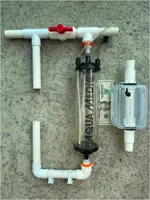
Just as a comparison to my vertical bubble reactor that I modified and used with a bypass (I connected the bits in the picture with flexible hose). I would estimate that the horizontal reactor should be roughly same power as the vertical reactor pushed to its maximum when using bubbles.

1708765830352.webp

Will update when I have tested this prototype, and when indeed it works will post more detailed instructions how to build it.
 

Top 10 Trending Threads

Back
Top