Welcome to ScapeCrunch

We are ScapeCrunch, the place where planted aquarium hobbyists come to build relationships and support each other. When you're tired of doom scrolling, you've found your home here.

DUTCH STYLE SCAPING

@GreggZ @Freshflora how would one allocate points in a garden tank though? With Dutch, you at least know the rules and know how points are awarded, so you could setup your tank to the specifics but in a garden tank, I think, points would be given too subjectively. In any case I wouldn't place anywhere in the top 100 but that's just my 2 cents 😁

Omid
As I've argued above, tanks are not necessarily judged by the rules regardless of there being rules in place. There also don't necessarily need to be rules, as there are no 'rules' to the regular AGA (non-Dutch) aquascaping contest. You could rather have criteria. I would do something like this, with all categories worth 10 points up to a total of 50:

1 . Overall impression
2. Plant health
3. Layout/arrangement
4. Color
5. Difficulty

Points are inherently subjective, which is why you usually have more than one judge for a contest.
 
Well, this is interesting and I completely agree. First, the AGA took a stance long ago to feature the Dutch style to try to re-popularize it. However, what we've seen is that sticking too rigidly to what was intended to be an in-person competition hasn't proven popular. I think the reason you are seeing certain tanks taking third place is because of limited submissions in the category. Of course, just my suspicion.

As I want to keep this thread focused on the trust Dutch style, I will put up another thread asking what would be the judging criteria of the "all stem" or "garden" style tank. Please answer there. It's an interesting thought.
 
Is Dutch style becoming more popular in the US? I kinda0sorta think so. I'm not talking about plant-filled tanks that have no rhyme or reason. My hope is that the style is gaining more traction but maybe the demanding rules of the traditional Dutch keeps people from dedicating a lot of time and effort.
 
How have I never seen this thread before today??? lol

Was literally just looking at that tank like an hour ago while thinking of ideas for new plants lol. Any idea what the back left plant is? Definitely isn’t hygrophila difformis red like he has it labeled as.

I'm not sure what it is but wouldn't rule out his labels. Maybe it could have different leaf shapes similar to proserpinaca palustris.
Pretty sure thats Hygro TriFlora. Red wisteria is probably just a trade name. That part of the world is notorious for naming stuff whatever they want. Even ADA is bad about doing it, their TC Enie is Rotala wallichii 'Long Leaf'

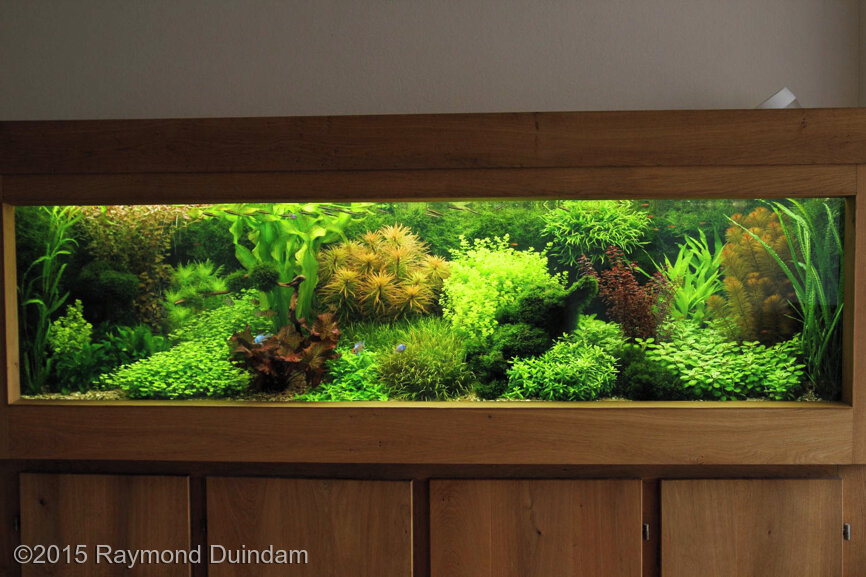
Ive long thought that one is the top 1 or 2 tanks Ive ever seen in this contest. Scoring almost certainly but also elusive intangibles like depth. The size of the groups and their shape, the direction everything runs, colors and contrasts. He fkn nailed

Raymond's from 2015 (couple posts up) also challenges for the top spot. Ive literally studied that tank
 
To me creating good depth is by far the hardest thing about making a good Dutch. And if a tank doesnt have good depth, its not a good Dutch. None of my entries have had good depth. Hell, not even decent depth

No offense to my fellow competitors here because I definitely include myself when I say this - None of us here have ever made a good Dutch tank. Our tanks so far have just checked the Dutch boxes and happened to be better than the rest of the field in a particular year. Placing high doesnt mean its good. It just means no good ones showed up

Look closely at those two tanks I said above, and then compare them to ours. Any of ours. You'll see the difference. And no offense to Bart, the man is a legend, but depth isnt his strong suit either

Thats what I keep trying to get better at. I can recognize it, whether its there or when its missing. I can even explain precisely how to do it! But actually pulling it off so it comes across in pictures, thats a whole different animal

And now dont get me wrong, checking all the boxes is no small feat! But that just gets a seat at the table. The whole depth thing is what separates the Dutch men from Dutch boys. Me and all you guys are somewhere mid-puberty

Real talk
 
Last edited:
To me creating good depth is by far the hardest thing about making a good Dutch. And if a tank doesnt have good depth, its not a good Dutch. None of my entries have had good depth. Hell, not even decent depth

No offense to my fellow competitors here because I definitely include myself when I say this - None of us here have ever made a good Dutch tank. Our tanks so far have just checked the Dutch boxes and happened to be better than the rest of the field in a particular year. Placing high doesnt mean its good. It just means no good tanks showed up

Look at those two tanks I said above and then compare them to ours. Any of ours. You'll see the difference. And no offense to Bart, the man is a legend, but depth isnt his strong suit either

Thats what Im trying to get better at. And not to take anything away from all of our tanks. Just checking the boxes is no small feat! But that just gets you in the door. The whole depth thing is what separates Dutch men from Dutch boys

Real talk
I agree with you on depth but creating decent depth in a 40 breeder or 120P is difficult because groups are mainly strong side-to-side and not back-to-front due to lack of space imo. If you look at some of the examples in the Dutch book that I uploaded to the facebook group, you would see that they used to bulid terraces using bricks, etc. and then cover with plants to have "layers."

Having said all that, how would you create depth? Placing a taller broad-leafed plant in front of an already-tall background group?
 
I agree with you on depth but creating decent depth in a 40 breeder or 120P is difficult because groups are mainly strong side-to-side and not back-to-front due to lack of space imo
The only size at a disadvantage is 12" front to back tanks like a 55 gal. Bart's 8 footer has no advantage over my little 37 gal. Every foot of width allows space for 1 each foreground/midground/background species. It scales up and down exactly the same for all sizes

Having said all that, how would you create depth? Placing a taller broad-leafed plant in front of an already-tall background group?
That would be a very long post but it comes down to the effective use of height contrasts. All these elaborate dioramas and nature scapes have amazing depth. That extreme depth is why they look amazing in the first place. And it all comes from the manipulation of height contrasts. Its easy to do with hardscape. Not so easy with just plants

Study those two I mentioned, Raymond's and the other one. Pay attention to what each group does in relation to the others and what kind of effect it has. Do the same for your tanks, and others. Compare the different moves that groups make. Think of the groups as just blocks of color in a certain shape. Because thats all they are, and they all "do something". Imagine these blocks in different lengths/shapes/heights, and what effect it would have. To see it for ourselves takes spending some time in close observation and thought and attention to small details. Youll never see it until you do that, and once you see it you cant unsee it

Having said all that, when my site opens here in a week or three there'll be a few blog articles covering these very subjects. I hope theyll be useful, think they will be..
 
Last edited:
The only size at a disadvantage is is 12" front to back tanks like a 55 gal. Bart's 8 footer has no advantage over my little 37 gal. Every foot of width allows space for 1 each foreground/midground/background species. It scales up and down exactly the same for all sizes


That would be a very long post but it comes down to the effective use of height contrasts. Study those two I mentioned, Raymond's and the other one. Pay attention to what each group does in relation to the others and what kind of effect it has. Do the same for your tanks, and others. Compare the different moves that groups make. Think of groups as just blocks of color in a certain shape. Imagine these blocks in different lengths/shapes/heights, and what effect it would have. To see it for ourselves takes spending some time in close observation and thought and attention to small details

Having said all that, when my site opens here in a week or three there'll be a few blog articles covering these very subjects. I hope theyll be useful, think they will be..
Have pictures of those 2 tanks you mention?
 
@OmidNiav did you happen to catch Bart's post in your street color thread in the dutch group? He may have deleted because its not there now, Anyway, he said the same thing I said

The sole purpose of the street is to create depth. It creates depth by being shorter than whats beside it

The reason its supposed to go all the way to the back is so it can run between taller groups. Thats its only purpose, to create depth by doing that

Thats why your lily was such a bad move. Because visually the street stops right there now. There was some real good depth to be had on back between the Hygro and Roraima. Its not there now though

1738370314337.jpeg

The whole depth thing is why Ive said that like my last entry so much. I dont even care about the other issues it has. I know what they are, I see them, but I dont care because I finally made one that has pretty good depth, and thats what I like about it

d1.jpg

Its not the first good street Ive made. There's more going on here than that. See how there's a space of darkness between the top of most groups and the group thats right behind it? Thats intentional, by precise and meticulous manipulation of heights

Those lines of darkness add a sense of separation, which translates to overall depth. Same principal as space betweeen the groups, it works front to back too, not just side by side
 
@OmidNiav did you happen to catch Bart's post in your street color thread in the dutch group? He may have deleted because its not there now, Anyway, he said the same thing I said

The sole purpose of the street is to create depth. It creates depth by being shorter than whats beside it

The reason its supposed to go all the way to the back is so it can run between taller groups. Thats its only purpose, to create depth by doing that

Thats why your lily was such a bad move. Because visually the street stops right there now. There was some real good depth to be had on back between the Hygro and Roraima. Its not there now though

View attachment 7162

The whole depth thing is why Ive said that like my last entry so much. I dont even care about the other issues it has. I know what they are, I see them, but I dont care because I finally made one that has pretty good depth, and thats what I like about it

View attachment 7163

Its not the first good street Ive made. There's more going on here than that. See how there's a space of darkness between the top of most groups and the group thats right behind it? Thats intentional, by precise and meticulous manipulation of heights

Those lines of darkness add a sense of separation, which translates to overall depth. Same principal as space betweeen the groups, it works front to back too, not just side by side
Very good points. One major thing I learned from Vin in the beginning is to look at the black and white photo and see if I can feel the groups apart. Tying that in with what you just mentioned, shadows help a great deal when it comes to layers as you mentioned.

PS. One day I'll pull off the whole something-coming-out-of-another-thing.
 

Top 10 Trending Threads

Back
Top