We are ScapeCrunch, the place where planted aquarium hobbyists come to build relationships and support each other. When you're tired of doom scrolling, you've found your home here.
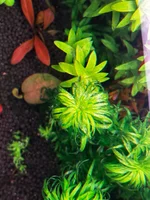
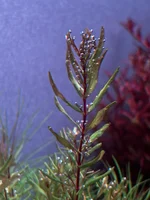
Furcata thrives on high everything, particularly Fe/micros. Its one of the only plants that seems to actually need pretty high micros. This is in my set ups with either sand sub or older soils and rich water
Idk how it does in rich soil/lean water. Its pretty fast when happy and fast stems tend to stunt in that scenario when you just replant a top. Have to let them root for a couple weeks then cut the bad tops off. New stems that come from the rooted bottom tend to do better. So you might need to handle it that way
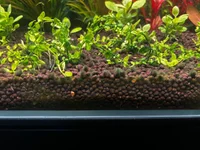
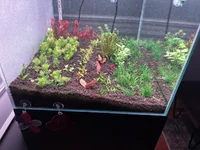
We had been on vacation in June and had done a minor rescape and added quite bit of fresh aquasoil before I left. This triggered a BBA outbreak. Although I was able to trim plants with it and do the usual replant, the BBA grew a lot on the aquasoil. I tried removing them one by one but just too many
Couldn’t really figure out how to get rid of them and spot dosing was not possible given how spread out it was.
That is how I came up with what I now realize was a bad solution.
I drained the tank completely, used a paper towel on the aquasoil surface and placed a gravel vac so all water got sucked up. Then took APT fix on a small sprayer bottle and misted all the aquasoil. Then refilled the tank.
Lo and behold, there was die back of all the BBA and was feeling quite smart about myself of finding a new way to apply APT fix.
Then the problem started happening, what I did not realize that it was quite heard to prevent the APT fix from landing on the plants when I misted the aquasoil and then started the die back….. the thing is it was not a quick process it was slow death of beautiful rotalas and other plants
Ended up removing massive chunks of plants
Then started the Cyanobacteria slow but steadily spreading on plants. Tried APT fix, excel, ultra life with no much avail.
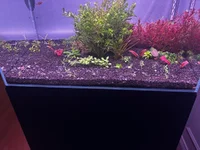
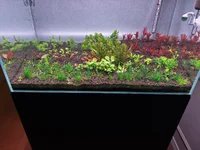
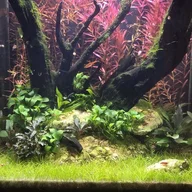
Ended up doing a major rescape, and tried my best to remove the cyano and the dying plants from the original injury. Got some nice tropical TC plants from @FreshTides_Neal for the foreground and replanted them.
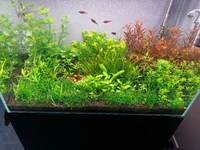
Things are starting to get stable now, cyano and bba still around the corner, found that hydrogen peroxide injected with a syringe and needle works well against it. For the BBA I now resort to Misting it underwater with APT fix which I find easier than spot dosing. Hopefully things get stable again. Let’s see
With the aquasoil getting older, the plant growth is not that fast. But I don’t want to add new aquasoil which to me seems to trigger algae. Resorted to adding root tabs. Let’s see how the tank does by next month when it would be a year of setup.
Fwiw I’ve had really good success beating back my bba outbreak with the APT lite version. I’ve used over 3/4 of a 300ml bottle so far spot dosing with the pipette 7-8ml per around 18 gallons twice a week with no water change directly after. I work a small section and let it sit with filter off for 10-15 minutes then fire it back up and go about my day.
It gets shot directly on spots with mini pellia and I’ve had no adverse effects so far.
Same with caridina shrimp, I think the goobers actually like the smell of it as they come out and start picking away in the section I just treated. Totally freaked me out the first time but so far no issues.
It may be a bit less potent but it does work well.
Sunlight & Tank Relocation
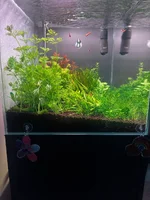
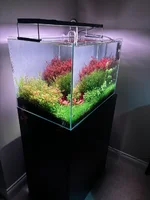
Decided to ultimately change the position of the tank away from direct sunlight given all the algae issues that i have had. One of the learning points that i have had with this tank is that direct sunlight results in variable PAR based on season and even weekly variation. I find that the advice of cut and replant might not apply since the PAR is so different that there is constant re-adaptation with the changes in amount of sunlight. The best times that i have had with this tank was in the Feb/March time and maybe that was to do with the sunlight.
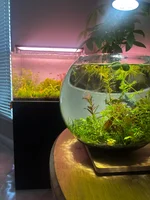
Anyways the new position is shielded away from direct sunlight and has actually been a nice spot close to the no filter bowl. Will have to see how this turns out.
Algae:
Continue to struggle with cyanobacteria. Tried using Ultralife blue green slime remover, but no effect on multiple use. Did H2O2 but, the spot dosing just does not cover all areas and it soon comes back. Trying to up my nitrate based on @Dennis Wong recommendation on the 2Hr website on beating Cyano.
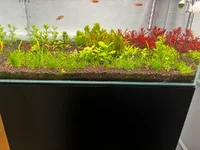
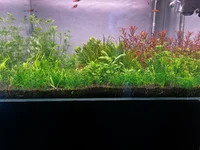
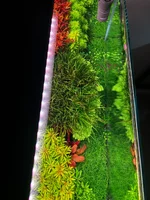
Do have some BBA , but quite manageable. I ended up taking the route that i recommended to @ScaperHaynes and let everything grow out and that has pretty much covered most of the Aquasoil. One of the terms that i think is not used often are "Filler plants" these are plants that just grow to fill up empty spots in the tanks and give more plant volume. I find pearlweed and Penthorum sedoides have been working out well and so are the Helanthium Tennelum (i think - @FreshTides_Neal could confirm - in the foreground i mixed it up with the eleocharis and it is filling up lot of spaces - but definitely a little bigger than i thought but has nice thick grass like blade and speads by runners).
Continue to get GDA even in this location away from sunlight usually by the end of the week.
Plants:
The Samolus parviflorus 'Red' (lysimachia) seems to be struggling quite a bit not sure why maybe it did not like being transferred. The AR mini is taking its time quite slow even with few root tabs under.
The rest are growing stable. Interestingly the L.Cardinalis mini is not a mini anymore!
Fertilizer:
Added few root tabs. Upped my dosing to 3 ml APT 3 daily and stopped APT 1. Also started dosing about 6 ml APT 3 after 75% water change. This should provide about 1.2 ppm of No3/day which i am estimating would be close to the consumption/day and the dose after water change of about 2.4 ppm should keep the levels steady of > 1 but <5 ppm of No3. I will remeasure NO3 at mid week and prior to WC and decide if i need to change anything. If i continue to have cyano, will plan to increase this further and target close to 5 ppm of NO3.
I've been slowly starting a multi-year campaign to get people to understand Cyanobacteria (BGA) better. There's a lot of misinformation in this hobby, but it's 2025, and times are changing. So let's give it a try! There will be a simple summary at the bottom.
Cyanobacteria are a special "algae" in aquaria because they are actually bacteria. These bacteria can utilize free N2 nitrogen gas from the atmosphere to provide the necessary Nitrogen for growth (source, source). Approx 78% of regular...
Yes, read this post and upped nitrates, got to do this slow in my tank though due to it being lean dosed. I have been paranoid about erythromycin though. I don’t think I would be able to handle another major outbreak of algae if it causes some imbalance to the biome of my tank. Ultralife doesn’t seem to work, which is not an antibiotic. Have you and others used erythromycin successfully without upsetting the tank? What dose do you use ?
I’ve used Maracyn, dosed according to package directions. I just do one dose and then do my regular 50% water change a week later. I haven’t seen it cause any problems, but I try other remedies first (hydrogen peroxide, Ultralife) because I don’t like medicating the fish unnecessarily. For a stubborn and widespread problem though, Maracyn works very well. As with any remedy, if you haven’t figured out and fixed the underlying cause, the algae will come back.
When I’ve had cyano, it has almost always been because of sunlight hitting the tank or from some other strong light source across the room, at least that is the conclusion I’ve drawn. Once blocking those problems and regularly cleaning between the substrate and the front glass, I’ve stopped having cyano outbreaks. Ten other people will say it’s 10 other reasons, lol!
Note: Don’t use Maracyn 2. That is something else, and I think it will affect your cycle.
Chemiclean is what I use and keep in the store for cyanobacteria. It is erythromycin, I have used it dozens of times over the years and have had many customers use it without any issues. I actually just used it on 2 of the tanks in the store that were especially bad, most likely due to the fact that I've been forced to do water changes with 82 degree water this summer.
Chemiclean is what I use and keep in the store for cyanobacteria. It is erythromycin, I have used it dozens of times over the years and have had many customers use it without any issues. I actually just used it on 2 of the tanks in the store that were especially bad, most likely due to the fact that I've been forced to do water changes with 82 degree water this summer.
Is chemiclean erythromycin?, do you have the link to the product info. When I read about it on their website it seems to be salt of sorts similar to blue green slime remover.
Is chemiclean erythromycin?, do you have the link to the product info. When I read about it on their website it seems to be salt of sorts similar to blue green slime remover.
They don't say exactly what's in it. Many people think it's not erythromycin because the packaging says it doesn't contain erythromycin succinate, but it's almost certainly some form of erythromycin.
Cyano:
Tried Chemiclean, Maracyn, Ultra-life blue green slime remover, with multiple dosing unfortunately nothing worked. What ultimately worked, unfortunately set the stage for the next algae bloom. Read on.....
Of water column nitrates and Root Tabs:
After reading through many posts, ultimately i felt that the lack of nitrates might be causing the cyano. Increasing the APT 3 slightly unfortunately did not increase the nitrates which remained at Zero. One of the fastest growing plants in the tank had been - Limnophilla Heterophylla (looks like sessiflora), which I came to find was a nitrate sink. So slight creep up with APT 3 on nitrates really did not budge the water column nitrates. Ended up hence removing the Heterophylla which I was anyways not a huge fan off and was having it as a filler plant.
Along with this ended up deciding to recharge the aquasoil with some root tabs. What i came to realize was the Seachem root tabs that i thought were awesome because they did not float and easily stay put had no macros!! So essentially one is giving few micros which was really not my intention. Ended up with Niloc G root tabs based on the cost/macro profile and planted bunch of them. Unfortunately, most of them floated up and emptied their contents into the water column, raising the WC nitrates to > 10. Ended up doing frequent water changes removed what i could, added a few APT JAZZ very deep in background alone which did not float up. Honestly, the Niloc G might have been fine as well if i had buried them very deep.
As you might know by the title i run a very lean water column and a spike to 10 however brief was not tolerated well by the plants. In addition Dennis pointed out that even with APT Jazz buried deep down the water still runs through them so one should expect a nitrate spike if lot of root tabs were used.
Anyways lesson learnt.......
1. Use root tabs that provide good amount of nitrogen - especially ammoniacal nitrogen
2. Plant them very deep so that they don't float
3. Do not use too many if you don't want a nitrate spike.
But....good news - No more cyano. Just needed the nitrates.
As Dennis had written, when the nitrates suddenly bumped went through another new algae phase now, with predominantly hair/fuzz algae. Having seen this a few times now, followed a set plan
Twice weekly 80% water changes when possible
Continue same APT 3 fertilization which was about 2.5 ml/day
Decrease light to about 50%
Clean Filter
Plant management: This was the tough part and it is interesting that when such hair/fuzz hair algae attacks different plants cope differently in this specific tank condition
-- Rotala Tulunadensis: Handled it bad and no coming back, removed the entire bunch and replanted the healthy tops. Also took the time to clean the base. This plant's main stems seems to rot easily if the substrate is dirty.
-- Blyxa Japonica - Interestingly this handles fuzz/hair algae quite well. Intermittently spot dosed with H2O2 /APT fix. Eventually fully recovered without having to remove any leaves
-- R.Blood red - The predominantly affected parts were the ones closest to the light and trimming the algae affected spots, would just have healthier leaves coming from the old stems without having to uproot and replant.
Went over this for 2-3 weeks, and by this time the nitrate spike settled out nicely and back to a baseline of > 0 but < 1 ppm on the Salifert fresh water nitrate kit. Slowly ramped up lighting back to 100% today (Setting R100, G 60, B 30).
Plant updates:
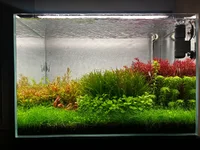
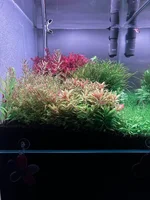
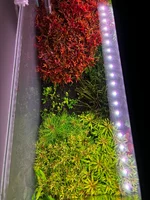
Rotala Macrandra Green : Set it up from TC. Growing nicely. Looking forward to see how it does at high PAR. Had gotten a little leggy at the relatively low PAR, hoping to see some fuller leaves and colors with the higher PAR.
Limnophilla Aromatica mini: This has exceeded my expectation, formed a nice tight canopy without much trimming.
Syngonanathus/Tonina: These have remained remarkably stable through the nitrate spike. Interestingly they have not split yet, hopefully soon.
Lysimachia Parviflora: Waiting to see if i can get a deeper pink with the higher PAR and if i don't will likely replace it with the AR mini which i like much better.
Pogostemon Decannensis: Very slow but very stable this cultivar from @Burr740 , looking forward to it getting taller.
Siamensis 53b: this took about 1.5-2 months to root in and now growing steadily, thought it was not doing well and just left a single one.
Penthorum sedoides: Solid plant, stable growth in the small areas that i have.
Lobelia Cardinalis mini: Another stable plant, not affected much by the nitrate spike. Doing well not much trimming needed.
Arrangement thoughts: The Rotala macrandra green with the pinkish hues almost mimic the L.aromatica mini. Should have spaced them apart. They both need a darker plan in the foreground or the background.
Current Settings:
Lights - 100% with my preferred spectrum (assuming PAR > 100 - need to check)
Fertilizer - 2.5 ml APT 3 daily
Other dosing - Flourish Excel 2 ml daily - something to prevent BBA based on what I have read.
Co2 - about 1ph drop - have'nt measured in a while likely 30 - 40 ppm
Water change - 80% weekly with RO water - remineralized with APT Sky to about 70 - 80 TDS (about 5 GH, 1-2 KH)
Nitrates - > 0, but < 1 ppm (Salifert nitrate test kit)
This site uses cookies to help personalise content, tailor your experience and to keep you logged in if you register.
By continuing to use this site, you are consenting to our use of cookies.