Welcome to ScapeCrunch

We are ScapeCrunch, the place where planted aquarium hobbyists come to build relationships and support each other. When you're tired of doom scrolling, you've found your home here.

Journal 20 Gal + 15 Gal Bucephalandra Recovery Tanks [Very high light, high co2]

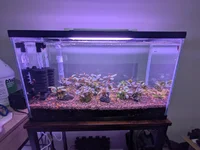
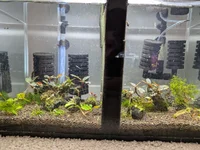
Sample tank 1:
1000006387.webp

Non co2.
Using ugf filter plate.
18 watt grow light on top.
Very high par.
Only dosing seachem equilibrium.
Testing to see if shrimp waste can supply nutrients for slow growing buce.
Gh around 5-7.
Kh 0.
1000006388.webp
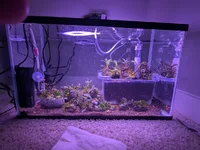
Sample tank 2.
Identical parameters, but ugf filter is in a box.
Substrate only 1cm on bottom.
Uses co2 injection.
0.5 ph drop.
Heated to 75 degrees as some buces were melting back a bit and I wanted to speed up the recovery.
 
Testing on both tank set ups for a month:
1/2 teaspoon of apt feast added to each tank per week as a slow release ammonia source.

I dosed apt thrive+ for a 2 months and kept getting melting buce for some reason. I'm not sure if it's the high iron content per dose? Think thrive+ was 0.45ppm per dose. Gonna lower it to 1/4 dose twice per week. So 0.22ppm of iron added per week.

The reason I think this is the tank with the best bucephalandra growth and no melting was the tank with some fish in it. I fed that tank more so under dosed thrive+ a lot. That tank had basically no melting and a decent algae green wall.

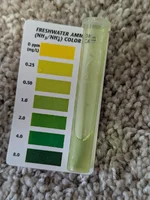
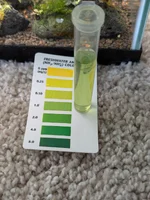
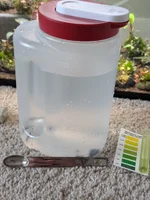
I also added 1/2 teaspoon of apt feast to a 2 liter jug to test ammonia content after 1-2 days.
 
Last edited:
1000006410.webp
1000006411.webp
1000006412.webp
After 24 hours.
Result was 0.5-1ppm of ammonia via API test kit after 24 hours.

Half teaspoon of soil in 2 liters of water lol.
If you add this into a 10 gallon tank, roughly (assume 1ppm of ammonia reading for caution, assume 9 gallons of actual water in tank).

0.055ppm of ammonia
Or
0.24 ppm of nitrates after conversion.

Tds change: 5 tds to 7 tds after 24 hours.

Safe to say this should be safe even in a caridina tank. Matter of fact I might do a full teaspoon of apt feast.

At least I found a use for the insane amount of slow release ammonia in this soil. Hopefully dennis doesn't randomly change ammonia formulations to suite hobbyists who want to add fish the first day. Godspeed to them.
 
Last edited:
So precious experiment kept getting algae and dying shrimp. Think I underestimated how much ammonia 5 month old apt feast can still hold.

Eventually I just said screw it and put the substrate back on the bottom and left the tank alone for a few months. Only did water changes if tds went too high.

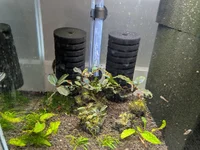
1000008508.webp1000008507.webp

What the heck, surprisingly this was my best result yet.

All buces stopped getting pinholes. All algae disappeared. Buce growth looked healthy. I'm still using 18watts over a 10 gallon tank, so par values are very high.

Non co2. Sponge filter low is always on bare minimum to prevent surface film.

Tank has around 0-5ppm nitrates from API test.

My co2 injected tank on the other hand still has algae. Despite using the same parameters.
 
I think a big part of bucephalandras in "lean nutrient" non co2 tanks is just what else is growing with them.

If you have pearl weed, rotalas, massive amounts of moss that are extremely good at outcompeting them, they will eventually perish through natural selection.

However, if they are by themselves or with other plants that grow at a similar speed of 1 leaf per month, this system actually works extremely well. Assuming ur tank is already aged and low bio load.

So far I've tried to mimic that same condition in my other tanks and all buces remained algae free as well. There can be algae on the glass, some string algae on the moss, but no algae on buces. Not even the BBA that usually collects on older leaves.
 

Top 10 Trending Threads

Back
Top