
Welcome to ScapeCrunch
We are ScapeCrunch, the place where planted aquarium hobbyists come to build relationships and support each other. When you're tired of doom scrolling, you've found your home here.
Social Feed

Staff member
I Donated 2026
Founding Member
Hi everyone -
This is our new forum where members can post their aquariums and ask for help with the aquascaping of it. It is a way to take advice and counsel from your online family in a safe and friendly environment. Together we learn better.
Most of us are NOT professional aquascapers. Most haven't won global aquascaping contests. BUT, we can certainly share our perspectives that may prove valuable to you in your journey to making your aquarium beautiful. This is what makes forum's GREAT. Learning and improving your skill in a slower-paced environment.
I am NO aquascaper. I am a pretty decent observer though and love to deconstruct things to better understand them. This can be useful when learning aquascaping especially when done with a humble spirit.
Here is an example of what I mean. It's my deconstruction of George Farmer's One-Pot Iwagumi from ScapeFu. Now I can't promise everyone will get a deep analysis like this if you post your aquarium but it gives you an idea of what can be done and learned.

George Farmer is well known in the aquascaping world. He is the co-founder of the UK Aquatic Plants Society and an incredibly talented aquascaper. I wrote about George in the past and referred to him as one of aquascaping’s most influential people. I still feel that way. So, when I came across a post by George on how he took a single pot (hence, the title of his work) of Tropica’s 1-2-Grow series Micranthemum sp. “Monte Carlo” and challenged himself to use it to create an entire aquascape, I was quite intrigued!
The idea was simple. Take one pot of Micranthemum and plant it in a basic iwagumi style aquascape and see if it will grow enough to create a complete aquascape. It reminds me of the experiment done by Amano and pictured in his first book, Nature Aquarium World, only that, I believe, Amano used Glossostigma in that scape.
The issue with these challenges is that few have the Buddha-like patience necessary to wait for the single pot to grow out. Most of us, myself included, would cave and order a few more pots to get it to fill in quicker! Of course, a less dense planting is also more susceptible to algae outbreaks so a skilled hand is necessary to maintain a good growing routine under these circumstances.
To deal with some of the issues, George used the “dry-start” technique that helps establish small-root plants before raising the tank’s water column. This is possible because no taller plants are being used that would otherwise require the water column to be higher. I typically use this method to start my foregrounds and, once it’s established, I raise the water and only then plant the middle and backgrounds.

As you can see below, maintaining a high humidity environment is critical for this to work. Additionally, starting with healthy plants that were grown hydroponically (emersed) increases the odds of this method working well without much die off.

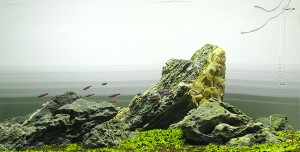
As you can see from the image that started this post, George succeeded in his challenge giving testament to his unusual level of self-control. Outstanding! However, what caught my eye even more than the great growth he got out of the plant was the overall aquascape he created that, at least from the post, seemed to be glossed over.
Did George simply throw some rocks in to the aquarium haphazardly? Hmm… This could be a chance to see how good of an aquascaper George really is! Whenever you get a chance to look at the work done by an artist either quickly or without much thought, you get a chance to see how much that artist is doing subconsciously. How much have they internalized of the art they have worked so hard to master? This is what people mean when they say, “It comes so naturally to him.” (Usually followed by, “I hate him!“)
I’m digressing! Let’s take this opportunity we have at hand to analyze the work done by our friend, George, when we know he really didn’t spend a ton of time planning the aquascape. Let’s see how much George has internalized! We promise, George, we won’t hate you in the end!
George mentions that he used a simple 7 stone iwagumi. Although there isn’t a rule regarding the number of stones, time has shown that odd numbers work best for the overall aquascape. In my opinion, the more stones, the more complex (and more difficult) the layout.
Let’s highlight the seven stones George chose to use. Did you see them in the original picture above? Count the colors below.

In an iwagumi, each stone has a purpose in the overall aquascape. It’s true synergy in that one stone without the others would be “less”. However, while the group working in harmony is what makes a good iwagumi, each stone playing its role is also critical to make the aquascape harmonious.
The primary or anchor rock is called Oyaishi and it is your primary focal point. It should be the most majestic or striking rock. The second (or balancing) rock is called Fukuishi and it goes on either side of the Oyaishi rock. The third rock, called Soeishi, supports Oyaishi and sits alongside the Fukuishi. Finally, Suteishi rocks balance out the overall layout and give it complexity. Let’s see how George placed the rocks and why.

The Oyaishi is definitely the largest, most striking rock in the layout. It’s balanced by Fukuishi that is what you would expect and want. Soeshi is properly supporting Oyaishi and balancing the layout on the right (the traditional Sanzon iwagumi). Suteishi rocks are placed in locations that continue to support and balance the over all layout. Certainly the complexity of the layout is increased with the Suteishi George placed.
George’s placement of the Oyaishi is almost spot on. It is said that you want it to be about 2/3rds from the top of the aquascape to give it a focal point. We’ll confirm is George placed it at the true focal point of the aquascape later, but for now, see how he did hit the 2/3rd mark in the Rule of Thirds.

Let’s deconstruct George’s rock placement and see why he placed the Suteishi the way he did. Below you can see the back right rock removed. Do you see how the layout is out of balance? The layout is too heavy to the left. It’s subtle, but a critical element, in my opinion.
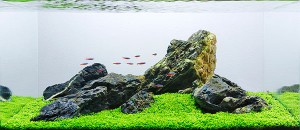
What is we remove the rock in the middle of the layout? What do you think it does to the overall impression?
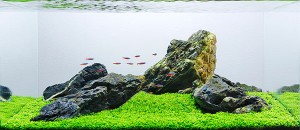
Something is missing, right? It’s OK, but less complex than with the Suteishi stone there. George could have left it out but the overall layout is better with it in there. Remember, add until adding something detracts from the overall aquascape. There is a fine line with this type of element and it requires a very experienced understanding of aquascape layout. Impressive, George!
How about removing the back left rock? What does that do? Let’s see.
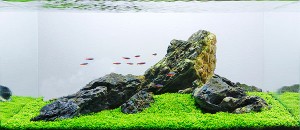
Wow! That really throws off balance, doesn’t it? I get the feeling the aquarium’s going to tip over with so much weight on the right side. Definitely better having that left rock to balance out the layout.
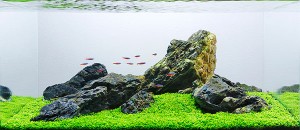
My only issue with the left rock is that bright white strip going down its side. My eyes immediately drift to it. I understand it’s natural veining in the rock and that the other rocks also have albeit to a lesser extent. Nevertheless, I think it would be better without it. See below what it would look like without the vein. What do you think?
Before moving away from the iwagumi style, I want to point out the direction of the rocks. The style tells us that the Oyaishi should be angled in a direction rather than be straight up and down. This gives a much more dynamic and natural impression of a current or movement. George does this well.
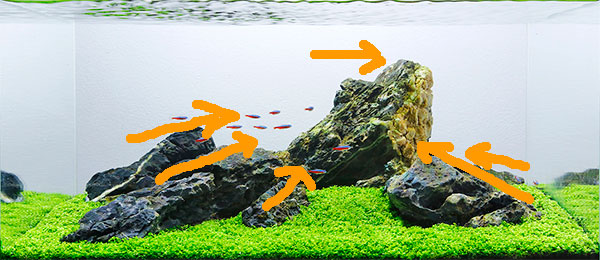
The supporting rocks should be angled to the Oyaishi in support of it but not conflict with the flow or movement created by the Oyaishi. Again, George does this exceptionally well. See the image below where I’ve highlighted the direction of movement. And, as a show of how masterful he is, George even photographed the school of Cardinals swimming in the exact direction of movement (current) that the Oyaishi depicts. Genius and pro tip to you beginners!
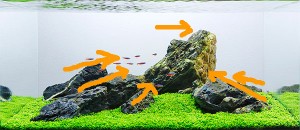
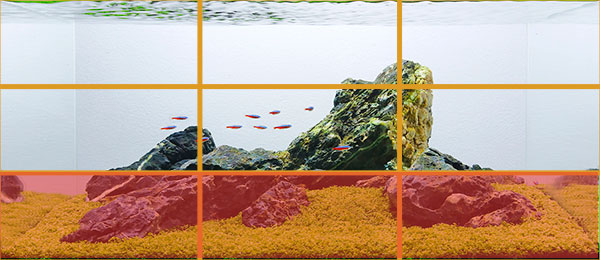
One of the more famous of these rules is the rule of thirds. Essentially, this rule says that a layout is better (more dynamic) if your focal point is placed in one of the lines or intersection of lines found at the layout’s mathematical thirds. It’s hard to explain but easy to see. Here is the rule superimposed on George’s aquascape.
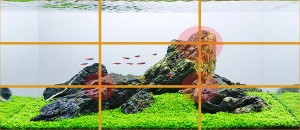
Bingo! This was the first rule I ran on the aquascape and it reinforced my initial impressions that this layout had something special. As you can see, George has hit the rule of thirds out of the park!
I’ve circled in red the area where there’s a critical intersection. Each represents a focal point with the top right one being the primary. It’s uncanny how George did this. Take a look at how the Oyaishi is sitting right on the third line.
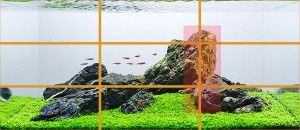
The weight of the aquascape is sitting right on the third line almost perfectly. How did you do this George?? I couldn’t have done it any better even if I had measured it exactly. Also, in the next image, notice how the bottom weight of the aquascape sits right on the lower third line.
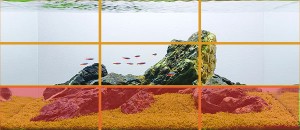
George has not only laid out the hardscape in a fantastic and complex 7 stone iwagumi style, but he’s managed to do it following the rule of thirds also perfectly! This was so striking to me that I actually reached out to George to confirm that he didn’t measure the layout as he installed it. He confirmed he only “eyeballed” it. I’m jealous…
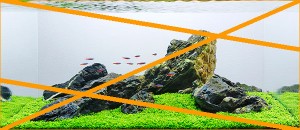
Once again, George seems to be right on the line with the golden triangles. Notice the diagonal line going from bottom left to top right. It intersects the Fukuishi and Oyaishi stones perfectly. The weight of the stones is mostly in the lower right isosceles triangle with the opposite triangle being white space. This yin-and-yang with white space is very important and I rarely see it with beginner and intermediate aquascapes. Only the more advanced artists now the importance of white space and what it can do to the composition.
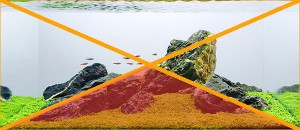
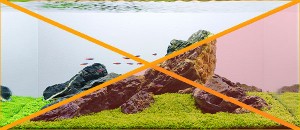
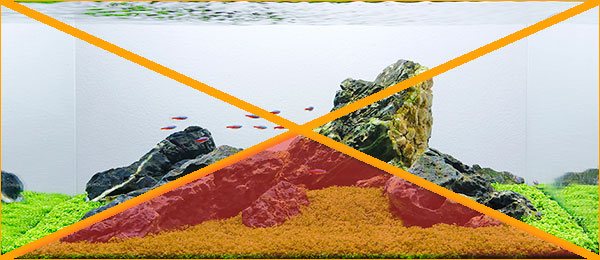
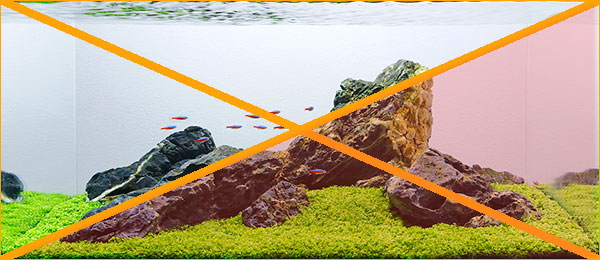
The two images below depict how simple triangles can also be brought into an aquascape to add complexity and pleasing symmetry. These triangles are subtle and you may not notice them at first glance. However, your brain picks them up and it feels that something is right or correct about this aquascape. It feels natural for some reason. One of those reasons is the use of triangles!
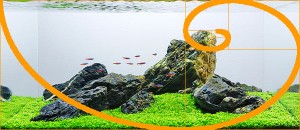
Let’s see how well the One-Pot Iwagumi does in terms of the golden spiral and it’s indication of the primary focal point.
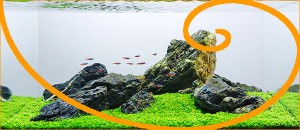
The golden spiral is a beautiful and mystical mathematical formula that is used to indicate the primary focal point of a work of art. The thought is that the piece’s primary focal point should be where the spiral ends.
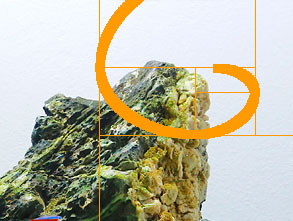
As you can see, George placed the top of the Oyaishi stone at almost the exact position indicated by the spiral. This is where the eye will look. How uncanny that he did this without much thought!
I was so intrigued that I ran the most complicated formula that subdivides the spiral type into sub-areas to see just how close he got to the mathematical idea. See the result below. His positioning of the Oyaishi stone would not change even if he had run this formula prior to positioning it. Extremely well done!
ONE-POT IWAGUMI
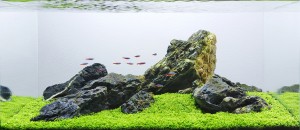
This aquascape achieves perspective and depth of field by using smaller stones and placing them closer to the front pane while larger ones are to the back. This gives an impression of depth. The aquascape certainly looks larger than what it really is. This is difficult to do when you only use rocks and one type of plant.
It is more common to see larger items upfront with smaller items transitioning to the back in some aquascape styles. This gives the impression of items in the back being very far away.
My sense of perspective here is looking from a distance at weathered and worn mountain peaks that are surrounded by a sea of grass or low trees. I get the feeling of openness. A wind-swept mountain.
What do you feel when taking it all in? Describe you feeling? Can you almost smell something? These are the things that are, at the end of the day, most important in judging an aquascape.

Color is so important to an aquascape but not many people focus on it. To me, proper use of color completes an aquascape. Improper use can severely detract from it. Make it less than it what it could have been.
One of my upcoming posts will be on the use of color theory in aquascapes. For now, however, let’s just focus on some basics. Colors can impact us mentally and physically. Being able to use colors consciously and harmoniously can help you create spectacular results.
Colors can be harmonious to one another. Some are complimentary, others analogous. One model is called triadic and it’s what George’s aquascape uses. Taking a quote from the above linked site on color theory:
The blue/black slate color serves as an accent to the green. I then picked up on George’s choice to use Cardinals with their red and blue. Just the right colors in the color wheel to accentuate the green.
It’s interesting that George first put red eye Tetras but felt they were wrong because they got lost into the background. I totally agree. Picking the right fish to complement the composition is harder than most people think. Unfortunately, the fish are usually an afterthought and the aquascape suffers for it.
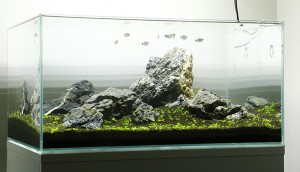
In this case, George recognized something was wrong and chose Cardinals instead. Again, I totally agree…and so does the color wheel.
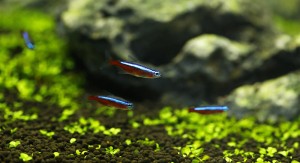 Notice also how the small size of the Cardinals and their swimming habit complement the overall composition. Any bigger and the fish would detract from the aquascape and throw off the entire perceptive. George does an excellent job here in terms of the color, size and swimming habits.
I think George’s intention with this challenge was to show people that you can create a complete aquascape with only one tiny pot of plants. In so doing, he has also revealed much deeper teachings some of which we discussed in this humble analysis. I’m sure as I continue to think about this composition, I will see many more things that I have so far overlooked. This is especially true as I’ve not had the privilege of studying the details that it contains.
It is well known that it takes many years of practice to make something look effortless and natural. With this aquascape, George has done just that. He has executed an iwagumi with masterful skill. At first blush, it looks natural and simple, almost minimalistic. It is only when you start to deconstruct it to its bones that it’s brilliance shows itself.
Well done, George. Very well done.
All the best,
Art
Here is a great video of the aquascape in progress:
Important Note: The unmodified images used in this article except for color_wheel are the copyrighted work of George Farmer and used with permission. Modified images are copyrighted by ScapeFu.com All Rights Reserved.
This is our new forum where members can post their aquariums and ask for help with the aquascaping of it. It is a way to take advice and counsel from your online family in a safe and friendly environment. Together we learn better.
Most of us are NOT professional aquascapers. Most haven't won global aquascaping contests. BUT, we can certainly share our perspectives that may prove valuable to you in your journey to making your aquarium beautiful. This is what makes forum's GREAT. Learning and improving your skill in a slower-paced environment.
I am NO aquascaper. I am a pretty decent observer though and love to deconstruct things to better understand them. This can be useful when learning aquascaping especially when done with a humble spirit.
Here is an example of what I mean. It's my deconstruction of George Farmer's One-Pot Iwagumi from ScapeFu. Now I can't promise everyone will get a deep analysis like this if you post your aquarium but it gives you an idea of what can be done and learned.
George Farmer is well known in the aquascaping world. He is the co-founder of the UK Aquatic Plants Society and an incredibly talented aquascaper. I wrote about George in the past and referred to him as one of aquascaping’s most influential people. I still feel that way. So, when I came across a post by George on how he took a single pot (hence, the title of his work) of Tropica’s 1-2-Grow series Micranthemum sp. “Monte Carlo” and challenged himself to use it to create an entire aquascape, I was quite intrigued!
The idea was simple. Take one pot of Micranthemum and plant it in a basic iwagumi style aquascape and see if it will grow enough to create a complete aquascape. It reminds me of the experiment done by Amano and pictured in his first book, Nature Aquarium World, only that, I believe, Amano used Glossostigma in that scape.
The issue with these challenges is that few have the Buddha-like patience necessary to wait for the single pot to grow out. Most of us, myself included, would cave and order a few more pots to get it to fill in quicker! Of course, a less dense planting is also more susceptible to algae outbreaks so a skilled hand is necessary to maintain a good growing routine under these circumstances.
To deal with some of the issues, George used the “dry-start” technique that helps establish small-root plants before raising the tank’s water column. This is possible because no taller plants are being used that would otherwise require the water column to be higher. I typically use this method to start my foregrounds and, once it’s established, I raise the water and only then plant the middle and backgrounds.
As you can see below, maintaining a high humidity environment is critical for this to work. Additionally, starting with healthy plants that were grown hydroponically (emersed) increases the odds of this method working well without much die off.
As you can see from the image that started this post, George succeeded in his challenge giving testament to his unusual level of self-control. Outstanding! However, what caught my eye even more than the great growth he got out of the plant was the overall aquascape he created that, at least from the post, seemed to be glossed over.
Did George simply throw some rocks in to the aquarium haphazardly? Hmm… This could be a chance to see how good of an aquascaper George really is! Whenever you get a chance to look at the work done by an artist either quickly or without much thought, you get a chance to see how much that artist is doing subconsciously. How much have they internalized of the art they have worked so hard to master? This is what people mean when they say, “It comes so naturally to him.” (Usually followed by, “I hate him!“)
I’m digressing! Let’s take this opportunity we have at hand to analyze the work done by our friend, George, when we know he really didn’t spend a ton of time planning the aquascape. Let’s see how much George has internalized! We promise, George, we won’t hate you in the end!
Initial Impressions
At first blush, this seems to be a very good aquascape in the iwagumi style. I don’t have the luxury of going too deeply into the iwagumi style in this analysis, but I am planning an article that will go into iwagumi’s history and incorporation into aquascaping. For the time being, please look at the above link and my post on Reciprocity by James Findley for great iwagumi overviews.George mentions that he used a simple 7 stone iwagumi. Although there isn’t a rule regarding the number of stones, time has shown that odd numbers work best for the overall aquascape. In my opinion, the more stones, the more complex (and more difficult) the layout.
Let’s highlight the seven stones George chose to use. Did you see them in the original picture above? Count the colors below.
In an iwagumi, each stone has a purpose in the overall aquascape. It’s true synergy in that one stone without the others would be “less”. However, while the group working in harmony is what makes a good iwagumi, each stone playing its role is also critical to make the aquascape harmonious.
The primary or anchor rock is called Oyaishi and it is your primary focal point. It should be the most majestic or striking rock. The second (or balancing) rock is called Fukuishi and it goes on either side of the Oyaishi rock. The third rock, called Soeishi, supports Oyaishi and sits alongside the Fukuishi. Finally, Suteishi rocks balance out the overall layout and give it complexity. Let’s see how George placed the rocks and why.
The Oyaishi is definitely the largest, most striking rock in the layout. It’s balanced by Fukuishi that is what you would expect and want. Soeshi is properly supporting Oyaishi and balancing the layout on the right (the traditional Sanzon iwagumi). Suteishi rocks are placed in locations that continue to support and balance the over all layout. Certainly the complexity of the layout is increased with the Suteishi George placed.
George’s placement of the Oyaishi is almost spot on. It is said that you want it to be about 2/3rds from the top of the aquascape to give it a focal point. We’ll confirm is George placed it at the true focal point of the aquascape later, but for now, see how he did hit the 2/3rd mark in the Rule of Thirds.
Let’s deconstruct George’s rock placement and see why he placed the Suteishi the way he did. Below you can see the back right rock removed. Do you see how the layout is out of balance? The layout is too heavy to the left. It’s subtle, but a critical element, in my opinion.

What is we remove the rock in the middle of the layout? What do you think it does to the overall impression?

Something is missing, right? It’s OK, but less complex than with the Suteishi stone there. George could have left it out but the overall layout is better with it in there. Remember, add until adding something detracts from the overall aquascape. There is a fine line with this type of element and it requires a very experienced understanding of aquascape layout. Impressive, George!
How about removing the back left rock? What does that do? Let’s see.

Wow! That really throws off balance, doesn’t it? I get the feeling the aquarium’s going to tip over with so much weight on the right side. Definitely better having that left rock to balance out the layout.
My only issue with the left rock is that bright white strip going down its side. My eyes immediately drift to it. I understand it’s natural veining in the rock and that the other rocks also have albeit to a lesser extent. Nevertheless, I think it would be better without it. See below what it would look like without the vein. What do you think?

Before moving away from the iwagumi style, I want to point out the direction of the rocks. The style tells us that the Oyaishi should be angled in a direction rather than be straight up and down. This gives a much more dynamic and natural impression of a current or movement. George does this well.
The supporting rocks should be angled to the Oyaishi in support of it but not conflict with the flow or movement created by the Oyaishi. Again, George does this exceptionally well. See the image below where I’ve highlighted the direction of movement. And, as a show of how masterful he is, George even photographed the school of Cardinals swimming in the exact direction of movement (current) that the Oyaishi depicts. Genius and pro tip to you beginners!
Rule of Thirds
As I’ve explained in the past, there are tried and true rules that have developed over centuries dealing with optimal layouts. These rules use mathematical equations that to humans represent the ideal. We’ve come to know these rules as the golden rules of layout and they can be seen in all great works of art, from paintings to photographs to aquascapes. I use these rules to see how close an aquascape comes to ideal layout.One of the more famous of these rules is the rule of thirds. Essentially, this rule says that a layout is better (more dynamic) if your focal point is placed in one of the lines or intersection of lines found at the layout’s mathematical thirds. It’s hard to explain but easy to see. Here is the rule superimposed on George’s aquascape.
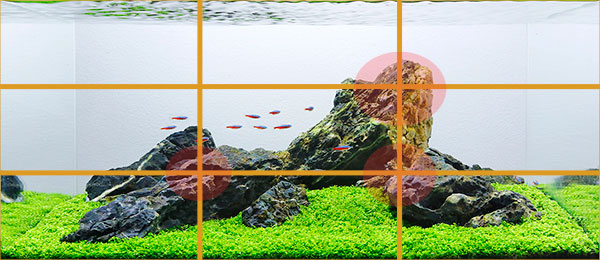
Bingo! This was the first rule I ran on the aquascape and it reinforced my initial impressions that this layout had something special. As you can see, George has hit the rule of thirds out of the park!
I’ve circled in red the area where there’s a critical intersection. Each represents a focal point with the top right one being the primary. It’s uncanny how George did this. Take a look at how the Oyaishi is sitting right on the third line.

The weight of the aquascape is sitting right on the third line almost perfectly. How did you do this George?? I couldn’t have done it any better even if I had measured it exactly. Also, in the next image, notice how the bottom weight of the aquascape sits right on the lower third line.
George has not only laid out the hardscape in a fantastic and complex 7 stone iwagumi style, but he’s managed to do it following the rule of thirds also perfectly! This was so striking to me that I actually reached out to George to confirm that he didn’t measure the layout as he installed it. He confirmed he only “eyeballed” it. I’m jealous…
Golden Triangles
The rule of thirds is only one of the rules of layout design that really impacts the overall composition. The proper use of triangles is just as important. You see, our brains are trained to see triangles for some reason. It’s a pattern that is hard-wired into us. We feel triangles are natural, comforting and give an overall impression of order. Let’s see if George did as well as he did with thirds?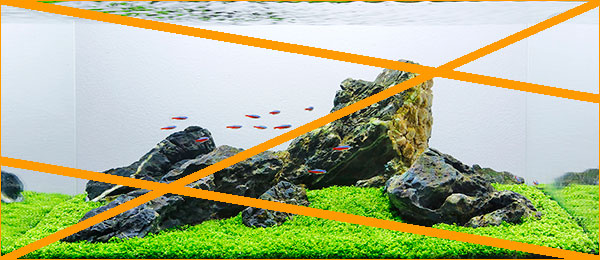
Once again, George seems to be right on the line with the golden triangles. Notice the diagonal line going from bottom left to top right. It intersects the Fukuishi and Oyaishi stones perfectly. The weight of the stones is mostly in the lower right isosceles triangle with the opposite triangle being white space. This yin-and-yang with white space is very important and I rarely see it with beginner and intermediate aquascapes. Only the more advanced artists now the importance of white space and what it can do to the composition.
The two images below depict how simple triangles can also be brought into an aquascape to add complexity and pleasing symmetry. These triangles are subtle and you may not notice them at first glance. However, your brain picks them up and it feels that something is right or correct about this aquascape. It feels natural for some reason. One of those reasons is the use of triangles!
Golden Spiral and Focal Point
So George seems to be a master of hitting the thirds and the triangles. It is obvious that his many years of working with aquascapes and noticing what works and what doesn’t have paid off. He is naturally placing key elements of the composition in just the right places as dictated by the golden rules. He does this with his gut. “It comes naturally to him.” No, we don’t hate him, though, because his gut is the result of years of practice and observation.Let’s see how well the One-Pot Iwagumi does in terms of the golden spiral and it’s indication of the primary focal point.

The golden spiral is a beautiful and mystical mathematical formula that is used to indicate the primary focal point of a work of art. The thought is that the piece’s primary focal point should be where the spiral ends.
As you can see, George placed the top of the Oyaishi stone at almost the exact position indicated by the spiral. This is where the eye will look. How uncanny that he did this without much thought!
I was so intrigued that I ran the most complicated formula that subdivides the spiral type into sub-areas to see just how close he got to the mathematical idea. See the result below. His positioning of the Oyaishi stone would not change even if he had run this formula prior to positioning it. Extremely well done!

Depth of Field and Perspective
Depth of field and perspective are just tricks used to give the impression that the aquascape is much larger than it seems. It accentuates the 3D space occupied and expands it.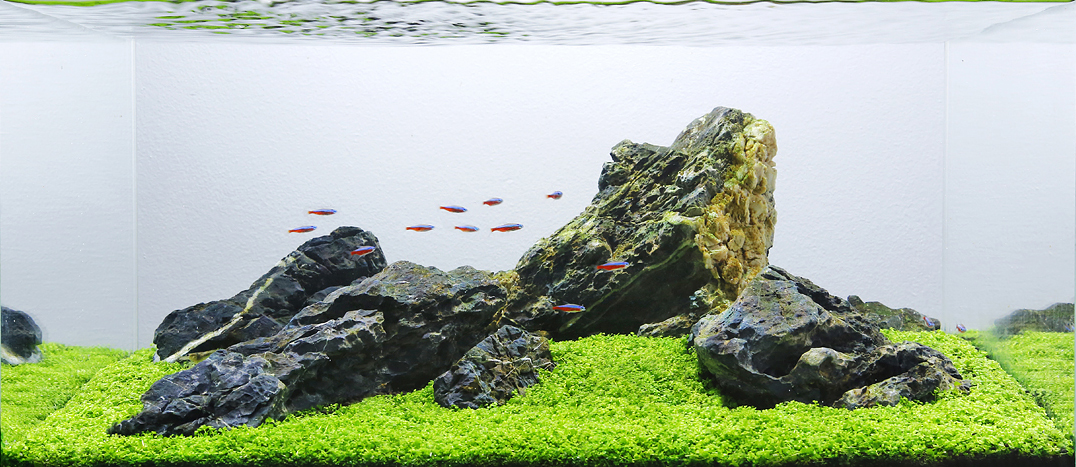
ONE-POT IWAGUMI
This aquascape achieves perspective and depth of field by using smaller stones and placing them closer to the front pane while larger ones are to the back. This gives an impression of depth. The aquascape certainly looks larger than what it really is. This is difficult to do when you only use rocks and one type of plant.
It is more common to see larger items upfront with smaller items transitioning to the back in some aquascape styles. This gives the impression of items in the back being very far away.
My sense of perspective here is looking from a distance at weathered and worn mountain peaks that are surrounded by a sea of grass or low trees. I get the feeling of openness. A wind-swept mountain.
What do you feel when taking it all in? Describe you feeling? Can you almost smell something? These are the things that are, at the end of the day, most important in judging an aquascape.
Color Choices

Color is so important to an aquascape but not many people focus on it. To me, proper use of color completes an aquascape. Improper use can severely detract from it. Make it less than it what it could have been.
One of my upcoming posts will be on the use of color theory in aquascapes. For now, however, let’s just focus on some basics. Colors can impact us mentally and physically. Being able to use colors consciously and harmoniously can help you create spectacular results.
Colors can be harmonious to one another. Some are complimentary, others analogous. One model is called triadic and it’s what George’s aquascape uses. Taking a quote from the above linked site on color theory:
The image above is what I got when I used George’s aquascape and ran it through the color wheel analyzer. The triadic color scheme is obvious. George uses green to dominate and the other colors accent it.
The blue/black slate color serves as an accent to the green. I then picked up on George’s choice to use Cardinals with their red and blue. Just the right colors in the color wheel to accentuate the green.
It’s interesting that George first put red eye Tetras but felt they were wrong because they got lost into the background. I totally agree. Picking the right fish to complement the composition is harder than most people think. Unfortunately, the fish are usually an afterthought and the aquascape suffers for it.

In this case, George recognized something was wrong and chose Cardinals instead. Again, I totally agree…and so does the color wheel.

 Notice also how the small size of the Cardinals and their swimming habit complement the overall composition. Any bigger and the fish would detract from the aquascape and throw off the entire perceptive. George does an excellent job here in terms of the color, size and swimming habits.
Final Impressions
If you read all the way down here, you know we’ve looked at George Farmer’s One-Pot Iwagumi from many different perspectives. We’ve deconstructed it and discussed it’s individual parts. These parts were put together, apparently without too much thought, by one of the true masters of aquascaping. It is obvious that he has, in fact, internalized many things that most people would need to carefully plan. I stand in awe.I think George’s intention with this challenge was to show people that you can create a complete aquascape with only one tiny pot of plants. In so doing, he has also revealed much deeper teachings some of which we discussed in this humble analysis. I’m sure as I continue to think about this composition, I will see many more things that I have so far overlooked. This is especially true as I’ve not had the privilege of studying the details that it contains.
It is well known that it takes many years of practice to make something look effortless and natural. With this aquascape, George has done just that. He has executed an iwagumi with masterful skill. At first blush, it looks natural and simple, almost minimalistic. It is only when you start to deconstruct it to its bones that it’s brilliance shows itself.
Well done, George. Very well done.
All the best,
Art
Here is a great video of the aquascape in progress:
Important Note: The unmodified images used in this article except for color_wheel are the copyrighted work of George Farmer and used with permission. Modified images are copyrighted by ScapeFu.com All Rights Reserved.
8 Replies
·
4358 views


Thinking about building an aquascape inspiration site — want honest feedback before I build anything
Long-time lurker in the hobby. I’ve been chewing on an idea for a website (maybe a weekly newsletter too) that’s focused purely on curated aquascape inspiration — not another feed to scroll, but something with an actual point of view: why a scape works, what makes the hardscape/planting choices interesting, styles worth studying, that kind of thing.
Before I build anything, wanted to ask people who’d actually use it:
• Where do you currently go for aquascape inspiration — Instagram, YouTube, forums, contest archives?
• Does that already fully scratch the itch, or is there something missing (context, explanation, curation vs. just a feed)?
• Would a smaller, curated site/newsletter add anything for you, or does it feel redundant with what’s already out there?
• Would you ever visit or subscribe to something like that regularly, or is it a “look at once, forget” kind of thing?
Genuinely trying to figure out if this fills a real gap or if I’d just be adding noise to a space that’s already well served. All takes welcome, including “this already exists” or “nobody needs this.”
Before I build anything, wanted to ask people who’d actually use it:
• Where do you currently go for aquascape inspiration — Instagram, YouTube, forums, contest archives?
• Does that already fully scratch the itch, or is there something missing (context, explanation, curation vs. just a feed)?
• Would a smaller, curated site/newsletter add anything for you, or does it feel redundant with what’s already out there?
• Would you ever visit or subscribe to something like that regularly, or is it a “look at once, forget” kind of thing?
Genuinely trying to figure out if this fills a real gap or if I’d just be adding noise to a space that’s already well served. All takes welcome, including “this already exists” or “nobody needs this.”
1 Replies
·
16 views
Thinking about building an aquascape inspiration site — want honest feedback before I build anything
Long-time lurker in the hobby. I’ve been chewing on an idea for a website (maybe a weekly newsletter too) that’s focused purely on curated aquascape inspiration — not another feed to scroll, but something with an actual point of view: why a scape works, what makes the hardscape/planting choices interesting, styles worth studying, that kind of thing.
Before I build anything, wanted to ask people who’d actually use it:
• Where do you currently go for aquascape inspiration — Instagram, YouTube, forums, contest archives?
• Does that already fully scratch the itch, or is there something missing (context, explanation, curation vs. just a feed)?
• Would a smaller, curated site/newsletter add anything for you, or does it feel redundant with what’s already out there?
• Would you ever visit or subscribe to something like that regularly, or is it a “look at once, forget” kind of thing?
Genuinely trying to figure out if this fills a real gap or if I’d just be adding noise to a space that’s already well served. All takes welcome, including “this already exists” or “nobody needs this.”
Before I build anything, wanted to ask people who’d actually use it:
• Where do you currently go for aquascape inspiration — Instagram, YouTube, forums, contest archives?
• Does that already fully scratch the itch, or is there something missing (context, explanation, curation vs. just a feed)?
• Would a smaller, curated site/newsletter add anything for you, or does it feel redundant with what’s already out there?
• Would you ever visit or subscribe to something like that regularly, or is it a “look at once, forget” kind of thing?
Genuinely trying to figure out if this fills a real gap or if I’d just be adding noise to a space that’s already well served. All takes welcome, including “this already exists” or “nobody needs this.”
0 Replies
·
14 views
Staff member
I Donated 2026
Founding Member
Hello Welcome, Vis123
Welcome to ScapeCrunch, @Vis123!
We would love to get to know you. Please tell us about yourself. What tank do you have?
We would love to get to know you. Please tell us about yourself. What tank do you have?
0 Replies
·
10 views

Supporting
I Donated 2026
Rockstar
Article Contributor
This is not a step by step tutorial, more for inspiration and general information!
My very first DIY stand was a 100cm two-door home-depot plywood stand. It looks fine in pictures, but was NOT up to the insanely high, unhealthy standards of excellence that I hold myself to with everything:
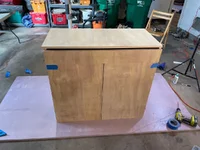


No journal for this old tank.
The lesson here was: don’t use home depot plywood! It sucks. Find a real plywood dealer and spend the extra $.
My next stand was way more ambitious: a 150cm x 60cm stand, designed to hold up 2400+ lbs, made from quality baltic birch plywood. 3 doors, two interior weight-bearing vertical panels, adjustable leveling feet. It worked great, and can be seen in my two journals Many Lessons and Inert Sand Trials:
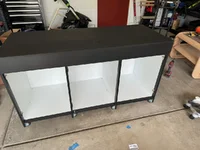
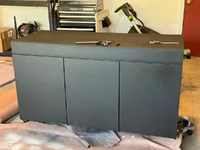
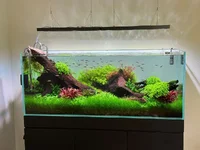
I did a WAY better job on this stand, and it now resides with @Kwyet ! Also, a spray finish really makes a big difference.
After that, the 90cm Experiment Tank stand. Two doors, and instead of a cumbersome middle panel, I used one hefty plywood column:


Scottish accent Fookin' crispay
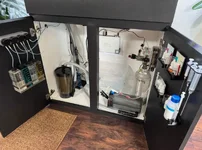
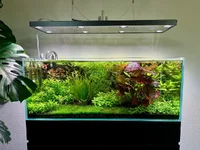
This tank also had a waterproof, sealed bottom “rim” so up to 2cm of water would have to fill the stand bottom before it overflows. Useful for emergencies or leaks, when combined with loud water leak alarms! This stand and tank is in my garage, soon to be sold to anyone in Colorado who wants it!
This stand is for my new 120cm tank! This stand is the culmination of seven years of stand-making. All of my mistakes, lessons, preferences, and skills were combined to make the stand of my dreams!
And of course, I had to move homes and got seriously injured, requiring surgery, while I was trying to finish it. Sorry for the lack of pictures!
I would not say this design is beginner friendly. It’s not expert, but likely intermediate difficulty. I have a Wen track saw and a Sawstop PCS Cabinet saw, which changes the entire process compared to someone working with more difficult tools. I also have a Graco Magnum X7 paint sprayer for a professional paint finish.
First, I started with mocking up the stand in Shapr3D, my modeling program:
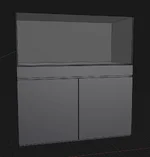

My local lumber company had really good deals on 5x5’ sheets of ¾” baltic birch plywood.
IT IS CRITICAL for precision woodworking like this (no trim to cover up mistakes) to get exact measurements, particularly for the thickness of the plywood. For example, using a pair of digital calipers, this 3/4" plywood was 17.8mm thick (0.7 in a lot smaller than .75"), which is what I used in my modeling program to create the exact length of cuts to properly span 120cm long and 60cm deep.
I collected the exact measurements of each part needed, and threw it into Opticutter to determine how to best cut my 5x5’ plywood sheets:
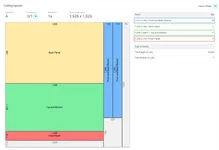
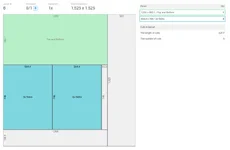

You don't need to study these sheets; the photos are just to show you how Opticutter works to save you from creating too much waste, and using the fewest cuts!
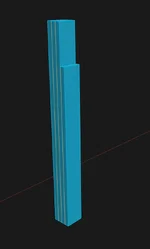
4-plywood-thick center column, with "notch" for the front brace to fit flush:
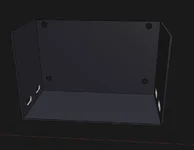
Top down first on a flat, even surface, then add sides and back:
Flip right-side-up, and add the bottom panel:
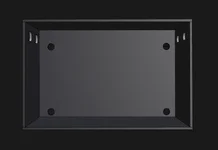
Add the rear brace, the front brace, and the center column. Make sure the front brace and column are flush with the front of the top/back panel edges.
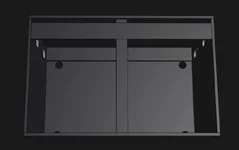
Add the front panel and bottom lip pieces:
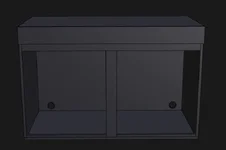
For the doors, create a notched finger pull (side view):

Door hinge stuff:
And it's done! Here's some of the few pictures I DID take of this process, sorry! I had a lot going on:
Gluing the 4-ply-thick center column:

To make the access holes in the back and side panels, I 3D printed some plastic guides for my router bit to follow, then roughly cut the inside out so the router had less material to work through:

Perfect routered holes:
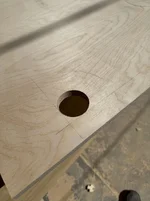
I learned to score the plywood with my box cutter first, so when it chipped from the rough jigsaw cut, it chipped ONLY to the scored lines:

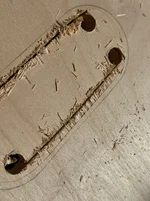
I removed the excess interior material with the jigsaw, then routered. I also used a roundover bit (in process on the left hole, right hole not rounded):
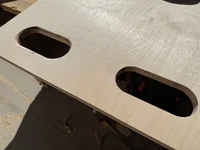
Any chips or imperfections could be fixed later with bondo wood filler and sanding.
Once I had my access holes cut out, I could assemble! I used clamps to hold the panels together and flush, used an Incra T-Rule (amazing device) to mark a line that was the middle of my plywood panel's core:

Then, I drilled countersink holes with this bit for the screw heads to sit below the level of the wood:
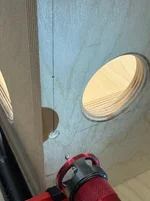
Screws:
Since the screws on the top, bottom, and rear of the stand would never be visible, I decided to skip the annoying "pocket screw and glue" scenario and just go with crazy robust torx-head 1.5” construction screws. I LOVED it. Definitely my preferred method, though they really do require pre-drilling AND drilling countersink heads. Still, way stronger than pocket screws my god.
Wood filling and Priming:
Bondo wood filler is amazing stuff. I used TONS of it, this was just the first pass:
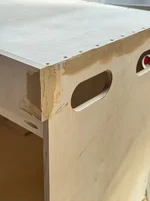
Apply, sand, apply more, sand more.
Then I primed with Sherwin Williams Gallery Series primer, and sprayed with a TrueAirless 515 tip in my Magnum X7:

Once the primer was dry, I sanded it, and sprayed again. Once dry, sanded again. Lots of sanding:

I wiped the tank down with tack cloth, then went for the finishing coat using a Graco FFLP 310 Tip and Sherwin-Williams Gallery Series Waterborne Topcoat in true black. Probably a matte or satin sheen, I can’t recall. Not cheap, good paint! Make sure to filter your paint through a find mesh before spraying.
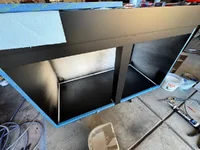
By far the best, most perfect finish I've ever had on a stand. BTW, the doors are fully adjustable up, down, left and right to get them nicely aligned. Blum hinges rock!
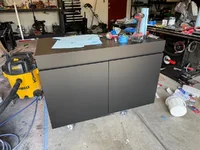
Once it was all put together, I got some help to move it into the new house. And installed the oversized Aquarium Mat.
I paid Tommy, the owner of Aqua Rocks Colorado, a delivery fee to have my custom 120x60x50cm tank delivered and installed on the stand. Once positioned evenly around all sides, I trimmed the aquarium mat with an Xacto knife, and was finished!
I'm tired today, but I'll upload more pics of this stand soon to this thread and to the 120cm Journal, too!
My very first DIY stand was a 100cm two-door home-depot plywood stand. It looks fine in pictures, but was NOT up to the insanely high, unhealthy standards of excellence that I hold myself to with everything:
No journal for this old tank.
The lesson here was: don’t use home depot plywood! It sucks. Find a real plywood dealer and spend the extra $.
My next stand was way more ambitious: a 150cm x 60cm stand, designed to hold up 2400+ lbs, made from quality baltic birch plywood. 3 doors, two interior weight-bearing vertical panels, adjustable leveling feet. It worked great, and can be seen in my two journals Many Lessons and Inert Sand Trials:
I did a WAY better job on this stand, and it now resides with @Kwyet ! Also, a spray finish really makes a big difference.
After that, the 90cm Experiment Tank stand. Two doors, and instead of a cumbersome middle panel, I used one hefty plywood column:
Scottish accent Fookin' crispay
This tank also had a waterproof, sealed bottom “rim” so up to 2cm of water would have to fill the stand bottom before it overflows. Useful for emergencies or leaks, when combined with loud water leak alarms! This stand and tank is in my garage, soon to be sold to anyone in Colorado who wants it!
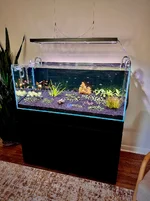
The new 120cm stand:
This stand is for my new 120cm tank! This stand is the culmination of seven years of stand-making. All of my mistakes, lessons, preferences, and skills were combined to make the stand of my dreams!
And of course, I had to move homes and got seriously injured, requiring surgery, while I was trying to finish it. Sorry for the lack of pictures!
I would not say this design is beginner friendly. It’s not expert, but likely intermediate difficulty. I have a Wen track saw and a Sawstop PCS Cabinet saw, which changes the entire process compared to someone working with more difficult tools. I also have a Graco Magnum X7 paint sprayer for a professional paint finish.
First, I started with mocking up the stand in Shapr3D, my modeling program:
My local lumber company had really good deals on 5x5’ sheets of ¾” baltic birch plywood.
IT IS CRITICAL for precision woodworking like this (no trim to cover up mistakes) to get exact measurements, particularly for the thickness of the plywood. For example, using a pair of digital calipers, this 3/4" plywood was 17.8mm thick (0.7 in a lot smaller than .75"), which is what I used in my modeling program to create the exact length of cuts to properly span 120cm long and 60cm deep.
I collected the exact measurements of each part needed, and threw it into Opticutter to determine how to best cut my 5x5’ plywood sheets:
You don't need to study these sheets; the photos are just to show you how Opticutter works to save you from creating too much waste, and using the fewest cuts!
Steps I followed for this stand:
- Cut all panels using table/track saw.
- Make 4-ply support column. Make notch cut ~145mm from top of column to fit behind front brace. Glue and trim/clean.
- Cut out "access holes" in panels, including pocket holes for front and back brace, predrilled holes for front brace (in middle, and upper portion for future front panel) and predrilled holes for back panel. Use a router with roundover bit to create round, smooth holes for cord and tubing access, as well as handles for moving the stand around!
- Run the "standing height "of the side and back panels (and 4-ply center column) through table saw to make uniform height for all 4 parts. All of these 4 parts should be cut to the exactly same height.
- Trim door “finger-pull” with a router. Just a 45-degree "slice" off the door's corner to make a finger pull.
- To assemble: Flip top upside down, test fit sides and back, secure with screws. Make front edge flush, back can be trimmed down with router flush bit if necessary.
- Attach the bottom panel, Make front edge flush, as the back can be trimmed down.
- Add 4-ply column, ensure front edge flush.
- Add front and back "braces".
- Add front panel, and bottom "lips" that hold any spilled water in.
- Spray and sand stand, fill gaps with Bondo wood filler. Sand and repeat until corners, cracks and divots are smooth.
- Caulk the inner corners where water would be.
- Paint stand and doors.
- Attach doors.
- Add feet.
- Run electrical and LED strips.
- Cut foam mat to size.
4-plywood-thick center column, with "notch" for the front brace to fit flush:
Top down first on a flat, even surface, then add sides and back:
Flip right-side-up, and add the bottom panel:
Add the rear brace, the front brace, and the center column. Make sure the front brace and column are flush with the front of the top/back panel edges.
Add the front panel and bottom lip pieces:
For the doors, create a notched finger pull (side view):
Door hinge stuff:
And it's done! Here's some of the few pictures I DID take of this process, sorry! I had a lot going on:
Gluing the 4-ply-thick center column:
To make the access holes in the back and side panels, I 3D printed some plastic guides for my router bit to follow, then roughly cut the inside out so the router had less material to work through:
Perfect routered holes:
I learned to score the plywood with my box cutter first, so when it chipped from the rough jigsaw cut, it chipped ONLY to the scored lines:
I removed the excess interior material with the jigsaw, then routered. I also used a roundover bit (in process on the left hole, right hole not rounded):
Any chips or imperfections could be fixed later with bondo wood filler and sanding.
Once I had my access holes cut out, I could assemble! I used clamps to hold the panels together and flush, used an Incra T-Rule (amazing device) to mark a line that was the middle of my plywood panel's core:
Then, I drilled countersink holes with this bit for the screw heads to sit below the level of the wood:
Screws:
Since the screws on the top, bottom, and rear of the stand would never be visible, I decided to skip the annoying "pocket screw and glue" scenario and just go with crazy robust torx-head 1.5” construction screws. I LOVED it. Definitely my preferred method, though they really do require pre-drilling AND drilling countersink heads. Still, way stronger than pocket screws my god.
- SPAX #8, 1-1/2" Interior Flat Head Torx Wood Screws
- INCRA T-Ruler 6 inch for marking my ~8.9mm line (middle of the plywood core I was screwing into).
Wood filling and Priming:
Bondo wood filler is amazing stuff. I used TONS of it, this was just the first pass:
Apply, sand, apply more, sand more.
Then I primed with Sherwin Williams Gallery Series primer, and sprayed with a TrueAirless 515 tip in my Magnum X7:
Once the primer was dry, I sanded it, and sprayed again. Once dry, sanded again. Lots of sanding:
I wiped the tank down with tack cloth, then went for the finishing coat using a Graco FFLP 310 Tip and Sherwin-Williams Gallery Series Waterborne Topcoat in true black. Probably a matte or satin sheen, I can’t recall. Not cheap, good paint! Make sure to filter your paint through a find mesh before spraying.
By far the best, most perfect finish I've ever had on a stand. BTW, the doors are fully adjustable up, down, left and right to get them nicely aligned. Blum hinges rock!
Once it was all put together, I got some help to move it into the new house. And installed the oversized Aquarium Mat.
I paid Tommy, the owner of Aqua Rocks Colorado, a delivery fee to have my custom 120x60x50cm tank delivered and installed on the stand. Once positioned evenly around all sides, I trimmed the aquarium mat with an Xacto knife, and was finished!
I'm tired today, but I'll upload more pics of this stand soon to this thread and to the 120cm Journal, too!
Questions? Ask below! I love to help out.
6 Replies
·
212 views


Hello Everyone. After a short 2 month wait, I finally received my 6', 235g Planet Aquariums tank. I've decided to document the build here as a way to document it's growth as well as, and maybe more importantly, seek advice as I've already stumbled onto a few 'problems'. So, without further ado, here is what I have so far:
Tank - 235g Planet Aquariums Mega Matrix (72" x 30" x 25")
Sump - 60g Breeder
Lighting - Skylight Hyperspot M (x2)
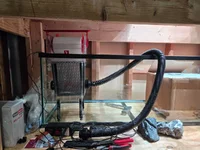
Mechanical Filtration - RedSea ReefMat 1200
Additional Filtration - Poret Foam (yet to purchase)
Return Pump(s) - Jebao DCP-10000
CO2 Reactor - Yugang from ARC
Dosing - Chihiros 4-Head with Magnetic Stirrer
Heater - 500W Titanium
Controller - Neptune Apex with pH and temp probes
Auto Feeder - Avast Plank
ATO - XP Aqua Duetto using a 35g Brute container filled with RODI water as source water.
Hardscape: UNS Controlsoil - Brown
Pacific Driftwood
Black Sieryu Stone
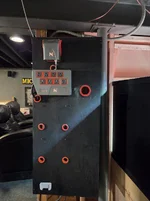
As a general thought at this point, the Apex will have some basic functions - control the temperature (77-78F), monitor the solenoid on the CO2 regulator should pH venture outside of acceptable ranges, and control the auto feeder. A 'feed mode' will be activated which will turn off the return pump prior to the auto feeder running so that the food is allowed to be eaten rather than washed into the overflow and into the sump filter. Aside from that, not much more is necessary other than simple on/off control for the return pump as the lights are on their own controller.
Controller and board:
ReefMat in sump:
Full shot of rear:
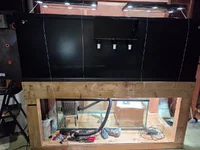
Current Scape - Half Complete:
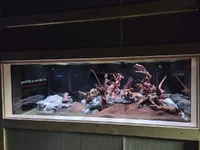
That's about all I've gotten done so far. Still working on fiddling with the hardscape on the right and then start on the left side. I'm open to any suggestions thus far and thanks for following along!
Tank - 235g Planet Aquariums Mega Matrix (72" x 30" x 25")
Sump - 60g Breeder
Lighting - Skylight Hyperspot M (x2)
Mechanical Filtration - RedSea ReefMat 1200
Additional Filtration - Poret Foam (yet to purchase)
Return Pump(s) - Jebao DCP-10000
CO2 Reactor - Yugang from ARC
Dosing - Chihiros 4-Head with Magnetic Stirrer
Heater - 500W Titanium
Controller - Neptune Apex with pH and temp probes
Auto Feeder - Avast Plank
ATO - XP Aqua Duetto using a 35g Brute container filled with RODI water as source water.
Hardscape: UNS Controlsoil - Brown
Pacific Driftwood
Black Sieryu Stone
As a general thought at this point, the Apex will have some basic functions - control the temperature (77-78F), monitor the solenoid on the CO2 regulator should pH venture outside of acceptable ranges, and control the auto feeder. A 'feed mode' will be activated which will turn off the return pump prior to the auto feeder running so that the food is allowed to be eaten rather than washed into the overflow and into the sump filter. Aside from that, not much more is necessary other than simple on/off control for the return pump as the lights are on their own controller.
Controller and board:
ReefMat in sump:
Full shot of rear:
Current Scape - Half Complete:
That's about all I've gotten done so far. Still working on fiddling with the hardscape on the right and then start on the left side. I'm open to any suggestions thus far and thanks for following along!
33 Replies
·
735 views


Supporting
I Donated 2026
Rockstar
Article Contributor
See this post regarding AR Mini trimming/planting, and this post regarding Cyperus helferi trimming and planting!
I have hardly seen this subject talked about enough, but I think that it's one of the biggest reasons contributing to beginner's algae-filled downfalls! If you're buying plants from big stores like Aquarium Plants Factory (really good btw), Buceplant, etc. 90% of the plants you are receiving are terrestrially-grown.
Here's an important fact about terrestrially-grown aquarium plants
100% of all terrestrial leaves, when submerged under water, for any plant, will eventually get algae and die.
Some can take a while (anubias, java fern, cyperus helferi), while others will either melt (Crypts) or quickly get algae (AR Mini, Staurogyne repens, stem plants, etc)
But what about buying submerged-growth plants? From hobbyists, or BurrAqua, for example?
There is still a chance that your tank's conditions are different enough that many, if not most leaves you plant, will melt/die/attract algae.
How do we fix this? By leaving only enough leaves for the plant to continue to absorb light and put out new growth. Usually the top 4-6 leaves for stem plants.
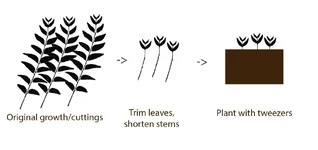
It's a lot of work up front, but you will MAJORLY reduce the amount of waste, DOC 's, and algae-inducing scenarios if you trim your plants before planting.
I've done this in ALL of my tanks in the last 4 years with great success.
The easiest way to do this is with stainless squeeze scissors over your sink:
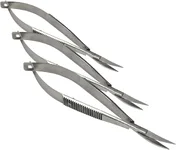
Here's the ones I recommend.
Yes, it takes a ton of patience. But if it could make a big difference in preventing the 2-3 month algae bloom in your tank, would you do it?
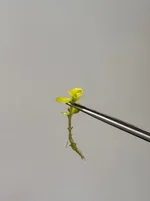
Lysimachia nummularia 'Aurea', only a few top leaves left, 3" of stem.
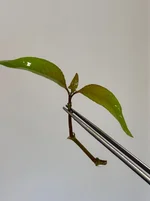
Hygrophila corymbosa. Note how I left the leaf nodes on the stem? That's where roots will grow from. Almost all stem plants need nodes to grow roots, even if you've removed the leaves from them.
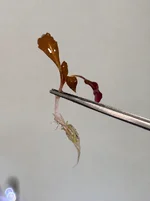
Terrestrially-grown AR 'Mini' from APF. See how I did the same in this thread for my previous tanks.
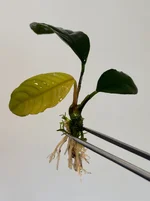
This Anubias barteri var. coffeefolia was grown terrestrially (often called 'emersed' or emergent) in a greenhouse. I removed all but the newest 3 leaves, and trimmed the roots too. Terrestrial roots are quite different from submerged with certain plants.
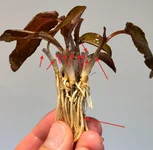
Almost ALL Cryptocoryne species are grown terrestrially. These plants grow as a Rosette, where the inner-most leaves on the "stem" are the freshest, and the outer-most are the oldest. I removed a TON of old terrestrial leaves, leaving just enough for the plant to be able to grow new submerged leaves in my tank as quickly as possible, while leaving as few algae-attracting terrestrial leaves as possible. I also trimmed the roots, which were 5" long upon receiving the plant.

Lobelia cardinalis 'mini'
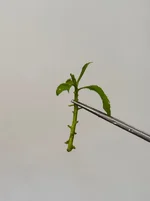
Penthorum sedoides. Would also look very similar for Staurogyne repens, too.
Did you know that Blyxa japonica is actually a stem plant? It looks like a rosette, but it's actually a squat, wide stem plant. The lowest/outermost leaves are the oldest, and even though this is a true aquatic plant with no terrestrial form in nature, I know that it likes to throw a fit and melt a good portion of it's oldest leaves when transitioning to my tank's conditions. Here's what it looked like when I received it from @Burr740:

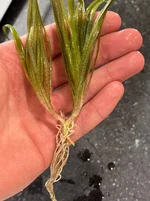
Nice and trimmed up. Less problematic at the 1-2 month mark in the tank's development, I know it!
What about delicate/feather plants?
They're super annoying to prep. I still only keep the top 3-4" max.
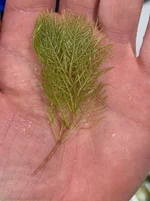
With Myriophyllum mattogrossense 'Golden', I only keep a few inches and still try to remove some of the lower leaves that would otherwise just rot by being buried in my inert sand.

What about Myriophyllum sp. "Roraima"? F*ck that. Nightmare to trim lower leaves, just trim it to 3" (not pictured) and discard the bottom when planting.
Curious what you guys think! I know I could receive plenty of "I've never done this, my tank has been fine" but I'd recommend trying it first before having a strong opinion of it
By the way, all plants pictured were actually used in my upcoming 120cm Showcase tank:
I have hardly seen this subject talked about enough, but I think that it's one of the biggest reasons contributing to beginner's algae-filled downfalls! If you're buying plants from big stores like Aquarium Plants Factory (really good btw), Buceplant, etc. 90% of the plants you are receiving are terrestrially-grown.
Here's an important fact about terrestrially-grown aquarium plants
100% of all terrestrial leaves, when submerged under water, for any plant, will eventually get algae and die.
Some can take a while (anubias, java fern, cyperus helferi), while others will either melt (Crypts) or quickly get algae (AR Mini, Staurogyne repens, stem plants, etc)
But what about buying submerged-growth plants? From hobbyists, or BurrAqua, for example?
There is still a chance that your tank's conditions are different enough that many, if not most leaves you plant, will melt/die/attract algae.
How do we fix this? By leaving only enough leaves for the plant to continue to absorb light and put out new growth. Usually the top 4-6 leaves for stem plants.
It's a lot of work up front, but you will MAJORLY reduce the amount of waste, DOC 's, and algae-inducing scenarios if you trim your plants before planting.
I've done this in ALL of my tanks in the last 4 years with great success.
The easiest way to do this is with stainless squeeze scissors over your sink:
Here's the ones I recommend.
Yes, it takes a ton of patience. But if it could make a big difference in preventing the 2-3 month algae bloom in your tank, would you do it?
Here are some specific plant examples:
For most true stem plants, I like to leave 3-4" of stem, trimming roots if necessary, and leaving only 4-6 of the freshest leaves. More than that, they will eventually be algae magnets. Less than that (like 2 leaves only) they might not survive the shock.Lysimachia nummularia 'Aurea', only a few top leaves left, 3" of stem.
Hygrophila corymbosa. Note how I left the leaf nodes on the stem? That's where roots will grow from. Almost all stem plants need nodes to grow roots, even if you've removed the leaves from them.
Terrestrially-grown AR 'Mini' from APF. See how I did the same in this thread for my previous tanks.
This Anubias barteri var. coffeefolia was grown terrestrially (often called 'emersed' or emergent) in a greenhouse. I removed all but the newest 3 leaves, and trimmed the roots too. Terrestrial roots are quite different from submerged with certain plants.
Almost ALL Cryptocoryne species are grown terrestrially. These plants grow as a Rosette, where the inner-most leaves on the "stem" are the freshest, and the outer-most are the oldest. I removed a TON of old terrestrial leaves, leaving just enough for the plant to be able to grow new submerged leaves in my tank as quickly as possible, while leaving as few algae-attracting terrestrial leaves as possible. I also trimmed the roots, which were 5" long upon receiving the plant.
Lobelia cardinalis 'mini'
Penthorum sedoides. Would also look very similar for Staurogyne repens, too.
Did you know that Blyxa japonica is actually a stem plant? It looks like a rosette, but it's actually a squat, wide stem plant. The lowest/outermost leaves are the oldest, and even though this is a true aquatic plant with no terrestrial form in nature, I know that it likes to throw a fit and melt a good portion of it's oldest leaves when transitioning to my tank's conditions. Here's what it looked like when I received it from @Burr740:
Nice and trimmed up. Less problematic at the 1-2 month mark in the tank's development, I know it!
What about delicate/feather plants?
They're super annoying to prep. I still only keep the top 3-4" max.
With Myriophyllum mattogrossense 'Golden', I only keep a few inches and still try to remove some of the lower leaves that would otherwise just rot by being buried in my inert sand.
What about Myriophyllum sp. "Roraima"? F*ck that. Nightmare to trim lower leaves, just trim it to 3" (not pictured) and discard the bottom when planting.
Curious what you guys think! I know I could receive plenty of "I've never done this, my tank has been fine" but I'd recommend trying it first before having a strong opinion of it
By the way, all plants pictured were actually used in my upcoming 120cm Showcase tank:
16 Replies
·
365 views
Staff member
I Donated 2026
Founding Member
This is the future home for the announcements when someone obtains an achievement badge. Let the games begin!
2032 Replies
·
52131 views

Sponsor
Expert in Residence
Rockstar
3 Replies
·
128 views
Staff member
I Donated 2026
Founding Member
Hello Welcome, fordohio
Welcome to ScapeCrunch, @fordohio!
We would love to get to know you. Please tell us about yourself. What tank do you have?
We would love to get to know you. Please tell us about yourself. What tank do you have?
2 Replies
·
62 views

This is my first time using a reactor. I have a Landen 100p (40x18x18 inches) and just received my Aqua Rocks Colorado Stainless Yugang Reactor. I had a spare Eheim 4+ 350 so it's now hooked to that with just foam filtration. My other filter is an Oase Biomaster Thermo 600 with an 850 head. I'm a little confused on the initial setup. I have my Co2 turning on at 9:30am, lights on 12-8pm. I have the offsets at 50% of the reactor, and the surface area is 4 inches larger than the calculations said I needed.
I know that contact time is the factor so my Eheim is about 50% flow. Do I initially increase the Co2 rate to purge the air out of the reactor, then dial it back so i'm seeing off-gassing every minute once I'm reaching my ppm? I'm using a Co2 Art Elite Pro regulator. My psi sits between 35-40 on a 20lb tank. Co2 is easy for me to get and cheap so I'm not concerned with excess. There's not a lot of information I can find on these so anything helps. Thanks for reading!
I know that contact time is the factor so my Eheim is about 50% flow. Do I initially increase the Co2 rate to purge the air out of the reactor, then dial it back so i'm seeing off-gassing every minute once I'm reaching my ppm? I'm using a Co2 Art Elite Pro regulator. My psi sits between 35-40 on a 20lb tank. Co2 is easy for me to get and cheap so I'm not concerned with excess. There's not a lot of information I can find on these so anything helps. Thanks for reading!
1 Replies
·
71 views