
Welcome to ScapeCrunch
We are ScapeCrunch, the place where planted aquarium hobbyists come to build relationships and support each other. When you're tired of doom scrolling, you've found your home here.
Social Feed

Staff member
I Donated 2026
Founding Member
This is an article written by @Zeus. that he generously posted here on ScapeCrunch. Thanks @Zeus.!
Why do we need a stable Carbon Dioxide (CO2) level?
A stable Carbon Dioxide (CO2) level or concentration is key to successfully growing plants in a CO2 injected tank. The CO2 concentration needs to be stable throughout the photoperiod, usually anything from 6 to 8 hours long, and consistent from one day to the next. If the CO2 level is not stable during this period, plants will have to constantly adapt and may not grow as well. A fluctuating CO2 concentration may also give algae an advantage and it could start to become a problem.
Stabilising CO2 during the photoperiod can be tricky and time consuming, and can sometimes take weeks of trial and error, especially for folk new to CO2 injection. Also key to success is good water flow. This is often overlooked but is essential to distribute CO2 evenly throughout the tank. CO2 travels 10,000 times slower in water than in air, so without good flow CO2 concentration will not be the same throughout the tank. Plants waving gently in the flow is a good indicator that it is adequate. Good surface agitation is also essential. This ensures adequate levels of gas exchange and helps to keep the tank water oxygenated.
What level of CO2 to aim for?
Many folk aim for a CO2 concentration of 30ppm. This is regarded as the upper safe limit for livestock. A lower CO2 concentration than 30ppm CO2 can also greatly benefit plants and is perhaps kinder to livestock, so don’t feel the need to hit the 30ppm mark. When tank water has 30ppm of CO2, the pH will be approximately 1.0 unit lower than it was before CO2 was injected. To find a tank’s CO2 level or baseline before injection starts, take a clean glass of tank water and leave it at room temp for 24 hrs after which take a pH reading. This will be the baseline or degassed pH of your tank water. For example, if the pH is 7.2 after fully degassing, and your target CO2 concentration is 30ppm then the target pH will be 6.2.
Watch your fish when Injecting CO2
It is best to adjust CO2 levels before adding any livestock to avoid accidentally stressing fish and other aquatic critters. If this is not possible it is essential to keep a close eye on your fish and shrimp etc when first injecting CO2 especially if you are new to the concept. Watch for any signs of abnormal behaviour. If the fish come to the surface and start gasping for air or show any other signs of distress, stop CO2 injection immediately. If this happens a large water change will be necessary as a temporary fix to reduce CO2 concentration and hopefully introduce more oxygen. Next check your equipment and don’t start CO2 injection again until you are confident the cause has been eliminated. If you are unable to get to the bottom of the problem seek advice or guidance, never be afraid to ask.
Injecting CO2
After starting to inject CO2 the pH of the tank water will drop quickly at first, then slowly until it reaches equilibrium with CO2 uptake by plants and CO2 loss from the water surface. If the injection rate is too high, you will overshoot your target CO2/pH which could be fatal to the tanks inhabitants so small steps at first are essential to avoid this. If the injection rate is too low, your tank water may take many hours to reach the target CO2 concentration and may not hold that concentration and remain stable once the lights come on. It’s often a case of trial and error, taking the greatest care to get it right especially when livestock is present.
Drop Checker (DC)
A drop Checker (DC) is a great tool for checking the concentration of CO2 in tank water. A working DC is filled with an indicator solution, usually a reagent in deionised water calibrated to a value of 4dkH. This solution changes colour according to the concentration of CO2. The colour will change from blue when tank water is fully degassed of CO2, to lime green when tank water has reached a CO2 concentration of 30ppm. DC’s can often change colour slowly; the rate varies with design and can take unto 2hrs. A DC can be used by itself to gauge CO2 concentration, however for the purposes of establishing a stable CO2 concentration it’s easier to use the combination of a pH profile and a DC
For further information on measurement using a drop checker, see Clive’s excellent article linked below
CO2 Measurement Using A Drop Checker
Time it takes to get your target CO2 level
The time it takes to reach a CO2 concentration of 30ppm varies with tank size and injection method. About 2hrs is normal for a 50 litre tank, but bigger tanks can take 4 to 5 hours plus.
Doing a pH profile
Doing a pH profile is a great way to achieve a stable CO2 concentration and is relatively simple to do, ‘if’ a little time consuming. Firstly, decide on your target CO2 level. Then find the baseline or degassed pH of your tank water as outlined above under the heading - What level of CO2 to aim for. Set the injection rate, or Bubbles Per Second (BPS) using a bubble counter, to a suitable level for your tanks size and CO2 setup. Take the pH of the tank water as CO2 injection starts or just before.
Thereafter, take a pH reading every 30 mins and note it down. As the pH change slows down start to take the pH a little more often. If the pH drops more than 1.0 unit reduce the injection rate (BPS). If it is taking too long to get the desired pH drop increase the BPS. Once the target pH is reached, turn the lights on, then keep taking the pH every 30 mins, repeating the BPS adjustment to keep the pH as stable as possible. After 4 to 5 hours of lights on turn the CO2 off and call it a day.
Next day take the pH as CO2 comes on and thereafter every 30 mins and note the time. As the target pH is reached turn the lights on and again note the time. Some fine tuning will probably still be needed to get a stable pH (I personally call it stable when there is less than 0.1 pH drift from lights on till CO2 off). So it’s a case of ‘rinse repeat’; check the pH and adjust BPS if required to suit, until you have a stable pH from lights on and all the way through to lights off. Then the hard work is over. DO NOT adjust your BPS rate again to try and get the pH to drop faster, it is not possible. The time it takes is the time it takes. You will have already got this time noted down. It may be 2hrs it may be 4 to 5hrs with bigger tanks. The length of time a pH drop takes is always worth a final check. You will already have a rough idea from the previous days pH profiling but some further fine tuning may be required.
The whole process can take days or even weeks to perfect, especially if you need to increase the water flow to ensure adequate CO2 distribution throughout the tank, or to increase surface agitation and therefore gas exchange. Other commitments, such as work and household chores, can interfere with the process so make sure you have at least a few days free to start with, any distraction may prove fatal to fish and other aquarium livestock, again another reason why it’s best to dial CO2 in before adding livestock.
If in doubt ask
Finally, there’s no such thing as a stupid question, especially where CO2 injection and the health of fish and other livestock is concerned. So if in doubt always ask. There are many experienced and knowledgeable members who will be only too happy to help.
@Zeus.
Dialing in the CO2 injection Rate and CO2 Profiles
Why do we need a stable Carbon Dioxide (CO2) level?
A stable Carbon Dioxide (CO2) level or concentration is key to successfully growing plants in a CO2 injected tank. The CO2 concentration needs to be stable throughout the photoperiod, usually anything from 6 to 8 hours long, and consistent from one day to the next. If the CO2 level is not stable during this period, plants will have to constantly adapt and may not grow as well. A fluctuating CO2 concentration may also give algae an advantage and it could start to become a problem.
Stabilising CO2 during the photoperiod can be tricky and time consuming, and can sometimes take weeks of trial and error, especially for folk new to CO2 injection. Also key to success is good water flow. This is often overlooked but is essential to distribute CO2 evenly throughout the tank. CO2 travels 10,000 times slower in water than in air, so without good flow CO2 concentration will not be the same throughout the tank. Plants waving gently in the flow is a good indicator that it is adequate. Good surface agitation is also essential. This ensures adequate levels of gas exchange and helps to keep the tank water oxygenated.
What level of CO2 to aim for?
Many folk aim for a CO2 concentration of 30ppm. This is regarded as the upper safe limit for livestock. A lower CO2 concentration than 30ppm CO2 can also greatly benefit plants and is perhaps kinder to livestock, so don’t feel the need to hit the 30ppm mark. When tank water has 30ppm of CO2, the pH will be approximately 1.0 unit lower than it was before CO2 was injected. To find a tank’s CO2 level or baseline before injection starts, take a clean glass of tank water and leave it at room temp for 24 hrs after which take a pH reading. This will be the baseline or degassed pH of your tank water. For example, if the pH is 7.2 after fully degassing, and your target CO2 concentration is 30ppm then the target pH will be 6.2.
Watch your fish when Injecting CO2
It is best to adjust CO2 levels before adding any livestock to avoid accidentally stressing fish and other aquatic critters. If this is not possible it is essential to keep a close eye on your fish and shrimp etc when first injecting CO2 especially if you are new to the concept. Watch for any signs of abnormal behaviour. If the fish come to the surface and start gasping for air or show any other signs of distress, stop CO2 injection immediately. If this happens a large water change will be necessary as a temporary fix to reduce CO2 concentration and hopefully introduce more oxygen. Next check your equipment and don’t start CO2 injection again until you are confident the cause has been eliminated. If you are unable to get to the bottom of the problem seek advice or guidance, never be afraid to ask.
Injecting CO2
After starting to inject CO2 the pH of the tank water will drop quickly at first, then slowly until it reaches equilibrium with CO2 uptake by plants and CO2 loss from the water surface. If the injection rate is too high, you will overshoot your target CO2/pH which could be fatal to the tanks inhabitants so small steps at first are essential to avoid this. If the injection rate is too low, your tank water may take many hours to reach the target CO2 concentration and may not hold that concentration and remain stable once the lights come on. It’s often a case of trial and error, taking the greatest care to get it right especially when livestock is present.
Drop Checker (DC)
A drop Checker (DC) is a great tool for checking the concentration of CO2 in tank water. A working DC is filled with an indicator solution, usually a reagent in deionised water calibrated to a value of 4dkH. This solution changes colour according to the concentration of CO2. The colour will change from blue when tank water is fully degassed of CO2, to lime green when tank water has reached a CO2 concentration of 30ppm. DC’s can often change colour slowly; the rate varies with design and can take unto 2hrs. A DC can be used by itself to gauge CO2 concentration, however for the purposes of establishing a stable CO2 concentration it’s easier to use the combination of a pH profile and a DC
For further information on measurement using a drop checker, see Clive’s excellent article linked below
CO2 Measurement Using A Drop Checker
Time it takes to get your target CO2 level
The time it takes to reach a CO2 concentration of 30ppm varies with tank size and injection method. About 2hrs is normal for a 50 litre tank, but bigger tanks can take 4 to 5 hours plus.
Doing a pH profile
Doing a pH profile is a great way to achieve a stable CO2 concentration and is relatively simple to do, ‘if’ a little time consuming. Firstly, decide on your target CO2 level. Then find the baseline or degassed pH of your tank water as outlined above under the heading - What level of CO2 to aim for. Set the injection rate, or Bubbles Per Second (BPS) using a bubble counter, to a suitable level for your tanks size and CO2 setup. Take the pH of the tank water as CO2 injection starts or just before.
Thereafter, take a pH reading every 30 mins and note it down. As the pH change slows down start to take the pH a little more often. If the pH drops more than 1.0 unit reduce the injection rate (BPS). If it is taking too long to get the desired pH drop increase the BPS. Once the target pH is reached, turn the lights on, then keep taking the pH every 30 mins, repeating the BPS adjustment to keep the pH as stable as possible. After 4 to 5 hours of lights on turn the CO2 off and call it a day.
Next day take the pH as CO2 comes on and thereafter every 30 mins and note the time. As the target pH is reached turn the lights on and again note the time. Some fine tuning will probably still be needed to get a stable pH (I personally call it stable when there is less than 0.1 pH drift from lights on till CO2 off). So it’s a case of ‘rinse repeat’; check the pH and adjust BPS if required to suit, until you have a stable pH from lights on and all the way through to lights off. Then the hard work is over. DO NOT adjust your BPS rate again to try and get the pH to drop faster, it is not possible. The time it takes is the time it takes. You will have already got this time noted down. It may be 2hrs it may be 4 to 5hrs with bigger tanks. The length of time a pH drop takes is always worth a final check. You will already have a rough idea from the previous days pH profiling but some further fine tuning may be required.
The whole process can take days or even weeks to perfect, especially if you need to increase the water flow to ensure adequate CO2 distribution throughout the tank, or to increase surface agitation and therefore gas exchange. Other commitments, such as work and household chores, can interfere with the process so make sure you have at least a few days free to start with, any distraction may prove fatal to fish and other aquarium livestock, again another reason why it’s best to dial CO2 in before adding livestock.
If in doubt ask
Finally, there’s no such thing as a stupid question, especially where CO2 injection and the health of fish and other livestock is concerned. So if in doubt always ask. There are many experienced and knowledgeable members who will be only too happy to help.
@Zeus.
0 Replies
·
739 views


Supporting
Trying a true journal format. Let me know if it's too much writing. My natural tendency is to bullet point everything.
The Mishap That Started It All
This whole project began at 6:30 a.m., courtesy of my Oase Biomaster Thermo 250 deciding to serenade me with impeller noise while I was trying to work from home. Biofilm on the impeller — nothing dramatic — but the sound was maddening, especially with an 8 a.m. call with our London office looming. So I did what any aquarist does under pressure: a lightning‑fast pre‑filter and impeller clean.That’s when the universe decided to intervene.
While disconnecting the hoses — the same routine I’ve done countless times — the lock failed. Suddenly a vacuum of water blasted across the floor of my upstairs alcove “office.” I yanked the intake and outflow from my 60U, stopping the torrent, but not before a solid gallon had soaked into the floorboards.
My wife woke up to the sound of chaos and the sight of me standing in a puddle. Understandably, she was not thrilled. The alcove has cathedral ceilings, so every noise echoes, and the massive 8‑foot cabinet we built with her dad years ago makes cleaning underneath nearly impossible. It’s not a space designed for aquariums, humidity, or early‑morning filter geysers.
As we cleaned, she admitted she hated having tanks and equipment out in the open upstairs. Fair enough. When we built the house, the plan was always for my “stuff” to live in the downstairs office while she had the rest of the house. But during COVID she needed privacy for patient calls, so I gave her the office and moved my stuff upstairs. Now her role has changed — two days in the hospital, one day from home — and the need for that arrangement is gone.
So I floated the idea: What if I moved everything back downstairs, consolidated the two smaller tanks into one larger, beautifully executed setup — something like the living room tank she actually likes? Less noise, less humidity upstairs, and I get a proper scaping space again.
To my mild shock, she was completely on board. From a mishap came opportunity.
Choosing the Tank
Once the idea settled, I had to pick the right aquarium. I landed on the AquaEl Ultrascaper 90 — the dimensions are perfect, and I’d been eyeing it ever since researching the Skylight Hyperspot and AquaEl’s filter lineup. The tank was designed with the scapers at AquaShow in Poland, and their sample layouts are right up there with ADA, ADG, and Green Aqua imo.Finding one in the U.S. was the next challenge. I reached out to the AquaEl rep, asked about the Hypermax for my living room tank, and inquired about Ultrascaper 90 availability. He pointed me to Fish Tanks Direct — and with a discount code in hand, I placed the order for the snow variant. My only quandy was to go for the cheaper one and get a Netlea AT5S to hang or try their newer attractive but inferior light option (RGB vs WBG). I chose to try their light as it looked interesting and the PAR on paper is more than enough.
Link for reference:https://fishtanksdirect.com/aquael-ultrascape-90-with-ultra-slim-snow-tank-light-cabinet/
Atlanta Weekend & Tank Comparisons
Right after ordering, we had a weekend trip to Atlanta for one of my wife’s appointments. On Friday we visited the botanical garden, grabbed food, and while she was at her appointment Saturday, I made the rounds to three local fish stores. The Aquarium was an option but a Saturday solo but spending roughly $100 to be around 10 million families sounded less enjoyable than exploring ATL suburbs and seeing the stores and their tanks.Premiere Aquatics had a beautiful setup UNS 90U and one for sale as well but at nearly $2,000 out the door it wasn't a great deal. Plus the tank is taller than I wanted, it wasn’t the right fit. I did pick up two gorgeous rose swords and a great piece of ghost wood.
I went to one store in Alpharetta but it was out of literally everything, not sure if they are doing poorly or just sell out fast and under order. I did buy a crinum there. Plus I liked driving from Premier to their.
Then I got lucky at Optimum Aquarium — they had an AquaEl Ultrascaper 90 in stock that had arrived that week, priced at a very respectable $1,000 (without the light). If the cabinet had been white, I would’ve bought it on the spot. They also had a wide range of tanks, which let me compare my choice to the Fluval Opti White 90 (a very reasonable $700) and several Aquatlantis rimless tanks I didn’t even know were available in the U.S. Their shallow 80 is especially cool — tank, stand, and light for $830, I would get a different color but I like the concept. They also had a bunch of healthy Dwarf Sag for $3 dollars so I bought a 4 bunches to use as I couldn't find dwarf chain swords easily online and heleiatium tenellum is a little too small.
My takeaways:
- Fluval Opti White 90: Nice tank but a bit small and too tall, the stand feels cheap and lightweight. Attractive for the price, but not my pick.
- Aquatlantis: Surprisingly impressive. I’d choose them over Fluval at similar price points.
- UNS 90U: The stands are unquestionably superior. The tank mitering is spectacular.
- AquaEl Ultrascaper 90:
- Stand: Best flat‑pack stand I’ve seen, though still a flat‑pack.
- Glass: Equal quality to UNS but no mitering.
- Dimensions: 90 × 60 × 45 — absolutely perfect.
- Incredible depth
- Lower height makes it ideal for seated viewing
- Easier to work in
- Better top‑down perspective


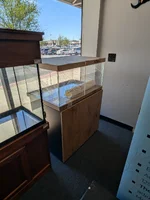

16 Replies
·
1032 views


Uh oh! Made the leap and purchased a UNS 60L aquarium today to replace my UNS 5N. It's going to go on the edge of my kitchen island, so keeping equipment minimal and attractive is going to be a priority here.
The aesthetic goal is something resembling an Iwagumi that can be viewed from 270 degrees. Biggest inspiration currently is this scape by @qball_aquatics in Sydney. I'm not a huge Iwagumi person and I normally like substantial hardscape, but something about the plant selection here scales so perfectly in this long shallow tank, so I'm simply going to copy it.
UNS 60L Dimensions: 24" x 8" x 8"
Tentative Equipment List
Filter: Oase Filtosmart 60
Inflow/outflow: ASG 10mm Stainless Steel Inflow/Outflow pipes
Light: Chihiros CII RGB or ONF Flat Nano - intentionally going for a short light for more of a spotlight effect with shadowing on the outer edges
CO2: Paintball setup, potentially mounted horizontally with brackets under the counter
Plants:
Glosso or HC carpet
Eleocharis parvula for height around the stones
Echinodorus 'Aflame" centerpiece plant
Livestock:
Blue dream neocaridina
Maybe chili rasboras
How does this setup sound? Very open to suggestions.
The aesthetic goal is something resembling an Iwagumi that can be viewed from 270 degrees. Biggest inspiration currently is this scape by @qball_aquatics in Sydney. I'm not a huge Iwagumi person and I normally like substantial hardscape, but something about the plant selection here scales so perfectly in this long shallow tank, so I'm simply going to copy it.
UNS 60L Dimensions: 24" x 8" x 8"
Tentative Equipment List
Filter: Oase Filtosmart 60
Inflow/outflow: ASG 10mm Stainless Steel Inflow/Outflow pipes
Light: Chihiros CII RGB or ONF Flat Nano - intentionally going for a short light for more of a spotlight effect with shadowing on the outer edges
CO2: Paintball setup, potentially mounted horizontally with brackets under the counter
Plants:
Glosso or HC carpet
Eleocharis parvula for height around the stones
Echinodorus 'Aflame" centerpiece plant
Livestock:
Blue dream neocaridina
Maybe chili rasboras
How does this setup sound? Very open to suggestions.
20 Replies
·
980 views
Staff member
I Donated 2026
Founding Member
Well, as this thread exists in a few places, I figured why not have it here also. Perhaps we can take up the baton and keep it active and bring some value to hobbyists.
For those of you that don't know, I got into thinking much more about my micros when I read this thread on another forum. It was started by our very own @GreggZ. It was spurred into existence because of our own @Burr740 and his work with micro fertilizers. Some really good discussion followed and a lot was learned.
I don't want to steal Gregg's thunder with this so I hope he posts his current thoughts on the subject and we can all take it from there.
All the best,
Art
For those of you that don't know, I got into thinking much more about my micros when I read this thread on another forum. It was started by our very own @GreggZ. It was spurred into existence because of our own @Burr740 and his work with micro fertilizers. Some really good discussion followed and a lot was learned.
I don't want to steal Gregg's thunder with this so I hope he posts his current thoughts on the subject and we can all take it from there.
All the best,
Art
85 Replies
·
14324 views
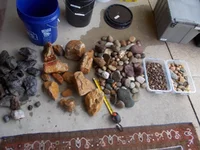
Got these for 10.00 a 5g bucket full I cant wont buy seriyu stone or others cost me 20 in rocks got 2 5g buckets for 22,00 for all in pics a steal for rock scapes with wood I'm going for. Its around 150lbs for 22.00 lol bye others! 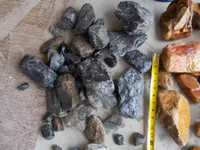
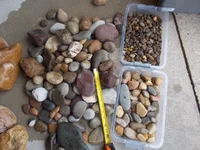
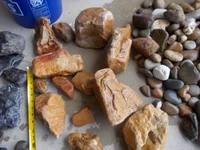
2 Replies
·
33 views
Staff member
I Donated 2026
Founding Member
Hello Welcome, chillguy
Welcome to ScapeCrunch, @chillguy!
We would love to get to know you. Please tell us about yourself. What tank do you have?
We would love to get to know you. Please tell us about yourself. What tank do you have?
0 Replies
·
7 views

Journal Farmer D. Singh's journal
Ive reorganized the order of my tanks so I can better keep track of them ie. Tank 2 moss tank is now tank 3. This helps in any confusion I had when tracking tanks they are in a sort of order now. Rather than taking time editing my old journal id rather create a new thread. Pics will be current (for the most part) as they are posted. I am not aquascaping. I am just farming.
52 Replies
·
2617 views

Supporting
I Donated 2026
Rockstar
Article Contributor
This is not a step by step tutorial, more for inspiration and general information!
My very first DIY stand was a 100cm two-door home-depot plywood stand. It looks fine in pictures, but was NOT up to the insanely high, unhealthy standards of excellence that I hold myself to with everything:
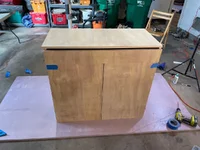


No journal for this old tank.
The lesson here was: don’t use home depot plywood! It sucks. Find a real plywood dealer and spend the extra $.
My next stand was way more ambitious: a 150cm x 60cm stand, designed to hold up 2400+ lbs, made from quality baltic birch plywood. 3 doors, two interior weight-bearing vertical panels, adjustable leveling feet. It worked great, and can be seen in my two journals Many Lessons and Inert Sand Trials:
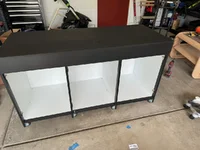
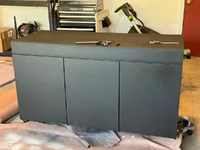
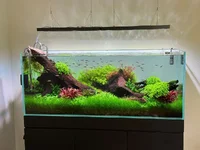
I did a WAY better job on this stand, and it now resides with @Kwyet ! Also, a spray finish really makes a big difference.
After that, the 90cm Experiment Tank stand. Two doors, and instead of a cumbersome middle panel, I used one hefty plywood column:


Scottish accent Fookin' crispay
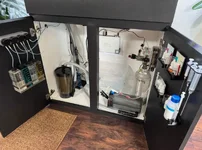
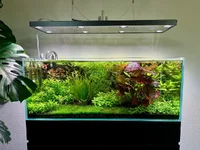
This tank also had a waterproof, sealed bottom “rim” so up to 2cm of water would have to fill the stand bottom before it overflows. Useful for emergencies or leaks, when combined with loud water leak alarms! This stand and tank is in my garage, soon to be sold to anyone in Colorado who wants it!
This stand is for my new 120cm tank! This stand is the culmination of seven years of stand-making. All of my mistakes, lessons, preferences, and skills were combined to make the stand of my dreams!
And of course, I had to move homes and got seriously injured, requiring surgery, while I was trying to finish it. Sorry for the lack of pictures!
I would not say this design is beginner friendly. It’s not expert, but likely intermediate difficulty. I have a Wen track saw and a Sawstop PCS Cabinet saw, which changes the entire process compared to someone working with more difficult tools. I also have a Graco Magnum X7 paint sprayer for a professional paint finish.
First, I started with mocking up the stand in Shapr3D, my modeling program:
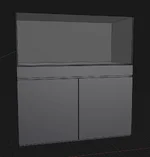

My local lumber company had really good deals on 5x5’ sheets of ¾” baltic birch plywood.
IT IS CRITICAL for precision woodworking like this (no trim to cover up mistakes) to get exact measurements, particularly for the thickness of the plywood. For example, using a pair of digital calipers, this 3/4" plywood was 17.8mm thick (0.7 in a lot smaller than .75"), which is what I used in my modeling program to create the exact length of cuts to properly span 120cm long and 60cm deep.
I collected the exact measurements of each part needed, and threw it into Opticutter to determine how to best cut my 5x5’ plywood sheets:
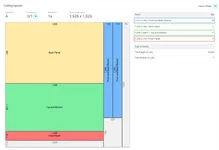
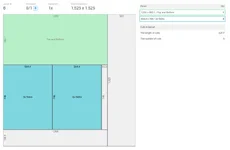

You don't need to study these sheets; the photos are just to show you how Opticutter works to save you from creating too much waste, and using the fewest cuts!
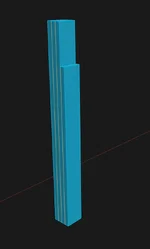
4-plywood-thick center column, with "notch" for the front brace to fit flush:
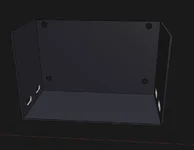
Top down first on a flat, even surface, then add sides and back:
Flip right-side-up, and add the bottom panel:
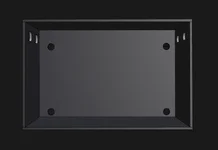
Add the rear brace, the front brace, and the center column. Make sure the front brace and column are flush with the front of the top/back panel edges.
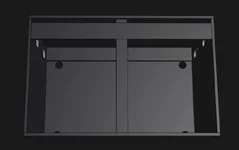
Add the front panel and bottom lip pieces:
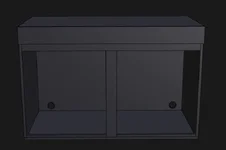
For the doors, create a notched finger pull (side view):

Door hinge stuff:
And it's done! Here's some of the few pictures I DID take of this process, sorry! I had a lot going on:
Gluing the 4-ply-thick center column:

To make the access holes in the back and side panels, I 3D printed some plastic guides for my router bit to follow, then roughly cut the inside out so the router had less material to work through:

Perfect routered holes:
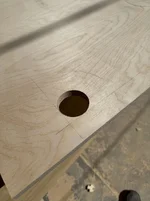
I learned to score the plywood with my box cutter first, so when it chipped from the rough jigsaw cut, it chipped ONLY to the scored lines:

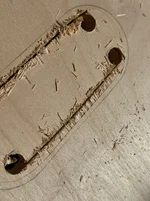
I removed the excess interior material with the jigsaw, then routered. I also used a roundover bit (in process on the left hole, right hole not rounded):
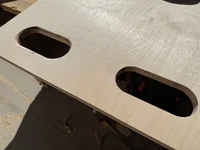
Any chips or imperfections could be fixed later with bondo wood filler and sanding.
Once I had my access holes cut out, I could assemble! I used clamps to hold the panels together and flush, used an Incra T-Rule (amazing device) to mark a line that was the middle of my plywood panel's core:

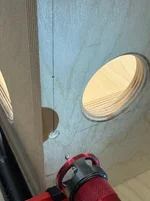
Then, I drilled countersink holes with this bit for the screw heads to sit below the level of the wood:
Screws:
Since the screws on the top, bottom, and rear of the stand would never be visible, I decided to skip the annoying "pocket screw and glue" scenario and just go with crazy robust torx-head 1.5” construction screws. I LOVED it. Definitely my preferred method, though they really do require pre-drilling AND drilling countersink heads. Still, way stronger than pocket screws my god.
Wood filling and Priming:
Bondo wood filler is amazing stuff. I used TONS of it, this was just the first pass:
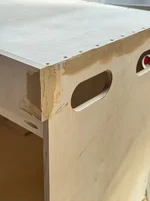
Apply, sand, apply more, sand more.
Then I primed with Sherwin Williams Gallery Series primer, and sprayed with a TrueAirless 515 tip in my Magnum X7:

Once the primer was dry, I sanded it, and sprayed again. Once dry, sanded again. Lots of sanding:

I wiped the tank down with tack cloth, then went for the finishing coat using a Graco FFLP 310 Tip and Sherwin-Williams Gallery Series Waterborne Topcoat in true black. Probably a matte or satin sheen, I can’t recall. Not cheap, good paint! Make sure to filter your paint through a find mesh before spraying.
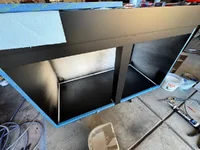
By far the best, most perfect finish I've ever had on a stand. BTW, the doors are fully adjustable up, down, left and right to get them nicely aligned. Blum hinges rock!
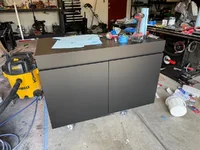
Once it was all put together, I got some help to move it into the new house. And installed the oversized Aquarium Mat.
I paid Tommy, the owner of Aqua Rocks Colorado, a delivery fee to have my custom 120x60x50cm tank delivered and installed on the stand. Once positioned evenly around all sides, I trimmed the aquarium mat with an Xacto knife, and was finished!
I'm tired today, but I'll upload more pics of this stand soon to this thread and to the 120cm Journal, too!
My very first DIY stand was a 100cm two-door home-depot plywood stand. It looks fine in pictures, but was NOT up to the insanely high, unhealthy standards of excellence that I hold myself to with everything:
No journal for this old tank.
The lesson here was: don’t use home depot plywood! It sucks. Find a real plywood dealer and spend the extra $.
My next stand was way more ambitious: a 150cm x 60cm stand, designed to hold up 2400+ lbs, made from quality baltic birch plywood. 3 doors, two interior weight-bearing vertical panels, adjustable leveling feet. It worked great, and can be seen in my two journals Many Lessons and Inert Sand Trials:
I did a WAY better job on this stand, and it now resides with @Kwyet ! Also, a spray finish really makes a big difference.
After that, the 90cm Experiment Tank stand. Two doors, and instead of a cumbersome middle panel, I used one hefty plywood column:
Scottish accent Fookin' crispay
This tank also had a waterproof, sealed bottom “rim” so up to 2cm of water would have to fill the stand bottom before it overflows. Useful for emergencies or leaks, when combined with loud water leak alarms! This stand and tank is in my garage, soon to be sold to anyone in Colorado who wants it!
The new 120cm stand:
This stand is for my new 120cm tank! This stand is the culmination of seven years of stand-making. All of my mistakes, lessons, preferences, and skills were combined to make the stand of my dreams!
And of course, I had to move homes and got seriously injured, requiring surgery, while I was trying to finish it. Sorry for the lack of pictures!
I would not say this design is beginner friendly. It’s not expert, but likely intermediate difficulty. I have a Wen track saw and a Sawstop PCS Cabinet saw, which changes the entire process compared to someone working with more difficult tools. I also have a Graco Magnum X7 paint sprayer for a professional paint finish.
First, I started with mocking up the stand in Shapr3D, my modeling program:
My local lumber company had really good deals on 5x5’ sheets of ¾” baltic birch plywood.
IT IS CRITICAL for precision woodworking like this (no trim to cover up mistakes) to get exact measurements, particularly for the thickness of the plywood. For example, using a pair of digital calipers, this 3/4" plywood was 17.8mm thick (0.7 in a lot smaller than .75"), which is what I used in my modeling program to create the exact length of cuts to properly span 120cm long and 60cm deep.
I collected the exact measurements of each part needed, and threw it into Opticutter to determine how to best cut my 5x5’ plywood sheets:
You don't need to study these sheets; the photos are just to show you how Opticutter works to save you from creating too much waste, and using the fewest cuts!
Steps I followed for this stand:
- Cut all panels using table/track saw.
- Make 4-ply support column. Make notch cut ~145mm from top of column to fit behind front brace. Glue and trim/clean.
- Cut out "access holes" in panels, including pocket holes for front and back brace, predrilled holes for front brace (in middle, and upper portion for future front panel) and predrilled holes for back panel. Use a router with roundover bit to create round, smooth holes for cord and tubing access, as well as handles for moving the stand around!
- Run the "standing height "of the side and back panels (and 4-ply center column) through table saw to make uniform height for all 4 parts. All of these 4 parts should be cut to the exactly same height.
- Trim door “finger-pull” with a router. Just a 45-degree "slice" off the door's corner to make a finger pull.
- To assemble: Flip top upside down, test fit sides and back, secure with screws. Make front edge flush, back can be trimmed down with router flush bit if necessary.
- Attach the bottom panel, Make front edge flush, as the back can be trimmed down.
- Add 4-ply column, ensure front edge flush.
- Add front and back "braces".
- Add front panel, and bottom "lips" that hold any spilled water in.
- Spray and sand stand, fill gaps with Bondo wood filler. Sand and repeat until corners, cracks and divots are smooth.
- Caulk the inner corners where water would be.
- Paint stand and doors.
- Attach doors.
- Add feet.
- Run electrical and LED strips.
- Cut foam mat to size.
4-plywood-thick center column, with "notch" for the front brace to fit flush:
Top down first on a flat, even surface, then add sides and back:
Flip right-side-up, and add the bottom panel:
Add the rear brace, the front brace, and the center column. Make sure the front brace and column are flush with the front of the top/back panel edges.
Add the front panel and bottom lip pieces:
For the doors, create a notched finger pull (side view):
Door hinge stuff:
And it's done! Here's some of the few pictures I DID take of this process, sorry! I had a lot going on:
Gluing the 4-ply-thick center column:
To make the access holes in the back and side panels, I 3D printed some plastic guides for my router bit to follow, then roughly cut the inside out so the router had less material to work through:
Perfect routered holes:
I learned to score the plywood with my box cutter first, so when it chipped from the rough jigsaw cut, it chipped ONLY to the scored lines:
I removed the excess interior material with the jigsaw, then routered. I also used a roundover bit (in process on the left hole, right hole not rounded):
Any chips or imperfections could be fixed later with bondo wood filler and sanding.
Once I had my access holes cut out, I could assemble! I used clamps to hold the panels together and flush, used an Incra T-Rule (amazing device) to mark a line that was the middle of my plywood panel's core:
Then, I drilled countersink holes with this bit for the screw heads to sit below the level of the wood:
Screws:
Since the screws on the top, bottom, and rear of the stand would never be visible, I decided to skip the annoying "pocket screw and glue" scenario and just go with crazy robust torx-head 1.5” construction screws. I LOVED it. Definitely my preferred method, though they really do require pre-drilling AND drilling countersink heads. Still, way stronger than pocket screws my god.
- SPAX #8, 1-1/2" Interior Flat Head Torx Wood Screws
- INCRA T-Ruler 6 inch for marking my ~8.9mm line (middle of the plywood core I was screwing into).
Wood filling and Priming:
Bondo wood filler is amazing stuff. I used TONS of it, this was just the first pass:
Apply, sand, apply more, sand more.
Then I primed with Sherwin Williams Gallery Series primer, and sprayed with a TrueAirless 515 tip in my Magnum X7:
Once the primer was dry, I sanded it, and sprayed again. Once dry, sanded again. Lots of sanding:
I wiped the tank down with tack cloth, then went for the finishing coat using a Graco FFLP 310 Tip and Sherwin-Williams Gallery Series Waterborne Topcoat in true black. Probably a matte or satin sheen, I can’t recall. Not cheap, good paint! Make sure to filter your paint through a find mesh before spraying.
By far the best, most perfect finish I've ever had on a stand. BTW, the doors are fully adjustable up, down, left and right to get them nicely aligned. Blum hinges rock!
Once it was all put together, I got some help to move it into the new house. And installed the oversized Aquarium Mat.
I paid Tommy, the owner of Aqua Rocks Colorado, a delivery fee to have my custom 120x60x50cm tank delivered and installed on the stand. Once positioned evenly around all sides, I trimmed the aquarium mat with an Xacto knife, and was finished!
I'm tired today, but I'll upload more pics of this stand soon to this thread and to the 120cm Journal, too!
Questions? Ask below! I love to help out.
7 Replies
·
412 views

Staff member
I Donated 2026
Founding Member
Hello Welcome, artandsoul
Welcome to ScapeCrunch, @artandsoul!
We would love to get to know you. Please tell us about yourself. What tank do you have?
We would love to get to know you. Please tell us about yourself. What tank do you have?
1 Replies
·
20 views

Supporting
I Donated 2026
Journal MrJG - UNS 90L
@Sb1415 Apologies I totally snagged the format of your journal post for this so thank you!
Many moons ago I was an active and contributing member on plantedtank.net, I think at one point I had around 14 scaped tanks going before burnout and life changes. Instead of weekends consisting of maintenance I transitioned to camping/boating and life has been great. I’ve always missed it. After downsizing and making a move to a new home I kept only a small 12x12 cube tank that started life as an amateur iwagumi layout, Seiryu and hairgrass only. I put it on the nightstand beside my bed and added some of my favorite Anubias and crypts from taken down tanks. Its been sitting there running for 5-6 years now, low light, top offs only w tap. Maintenance when it got out of control. Super old aquasoil now flattened out to a thick 4-5 inch thick layer in a perfect line front to back.
In Aug/Sept 25 had a bit of a health issue that kept me in bed for several weeks recovering while I looked at this sad little cube, mostly healthy but not truly thriving. No fertilizer being added for years, GDA covered anubias leaves that also were many years old and I thought to myself I should make this better… that was the tipping point. OK I’ll do a deep clean on the substrate, get some stems to throw in there, maybe get a carpet going. Tissue cultures/stems ordered and I got to work. No more top offs, 10% water changes instead. TDS ~900 when I started. Ultimately everything melted back and didn’t grow well. I’d been keeping the lighting so dim all these years to maintain just the crypts/epiphytes without it turning into a mess and I was ok with it again. That was the spark.
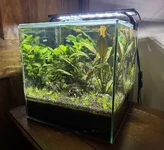
I decided I wanted to build out a new tank, most of my old hardware/tanks I had let go of in a bulk way so I was going to have to start new with everything sans some 5 gallon buckets of Amazonia that I’d placed in the basement of the new house.. Phoenix rising from the ashes? Most likely more like algae emerging from the depths. I still consider myself a beginner and maybe amateur at best so yeah…
So I got to work again reading, researching, what’s new, what has changed since I’ve been out of the loop for so long? Ooo dark start that sounds much better, in line CO2 diffusers cool! CO2 reactors, pretty awesome sounding, 2Hr aquarist read every article, and I’m back in baby!
Tank inspiration
None really hence no name, it fit right into a slot to occupy my mind from a not so great situation that I was in and I’m ok with that. Ultimately I’d like this to be a low-mid energy tank that can have minimal amounts of weekly maintenance while still looking the part. I’d prefer to keep it as simple as possible while still having some high tech bits. Get all the equipment out of the tank, co2, low-mid level lighting, minimal/simple fertilization. I got busy ordering equipment and started brainstorming layouts and what hardscape materials I could find. Instagram was my friend for a while, seems that everything that kept grabbing my attention were island style layouts with a very thin layer of sand surrounding. I’ve also always been partial to big chonky pieces of driftwood, I thought to go the manzanita route but wysiwyg pieces were fetching stupid prices. I ran across this ironwood in a listing and couldn’t let it go. The deep lines in the bark were just calling me so I quick snap ordered it before my brain could process dimensions, I knew it would fit but didn’t fully visualise how much it would ultimately limit the layout. I wanted to stay mostly inert with stone and eventually/begrudgingly ordered the tumbled lava stone with the intention of keeping it to a island/river layout style and mimicking some of my found instagram muse tanks. It will mostly likely end up more nature style although the start will be more Willy Wonka than anything. Thanks @Burr740 for that, I shopped like a kid in a candy store.
Equipment
Tank

Many moons ago I was an active and contributing member on plantedtank.net, I think at one point I had around 14 scaped tanks going before burnout and life changes. Instead of weekends consisting of maintenance I transitioned to camping/boating and life has been great. I’ve always missed it. After downsizing and making a move to a new home I kept only a small 12x12 cube tank that started life as an amateur iwagumi layout, Seiryu and hairgrass only. I put it on the nightstand beside my bed and added some of my favorite Anubias and crypts from taken down tanks. Its been sitting there running for 5-6 years now, low light, top offs only w tap. Maintenance when it got out of control. Super old aquasoil now flattened out to a thick 4-5 inch thick layer in a perfect line front to back.
In Aug/Sept 25 had a bit of a health issue that kept me in bed for several weeks recovering while I looked at this sad little cube, mostly healthy but not truly thriving. No fertilizer being added for years, GDA covered anubias leaves that also were many years old and I thought to myself I should make this better… that was the tipping point. OK I’ll do a deep clean on the substrate, get some stems to throw in there, maybe get a carpet going. Tissue cultures/stems ordered and I got to work. No more top offs, 10% water changes instead. TDS ~900 when I started. Ultimately everything melted back and didn’t grow well. I’d been keeping the lighting so dim all these years to maintain just the crypts/epiphytes without it turning into a mess and I was ok with it again. That was the spark.
I decided I wanted to build out a new tank, most of my old hardware/tanks I had let go of in a bulk way so I was going to have to start new with everything sans some 5 gallon buckets of Amazonia that I’d placed in the basement of the new house.. Phoenix rising from the ashes? Most likely more like algae emerging from the depths. I still consider myself a beginner and maybe amateur at best so yeah…
So I got to work again reading, researching, what’s new, what has changed since I’ve been out of the loop for so long? Ooo dark start that sounds much better, in line CO2 diffusers cool! CO2 reactors, pretty awesome sounding, 2Hr aquarist read every article, and I’m back in baby!
Tank inspiration
None really hence no name, it fit right into a slot to occupy my mind from a not so great situation that I was in and I’m ok with that. Ultimately I’d like this to be a low-mid energy tank that can have minimal amounts of weekly maintenance while still looking the part. I’d prefer to keep it as simple as possible while still having some high tech bits. Get all the equipment out of the tank, co2, low-mid level lighting, minimal/simple fertilization. I got busy ordering equipment and started brainstorming layouts and what hardscape materials I could find. Instagram was my friend for a while, seems that everything that kept grabbing my attention were island style layouts with a very thin layer of sand surrounding. I’ve also always been partial to big chonky pieces of driftwood, I thought to go the manzanita route but wysiwyg pieces were fetching stupid prices. I ran across this ironwood in a listing and couldn’t let it go. The deep lines in the bark were just calling me so I quick snap ordered it before my brain could process dimensions, I knew it would fit but didn’t fully visualise how much it would ultimately limit the layout. I wanted to stay mostly inert with stone and eventually/begrudgingly ordered the tumbled lava stone with the intention of keeping it to a island/river layout style and mimicking some of my found instagram muse tanks. It will mostly likely end up more nature style although the start will be more Willy Wonka than anything. Thanks @Burr740 for that, I shopped like a kid in a candy store.
Equipment
Tank
- UNS 90L
- 90 cm x 30 cm x 30 cm
- 79 liters or 21 gallons by volume, 62.5 liters or 16.5 gallons actual w hardscape
- Oase Thermo 200
- Replaced the charcoal media with more ceramic from Oase
- Replaced w Fzone stainless steel -Fzone glass Lily w skimmer ⅝”
- Replaced tubing with UNS pro tubing ⅝”
- Fzone Quick release ⅝” so Lily pipes can be cleaned without having to reprime filter
- Gla inline atomizer - replaced Fzone Co2 inline diffuser ⅝”
- GLA dual stage - replaced Fzone pro series dual stage regulator w/ 5lb tank
- Timed on 3 hours before lights on, off 1 hour before lights off
- Using distilled by gallon, remineralized with salty shrimp GH targeting GH around 4-5
- Hoping for 0-1 KH
- Dark start cycled with prime dechlorinated Tap and APT Start
- 80% old used ADA Amazonia v1, small bits sifted and bagged to create slight slope
- 2HR Feast topped to around 2 inches
- UNS Bora sand
- UNS Kona pebbles
- Fzone Bright 90 - 90CM
- Before hardscape made rough par map using photone with diffuser iPhone 15 Pro
- At 100% top 404, mid 219, base 127 PAR
- At 50% top 190, mid 110, base 62 PAR
- Will be starting tank with 45-50% lighting intensity
- Timed at 3pm-9pm photoperiod with 60 minute ramps
- Current Colorcast LED strip w/frosted background
- Timed scenes for dawn (orange 1 HR during pre-ramp) /daylight (green during ON cycle) /sunset (red 1 HR during post-ramp) /night (indigo 1 HR after lights out)
- Arizona Ironwood
- Black tumbled lava stone
- APT 1 and 3 dosed at recommended levels per calculator
- APT Jazz - in 3-4 months as Feast gives out
- Trying to keep it simple with fertilization to start
46 Replies
·
3635 views

Supporting
I Donated 2026
Rockstar
Inspired by @Naturescapes_Rocco ’s no-tech bowl thread, I decided to set up something similar.
With all the highs and lows of running a high-tech planted tank, I was hoping to put together something much simpler—a small bowl with no filter, no CO₂, and minimal equipment.
12" diameter × 10" height
Approximately 3 gallons
5 watts
At the end of the two weeks, ammonia remained super high.
I eventually got impatient, did about a 90% water change, and planted the bowl.
Current plants include:
A 75% water change takes less than 10 minutes.
For the last couple of weeks after planting, I’ve been doing water changes approximately every 2–3 days.
Maybe it’s the fresh aquasoil, but the pH has been sitting around 6.6. For comparison, my main high-tech tank with APT Feast (about a year old) sits around pH 7 before the CO₂ comes on.
Plant growth has been surprisingly good. I also frequently see the plants pearling, which I wasn’t necessarily expecting from a little no-tech setup like this. The L.heterophylla has been trimmed once.
What has been particularly interesting is how easily plants taken directly from my high-tech tank seem to have transitioned to these very different conditions.
A bladder snail somehow hitchhiked in with the plants. It seems perfectly happy and has already started reproducing.
With the relatively low pH, I suspect much of the measured ammonia is present as the less-toxic ammonium form, which may also explain why the snail seems completely unbothered.
I am starting to see the power of frequent water changes with the lack of algae so far (fingers crossed).
For such a small volume of water, APT Feast may simply be more nutrient-rich than necessary. I’m curious to see how things evolve once the bowl matures.
2. Choose a different light.
The light itself works fine, but the built-in timer is frustrating.
If I turn the light on at night just to look at the bowl, it interrupts the timer cycle, and I then have to reset it the following day.
I’m not particularly handy with electrical work, but ideally I’d love a simple light that could just be plugged into a Kasa smart plug and controlled externally.
If anyone has recommendations for a good small bowl light that works that way, let me know.
Overall, though, I’m really enjoying the simplicity of this setup so far.
Looking forward to letting it mature a little more and hopefully adding some red cherry shrimp soon.
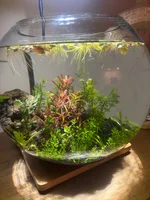
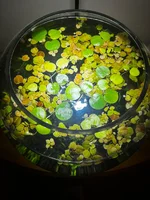
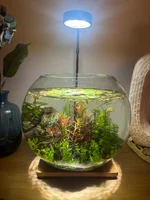
With all the highs and lows of running a high-tech planted tank, I was hoping to put together something much simpler—a small bowl with no filter, no CO₂, and minimal equipment.
Bowl
WGV Large Glass Bowl Vase12" diameter × 10" height
Approximately 3 gallons
Light
AREPK Aquarium & Terrarium Full Spectrum LED5 watts
Substrate / Hardscape
- APT Feast
- A single lava rock
Water
RO water remineralized with APT SkyFertilizer
None so far.Dark Start
I did a dark start for about 2 weeks after squeezing some mulm from an established filter into the bowl.At the end of the two weeks, ammonia remained super high.
I eventually got impatient, did about a 90% water change, and planted the bowl.
Plants
My initial goal was to use relatively fast-growing plants to help stabilize the system. Some of these may not necessarily remain in the bowl long term.Current plants include:
- Limnophila heterophylla
- Pearlweed
- Rotala ‘Blood Red’
- Helanthium tenellum
- Trident Java fern
- Mini Bolbitis
- A few assorted stems from my main tank
- Some nice floating plants
Water Changes
One of the biggest advantages of a bowl this size is how easy maintenance is.A 75% water change takes less than 10 minutes.
For the last couple of weeks after planting, I’ve been doing water changes approximately every 2–3 days.
Experience So Far
So far, the water has remained crystal clear.Maybe it’s the fresh aquasoil, but the pH has been sitting around 6.6. For comparison, my main high-tech tank with APT Feast (about a year old) sits around pH 7 before the CO₂ comes on.
Plant growth has been surprisingly good. I also frequently see the plants pearling, which I wasn’t necessarily expecting from a little no-tech setup like this. The L.heterophylla has been trimmed once.
What has been particularly interesting is how easily plants taken directly from my high-tech tank seem to have transitioned to these very different conditions.
A bladder snail somehow hitchhiked in with the plants. It seems perfectly happy and has already started reproducing.
With the relatively low pH, I suspect much of the measured ammonia is present as the less-toxic ammonium form, which may also explain why the snail seems completely unbothered.
I am starting to see the power of frequent water changes with the lack of algae so far (fingers crossed).
Things I Might Do Differently Next Time
1. Use a less nutrient-rich substrate or cap the aquasoil.For such a small volume of water, APT Feast may simply be more nutrient-rich than necessary. I’m curious to see how things evolve once the bowl matures.
2. Choose a different light.
The light itself works fine, but the built-in timer is frustrating.
If I turn the light on at night just to look at the bowl, it interrupts the timer cycle, and I then have to reset it the following day.
I’m not particularly handy with electrical work, but ideally I’d love a simple light that could just be plugged into a Kasa smart plug and controlled externally.
If anyone has recommendations for a good small bowl light that works that way, let me know.
Overall, though, I’m really enjoying the simplicity of this setup so far.
Looking forward to letting it mature a little more and hopefully adding some red cherry shrimp soon.
12 Replies
·
350 views
