





Today I did nothing for the first time since setup. I did not test or mess with anything.
Just enjoyed the view.
Just enjoyed the view.
Follow along with the video below to see how to install our site as a web app on your home screen.
Note: This feature may not be available in some browsers.

Lol , same hereSunday means Water Change Day.


That makes 3 of us.Lol , same here

4 except I did mine early this weekThat makes 3 of us.

5 of us, plus some trimming and completing the farm tank move from a 20 gallon to a 40 gallon. It was a busy Sunday aquarium day.4 except I did mine early this week

Dennis, how long can you maintain a tank like this with just APT daily fertilizer before you have to do something more significant like add APT Jazz or change out the substrate? Do these high energy tanks burn themselves out quickly or can you maintain them for long periods.... like maybe at least a year minimum?


Thanks Dennis very helpful. As i am starting a new tank i am curious if you have a list of plants that works well for such layouts that one can hope to maintain a long time without needing to uproot.When doing layouts I think it is a good idea to plant a bunch of stuff that does not have to be replanted as often. Then the remainder can be more intensively maintained so to say. I would consider this layout an easy layout to maintain as most of the stems can be trimmed in place many times before needing uprooting/replanting. Rotala 'blood red', Ludwigia arcuata, Lobelia cardinalis bushes can all be trimmed many times before replanting is required (if your tank is healthy, stable and algae free). The stable and algae free criteria is a major determinant though, if the tank is unstable the lower portions will not be healthy enough to regenerate from a straight trim - and I think that this is the problem that prevents many folks from executing what I'm doing.
Lysimachia parvifolia, Buceps, downoi, S repens can all be trimmed in place. Monte carlo carpet has its own time scale/trimming cycle. The Myrio golden can be trimmed in place for quite sometime, but is quite vulnerable to algae, so if the bottoms get algae, I'll replant tops. All bushes will be replanted in time on a rotational basis.

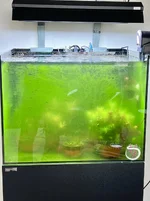

Hopefully you just have to clean the glass good and behind that everything looks great.Just back from a trip. Guess what I’ll be doing today?
This is great info. I'm dealing with having to uproot and replant some mid-ground plants now but probably could have gone much longer if I had a fraction of your knowledge on plant growth and health. I've learned a lot from your posts here, on FB, and on the 2HR Aquarist website. Have you thought about putting out a book? Your tanks have inspired me to try a Dutch style scape as one of my next.I don't think that adding root tabs is a significant event at all - its an effortless action compared to what really needs work in the long run - which is that stems eventually age and deteriorate at their lower portions, and have to be topped and replanted (and older portions need to be uprooted and discarded). Erios get fat and have to be split. Enriching the aquasoil, whether by adding new aquasoil or by adding root tabs is the easy step when replanting is done. The actual uprooting, selection of fresh tops and replanting is what takes a lot of time. The burnout is not in the plants or aquasoil, but in aquarist maintenance.
When doing layouts I think it is a good idea to plant a bunch of stuff that does not have to be replanted as often. Then the remainder can be more intensively maintained so to say. I would consider this layout an easy layout to maintain as most of the stems can be trimmed in place many times before needing uprooting/replanting. Rotala 'blood red', Ludwigia arcuata, Lobelia cardinalis bushes can all be trimmed many times before replanting is required (if your tank is healthy, stable and algae free). The stable and algae free criteria is a major determinant though, if the tank is unstable the lower portions will not be healthy enough to regenerate from a straight trim - and I think that this is the problem that prevents many folks from executing what I'm doing.
Lysimachia parvifolia, Buceps, downoi, S repens can all be trimmed in place. Monte carlo carpet has its own time scale/trimming cycle. The Myrio golden can be trimmed in place for quite sometime, but is quite vulnerable to algae, so if the bottoms get algae, I'll replant tops. All bushes will be replanted in time on a rotational basis.
This is the trimming cycle before the photos above were taken. I replanted the golden myrio, and straight cut the blood red and arcuata.
View attachment 9378
There are also other things one can do to slow down growth. Dosing less in water column, using less CO2 are both valid approaches once you can grow plants well enough. I can straight cut again this month end. But I envision replanting the blood red and Ludwigia arcuata bushes by end of Aug. If I replant those 2 bushes, it will take them a full month to thicken back up. Usually this is where adding a portion of new soil or root tabs is ideal - it provides a short term boost to growth.
In a simple layout such as this, you can farm such displays infinitely if you keep enriching the soil, and keep replanting the bushes. This tank is a standard format I revert to for a plant box display - with 5-6 contrasting stem plant bushes that is easy to maintain. The tank below (from the past) is more than 1 year old when the photo was taken - every bush has been replanted more than once, and even the carpet was switched to hairgrass from HC at some point of time. Notice the similarity in plants used lol. You can tell the golden myrio was more recently replanted, while the Ludwigia arcuata is way past its replanting cycle.
View attachment 9381
Ludwigia brevipes is similar to arcuata. Pearlweed is a good candidate also (but quite weedy). There are many rotala rotundifolia variants, so there are choices for green, orange/yellow tones. Limnophila aromaticaThanks Dennis very helpful. As i am starting a new tank i am curious if you have a list of plants that works well for such layouts that one can hope to maintain a long time without needing to uproot.
Based on your website, I am thinking the following works well for getting bushy and now also reading likely will be easier to keep trimming,
- Rotala blood red sg
- L.Arcuata / L.super red
- P.decannensis.
What about midground plants
- Good to know about L.Cardinalis
- any other suggestions ?
I find that books are difficult to update. I like the website format as it is because I can make changes and updates frequently. Even as recent as this month I rewrote some key concepts that I thought were not phased as well or lacked certain data points. I think there are many more discoveries to be made as time goes by, exciting times !This is great info. I'm dealing with having to uproot and replant some mid-ground plants now but probably could have gone much longer if I had a fraction of your knowledge on plant growth and health. I've learned a lot from your posts here, on FB, and on the 2HR Aquarist website. Have you thought about putting out a book? Your tanks have inspired me to try a Ditch style scape as one of my next.
I was away for about 5 days.How long were you away for?
What do you think causes this?

Wishing you the best of luck with that battle lol!View attachment 9385
Just back from a trip. Guess what I’ll be doing today?
Thanks for all the effort you put into that. I wasn't thinking of the labor. I believe I phrased my question poorly. I think you and I see differently (and it's OK) about what the next step is once the substrate gives out of ammonia.I don't think that adding root tabs is a significant event at all - its an effortless action compared to what really needs work in the long run - which is that stems eventually age and deteriorate at their lower portions, and have to be topped and replanted (and older portions need to be uprooted and discarded). Erios get fat and have to be split. Enriching the aquasoil, whether by adding new aquasoil or by adding root tabs is the easy step when replanting is done. The actual uprooting, selection of fresh tops and replanting is what takes a lot of time. The burnout is not in the plants or aquasoil, but in aquarist maintenance.

Thanks for all the effort you put into that. I wasn't thinking of the labor. I believe I phrased my question poorly. I think you and I see differently (and it's OK) about what the next step is once the substrate gives out of ammonia.
In a normal high tech tank with a lower PAR, when the substrate ammonia is depleted, many people just increase whatever the are dosing. They add extra APT or whatever. However, I would consider the set-up above a super high energy tank. The PAR is 150. So my question is, is the decision to increase water column dosing or whether to replete the substrate of ammonia a personal choice, or do you think the super high energy tank has to have that ammonia to be successful.
For a regular high tech tank, many people obviously just use water column dosing, but I'm inclined to believe the high energy set-up needs that ammonia.
FWIW, There is some APT Jazz in the mail on the way to my house as I type. I might have my tank finally on track, and I'm curious to try some different stuff.


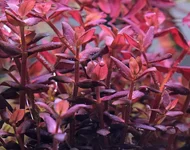


Rotala kill tank comes to mind whenever people bring up heavy water colum+inertSome folks claim that heavier water column feeding plants + inert substrate is the same as feeding plants through water column + rich substrate/aquasoil. However, as someone that grows plenty of pickier species, I find that growth with aquasoil/ammonia produces better growth in many species. Better in the sense of not only faster growth, but better growth forms - thicker leaves, fuller crowns, denser bushes etc. It can be observed in macro photographs of plants when you look up close. A little goes a long way also - small amounts of ammoniacal nitrogen in substrate substitutes a lot of NO3 in the water column.


