A quick update, as I continue to learn from using the reactor in my tank.
My favourite mode of operation is the overflow mode
... which means that I always use the reactor at its maximum capacity and that it is the reactor geometry that stabilises CO2. As I used the original 17.7 ratio for calculating the dimensions, my pH drop exceeded 1.5, which actually I found a bit too much.
I decided to reduce my reactor power a lot, so that I now have a nice lime green drop checker.
Original dimensions (using 17.7 ratio for 1.5-1.6 pH drop):
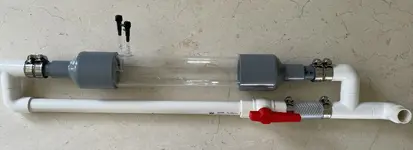
I reduced the size. It helps that I did not use glue for the transparent acrylic to pvc, but teflon tape and can easily disassemble and assemble back again with adjusted dimensions.

I fully understand that all users so far use the reactor in a more conventional manner, i.e. adjusting the CO2 flow with a precision CO2 needle valve or using a pH/CO2 controller. I believe it is only a matter of time for others to start using overflow mode as I am doing. I don't care anymore about the precision or stability of my CO2 regulator, I am not using a pH/CO2 controller anymore, and I don't even see why I would buy a new pH probe (it broke down a couple of months ago). With overflow mode, and especially now that I understand much better how it works, CO2 has become so easy and reliable for me. But we need a slightly different approach, and know how to set it up and verify if everything is ok.
I have now three different checks to verify if I inject enough CO2 in my reactor:
- Having a transparent tube, I can see the bubbles injected in the reactor. I know the bubble / second for my maximum reactor capacity, and target 5-10% higher to make sure overflow mode is optimised. For this I would need to make a 10 seconds video, and obviously I don't want to do that too often.
- When the reactor works well in overflow mode, I will have some small bubbles escaping every now and then through the spray bar in my tank. This is a very easy verification that injection is good, and I check that with observing my spray bar for half a minute or so, several times per week. My CO2 regulator is not perfectly stable, so if I see no bubbles escaping at all, I will give it a bit more flow without caring too much about precision.
- As I described in an earlier post, the same physics that lets CO2 absorb in the water will cause some other gases to build up in the reactor. This happens for bubble reactors, or horizontal reactors, in fact at any interface between pure CO2 and water. In my post #156 I calculated how much 'air' will build up as a function of CO2 flow, and I can see this air early in the morning in the reactor before CO2 turns on. If I see really little air, it means that my reactor the previous day has been purging very efficiently, and that I have a really good CO2 flow or perhaps even too much flow and unnecessarily waste some CO2. If I see too much air in the morning, I'd better increase my CO2 flow a bit. I can imagine that this is still a bit confusing to read, and I am happy to further elaborate in follow up posts. I use this method just when I am curious if everything is ok, and definetely not as regular as the previous 2 methods mentioned.
This is my reactor early this morning. I see very little air in the top, and know that everything if fine.
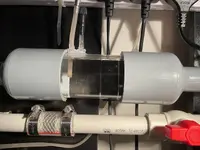
I believe in a few years time, many if not most will use overflow mode and enjoy the savings on expensive CO2 components that are now still necessary for CO2 stability. Anyone who wants to give it a try, do not hesitate to reach out to me with PM, so that I can help as much as I can until we are all confident it works well.


 to UKAPS admins for deleting this thread. A tribute to innovation and progress in the hobby. I have moved on, and am not that passionate anymore to test and share new ideas, but I like to avoid that so much work over 2 years gets lost. When I have more time, I will scan my notes and post here in ScapeCrunch what is missing after deletion. Unfortunately I will not be able to recover the many questions and suggestions from UKAPS members, which was probably the most valuable and most fun to read.


 .
.