Welcome to ScapeCrunch

We are ScapeCrunch, the place where planted aquarium hobbyists come to build relationships and support each other. When you're tired of doom scrolling, you've found your home here.

Horizontal CO2 Reactor - Yugang 鱼缸 Reactor

  • Thread starter Thread starter Yugang
  • Start date Start date
  • Tagged users Tagged users None
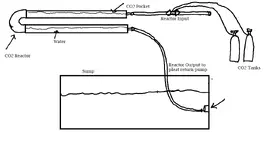
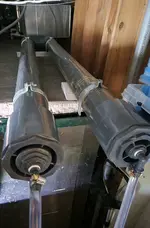
nearing completion. The one piece not shown is the currently in use in line diffuser which will be the injection point (ceramic disc removed). I will drive it with an eheim 2213 (most filter media removed, maybe keep the tube type in there), also currently in use. But that should be ready to use in a couple of weeks. I will mount this in the cabinet under the tank. Endcap to endcap is 40”. Tank is a standard 75, 48x18x21, 2” pvc.

1692898398190.webp
 
I have most of the parts to build my reactor now. I’m waiting on the pipe brackets until I figure out the configuration. In my poorly hand drawn sketch.

Which so you think will work best?

Option 1 is the easiest to build given my filter location relative to the discharge to the tank. Option 2 requires more pipe but might be more effective with the bypass.

The reactor is 2 inch, all other piping is 1 inch.
I am most likely over thinking the bypass and should just roll with the easiest to build, option 1. My concern with option 1 is there will not be enough flow through the reactor without throttling the bypass valve almost closed which could be very noisy.

I’d prefer this whole system to be hard pipe and minimize hoses and hose barbs. Both designs will only require one hose barb with a clamp.
IMG_2180.webp
 
I have most of the parts to build my reactor now. I’m waiting on the pipe brackets until I figure out the configuration. In my poorly hand drawn sketch.

Which so you think will work best?

Option 1 is the easiest to build given my filter location relative to the discharge to the tank. Option 2 requires more pipe but might be more effective with the bypass.

The reactor is 2 inch, all other piping is 1 inch.
I am most likely over thinking the bypass and should just roll with the easiest to build, option 1. My concern with option 1 is there will not be enough flow through the reactor without throttling the bypass valve almost closed which could be very noisy.

I’d prefer this whole system to be hard pipe and minimize hoses and hose barbs. Both designs will only require one hose barb with a clamp.
View attachment 2823

Remind me, what pump and what flow rate do you have? If it is a really small pump, perhaps a dedicated pump for the CO2 circuit, you may keep the configuration as simple as possible and direct all flow through the reactor and skip the bypass. For a bigger pump, like most canisters, you would probably prefer a bypass.

My experience, others may chime in, is that the reactor works best with low flow and a nearly ripple less 'river' in the reactor pipe. This will eliminate all noise, and having small surface ripples only tiny CO2 bubbles escape occasionally if you would ever like to use it in overflow mode (ie at maximum capacity). More flow, and more turbulence in the water will still work, but it could start making some noise and the waves and turbulence may start generating and pushing CO2 bubbles out.

This is why I built my reactor with the following configuration
1692917640872.png

When I operate it the bypass (from FX4) is nearly fully open and I see only a minor movement in the transparent reactor pipe. So in fact I optimised my bypass for it to give minimum pressure loss for my pump, as I know that the reactor will be fine anyway with any amount of flow (as long as the water does not fully stop and gets stagnant).
 
Remind me, what pump and what flow rate do you have? If it is a really small pump, perhaps a dedicated pump for the CO2 circuit, you may keep the configuration as simple as possible and direct all flow through the reactor and skip the bypass. For a bigger pump, like most canisters, you would probably prefer a bypass.

My experience, others may chime in, is that the reactor works best with low flow and a nearly ripple less 'river' in the reactor pipe. This will eliminate all noise, and having small surface ripples only tiny CO2 bubbles escape occasionally if you would ever like to use it in overflow mode (ie at maximum capacity). More flow, and more turbulence in the water will still work, but it could start making some noise and the waves and turbulence may start generating and pushing CO2 bubbles out.

This is why I built my reactor with the following configuration
View attachment 2824

When I operate it the bypass (from FX4) is nearly fully open and I see only a minor movement in the transparent reactor pipe. So in fact I optimised my bypass for it to give minimum pressure loss for my pump, as I know that the reactor will be fine anyway with any amount of flow (as long as the water does not fully stop and gets stagnant).
This will be attached to my FX4 filter outlet.
 
This will be attached to my FX4 filter outlet.
In that case I would assume that your reactor is good with 10-20% of your FX4 flow, and you would like to optimise the flow rate from your FX4 by building a bypass that has as little resistance as possible and takes 80-90% of the flow. Use a valve in the bypass, that you can close a bit when you suspect the reactor does not get enough water flow to make it work. Also, build everything with 1" tubing, same as FX4 diameter, to optimise flow. This is all about sacrificing as little as possible from your FX4 flow, as we can be confident that the CO2 reactor is tolerant and can handle most situations.
 
Last edited:
I'm considering using something like gutter downspouts to create a rectangular cross-section for increased/more consistent surface area.
Perhaps I saw what you would be looking for @CFassett :

1692945068152.png

This box, for fruit or slices ham or cheese in the fridge, is only 1" high, with a volume of 1 liter.

A quick calculation shows that it does the job for a 1.5 pH drop on a 100 gallon, 375 L (59" * 20" * 20") tank. A lot of punch for a 1 liter reactor, and indeed more compact and for some probably preferable over a tube. If I would use this box (unfortunately my tank is too small for it), I would just glue the lid as there is no need to open it.
 
Last edited:
IMG_2184.webp
Ran out of 1 inch pipe. I thought I could get away with 5 feet of 1 inch but the small sections between fittings used up more pipe than I anticipated. The build ended up being much longer than I anticipated too. Over 48 inches end to end. So, I am going to have to replace the top hose barb with a 90 degree barb to account for mounting this lower down on the back of the tank. I am also considering shortening the entire thing and increasing the reactor diameter to 3 inches. All this stuff was free so I am not that concerned about it not ending up 100% correct.
 
I am definitely going to shorten this up and change the reactor from 2 inches to 3 inches. My math gets me 30,980 mm2 with a 16 inch long 3 inch diameter reactor based on the minimum required 31,000 mm2 based on my tank’s surface area using @Yugang 17.7 factor.
 
I shared this reactor on my tank journal but I thought I should also share it to this thread. A few months ago @Yugang helped me design this reactor and do the calculations to determine the size. We ended up needing an 8 foot reactor with at least 4 inch PVC pipe.

The length would make it difficult to fit in the room so I curved the reactor like in this drawing. I liked the compactess of this design, but it is essentially still the same thing except that the river in the reactor hits a U turn in the middle.
1693179846942.png
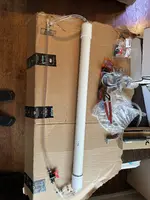
The final dimensions of the reactor were 66 inches in length on each side, and about 6 inches on the U pipe. Total reactor length is about 138 inches or 11.5 feet. The pipe is 4 inch industrial grade PVC.

Here is the reactor.20230623_114850.jpg20230729_114317.jpg20230729_114255.jpg
Here is a video of the setup.
You can see all the bubbles going into the reactor and nothing coming out. 100% efficient. I've so far used it up to 1.3 pH drop with 100% dissolution I have not tried pushing it further but I'm sure it can do more. You can see the flow going through the reactor at the end.

This is the pH profile. I'm hitting a 1 pH drop very fast in 38 minutes! This reactor is on a 1000 gallon tank so I am very impressed with its performance. I was originally anticipating several hours to reach a 1 point drop but instead hit it in 38 minutes! You can also see how stable the pH stays after hitting th3 equilibrium point.
Screenshot_20230807_172658_Sheets.jpg
So easy to build and so much performance. I highly highly recommend this reactor for others thinking about it, especially for big tanks. Thanks again @Yugang for helping me make this.
 
I shared this reactor on my tank journal but I thought I should also share it to this thread. A few months ago @Yugang helped me design this reactor and do the calculations to determine the size. We ended up needing an 8 foot reactor with at least 4 inch PVC pipe.

The length would make it difficult to fit in the room so I curved the reactor like in this drawing. I liked the compactess of this design, but it is essentially still the same thing except that the river in the reactor hits a U turn in the middle.
View attachment 2878
The final dimensions of the reactor were 66 inches in length on each side, and about 6 inches on the U pipe. Total reactor length is about 138 inches or 11.5 feet. The pipe is 4 inch industrial grade PVC.

Here is the reactor.View attachment 2879View attachment 2881View attachment 2880
Here is a video of the setup.
You can see all the bubbles going into the reactor and nothing coming out. 100% efficient. I've so far used it up to 1.3 pH drop with 100% dissolution I have not tried pushing it further but I'm sure it can do more. You can see the flow going through the reactor at the end.

This is the pH profile. I'm hitting a 1 pH drop very fast in 38 minutes! This reactor is on a 1000 gallon tank so I am very impressed with its performance. I was originally anticipating several hours to reach a 1 point drop but instead hit it in 38 minutes! You can also see how stable the pH stays after hitting th3 equilibrium point.
View attachment 2883
So easy to build and so much performance. I highly highly recommend this reactor for others thinking about it, especially for big tanks. Thanks again @Yugang for helping me make this.

would you happen to know what your injection rate is?
 
would you happen to know what your injection rate is?
I am not sure on the exact injection rate, I will need to measure next time I see the tank. I just know I am injecting enough for a 1.1 drop. One of the 20lb CO2 tanks lasted me 3 weeks, assuming the other one also lasts 3 weeks I am using about 1.9 lbs of CO2 a day. CO2 is on for 9.5 hours each day.
 
Hey all, I went ahead and created an Excel-based calculator for sizing a reactor. You can't edit it directly in my Drive, but you can download a copy and do as you will.
This will save me some work, thank you :)

My suggestion would be to add fields for a sump to the calculation inputs. So far about half of the calculations I helped with included a sump, and it contributes equally to the outgassing surface area as the tank.

Then, to make it even more fancy you may add a few reminders about the rate of CO2 outgassing and therefore required reactor strength:
  1. This is an estimation, based on a 'average' surface agitation in an open top tank and a targeted 1.5 drop from fully degassed tank water.
  2. A tank/sump covered with lid, or build-in 'closed' cabinet configuration will reduce CO2 outgassing, CO2 consumption, and may require a smaller reactor.
  3. Overflows and aeration pumps will increase outgassing.
 
Last edited:
what are your guys' starting pH and kh?
I change 70% water weekly, kH around 2 with some seasonal variations, degassed pH at 7.3. My pH drops about 1.5 from fully outgassed, and around 1.0 from partially outgassed in the morning.

part of me is worried that i wont get the same results due to my high kh. my tap fluctuates between 9 and 11 year round
I don't think that higher 11 KH will change CO2 injection a lot (of course need to correctly set pH targets), nor that slow seasonal 9-11 KH fluctuations are huge impacts on CO2. When using a pH controller, I would only be concerned with faster KH changes (say 2 KH within a week) as this may give typically 20% CO2 ppm variations.

Note:
Also Hong Kong tap water has some variations depending on the season. With the reactor in overflow mode, there is less need to be worried about kH fluctuations, or the need for pH target adjustments, as it is the reactor geometry (which is constant) that drives CO2 injection. There is no role for any precision CO2 regulator or pH controller, nor a need to precisely know/control kH or pH values.

My current focus is consistency and stability, and hence the more variations I can eliminate, the better. Perhaps you know the paint markers that are sometimes used in engineering, that help to identify if anything has changed that may be relevant for the setting of a machine? These markers help to keep things as-is, and freeze the status.


1694056361947.png

With the reactor in overflow more, there are less control points that can be changed and with that potentially do more harm than good. I am hoping that this simplicity in my system helps me to keep injection stable and allow me to be less focussed on measurements as well.
 
Last edited:
Back
Top