Hi, which media is in the filters, and in which condition are they?Filtration: tetra ex 1500, oase biomaster 750 thermo
Follow along with the video below to see how to install our site as a web app on your home screen.
Note: This feature may not be available in some browsers.
Hi, which media is in the filters, and in which condition are they?Filtration: tetra ex 1500, oase biomaster 750 thermo

Oase has standard oase filters in it and 1 basket of bio material.Hi, which media is in the filters, and in which condition are they?

The tank could use some more plant mass.Thought I'd join this thread, as I've had similar issues with diatoms never seeming to go away. However, a lot of this was probably because I attempted to do DIY fertz and a DIY horizontal reactor on my very first planted aquarium. As someone who had reasonably good success with reef aquariums, I wayyy overestimated my abilities with planted tanks. That resulted in 10 months of hell trying to diagnose the issues and nearly quitting the hobby several times.
Long story short, I'm fairly certain that the most likely causes were #1 Unstable CO2 from my crappy DIY reactor #2 Unstable Nutrients #3 Generally being a noob #4 Not changing my DI resin on time because I thought it wasn't as crucial for freshwater.
I took a break from the hobby by running my tank in "dark start" mode for about 2 months, and I let my plants grow out emersed in some plastic bins to get a larger plant mass without combating algae.
I changed to off the shelf products for CO2 Injection (In-line diffuser) and fertilization (APT 3) so that I could start fresh with less variables to track (just as Dennis suggested in a recent podcast).
A little over a week ago I replanted the tank, performed ~50% water changes daily and things were looking SO much better than before. I thought I'd finally figured things out. But around day 8, the diatoms started to be much more noticable despite my best efforts to manually remove algae with daily water changes in the first week.
Of course I've read Dennis' algae control articles dozens of times but have some trouble with the implementation.
Where I struggle with this, is that by following the advice to trim off the tops and replant, the plant mass in the tank is reduced and the algae seems to gain the advantage.
With the carpeting plants, removing algae manually is pretty much impossible with a brush or by hand without ripping the plant up entirely. I trim away stuff that is clearly dead/melting, but algae seems to cover leaves about the same rate that new ones grow. I'd have to use way too much H2O2 to treat everything.
Either way, I fear that I'm re-living the same cycle where algae isn't on the very newest growth, but takes over anything more than a few days old.
I'm hoping that because my CO2 and nutrients will be more stable using off-the-shelf products that I'll be able to get past this diatom phase this time. I'd expect that if parameters are held stable, new growth won't be taken over by algae within a few days and therefore break the cycle?
I'd love the experts here to take a look at the current tank parameters and tell me if anything looks off or what I should do differently.
Tank: ADA60P
Light: Twinstar S | 95 PAR @ Substrate for 6 hours/day
CO2: UNS In-line Diffuser | 35-40ppm (Tested Hanna CO2 Test Kit) | On 2.5hrs prior to lights, off 30 mins before lights off
Filter: Oase 350 with 30ppi Sponge Only
Soil: Amazonia II Aquasoil (almost 10 months old, no root tabs used but also hasn't ever seen a heavy plant load)
Fertz: APT 3 —> 1 ml/day first week, bumped up to 2ml/day once plants filled out a bit... probably shouldn't have increased this quickly... I used the APT calculator but wasn't sure whether to use the "lightly planted" dose or default dose.
Water: RODI remineralized with 30ppm Ca and 6ppm Mg.
50% water changes daily for first week
Plants: Rotala blood red, crypto wendtii, hydrocotyle tripartita, pearlweed, javafern, hygrophila pinnatifida
Tank is in farm mode so that I can learn to grow plants before introducing wood, stone, etc.
My questions for the experts:
View attachment 18438View attachment 18436View attachment 18437
- Is it a problem that plant mass is reduced when you trim off the good parts of the plant to replant and discard the algae covered stuff?
- How do you deal with this with carpeting plants that are much harder to clean off manually and separate new growth from old?
- APT3 is a zero-bound system, which I understand to be used with nutrient rich soil. Is it potentially problematic that I'm using old soil despite it never having seen a full plant load?
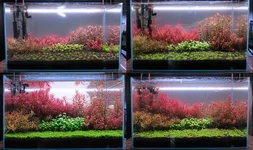
As in buy some more plants or let these grow out more? (Used up my emersed stock)The tank could use some more plant mass.
I am just farming out these plants to add hardscape later. Would APTe still be appropriate for a tank with medium plant density versus a dutch style?If you are have no other source for N (no livestock for example), and your soil is relatively depleted, and your tank aims to be fully planted, APTe will likely be more suitable than APT3. If you add livestock, or enrich soil, then staying with APT3 will work.
The filter on this tank has been running for 10 months continuously. It was seeded with commercial bacteria as I don't have other tanks (yet...).For diatoms - accelerating tank maturity helps a lot, introducing mulm/media from matured aquariums will help.
The diatoms I'm dealing with cover the surface of the leaves rather than stringy-like algae shown in your example tanks. My algae won't come off by siphoning, I have to rub the algae off with my fingers or a brush.If the diatom issues are slight, I wouldn't do anything drastic. Just vaccum them off during water changes and let the tank grow in.
The tipping point can take weeks to reach for some tanks.
I think you can get just let stuff grow out more.As in buy some more plants or let these grow out more? (Used up my emersed stock)
I am just farming out these plants to add hardscape later. Would APTe still be appropriate for a tank with medium plant density versus a dutch style?
The filter on this tank has been running for 10 months continuously. It was seeded with commercial bacteria as I don't have other tanks (yet...).
I would assume "tank maturity" from a microbial standpoint is not just a factor of letting your filter run long enough to build beneficial bacteria? What factors are we working towards in tank maturity?
The diatoms I'm dealing with cover the surface of the leaves rather than stringy-like algae shown in your example tanks. My algae won't come off by siphoning, I have to rub the algae off with my fingers or a brush.
I think I was under the impression that I needed to keep the tank as spotless as possible the first few weeks in order to give the plants the ability to gain the advantage. It's been pretty exhausting to rub algae off an prune nightly.
I'm also not sure if doing daily water changes is necessary when using used aquasoil. However, this round of planting with an in-line diffuser and APT fertilizer has gone so much better than my past several attempts with DIY reactor and fertz.

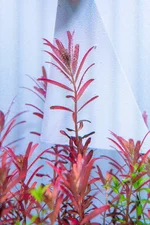

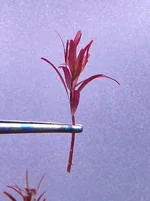


if new growth looks good for some time and then develops algae, it means that your system is not stable. How frequently are you doing water changes now that you are past your first week. What is the ammonia/nitrate level and PAR level at substrate? If you are confident that the co2 and nitrate levels are stable then i might recommend more water changes to help you reach some stability. Plants like pearl weed and H.tripartita might be good to let them grow out and reach significant mass which can help reach stability. Once you are stable you can replace them.The problem I've been having (and why I originally posted on this thread) is that I follow the steps to discard any old growth through pruning and/or trim & replant. However, any new growth more than a few days old seems to develop some algae.
Is that normal for a newer tank?
Or, Will it take a few cycles of trimming and replanting for everything to stay algae free?
The way I'm currently thinking about it is that any new growth should have adapted if parameters were stable, so any new growth should remain algae free. And, if any algae develops that means parameters weren't stable. But, I can also see how it may take a few cycles of replanting to stick.
As I mentioned before, I suspected a lot of my algae issues came from DIY fertz and DIY reactor in my previous attempts to plant this tank. But, I still seem to be experiencing this to some degree of algae covering fairly fresh growth even with off the shelf fertz and diffuser. I’m holding parameters pretty stable as far as I can tell.
My hydrocotyle tripartita seems to be getting less algae after I discarded old growth and only replanted new growth. I'll be interested to see what happens when I do this with the rotala and pearlweed this time around.
I've been doing at least 50% water changes daily for the first two weeks, some 80%-100% over the weekends when I have more time. Nitrates are usually around 3-5ppm, and my PAR is about 95 at the substarate. I'm pretty confident that my CO2 levels are stable because my diffuser is new, the drop checker is consistently the same color each day and I check it periodically with the Hanna CO2 kit.if new growth looks good for some time and then develops algae, it means that your system is not stable. How frequently are you doing water changes now that you are past your first week. What is the ammonia/nitrate level and PAR level at substrate? If you are confident that the co2 and nitrate levels are stable then i might recommend more water changes to help you reach some stability. Plants like pearl weed and H.tripartita might be good to let them grow out and reach significant mass which can help reach stability. Once you are stable you can replace them.
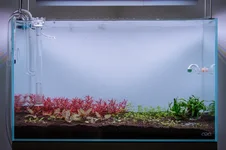

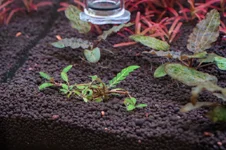

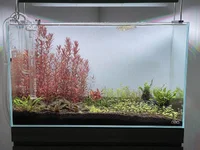
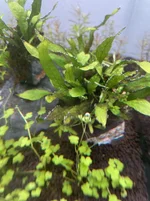
Plant Mass --> The plants have grown out quite a lot so I'm surprised that this is still considered a low plant mass tank. Between needing to prune and replanting stems to discard algae portion, it's a bit difficult to keep it much denser than it already is but I will try.Interesting, that your nitrate is getting to 5 ppm with just 0.5 ml of apt 3. Mine is a slightly bigger tank than yours and I dose 2 ml of apt3 with barely any nitrates measurable. Your blood red color seems really good so I would assume that your nitrates are pretty low.
Couple of things to try out
- it would be beneficial to do more plant mass. Your blood reds can be basically doubled or tripled in density if you are going for the Dennis Wong style bush. Maybe plant 2 or 3 more bushes with the HRA and pearl weed.
- how do you check nitrates? I would suggest using the salifert nitrate kit. If you are consistently measuring <1 which Is what I would expect you to measure - yours would be a zero bound system based on my understanding of 2hr aquarist method and would not updose with water change.
- do you get lot of direct sunlight ?
- 90 par might not be necessary and you could aim for 50 par and all your listed plants will still grow really well (don’t know about Wallichi though since I don’t have experience with it). 50 par is more than enough to get bright red with rotala br with nitrate limitation and a orangish greenish red with HRA.
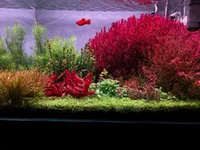
View attachment 19629View attachment 19631
A quick update on this tank about a month after last post.
Generally things have gone better, but I'm still frustrated. The plants are growing a lot and I've been through periods where there's very little algae. However, if nutrient levels creep up to 5ppm NO3 or so then ~20% of leaves start to get covered in brown algae. I prune very regularly and have been through a few cycles of full leaf change-over and or re-topping for stems.
As far as I'm aware, I've kept parameters pretty darn stable with NO3 hovering between 2-5ppm. I've been doing 70% water changes 2x per week for over a month. CO2 seems quite stable as far as I can tell.
I thought I was finally in the clear with commercial CO2 injection and fertz, but it seems something still isn't quite right. I've measured my nutrient uptake over a week a few times via NO3 testing and it's less than 0.5ppm per day NO3.
I'm at a loss as to what could be wrong and am pretty discouraged. I know this is a challenging hobby, but I'm pretty attentive to detail and just don't think it should be THIS difficult. Any suggestions would be appreciated. Below is a refresher on tank parameters.
Tank: ADA60P (Tank started with dark start method ~11 months ago)
Light: Twinstar S | 95 PAR @ Substrate for 6 hours/day
CO2: UNS In-line Diffuser | 35-40ppm (Tested Hanna CO2 Test Kit) | On 2.5hrs prior to lights, off 30 mins before lights off
Filter: Oase 350 with 30ppi Sponge Only
Soil: Amazonia II Aquasoil (almost 12 months old, no root tabs used but also hasn't ever seen a heavy plant load)
Fertz: APT 3 —> NO3 kept at 2-5ppm as proxy for overall nutrient levels. Usually about 0.5 ml/day average. Replenishing dose added post WC to make NO3 2ppm
Water: RODI remineralized with 30ppm Ca and 6ppm Mg.
50% water changes daily for first week
Plants: Rotala blood red, Rotala H'ra, Rotala Wallichii, crypto wendtii, hydrocotyle tripartita, pearlweed, javafern, hygrophila pinnatifida, monte carlo, AR Mini

 www.2hraquarist.com

I'm considering just getting a Hanna Checker
 Big fan, I got mine half price on eBay, or they usually go on sale close to half price around Black Friday

I'd like to test my tank
how do you find deciphering the colour changes using salifert

 www.plantedtank.net

This makes me wonder if my aquasoil is just depleated... It's about 1 year old, but the first 2 months were dark start and there were a few additional months that the filter was running but with no light and no plants. It never saw a plant load heavier than the last few photos (so fairly light/medium). I have never added fresh aquasoil or root tabs. I did use the pellets that come with Amazonia II, and they're still in good shape. Our apartment does get quite a lot of natural light, but I measure the corner where the tank lives at about 10 PAR at its brightest.View attachment 19633
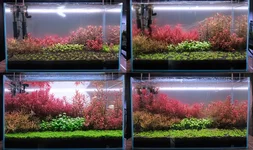
I would say that you have good number of plants but just would need to be denser. This is a pic of my tank I would say in peak condition (in winter with not much sunlight and still strong aquasoil) with relatively good plant mass (rotala blood red in the back with Rotala HRA in the front of it). This is with nitrates <1-2. Now experiencing constant algae issues in summer with lot of direct sunlight and weakening aquasoil.

 www.2hraquarist.com