Welcome to ScapeCrunch

We are ScapeCrunch, the place where planted aquarium hobbyists come to build relationships and support each other. When you're tired of doom scrolling, you've found your home here.

Experiment: Finding optimal conditions for growing aquarium plants

Chapter 1: Growing plants with heavy fertilisation in the water column

Introduction

Plants differ not only in shape, color, size or growth rate, but also in their requirements or preferences. While all plants need water, light, heat, nutrients and the absence of harmful influences to grow well, some need to have these mixed in a specific ratio. In a way, it's similar to humans: while some people are not too picky about food (they'll eat anything), gourmets are picky eaters (they despise ordinary food). Similarly, some plants will grow in almost any circumstances (in acidic or alkaline water, in low or high light, in sand or organic soil, in nutrient-poor or nutrient-rich water), while others are a little more "spoiled" and therefore require more specific environmental parameters (whether it concerns the intensity of the light, the physico-chemical parameters of the water, or the composition and characteristics of the substrate). Figuring out what each plant prefers (or downright requires) is not easy. First of all, it requires us to identify all the relevant factors that play a significant role → e.g. pH, redox, organic compounds, light intensity, temperature, content and ratio of different nutrients, substrate properties, microbial composition, etc. These factors then need to be tested in order to clarify the extent to which they influence the outcome - i.e. the growth and condition of our plants. This experiment is an attempt to test a particular set of factors that I have identified as potentially important. [I am by no means claiming that my selection is the most important or comprehensive. But I have to start somewhere.] In each of the eight aquariums, I used a different recipe (i.e., a different set of factors) in the hope of revealing the particular preferences of each [tested] plant. This experiment, however, is only a sort of "first chapter" in a series of other tests that I plan to carry out gradually. I believe, however, that it may provide valuable partial insights from which a more complete picture (mosaic) of our aquarium plants and their needs (preferences) can be assembled over time. More detailed information and further experiments can be found [if interested] on my website: golias.net/akvaristika/.

The main objective

To identify the optimal parameters for cultivation of aquarium plants.

Aquariums

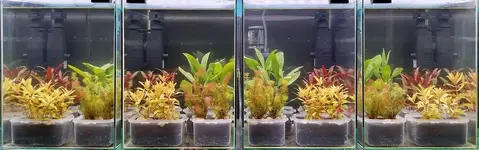
Eight identical aquaria → 20 liters or 5 gallons (net volume) each

Plants

In this experiment I decided to use the following emersion plants (i.e. plants grown in a greenhouse):
  • Ammannia pedicellata 'Gold' (formerly known as Nesaea sp. Gold)
  • Hygrophila corymbosa
  • Pogostemon deccanensis (formerly known as P. erectus)
  • Rotala wallichii

Diagram of plant placement in individual aquariums ↓

1735031504175.png

Picture of the fifth aquarium (few days old) ↓

1735031603943.png

Picture of all eight experimental aquariums ↓

1735031657632.png

Light

Lighting interval: 8h/day

Light intensity (PAR) in individual aquariums:
  • top: 231 µM/m2·s → just below the water surface
  • middle: 98 µM/m2·s
  • bottom: 96 µM/m2·s → at the bottom

1735031758833.png

Note: There was no difference between the values in the middle vs. at the corners of the aquarium on the horizontal axis (except for the top section = near the light source).

1735031847089.png

1735031872957.png

↑ Measured with Apogee MQ-610 (full-spectrum quantum meter). The measured values were [in accordance with the manufacturer's instructions] converted for an underwater environment using a correction factor of 1.25.

Substrate

While in the first set (aquaria #1 to #4) a substrate for aquatic plants covered with a layer of pure silica sand was used, in the second set (aquaria #5 to #8) no substrate was used.

1st set → nutrient-rich substrate

1735031961394.png

2nd set → no substrate

1735031991447.png

Because the organic substrate should contain sufficient N, P and micronutrients (NPµ), these nutrients were not added to the water column; I assumed that some N and P would be leached from the substrate into the water column anyway.

I used a local horticultural substrate for aquatic plants capped with a layer of silica sand.

In aquariums without substrate, I used M16 stainless steel hexagonal nuts inserted into small hydroponic net pots (Ø 5 cm = 2") to anchor the plants. The stems in the nuts were held in place by a small strip of coarse foam.

Water

Note: The recipes below were prepared using pure (demineralized/deionized) reverse osmosis water.

1735032091014.png
  • Water flowensured by a surface skimmer (Jingye JY-350)
    • no filtration used
  • Water changes done once a week (with 50% of the water changed) with macro-nutrients replenishment
  • Micro-nutrients added every other day (most in the form of EDTA chelates, iron in the form of gluconate + DTPA)
  • Extra CO2 added to aquaria #1, #3, #5 and #7 using a simple glass diffuser, the function and parameters of which are described in more detail in a separate article
    • target CO2 concentration in these aquaria: ~15 ppm
  • The pH fluctuated or decreased during the experiment (in some aquariums quite significantly) → see photo documentation for week #4.

Documentation

planting: 2024-10-04

1735032226954.png

1735032253556.png

week #1: 2024-10-12

1735032306893.png

1735032329898.png

week #2: 2024-10-19

1735032364139.png

1735032386042.png

week #3: 2024-10-26

1735032405332.png

1735032422068.png

week #4: 2024-11-02

1735032443172.png

1735032458203.png

Details (first experimental set: aquaria #1 to #4):

1735032599518.png

Details (second experimental set: aquaria #5 to #8):

1735032641721.png

week #5: 2024-11-09

1735032693604.png

1735032710226.png

week #6: 2024-11-16

1735032730584.png

1735032744549.png

week #7: 2024-11-23

1735032764154.png

1735032779623.png

Results

Note: In the first weeks a brown haze was visible in the first experimental set (from leached humic substances from freshly flooded substrate).

The following data is a brief description of the visual condition of the plants in each aquarium (1 to 8). Green indicates best condition, blue indicates good condition and red indicates fair condition.

The pH values below represent the average measured in the last weeks of the experiment.

Ammannia pedicellata 'Gold'

1735032926960.png

Hygrophila corymbose

1735032961928.png

Pogostemon deccanensis

1735032984426.png

Rotala wallichii

1735032993596.png

Evaluation

Keep in mind that:
  • Higher light (more energy) = higher nutrient demand (especially CO2) = higher risk of deficiency
  • In the first experimental set, NPμ is absent in the water column and plants there depend on NPμ in the sediment, which might have [negatively] affected the result (yield/condition) compared to the second experimental set → causing NPμ deficiency or heavy metal (or hydrogen sulphide) toxicity in the sediment
1735034434963.png

Ammannia pedicellata 'Gold'

Probable characteristics:

1735033304397.png

Hygrophila corymbosa

Probable characteristics:

1735033318168.png

Pogostemon deccanensis

Note: The purchased plants were not in the best condition, so their onset was considerably delayed (they started to show some growth only from about the third week). Also, this plant [appears] to show no marked signs of deficiency and is therefore not a suitable indicator of malnutrition.

Probable characteristics:

1735033331046.png

Rotala wallichii

Probable characteristics:

1735033344022.png
 
Last edited:
Amazing work and post @Marcel G.

Can't believe it is a coincidence that this got posted just before the holidays?

I hope you continue your experiments and these really high quality sharing of your experience.
 
Can't believe it is a coincidence that this got posted just before the holidays?
Here in Europe we celebrate Christmas on the 24th of December, so I thought it might be a nice Christmas present [for some aquarists here].
I hope you continue your experiments ...
Yes I do, Chapter 2 is already in progress; this time with a lean fertilisation in the water column:

1735103976997.png

1735104012640.png
 
Amazing work Marcel. Ive always been an admirer of your experiments. But Im curious what metric you're using to know which results are truly healthy plants vs plants that just appear healthy

In our PM conversations you told me that my plants were not "truly" healthy, they just appeared that way. You went on the compare them to bodybuilders on stage who appeared to be great physical specimens but were really in terrible health due to steroids and hormones. And you used a couple other examples to show your point such as the Chinese gardens mentioned below

To quote just a few of your words to me about my plants:

The fallacy of your view (i.e. the falsity of the conclusion you draw from the above assumptions) is that you confuse "truly" thriving plants and animals with "apparently" thriving plants and animals.

So the key is to think about whether how things "appear" to us automatically means how things "really" are.

I will give a simple example which will [hopefully] make it clear that appearance and reality are not necessarily one and the same:

Many Chinese cities tend to have extremely polluted air (smog) in winter, which exceeds the standards set by the World Health Organization several times over. Yet these cities are home to people who are happily reproducing and raising children. On the face of it (i.e. if you judge people's health or well-being solely by whether they breed or whether they go out, play in the playground, ride their bikes or eat in restaurants), you could say that there is no problem and that air pollution poses no risk to people. BUT IF you looked at this more closely and started looking at factors like maternal mortality rates, life expectancy, cardiovascular disease rates in the population, etc., and compared it to other cities where there is no smog, you would immediately see the difference => the maternal mortality rates [for people living in these Chinese cities] is higher, as is the rate of cardiovascular disease, and conversely the life expectancy is lower.

So Im curious what metric you are using to determine which of the plants in your experiments are "Truly" healthy vs only appearing to be healthy but really are not (like you say my plants are)

To me if an aquarium plant looks healthy thats proof enough that it is healthy. But according to you, that isnt the case, at least with my plants. So would you kindly explain to a simple minded chap like myself what to look for in your experiments to know which results are the "truly" healthy ones?

Thanks!
 
Hi @Burr740,

the answer to your question lies in the answer I gave you, which you quoted here, but which you persistently ignore. Therefore, there is no point in discussing it further with you.

Briefly: My results only suggest something, not prove it! CO2 seems to be the biggest guarantee of success, but that doesn't mean I have indisputable proof for it. In the "Evaluation" section I describe probable characteristics, not indisputably proven characteristics. And that's the difference between us => I (unlike you) don't consider good looks as evidence. I consider it at most an indication, which may or may not actually be true. So I allow for the possibility that how plants look on the outside is not necessarily evidence of their impeccable internal condition.

PS: I find it disrespectful and unethical to publicly quote someone's private correspondence without their permission. :mad:(n)
PPS: I won't answer any more of your further questions, because I've ceased to regard you as someone who is genuinely interested in understanding the substance of the matter.


Marcel
 
Last edited:
I hope we can bring this back to a conversation about the experiment, as there is so much value in it. I spent some time studying all of it, and it is a great exercise to ask and try to answer questions about our hobby. I wish we don't get distracted from that.
 
I was wondering if further clarification of Burr's question would only stir up more controversy, but since this is a factual question at its core, I'll try to explain it with one more example.

Imagine that you have two Rotala wallichii plants from two different aquariums, where significantly different fertilization methods are used (one uses lean fertilization, the other overfertilizes heavily) and that they all look the same => equally nice and healthy.

Suppose you already have a laboratory analysis done on all these plants, which reveals the following facts:

1) R. wallichii from aquarium #1:
N = 3%
P = 0.5%
K = 3%
Ca = 2.5%
Mg = 0.7%
Fe = 300 ppm
Mn = 150 ppm

2) R. wallichii from aquarium #2:
N = 5%
P = 0.9%
K = 8%
Ca = 3%
Mg = 1%
Fe = 1600 ppm
Mn = 400 ppm

Suppose that some scientists have already studied this plant in detail and found that it achieves the best health (= optimal functioning of its metabolism) with the following range of nutrients in the dry matter:
N = 2.5-4.5%
P = 0.2-0.75%
K = 1.5-5.5%
Ca = 1.0-4.0%
Mg = 0.25-1.0%
Fe = 100-500 ppm
Mn = 20-300 ppm

What can we conclude about the status of these two plants?

If we judge these plants only externally (by sight), then we have to say that they both look healthy. However, if we add the results of the laboratory analyses to our assessment, we have to conclude that the second plant is significantly outside the optimal values => the measured values show that many nutrients are already at toxic levels. Obviously this has not manifested itself externally yet, but internally something is wrong. So you could say that the plant in the second aquarium can successfully tolerate extremely high nutrient concentrations. But this does not mean that they are optimal (completely harmless) for it, as the comparison with the optimal range of nutrients in the dry matter confirms.

Of course, this is not to say that the apparently healthy plants in a particular aquarium are not in fact perfectly healthy. What I am saying is that unless their health can be compared to some objective measure (e.g. the optimal range of nutrients in the dry matter), then none of us can be sure that our plants are actually in optimal condition [not only externally, but internally also].

Of course, most aquarists are used to judging the condition of plants by their appearance or growth rate. I'm just trying to point out that these criteria are not objective, so if we draw any conclusions from them, we should be aware of this limitation and not draw any categorical conclusions like "I fertilize with this method and my plants are perfectly healthy; their appearance is proof of that!". No, it is not proof, but merely an external (subjective) indication.
 
I’d like to be devils advocate here. If visual display is not enough to indicate plant health, then why do people who fertilize differently manage to keep their plants in such good “appearing” state and not crash? If they are not internally healthy, at what point should that manifest externally?
 
I'll answer with a counter-question: Why do some people who smoke manage to keep their appearance in such good condition and it doesn't show on the outside? And if smokers aren't internally healthy, at what point does the internal damage to their lungs manifest itself externally? Is it possible for a moderate smoker to live to a long age without the damage to their lungs showing externally?
PS: By what measure is it better to judge a person's health - by his outward appearance or by his medical record? Or are you able to detect early stage cancer (or whatever inner metabolic disorder) in a person just by looking at them?
 
Not to insult any smokers here, but they often have stained teeth, smell like cigarette smoke, their houses smell, and they have poor respiratory endurance long before other more obvious effects occur. We don’t have medical records on plants, so how else would you tell? Subject them to stress and see how long it takes them to die? That seems counter-productive, so I think it’s a valid question. Not trying to be sarcastic in any way, but what else is there to evaluate plants except appearance, growth and robustness?
 
Of course, most aquarists judge the health of plants by [subjective] external criteria because they have no other [objective] criteria. Discovering objective criteria is very challenging and for each plant the criteria will be different. Therefore, I see nothing wrong with using subjective benchmarks ... provided that their users are aware of this limitation (which unfortunately most aquarists are not, when they pass off their subjective assessments as objective truth/norm).

PS: As for the smoking example, it's good to remember that every disease has different stages. There are occasional smokers on whom you won't see any negative effects of smoking (and their internal organs won't be affected much by smoking either). You may already see some outward signs in moderate smokers, for example, they will be short of breath on a long run, but you probably won't be sure whether this is due to smoking or some other cause. For heavy smokers, you will notice their internal annoyance at first glance in the form of yellow fingertips, sulphurous breath, coughing fits, etc. But it seems to me that some aquarists only focus on the extreme manifestations. But can't I have outwardly healthy plants (i.e. occasional or moderate smokers) that experience some internal toxicity (internal stress), but can cope with it because they can successfully tolerate these negative influences to some degree? After all, it is also true of humans that different people have different levels of psychological resilience (e.g. stress resilience). So some people seem to be fine even when they are under some pressure. But are they okay under this pressure? Is it an optimal environment for them? Of course it is not! But you can't tell on the outside because they have a higher tolerance to stress. And the same can be true for our plants. Here we have two plants, each living in a different environment (with the other being mild, moderate or high stress). But both look equally good (healthy) to the eye. How can you conclude from this that both of them live in an optimal (i.e. stress-free) environment?
 
Okay, but to continue using the smoking example, if you look at the population of smokers you can see a higher incidence of respiratory problems, lung cancer etc than in the non-smoking population. Can’t you use this as an indication for plants too? That is, if 75% of a group of plants in the tank is having problems (algae, weak stems, slow growth, dying off) versus only say 2% of the same species in another tank showing the same problems, can’t you conclude that the plants in the 2nd tank are much healthier (truly healthier)?
 
To continue using the smoking example ... can’t you conclude that the plants in the 2nd tank are much healthier (truly healthier)?
No, you can't. You're using extreme cases. But what if you include only occasional (or moderate) smokers in the group of smokers? Would the same apply? I suspect in that case you wouldn't get any clear distinctions between smokers vs. non-smokers. At least not on a cursory (external) inspection. Only a thorough medical examination (i.e., if we apply this to our plants, a lab analysis) would probably reveal the differences to you.

Anyway, we can look at our aquariums fertilized with different fertilization methods as plants that grow (1) in nature, (2) in a greenhouse. Plants growing in nature are usually severely limited not only by the availability of nutrients, but also by light, heat, water (not to mention the threat of various invaders). Plants grown in a greenhouse usually have unlimited nutrients and much more heat and water available than in nature, so they also have much higher yields. While nature can be compared to our low-tech aquariums, the greenhouse can be compared to high-tech aquariums. High-tech aquariums undeniably have much higher yields, the plants in them tend to be bigger, more colourful, "juicier". Only a complete ignoramus would contradict something like that. I'm just trying to show that if we overdo it with the fertilizing in greenhouses, it can negatively affect the health or condition of our plants without necessarily showing on the outside. Of course, acute poisoning will show up immediately, but chronic poisoning may not be registered. You may have come across the acronym NOAEL (No Observed Adverse Effect Level). You can think of the negative effects on the organism as iceberg floating in the ocean. Many (or rather the vast majority) of those effects are inside that organism and are invisible. The influences that begin to manifest externally are like the tip of an iceberg. The surfacing of the problem is usually the last stage of the issue.

I have come across many cases where the State Food Inspection Authority has detected the presence of various toxins in food sold in our shops. If we were to carry out laboratory analyses of our plants and find out their dry matter content, we might be surprised at how many of them are nearly poisoned [as a result of our careless fertilisation methods]. But as long as it doesn't show on the outside (i.e. as long as it has NOAEL), most aquarists don't care (or don't believe it). Few experiments are conducted by aquarists to investigate what nutrient doses are optimal for plants and whether there are any significant differences between e.g. 4, 8, 16, 32, 64 ppm NO3 or CO2. If you found that the difference [in growth rate of most aquatic plants] between 15 vs. 30 ppm CO2 is minimal, wouldn't it be better [with respect to animals] to use the lower concentration?
 
I was using extreme cases on purpose actually. Thanks for the detailed response, and I agree with that, but are you saying then that we can never know if our plants are actually healthy, that no amount of testing, repeated good results, or population without observed negative effects can tell us that?
 
Are you saying then that we can never know if our plants are actually healthy, that no amount of testing, repeated good results, or population without observed negative effects can tell us that?
This question is, of course, completely relevant. But I think that if we do not have an objective standard against which we can judge the condition of our plants and decide whether they are in compliance or not, then we really cannot be 100% sure of their true condition. On the other hand, there are some clues that can help us in assessing the condition of our plants => e.g. the aforementioned external appearance, colour, growth rate, presence or absence of growth deformities; and also the comparison of our plants with plants grown in different conditions (as long as we only have our own plants in front of us, they may seem perfect, but only by comparing them with the same plants grown in other aquariums can we realise certain limitations); laboratory analysis to some extent; and last but not least, the use of common sense, which can help us to judge whether the conditions we have in our aquarium are close to natural ones or extremely far from them. But I definitely think that the absence of objective standards should lead us to be more humble. I myself used to pass off a lot of indications as evidence, and today I regret it. So I can hardly blame others for a similar attitude. But if we want our field to move forward for the better, then it is imperative that we arrive at true conclusions and not cling to false ones. That's all. This is my belief, but you don't have to share it.
 
I was wondering if further clarification of Burr's question would only stir up more controversy, but since this is a factual question at its core, I'll try to explain it with one more example.

Imagine that you have two Rotala wallichii plants from two different aquariums, where significantly different fertilization methods are used (one uses lean fertilization, the other overfertilizes heavily) and that they all look the same => equally nice and healthy.

Suppose you already have a laboratory analysis done on all these plants, which reveals the following facts:

1) R. wallichii from aquarium #1:
N = 3%
P = 0.5%
K = 3%
Ca = 2.5%
Mg = 0.7%
Fe = 300 ppm
Mn = 150 ppm

2) R. wallichii from aquarium #2:
N = 5%
P = 0.9%
K = 8%
Ca = 3%
Mg = 1%
Fe = 1600 ppm
Mn = 400 ppm

Suppose that some scientists have already studied this plant in detail and found that it achieves the best health (= optimal functioning of its metabolism) with the following range of nutrients in the dry matter:
N = 2.5-4.5%
P = 0.2-0.75%
K = 1.5-5.5%
Ca = 1.0-4.0%
Mg = 0.25-1.0%
Fe = 100-500 ppm
Mn = 20-300 ppm

What can we conclude about the status of these two plants?

If we judge these plants only externally (by sight), then we have to say that they both look healthy. However, if we add the results of the laboratory analyses to our assessment, we have to conclude that the second plant is significantly outside the optimal values => the measured values show that many nutrients are already at toxic levels. Obviously this has not manifested itself externally yet, but internally something is wrong. So you could say that the plant in the second aquarium can successfully tolerate extremely high nutrient concentrations. But this does not mean that they are optimal (completely harmless) for it, as the comparison with the optimal range of nutrients in the dry matter confirms.

Of course, this is not to say that the apparently healthy plants in a particular aquarium are not in fact perfectly healthy. What I am saying is that unless their health can be compared to some objective measure (e.g. the optimal range of nutrients in the dry matter), then none of us can be sure that our plants are actually in optimal condition [not only externally, but internally also].

Of course, most aquarists are used to judging the condition of plants by their appearance or growth rate. I'm just trying to point out that these criteria are not objective, so if we draw any conclusions from them, we should be aware of this limitation and not draw any categorical conclusions like "I fertilize with this method and my plants are perfectly healthy; their appearance is proof of that!". No, it is not proof, but merely an external (subjective) indication.

Enlarged txt bolded in red. How do you know they are already at toxic levels? By what metric are you judging this?

Sorry but all these questions are relevant for anyone to gain anything from your words or experiments

I will use and example I gave in our PM conversation. Where you seem to base some of your "high nutrients are bad" stance on what conditions are found in their natural habitat

Lions in Africa every year go through the dry period. Water is scarce, food is non-existent. They look like walking skeletons

It would be a mistake to discover Lions in that state and assume those are natures best intended conditions for them to thrive in, or that they are their natural best physical shape

Surviving in nature =/= thriving in nature. Yet you base some of your claims on these plants <current> natural habitat, transposing those parameters to form what you claim are ideal levels for them to be in.

Personally I think plants look better in our pampered well-fed aquarium environments than the colorless stringy growth state you find most of them in in nature. And I think most hobbyists would agree. Nobody's trying to grow Ludwigia to look like it does in the neighborhood creek. Why would they?

I said all this to respectfully ask why you are so resistant to acknowledging that high nutrients *can grow plants into very desirable conditions. Why is that?

I mean cmon man 10 years later youre still trying to "discover" how to grow wallichii. There are examples all around to show that

Rotala-wallichii-13.jpg

These are at the surface of a 24" tall 120 gal. Inert sand substrate, KH 5-6, dosing roughly 24/6/30 per week with ~60% water changes. Its not even about dosing numbers. The basics of aquarium keeping plays a huge role - clean conditions, STABLE ferts and CO2, regardless what the numbers actually are

Youre such a smart and thoroughly analytical guy, I dont understand why you remain stuck in such a fundamentally baseless opinion that high nutrients=bad. You are doing yourself and the hobby itself an incredible disservice, because you have the capacity to contribute so much

Back to your experiments: Id like to see you run these for a year. Through multiple trim and growth phases. See how the plants are doing several months down the road. Because I dont think we can glean much from how they respond in one spurt of growth over a month

There. There is a suggestion you asked for re your experiments
 
Last edited:
What I am not understanding is the value of using no soil for the experiment with these plants. None of these are epiphytes. Would it not be better to check these plants in an inert soil with low/no CEC substrate?
One of the objectives was to find out what influence the substrate plays in the nutrition of the tested plants. If a plant grew equally well in substrate and without substrate, then it clearly does not need substrate to live & thrive. In other words, you can use any substrate you like because the substrate does not play a role. If a plant grew better without a substrate than in a substrate, then the substrate [for some unknown reason] is more likely to harm it. This can be instructive for us in that we can realize that even with an organic substrate (like ADA Amazonia) some plants may have a problem and that sometimes they may do better without it. The amount of conclusions that can be drawn from this seems quite large to me. Just think about it, think through the implications. But it's good to keep in mind that these are just hypotheses for which we don't yet have enough evidence.
 

Top 10 Trending Threads

Back
Top