Welcome to ScapeCrunch

We are ScapeCrunch, the place where planted aquarium hobbyists come to build relationships and support each other. When you're tired of doom scrolling, you've found your home here.

Experiment: Finding optimal conditions for growing aquarium plants 2

Chapter 2: Growing plants with lean fertilisation in the water column

Introduction


See Chapter 1 for an introduction and more general information about this experiment.
More detailed information and further experiments can be found [if interested] on my website: golias.net/akvaristika/.

Plants

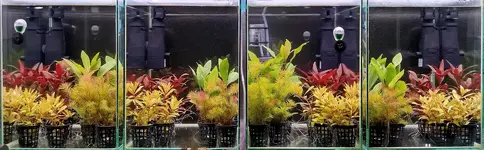
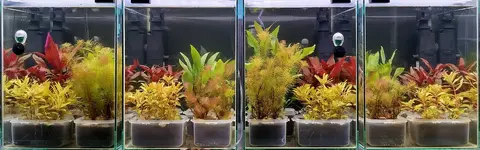
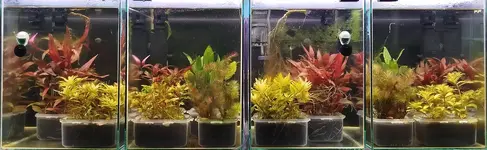
In this experiment I decided to use the following emersion plants (i.e. plants grown in a greenhouse):

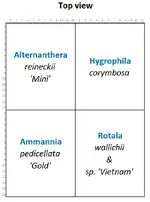
  • Alternanthera reineckii 'Mini'
  • Ammannia pedicellata 'Gold' (formerly known as Nesaea sp. Gold)
  • Hygrophila corymbosa
  • Rotala wallichii & Rotala sp. 'Vietnam'

Diagram of plant placement in individual aquariums ↓
1737293943706.png

Picture of the fifth aquarium (few days old) ↓

1737294055644.png

Light

Lighting interval:
8h/day
Light intensity (PAR) in individual aquariums: 100-230 µM/m2·s (bottom to top)

Substrate

While in the first set (aquaria #1 to #4) a soil substrate was used, in the second set (aquaria #5 to #8) no substrate was used.

1st set → nutrient-rich substrate

1737294442925.png
  • I used the ADA Aquasoil Amazonia substrate (in powder version), which I soaked in tap water for two weeks before starting the experiment.
2nd set → no substrate

1737294488720.png
  • In aquariums with no substrate, I used M16 stainless steel hex nuts inserted into small size (2") hydroponic net pots to anchor (secure) the plants.
Water

Note: The recipes below were prepared using pure (demineralized/deionized) reverse osmosis water.

1737294781840.png
  • Water flow ensured by a surface skimmer (Jingye JY-350)
    • no filtration used
  • Water changes done once a week (with 50% of the water changed) with macro-nutrients replenishment
  • Micro-nutrientsadded every other day
    • Weekly amount of microelements (divided into three doses):
      • Fe/DTPA = 0.04 ppm (+ 0.02 ppm Fe/gluconate)
      • Mn/DTPA = 0.02 ppm
      • B = 0.01 ppm
      • Zn/DTPA = 0.006 ppm
      • Cu/DTPA = 0.002 ppm
      • Co/DTPA = 0.00002 ppm
      • Mo = not added
  • Carbon dioxide:
    • Extra CO₂added to aquaria #1, #3, #5 and #7 using a simple glass diffuser, the function and parameters of which are described in more detail in a separate article
      • CO₂ concentration in these aquaria: ~11 ppm
    • No extra CO₂added to aquaria #2, #4, #6 and #8
      • CO₂ concentration in these aquaria: ~4 ppm
    • CO₂ concentration measured by Carbon Dioxide Chemical Test Kit (Hanna HI3818), which should give similar results to a professional CO₂ meter (OxyGuard) → see 2hraquarist.com.
    • 1737295185480.png
    • Hanna CO2 chemical test kit HI3818
Documentation

planting: 2024-12-18

1737295745357.png

1737295784401.png

week #1: 2024-12-21

1737295856187.png

1737295883029.png

week #2: 2024-12-28

1737295923022.png

1737295942111.png

week #3: 2025-01-04

1737295980992.png

1737296005089.png
  • Some fully grown or dying plants have been removed (so you may not see them in the following pictures).
week #4: 2025-01-10

1737296034756.png

1737296062255.png

week #5: 2025-01-18
1737296110533.png
1737296135300.png

To be continued ...
 
Last edited:
So lets say one set of tanks shows the one that got 4 ppm of (whatever nutrient) grew plants the best. And 15 ppm proved to be way too much. How do we extrapolate that data to apply to a full size heavily planted tank? There's only a few stems here pulling from that 4 ppm. Each stem pulling x amount

What about a real tank with 200 or 300 stems? How do we scale that to apply to 10 or 20x more stems, each pulling what they need?

Would you recommend lower dosing ppm for a 20 gallon tank vs a 100 gallon tank? Cause a 100 gallon can hold a heck of a lot more plant mass than a 20….
 
100 gallon can hold a heck of a lot more plant mass than a 20….
True. But it also takes a heck of a lot more ferts (by weight) to hit the same ppm ;)

Id be more inclined to base it on how heavily a tank was planted, and with what kind of plants. Light of course, and perhaps most importantly, how much co2 is being injected. No cite to back this up but I believe CO2 drives growth as much as anything, even light. By that I mean the difference between injecting 10 ppm and 40

While I did use tank size as an example of variables here, by itself itd be pretty low on my list of things to consider

*Adding: But lets say both tanks were packed equally full of hungry stems, same light with high co2 injection, I do believe the 100 gal could eat through a few more ppm than the 20
 
Last edited:
Speaking of experiments that'd be an interesting one to me. Two tanks with everything the same, packed with the same hungry plants, unlimited ferts (they'd have to be) put 10 ppm co2 in one and 40 in the other one

But wait, first thing you'd have to know the lowest amount of co2 it takes to have favorable results, because you couldnt start out deficient enough to cause problems. 10 was just a number but that might not be enough

Whew so many variables...
 
The author of this thread posts now a series of new experiments elsewhere. I believe we all regret it is not here, but that's not the issue now. While we, including myself, were initially concerned about design of experiment, the author describes his process as " a bit of detective work that is exciting and brings me the joy of "interrogating and uncovering the guilty". His approach is unique, and while not a perfect scientific experiment, which is impossible with reasonable resources for a hobbyist, it stands out with no equal currently anywhere in the hobby.

 
The author of this thread posts now a series of new experiments elsewhere. I believe we all regret it is not here, but that's not the issue now. While we, including myself, were initially concerned about design of experiment, the author describes his process as " a bit of detective work that is exciting and brings me the joy of "interrogating and uncovering the guilty". His approach is unique, and while not a perfect scientific experiment, which is impossible with reasonable resources for a hobbyist, it stands out with no equal currently anywhere in the hobby.

Yea i saw it this morning and he had posted a pointer to this thread. I read somewhere (though not sure if it is true) that low ph not only allow for more co2 in the water column but makes it easier for the plants to uptake mineral (i don't know if this is factual true but it was in the article); i have no doubt that co2 itself helps with high nutrient but i have noticed that my blackwater aquariums many plants do better (grow faster); though i've not had much success with red plants. I do try to keep par at the bottom between 10 and 20 which seems to work well overall long term (though the lights i have are capable of producing 100+ par at the bottom).

Though in the new set of experiment all will have co2 injected.
 
Last edited:
I have a few comments here.

First, I've said it before but just for the record, the OP here asked us to anonymize his posts for personal reasons. I don't know why but we must respect people's choices. I do wonder whether he will find a better fit at UKAPS but I wish him well. He's always welcomed to come back here if and when he wishes.

Second, I question whether there is such a thing as optimal conditions for growing aquarium plants that can be universally applied given the huge variability between our aquariums and the factors at play. I would suggest that you can find optimal growing conditions for your particular aquarium ecosystem. However, that may or may not apply to someone else's aquarium.

Lastly, on pH and nutrient uptake by plants. Let's remove supplemental CO2 (as non-supplemented CO2 tanks do have a baseline of about available CO2 in the water column) from the discussion. The pH of the water will determine the bioavailability of a nutrient in solution. This is well-known and studied in hydroponics.

This is the often-cited table:
ph-hydroponics-solution-nutrient-availability.webp
In the yellow section, you find the reason why many people suggest 5.5 to 6.5 pH as being ideal. Honestly, looking at the table, I always thought of a 1 point drop from 6.5 to 5.5 being what we should target. Takashi Amano seemed to always target 6.4 pH in Aqua Design Amano aquascapes. In fact, this is the range that Aqua Soil buffers water to which is one of the reasons people find it works so well.

Given the above, I venture to say that the optimal pH range may already be known. The question is, how do you arrive at the pH range? Using mostly CO2 or other buffers? How does KH play into this, if at all?

I don't mean to put down the experiment being done in anyway. In fact, I applaud any hobbyist that conducts these to push forward our understanding of aquatic plant husbandry in aquarium settings. I just don't see it arriving at a universal formula.
 
It may be one of the reasons. If they are growing well, then your system is providing them with what they need to grow.

As we have seen with other member's tanks, especially @sudiorca, CO2 is not required to have a beautiful, healthy planted aquarium. His journal on his soft water tank should be required reading for anyone wanting to go deeper into the workings of our aquatic ecosystems.
 
Back
Top