Welcome to ScapeCrunch

We are ScapeCrunch, the place where planted aquarium hobbyists come to build relationships and support each other. When you're tired of doom scrolling, you've found your home here.

Aeration in a planted aquarium

After my lights didn’t come on but co2 did after a power outage my fish were in distressed, I was gassing them. Now I run two air stones 24x7 but needed to turn up the Co2 to keep the ph drop. Now I have high Co2 and full O, CO2 on 8 hours a day. I have a 20 pound Co2 tank on 60 gal tank, Not sure how long tank will last as I haven’t refilled yet. I am new to co2 so I know I don’t know a lot about this yet but gassing my fish and shrimp made me feel sick.
 
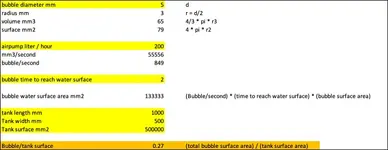
A slightly different perspective, estimating how much gas exchange will be improved by an air pump as compared to what the tank's surface area contributes. This is not exact science, but just a rough estimation to get a feeling for relative importance.

Let's assume the following model
  • The air pump blows 200 liter per hour, which is probably mid/high range of commercial pumps in most tanks.
  • Each air bubble is 5 mm diameter, and will take 2 seconds to rise to the surface.
  • Our tank surface area is 1000 mm * 500 mm.
With a simple excel model we can calculate that the surface area of all bubbles in the water column is much smaller that the surface area of the tank. With the above assumptions the air pump adds around 27% of the gas exchange that comes from the tank surface area.

1697326817093.png

So the air pump does improve gas exchange, but its effect is not impressive as compared to what can be achieved by a good tank surface gas exchange. This is assuming that there is a good surface agitation (no stagnant water that will limit gas exchange by diffusion), no lid covering the tank, and no "oily' surface film on the tank surface that may limit gas exchange (use skimmer).

Whether the air pump really makes a difference therefore depends a lot how the tank is set up, and how much the gas exchange through the tanks water surface has already been optimised.

Note: when we succeed to make more and smaller air bubbles, then the gas exchange will be improved. Making small bubbles is not easy, as the working pressure from air pumps is not very high (for example compared to CO2 that we can diffuse to very fine bubbles), but perhaps the initial assumption of 5 mm diameter is too pessimistic. If we rerun the above canculations, and reduce the air bubble diameter to 1.3 mm (which is probably unrealistically small for a low pressure pump), then we find that 200 liter air pump will create a surface area that is comparable to the tank's surface area.
 
Last edited:
My understanding is that the bubbles in the water column does minimal to aerate the water. The majority of the aeration comes from the bubbles popping on the surface and causing surface disturbance.
I share an observation, but I am not sure how many could reproduce a similar finding in their tanks.

My tank has a pretty high surface agitation, a spray bar directed slightly up and ripples all over the surface. So I would assume a perfectly clear water surface, with optimal flow enabling gas exchange.

My LED lighting is just 2 cm above the water surface, but what I describe can probably be replicated with a focused torch light that shines from top towards bottom. When I look at night, in a dark room from below the water surface to where the LED beams hit the water (or the torch light, if you prefer), I see dust particles and some other stuff (a thin organic film?) that appears almost stationary, even though my spray bar makes me believe there is flow of water everywhere. Ripples on the surface could be misleading, because even water with a layer on top can show some waves and ripples, even though the layer is stationary in the horizontal directions. So the ripple does not necessarily mean flow, or a clean water surface, and could lead us to the wrong assumptions regarding gas exchange.

Inspired by this thread, I tried to convince myself that an air pump may be a nice new toy, but from the calculations I posted earlier, plus the detailed observation of my tanks surface in a spot light, I believe that my old EHEIM skimmer is the better choice to optimise the gas exchange via the tanks water surface. When the skimmer goes on, what I observed disappears. Obviously, as @Pepere mentions, bubbles breaking the surface could also bring water in more direct contact to ambient air and promote gas exchange.

I would be excited to hear if my observation with a torch light in a dark tank can be seen by others as well. It could be a good clue that we may need to pay a bit more attention to the tanks water surface cleanliness, not just flow or 'agitation', and/or that our assumptions on gas exchange (incl CO2) may not always be correct.

If my observations can't be replicated, then I wish I hadn't posted the above, as it would be a distraction or risks the creation of a new myth.
 
Last edited:
Obviously, as @Pepere mentions, bubbles breaking the surface could also bring water in more direct contact to ambient air and promote gas exchange.
Yes it is not the bubbles that add O2, it's the breaking of the surface tension that does it.

In my case, I use a very strong pump and use large air stones along the back of the tank. When they come on two things happen.

First is that the huge rush of bubbles increases the normal flow across the surface that my spray bars provide.

Second is that the increased flow goes across the top of the tank, down the front glass, then along the substrate towards the back of the tank. This sweeps the substrate of any detritus and keeps the front of the substrate looking very clean.
 
Back
Top