
Welcome to ScapeCrunch
We are ScapeCrunch, the place where planted aquarium hobbyists come to build relationships and support each other. When you're tired of doom scrolling, you've found your home here.
Social Feed

Could one add baffles to the reactor to increase surface area instead of extending the reactor? Just curious if there is a reason it wouldnt work?
8 Replies
·
105 views

AquaGirls
I'm back with another new setup! Well, sort of new. I ran out of space in my 20g long farm tank, to the point that I had bucephalandra suction cupped to the tank walls. Not only that, but the buce wasn't as happy as it should have been with inert sand, as I felt it isn't fast enough in regards to nutrient absorption that it was able to take what it needed just from the water column.
The buce that I keep are all rare collectors species as well, which really benefit from a more acidic environment to reach their full color potential. Taking those things into account, I knew my collection would benefit greatly by swapping over to a tank with aquasoil and RO water.
Here's the details of the setup:
Landen 90p (44 gallon)
36"×18"x18"
Netlea AT5
Netlea soil capped with Samurai Soil
Inline co2 diffuser
Oase Biomaster 350
Current water parameters:
76F
pH of 6.5, gH of 7, kH<1
The lights are currently running 8 hours, though I wish I could afford a PAR meter rental right now. For what it's worth, my Netlea app says my custom setting is at 70 watts. I'm aiming to run this tank at about 100 watts eventually, but since the buce is going to need some time to settle, slow and steady wins the race on this one. I did dark start the Netlea soil for about 2 weeks, using cycled filter media. When I break down the old farm tank, I'll be taking my Fluval canister off and adding it to this new tank and running 2 filters, to keep flow on the moderate end. I also made the decision to run my co2 24/7, to keep things as stable and consistent as possible for the buce. The only inhabitants I'll be keeping in this tank will be some ramshorn snails and my CRS colony.
Currently I have a little over 40 rare to incredibly rare species in the tank, though I do have more on the way as you can see, I'm already running low on floor space.
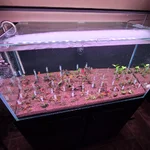
I'm not entirely sure how I feel about the ID stakes I made, truthfully I'm able to ID them by leaf shape and size, but I thought it may make things look more organized. That being said, they're itching my brain in a bad way, so I may end up removing them.
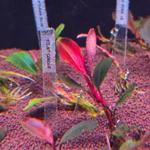
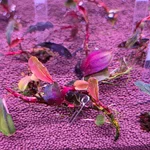
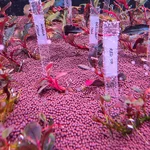
Here's some photos of species that managed to maintain some good color even in a more alkaline setup, so it can only get better from here! I've spent countless hours translating articles and posts in Chinese to figure out what kind of parameters the Chinese collectors use to get their crazy colors and leaf forms, so this will be a very interesting experiment for me!
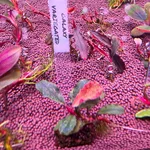
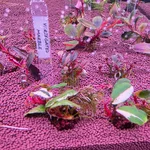
The buce that I keep are all rare collectors species as well, which really benefit from a more acidic environment to reach their full color potential. Taking those things into account, I knew my collection would benefit greatly by swapping over to a tank with aquasoil and RO water.
Here's the details of the setup:
Landen 90p (44 gallon)
36"×18"x18"
Netlea AT5
Netlea soil capped with Samurai Soil
Inline co2 diffuser
Oase Biomaster 350
Current water parameters:
76F
pH of 6.5, gH of 7, kH<1
The lights are currently running 8 hours, though I wish I could afford a PAR meter rental right now. For what it's worth, my Netlea app says my custom setting is at 70 watts. I'm aiming to run this tank at about 100 watts eventually, but since the buce is going to need some time to settle, slow and steady wins the race on this one. I did dark start the Netlea soil for about 2 weeks, using cycled filter media. When I break down the old farm tank, I'll be taking my Fluval canister off and adding it to this new tank and running 2 filters, to keep flow on the moderate end. I also made the decision to run my co2 24/7, to keep things as stable and consistent as possible for the buce. The only inhabitants I'll be keeping in this tank will be some ramshorn snails and my CRS colony.
Currently I have a little over 40 rare to incredibly rare species in the tank, though I do have more on the way
as you can see, I'm already running low on floor space.I'm not entirely sure how I feel about the ID stakes I made, truthfully I'm able to ID them by leaf shape and size, but I thought it may make things look more organized. That being said, they're itching my brain in a bad way, so I may end up removing them.
Here's some photos of species that managed to maintain some good color even in a more alkaline setup, so it can only get better from here! I've spent countless hours translating articles and posts in Chinese to figure out what kind of parameters the Chinese collectors use to get their crazy colors and leaf forms, so this will be a very interesting experiment for me!
26 Replies
·
571 views


It finally happened!
I've been away for work for a few months, during which I got really into the idea of getting a nice aquarium. While I'd already begun planning out a 125 L / ~30 gal tank, expectations had to be tempered because I'll be gone again for a while soon, and my partner would have to take care of the tank alone during that time. So we chose to settle for a 45 L / 12 gal shrimp tank first to test the waters, with me getting to take care of the 125 L tank after returning from my last long trip some time next year. We already got some of the equipment for the larger tank, which is why some of the things here are somewhat oversized.
Things then happened quite quickly when I found a great deal on our shrimp-tank-to-be in a local group. Initially, we'd planned a dark start and to use that time to settle on a plant list, but this used tank came with some plants already, so I'd appreciate any help with plant IDs and input on how to go forward from here.
This tank is intended to be a medium energy setup that allows for some flexibility in care, such as reducing water changes to every two or three weeks when needed. We're looking at slow and medium speed growers, with only very few if any fast growers. We really like bucephalandra and want a few nice ones!
Equipment, flora, fauna
Tank: SuperFish Scaper 45 (45x32x32 cm)
Light: SuperFish Scaper LED 64 (24 W, 16100 Lux, 269 PAR) (I also have a Week Aqua Z400 Pro lying about...), 8 hours a day
Filter: Tetra Ex 1000 Plus (1150 L/h canister filter with 30 ppi foam and some filter wool), surfrace scimmer on intake
Substrate: Tropica Aquarium Soil
Fertilizer: APT 3/Complete, APTe and DIY micros/macros,. Currently dosing 15 mL APT 3 after 50% weekly water change, this should stabilize to 20 ppm NO3 without accounting for uptake
CO2: Injection from 2 kg bottle with JBL Proflora CO2 Taifun Spiral 5 (though this will likely become an in-line diffuser) and an Fzone regulator, starts 2 hours before lights
Hardscape: Mangrove roots and millenium stone, not set up yet
Parameters
Flora:
There are 10 species in here right now (I think), as well as some Amazon Frogbit and Salvinia minima on top. I think they might be:
Fauna (planned):
Looking for advice
I really wanted this to be a journal about planning and setting up a tank and how well we eventually managed to translate our plan into reality, but thought it best to ask for advice on how to proceed from here first. Yesterday evening (it's now ~24 hours later), we got home with the aquarium and after a good cleaning, I filled it with aquasoil and water and planted the healthiest plants before heading to bed.
As you can see, these plants aren't doing too great, and some have quite a bit of algae on them. With live plants on our hands, we're skipping the originally planned dark start. I got the filter from the previous owner (asked him to not rinse it), and even though it's only a tiny HOB, we at least have some beneficial bacteria there. I'm running both filters right now in hopes of seeding the canister filter quickly.
I'd appreciate any help with plant IDs and care tips for the different species to help them grow in more healthy. Any recommended treatments to get rid of the algae? Especially the anubias have some small, black spots on them. The Amazon Sword has some pretty torn up leaves with brown and thin spots.
I'm considering hanging the Z400 Pro (rated at 120 W) quite high up, as it blinds surprisingly little for such a powerful light. Though I have noticed that it's hue at the same RGB ratio changes quite drastically as you go down in power. Still, this would give me more control over the lighting, as the current light is fixed at 8 cm above the water surface and can't be adjusted.
Future plans
I'm really happy about finally getting into this hobby. We're already super excited and don't even have the shrimps in yet!
For now, I think we'll let the plants recuperate a bit and adjust to the new environment. I think they came from harder water and no CO2. Since we're gone in the weekend, we'll set up the hardscape next week and do a short replant, hopefully that won't bother the plants too much.
Then we'll finalize our personal plant list and begin assembling those, replacing some of the current plants. If you have any favorite plants that would suit this type of environment, I'd love to hear about them!
And last, when we have some nice biofilm developing, we'll add the tiny little shrimps!
I've been away for work for a few months, during which I got really into the idea of getting a nice aquarium. While I'd already begun planning out a 125 L / ~30 gal tank, expectations had to be tempered because I'll be gone again for a while soon, and my partner would have to take care of the tank alone during that time. So we chose to settle for a 45 L / 12 gal shrimp tank first to test the waters, with me getting to take care of the 125 L tank after returning from my last long trip some time next year. We already got some of the equipment for the larger tank, which is why some of the things here are somewhat oversized.
Things then happened quite quickly when I found a great deal on our shrimp-tank-to-be in a local group. Initially, we'd planned a dark start and to use that time to settle on a plant list, but this used tank came with some plants already, so I'd appreciate any help with plant IDs and input on how to go forward from here.
This tank is intended to be a medium energy setup that allows for some flexibility in care, such as reducing water changes to every two or three weeks when needed. We're looking at slow and medium speed growers, with only very few if any fast growers. We really like bucephalandra and want a few nice ones!
Equipment, flora, fauna
Tank: SuperFish Scaper 45 (45x32x32 cm)
Light: SuperFish Scaper LED 64 (24 W, 16100 Lux, 269 PAR) (I also have a Week Aqua Z400 Pro lying about...), 8 hours a day
Filter: Tetra Ex 1000 Plus (1150 L/h canister filter with 30 ppi foam and some filter wool), surfrace scimmer on intake
Substrate: Tropica Aquarium Soil
Fertilizer: APT 3/Complete, APTe and DIY micros/macros,. Currently dosing 15 mL APT 3 after 50% weekly water change, this should stabilize to 20 ppm NO3 without accounting for uptake
CO2: Injection from 2 kg bottle with JBL Proflora CO2 Taifun Spiral 5 (though this will likely become an in-line diffuser) and an Fzone regulator, starts 2 hours before lights
Hardscape: Mangrove roots and millenium stone, not set up yet
Parameters
- RO/DI remineralized to 6 dGH (4:1 Ca:Mg using CaSO4 and MgSO4), 0 dKH
- pH: 6.2
- CO2: To be measured, 1 bubble every 4 s for now, fair amount of surface agitation (gentle, visible waves)
- NH4: undetectable
- NO2: undetectable
- NO3: 20 ppm
Flora:
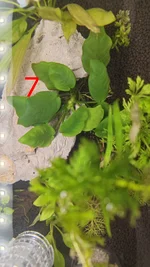
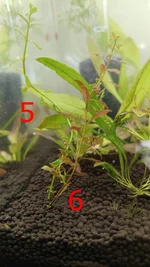
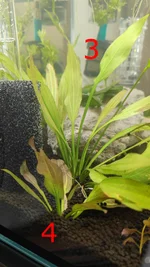
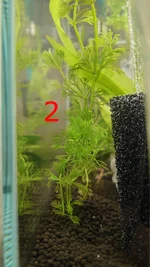
There are 10 species in here right now (I think), as well as some Amazon Frogbit and Salvinia minima on top. I think they might be:
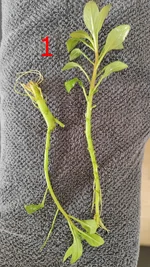
- 1 - ???
- 2 - Limnophila sessiliflora
- 3 - Amazon Sword (Echinodorus amazonicus)
- 4 - Echinodorus ?
- 5 - Rotala ?
- 6 - Ludwigia repens
- 7 - Anubias nana
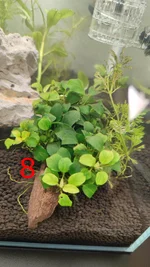
- 8 - Anubias mini coin
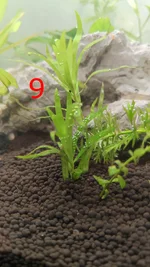
- 9 - Hygrophila salicifolia
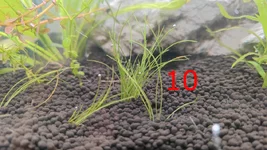
- 10 - Dwarf Hairgrass
- Hopefully no Duckweed
Fauna (planned):
- Red Rili Blue Body Neocaridina
- Possibly a school of nano fish
Looking for advice
I really wanted this to be a journal about planning and setting up a tank and how well we eventually managed to translate our plan into reality, but thought it best to ask for advice on how to proceed from here first. Yesterday evening (it's now ~24 hours later), we got home with the aquarium and after a good cleaning, I filled it with aquasoil and water and planted the healthiest plants before heading to bed.
As you can see, these plants aren't doing too great, and some have quite a bit of algae on them. With live plants on our hands, we're skipping the originally planned dark start. I got the filter from the previous owner (asked him to not rinse it), and even though it's only a tiny HOB, we at least have some beneficial bacteria there. I'm running both filters right now in hopes of seeding the canister filter quickly.
I'd appreciate any help with plant IDs and care tips for the different species to help them grow in more healthy. Any recommended treatments to get rid of the algae? Especially the anubias have some small, black spots on them. The Amazon Sword has some pretty torn up leaves with brown and thin spots.
I'm considering hanging the Z400 Pro (rated at 120 W) quite high up, as it blinds surprisingly little for such a powerful light. Though I have noticed that it's hue at the same RGB ratio changes quite drastically as you go down in power. Still, this would give me more control over the lighting, as the current light is fixed at 8 cm above the water surface and can't be adjusted.
Future plans
I'm really happy about finally getting into this hobby. We're already super excited and don't even have the shrimps in yet!
For now, I think we'll let the plants recuperate a bit and adjust to the new environment. I think they came from harder water and no CO2. Since we're gone in the weekend, we'll set up the hardscape next week and do a short replant, hopefully that won't bother the plants too much.
Then we'll finalize our personal plant list and begin assembling those, replacing some of the current plants. If you have any favorite plants that would suit this type of environment, I'd love to hear about them!
And last, when we have some nice biofilm developing, we'll add the tiny little shrimps!
0 Replies
·
9 views

Supporting
I Donated 2026
Rockstar
Article Contributor

The 2hrAquarist legend Dennis Wong tested the Hanna Test Kit vs a $3,000+ CO2 testing device and found accurate results in low kH aquasoil based tanks when compared. $30 for CO2 readings vs $3,000+!
It's a simple kit that comes with simple instructions, two differently sized vials for different detection ranges, a titration syringe phenolphthalein indicator, and an NaOH solution of some unknown concentration to titrate with.
For the range of detection on the Hanna CO2 test kit we want (0-50ppm):
- Add 10mL of aquarium water to the small flask. Add 1 drop phenolphthalein and swirl gently.
- With the titration syringe (markings are "reversed" from traditional syringes), add the NaOH solution dropwise and swirl gently until color goes from clear to pink. Don't shake/agitate, or you will de-gas your CO2 concentration.
- For the 50ppm detection range, multiply the number on the syringe by 50 to get your result (if you used 0.4mL NaOH to turn the vial pink, you would have 20ppm CO2).
My findings:
It seems to be "accurate" based on my comparisons with 1) drop checkers, 2) my pH reading/meter, and 3) the inhabitant-response (fish gasping at 35+ppm, shrimp uncomfortable at 30ppm+). It's not perfectly accurate (±5ppm), but it does a good "instant" job at giving some information in about 1-2 minutes. The kit also comes with enough for MANY, many tests (at least a hundred). For $30 I think it should become standard equipment for most CO2-injecting hobbyists.I was worried about interactions with other acids in the flask, and I'm sure there are a few, but in clean, low-kH water, it doesn't seem like a problem. I found some stuff online from published journal articles about how there are no other worrisome strong acids to compete with the NaOH and that the CO2 readings from NaOH titration are generally accepted as accurate (in peer-reviewed journals). Not a silver bullet for CO2 testing, but really helps me get an understanding of my tank and keep it dialed in.
How I use it
- If I want a quick glance of CO2 concentration for whatever reason in that moment (e.g., my fish are lethargic or shimp are at the surface).
OR, the more complex way using it to dial in CO:
- Day 1 of CO2 on a new tank: I keep an eye on inhabitants and their behaviors (to make sure I don't over-inject) and I test 2-3 times throughout the day. The most important is the test done right before the CO2 shuts off, which would be the maximum CO2 level for the day. As long as I didn't get to "true yellow" on my Drop Checker, I hopefully plateaued in terms of injection, finding the equilibrium between injection and off-gassing.
- On Day 2: CO2 comes on 1-3 hours before the photoperiod. I compare the CO2 readings at the very start of the photoperiod, once during, and once at the end. A quick estimative plot on the graph should tell me if I'm at/around equilibrium.
- For example, if my tank tests 6-10ppm CO2 before the solenoid turns on, then 20ppm when the lights come on, then 25ppm halfway through the photoperiod, and 30ppm by the end of the photoperiod, I know I'm somewhere in the proper "zone" (highlighted in pale yellow):

- For example, if my tank tests 6-10ppm CO2 before the solenoid turns on, then 20ppm when the lights come on, then 25ppm halfway through the photoperiod, and 30ppm by the end of the photoperiod, I know I'm somewhere in the proper "zone" (highlighted in pale yellow):
- On Day 3: I double-check the measurement at the start of the photoperiod, during, and at the end of the CO2 injection. As long as all 3 are close/approaching 30ppm, we're good!
On general timing of CO2 injection in this hobby:
I continue to hear/read from reputable sources about how plants use the most CO2-per-hour in the first 3-4 hours of the photoperiod, which is why it's so important to have CO2 injection reach/near 30ppm @ equilibrium between injection and off-gassing.
Many beginners inject too little, or start injecting too late relative to their photoperiod. As Wong states in his article here,
I think many users fall in the "Low injection rate" category, where they are only hitting optimum CO2 levels in the afternoon (when plants are using less of it to begin with!):

But they don't realize that you can fix that either by 1) increasing surface agitation (for increased off-gassing) as well as increasing injection rate:

OR by 2) Starting your CO2 injection way earlier than you think. For example:
Many hobbyists read "turn CO2 on 1 hour before lights" and end up with this:

Where they are only reaching optimum levels waaaay too late in their photoperiod, when they really should either start the CO2 way earlier, or start their photoperiod way later, like this:

To bring it all home (what I think):
- The Hanna CO2 test kit is a lot cheaper than a reliable pH pen/meter/computer, and requires no calibration fluids or calibration itself.
- It's been tested to be somewhat accurate when compared to a very expensive aquatic CO2 testing device.
- You can use something like the Hanna CO2 test kit to test for whether you're starting CO2 early enough, or whether you are even reaching equilibrium between off-gassing and injecting CO2.
- Like all titration, it can be prone to user error. If the goal is light pink, everyone will see light pink differently. Just do your best to be consistent with your readings!
- It costs $33+ shipping and will likely last the average user a few years (if the reagents don't go bad before then). Worth it!


42 Replies
·
6224 views

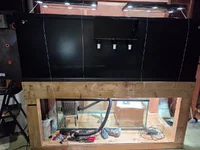
Hello Everyone. After a short 2 month wait, I finally received my 6', 235g Planet Aquariums tank. I've decided to document the build here as a way to document it's growth as well as, and maybe more importantly, seek advice as I've already stumbled onto a few 'problems'. So, without further ado, here is what I have so far:
Tank - 235g Planet Aquariums Mega Matrix (72" x 30" x 25")
Sump - 60g Breeder
Lighting - Skylight Hyperspot M (x2)
Mechanical Filtration - RedSea ReefMat 1200
Additional Filtration - Poret Foam (yet to purchase)
Return Pump(s) - Jebao DCP-10000
CO2 Reactor - Yugang from ARC
Dosing - Chihiros 4-Head with Magnetic Stirrer
Heater - 500W Titanium
Controller - Neptune Apex with pH and temp probes
Auto Feeder - Avast Plank
ATO - XP Aqua Duetto using a 35g Brute container filled with RODI water as source water.
Hardscape: UNS Controlsoil - Brown
Pacific Driftwood
Black Sieryu Stone
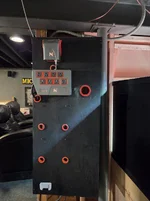
As a general thought at this point, the Apex will have some basic functions - control the temperature (77-78F), monitor the solenoid on the CO2 regulator should pH venture outside of acceptable ranges, and control the auto feeder. A 'feed mode' will be activated which will turn off the return pump prior to the auto feeder running so that the food is allowed to be eaten rather than washed into the overflow and into the sump filter. Aside from that, not much more is necessary other than simple on/off control for the return pump as the lights are on their own controller.
Controller and board:
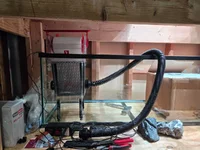
ReefMat in sump:
Full shot of rear:
Current Scape - Half Complete:
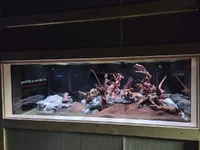
That's about all I've gotten done so far. Still working on fiddling with the hardscape on the right and then start on the left side. I'm open to any suggestions thus far and thanks for following along!
Tank - 235g Planet Aquariums Mega Matrix (72" x 30" x 25")
Sump - 60g Breeder
Lighting - Skylight Hyperspot M (x2)
Mechanical Filtration - RedSea ReefMat 1200
Additional Filtration - Poret Foam (yet to purchase)
Return Pump(s) - Jebao DCP-10000
CO2 Reactor - Yugang from ARC
Dosing - Chihiros 4-Head with Magnetic Stirrer
Heater - 500W Titanium
Controller - Neptune Apex with pH and temp probes
Auto Feeder - Avast Plank
ATO - XP Aqua Duetto using a 35g Brute container filled with RODI water as source water.
Hardscape: UNS Controlsoil - Brown
Pacific Driftwood
Black Sieryu Stone
As a general thought at this point, the Apex will have some basic functions - control the temperature (77-78F), monitor the solenoid on the CO2 regulator should pH venture outside of acceptable ranges, and control the auto feeder. A 'feed mode' will be activated which will turn off the return pump prior to the auto feeder running so that the food is allowed to be eaten rather than washed into the overflow and into the sump filter. Aside from that, not much more is necessary other than simple on/off control for the return pump as the lights are on their own controller.
Controller and board:
ReefMat in sump:
Full shot of rear:
Current Scape - Half Complete:
That's about all I've gotten done so far. Still working on fiddling with the hardscape on the right and then start on the left side. I'm open to any suggestions thus far and thanks for following along!
3 Replies
·
59 views

M
I Donated 2026
Journal 75P - Journey Into High Tech
Inspiration, Goals, & Considerations
I've had an interest in aquariums since a young age and had my own aquarium with fish like Angelfish and Mollies around middle school. Growing up, my dad had a bigger tank with Blood Parrots and Silver Dollars. Over 10 years ago, I had a low maintenance 55 gallon planted tank. I was pretty proud of it, but always envied the high tech tanks I saw on forums/social media and told myself when I broke that tank down that the next time I set up a tank, it would be like what I envied. At the end of 2024, I set up a small low tech 5 gallon planted tank to help scratch my aquarium itch, which really only reaccelerated my desire for setting up a high tech tank. And now, here we are!
The size of the tank was mostly dictated by the space. I originally planned on something around 30 gallons, but my LFS had the UNS 75P in stock and after measuring and discussing with my wife, we agreed it would work for the space. The tank is between the kitchen and living room, which is essentially a play area for my son, so lighting needs to be adjusted to make sure he's not blinded by the light when looking up at the tank.
Generally, I'd like to have a visually pleasing aquarium with lots of fish and plants that's peaceful to enjoy. I'd like to automate / reduce as much friction as possible and I realize there's still plenty I need to learn, so I'll need to have patience when things go wrong. I want to keep away from anything that's hard to get out of the tank once it's in (duckweed, moss, pest snails, etc). I felt like sharing prices below might give value to anyone in the future that's looking to start where I did with a high tech tank.
Specs (prices include sales tax)
Tank:
Lighting:
Filtration:
Co2:
Inflow & Outflow Pipes:
Substrate & Hardscape:
Fertilization:
Other Misc Equipment:
Chihiros CO2 Drop Checker
5 x Oase ShutOff Valve 16/22
Inkbird WiFi ITC-308 - $38
SwitchBot Leak Detectors - $15 each
"Stand"
Because the guts are located in a kitchen cabinet, I didn't want to screw directly into it and damage it. I was also concerned silicone would not be able to dry and outgas properly when sealing the edges. I opted to line the cabinet with contact paper. It's essentially a giant sticker, so I lined the sides, bottoms, and a second layer over the bottom edges/joints. I built a 3 panel "stand" inside of the cabinet so I could house everything and screw into the plywood without any concerns. I used 1 sheet of 3/4" Maple plywood and coated 1 side with a latex primer followed by a layer of latex white paint. This is mostly for water resistance and not necessarily water proof. I placed a silicone cabinet liner under the right side equipment. I made a shelf to place the EcoFlow on so if there's a catastrophic leak it's off the bottom.
One consideration I hadn't thought about was how "cramped" the cabinet would be since I placed the EcoFlow on a shelf with a "wall", which essentially made the work area much tighter.
Cable Management: Raceway and cable clips
Water
Express Water RO5DX - $160
Coming soon
I've had an interest in aquariums since a young age and had my own aquarium with fish like Angelfish and Mollies around middle school. Growing up, my dad had a bigger tank with Blood Parrots and Silver Dollars. Over 10 years ago, I had a low maintenance 55 gallon planted tank. I was pretty proud of it, but always envied the high tech tanks I saw on forums/social media and told myself when I broke that tank down that the next time I set up a tank, it would be like what I envied. At the end of 2024, I set up a small low tech 5 gallon planted tank to help scratch my aquarium itch, which really only reaccelerated my desire for setting up a high tech tank. And now, here we are!
The size of the tank was mostly dictated by the space. I originally planned on something around 30 gallons, but my LFS had the UNS 75P in stock and after measuring and discussing with my wife, we agreed it would work for the space. The tank is between the kitchen and living room, which is essentially a play area for my son, so lighting needs to be adjusted to make sure he's not blinded by the light when looking up at the tank.
Generally, I'd like to have a visually pleasing aquarium with lots of fish and plants that's peaceful to enjoy. I'd like to automate / reduce as much friction as possible and I realize there's still plenty I need to learn, so I'll need to have patience when things go wrong. I want to keep away from anything that's hard to get out of the tank once it's in (duckweed, moss, pest snails, etc). I felt like sharing prices below might give value to anyone in the future that's looking to start where I did with a high tech tank.
Specs (prices include sales tax)
Tank:
UNS 75P (8mm Glass - 29.52" x 17.71" x 17.71") - $519
UNS Atmos Backlight - $274
Lid - Working on getting a custom lid made
Lighting:
Chihiros WRGB II Pro 60 - $263
Chihiros WRGB II Pro Shades- $40
3D Printed Side Shades - Still need to do this
Chihiros Hanging Rope Kit- $37
Chihiros LED Lights Hanging Stand Kit - $64
Chihiros WRGB II Pro Shades- $40
3D Printed Side Shades - Still need to do this
Chihiros Hanging Rope Kit- $37
The mounting screws provided protruded beyond the bracket and would not fit with the backlight. I ended up getting washers and placing them outside the bracket to limit the screw depth.
Really disliked the fact that the stand was branded with Chihiros and visible when looking into the aquarium.
UNS Light Hanging Bar - $105
Filtration:
Oase BioMaster 2 Thermo 850 - $461
Oase tubing - Included with filter
Co2:
Misc. 10lb Cylinder - $118 (includes CO2)
CO2 Art PRO-SE Regulator - $105
Aqua Rocks Colorado Small Yugang Reactor 19mm w/ 90 degree elbows - $150
Inflow & Outflow Pipes:
Aqua Rocks Colorado Stainless Steel Lily Pipes 17mm - $54
Aqua Rocks Colorado Lily Pipe Clipper - $11
Substrate & Hardscape:
UNS Controsoil - Black, 'normal' used as a base and ‘fine’ on top - ~$129
CaribSea Super Naturals- Jungle River Sand (foreground sand) - $42 (only used a small mount of the bag - will user remainder in upcoming tank)
UNS Controsand Santa Fe (used as accent around dragon stone) - $57 (only used a small mount of the bag - will user remainder in upcoming tank)
UNS Controsand Sequoia (used as accent around dragon stone) - $52 (only used a small mount of the bag - will user remainder in upcoming tank)
I was surprised how dirty these rocks were and how much rinsing was required. For the price point, I felt like they should have come pre-washed.
Driftwood & Dragon Stone from Aquarium Co-Op - $111
Fertilization:
Burr Aqua Micros and Macros
Chihiros Magnetic Stirrers - $100
Battery Backup & PowerEcoFlow DELTA 3 Max (2kwh) - $680
Unfortunately prolonged power outages are not uncommon for us. We've been without power for multiple consecutive days, 7 days being the longest. This battery backup gives me some peace of mind knowing the tank can run for some time uninterrupted giving me the flexibility to get the generator out and running at a later time, refill with gas, etc. I believe run time will be around 12 hours.
Other Misc Equipment:
Chihiros CO2 Drop Checker
5 x Oase ShutOff Valve 16/22
Inkbird WiFi ITC-308 - $38
SwitchBot Leak Detectors - $15 each
"Stand"
Because the guts are located in a kitchen cabinet, I didn't want to screw directly into it and damage it. I was also concerned silicone would not be able to dry and outgas properly when sealing the edges. I opted to line the cabinet with contact paper. It's essentially a giant sticker, so I lined the sides, bottoms, and a second layer over the bottom edges/joints. I built a 3 panel "stand" inside of the cabinet so I could house everything and screw into the plywood without any concerns. I used 1 sheet of 3/4" Maple plywood and coated 1 side with a latex primer followed by a layer of latex white paint. This is mostly for water resistance and not necessarily water proof. I placed a silicone cabinet liner under the right side equipment. I made a shelf to place the EcoFlow on so if there's a catastrophic leak it's off the bottom.
One consideration I hadn't thought about was how "cramped" the cabinet would be since I placed the EcoFlow on a shelf with a "wall", which essentially made the work area much tighter.
Cable Management: Raceway and cable clips
Water
Express Water RO5DX - $160
I saw this recommended by @Naturescapes_Rocco, and feel like the value is pretty hard to beat. I waited until it was on sale to purchase, but even at the $190 list price, it's great. Water source is an artesian spring (well). From the tap, TDS measures 56. In my 5g, I've used water straight from the tap, but opted for RO so I can keep things consistent with this setup. TDS after initial filter flushing was 0 (yeah, 0!).
55 Gallon Brute Trash Can, 44 Gallon Brute Trash Can, 32 Gallon Greenmade Trash Can, and 2x dollys.I need to improve this setup because it's a PITA. RO goes into the 55g, then I need to transfer it to the 44g to fill the tank. The 32g was originally what I purchased because that was the biggest Costco had, but it didn't hold enough water to fill the tank, so I had to rethink my plans. Seeing the 55g in person, I wasn't confident I could fit 2 side by side in the space I set up the RO in (which I couldn't). This setup is very clunky and requires a lot of water moving to make it to the tank. I've been using the 32g for waste water so I could water plants with it, but I might get worn down quickly and send it down the drain.
Plants (all UNS TC)- Homalomena Sp Sekadau South (babysitter)
- Hydrocotyle Tripartita (potentially babysitter)
- Alternanthera Reineckii Rosanervig (initially planned as babysitter, but may keep some in long term)
- Hemianthus Callitrichoides 'Cuba'
- Rotala Rotundifolia Blood Red
- Anubias Nana Petite
- Micranthemum 'Monte Carlo'
- Alternanthera Reineckii 'Mini'
- Echinodorus Rose
Coming soon
- 25x Red Neon Blue Eye Rainbow
- 7x C005 Corydoras pantanalensis
- 3x C123 Yellow Cory 'Rio Nanay'
- Aphyosemion bivittatum 'Funge' Pair
- 5x Stiphodon rutilaureus Goby
- 1x True Siamese Algae Eaters
- 1x Bamboo Shrimp
- 8x Amano Shrimp
63 Replies
·
4165 views

Hi all,
I’m in the very early stages of a 120P build, currently still collecting gear with the tank on order and a stand under construction. I’m going for a lower maintenance, lower energy but still high tech setup with daily dosing and pressurised CO2.
In considering tank inhabitants, I have always wanted to keep a couple of special plecos. Available here and within my price range are the L201 (Orinoco Pleco) and the L134 (Leopard Frog Pleco).
Pics for reference.
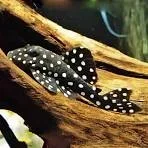
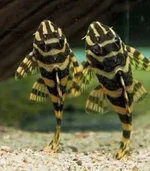
These are smaller plecos and while I appreciate they may do some "damage" to more delicate plants, I was wondering what thought are one incorporating 2-3 individuals as part of a community heavily planted tank. I am going for more of a natural scape, with few to no stem plants. Other tank mates would be Chilli rasporas, a couple of corys to shuffle substrate and perhaps some ottos to help cleaning the glass and generally looking cool.
Whats thoughts?
Cheers
I’m in the very early stages of a 120P build, currently still collecting gear with the tank on order and a stand under construction. I’m going for a lower maintenance, lower energy but still high tech setup with daily dosing and pressurised CO2.
In considering tank inhabitants, I have always wanted to keep a couple of special plecos. Available here and within my price range are the L201 (Orinoco Pleco) and the L134 (Leopard Frog Pleco).
Pics for reference.
These are smaller plecos and while I appreciate they may do some "damage" to more delicate plants, I was wondering what thought are one incorporating 2-3 individuals as part of a community heavily planted tank. I am going for more of a natural scape, with few to no stem plants. Other tank mates would be Chilli rasporas, a couple of corys to shuffle substrate and perhaps some ottos to help cleaning the glass and generally looking cool.
Whats thoughts?
Cheers
27 Replies
·
163 views

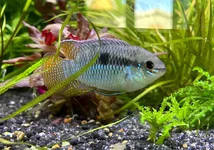
I am the proud new owner of a pair of Laetacara (probably L.dorsigera). About 2" TL currently. They don't seem to be common in the hobby. Does anyone else have any ? Or experience of keeping them ?
6 Replies
·
273 views

Hi, been a while. I was looking through Tropica's plant list. And my attention snagged on their inspiration scapes, as it often does.
The one below is new to me though. I really like it, and it's become my favourite. Its by Fabian Beck, and called Ndokulandela. Which led me to wondering, do you have a favourite?
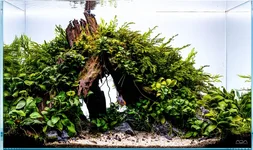
The one below is new to me though. I really like it, and it's become my favourite. Its by Fabian Beck, and called Ndokulandela. Which led me to wondering, do you have a favourite?
4 Replies
·
73 views

I Donated 2026
Expert in Residence
MOTM Winner
I came into some Hygrophila polysperma "white" by Tropica recently. Grew it out and it seems to be able to be shaped into good midground bushes so I decided to create a layout to showcase it. Contemplated whether to use it as the only white plant in the tank, but decided to use some Anubias white petite as well so that the white polysperma doesn't stand out awkwardly.

30 Replies
·
1809 views


Staff member
I Donated 2026
Founding Member
This is the future home for the announcements when someone obtains an achievement badge. Let the games begin!
1997 Replies
·
49849 views