
Welcome to ScapeCrunch
We are ScapeCrunch, the place where planted aquarium hobbyists come to build relationships and support each other. When you're tired of doom scrolling, you've found your home here.
Social Feed
It finally happened!
I've been away for work for a few months, during which I got really into the idea of getting a nice aquarium. While I'd already begun planning out a 125 L / ~30 gal tank, expectations had to be tempered because I'll be gone again for a while soon, and my partner would have to take care of the tank alone during that time. So we chose to settle for a 45 L / 12 gal shrimp tank first to test the waters, with me getting to take care of the 125 L tank after returning from my last long trip some time next year. We already got some of the equipment for the larger tank, which is why some of the things here are somewhat oversized.
Things then happened quite quickly when I found a great deal on our shrimp-tank-to-be in a local group. Initially, we'd planned a dark start and to use that time to settle on a plant list, but this used tank came with some plants already, so I'd appreciate any help with plant IDs and input on how to go forward from here.
This tank is intended to be a medium energy setup that allows for some flexibility in care, such as reducing water changes to every two or three weeks when needed. We're looking at slow and medium speed growers, with only very few if any fast growers. We really like bucephalandra and want a few nice ones!
Equipment, flora, fauna
Tank: SuperFish Scaper 45 (45x32x32 cm)
Light: SuperFish Scaper LED 64 (24 W, 16100 Lux, 269 PAR) (I also have a Week Aqua Z400 Pro lying about...), 8 hours a day
Filter: Tetra Ex 1000 Plus (1150 L/h canister filter with 30 ppi foam and some filter wool), surfrace scimmer on intake
Substrate: Tropica Aquarium Soil
Fertilizer: APT 3/Complete, APTe and DIY micros/macros,. Currently dosing 15 mL APT 3 after 50% weekly water change, this should stabilize to 20 ppm NO3 without accounting for uptake
CO2: Injection from 2 kg bottle with JBL Proflora CO2 Taifun Spiral 5 (though this will likely become an in-line diffuser) and an Fzone regulator, starts 2 hours before lights
Hardscape: Mangrove roots and millenium stone, not set up yet
Parameters
Flora:
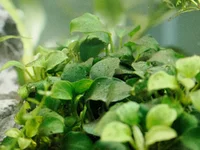
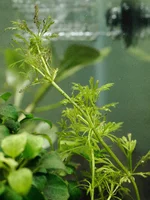
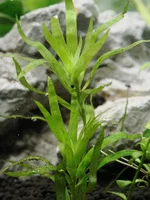
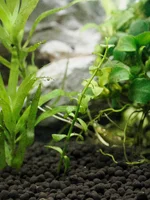
There are 10 species in here right now (I think), as well as some Amazon Frogbit and Salvinia minima on top. I think they might be:
Fauna (planned):
Looking for advice
I really wanted this to be a journal about planning and setting up a tank and how well we eventually managed to translate our plan into reality, but thought it best to ask for advice on how to proceed from here first. Yesterday evening (it's now ~24 hours later), we got home with the aquarium and after a good cleaning, I filled it with aquasoil and water and planted the healthiest plants before heading to bed.
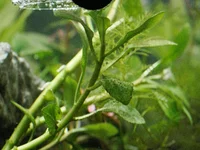
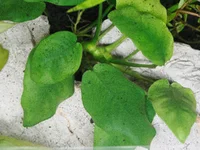
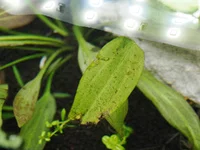
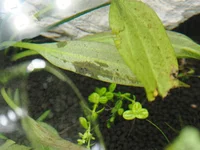
As you can see, these plants aren't doing too great, and some have quite a bit of algae on them. With live plants on our hands, we're skipping the originally planned dark start. I got the filter from the previous owner (asked him to not rinse it), and even though it's only a tiny HOB, we at least have some beneficial bacteria there. I'm running both filters right now in hopes of seeding the canister filter quickly.
I'd appreciate any help with plant IDs and care tips for the different species to help them grow in more healthy. Any recommended treatments to get rid of the algae? Especially the anubias have some small, black spots on them. The Amazon Sword has some pretty torn up leaves with brown and thin spots.
I'm considering hanging the Z400 Pro (rated at 120 W) quite high up, as it blinds surprisingly little for such a powerful light. Though I have noticed that its hue at the same RGB ratio changes quite drastically as you go down in power. Still, this would give me more control over the lighting, as the current light is fixed at 8 cm above the water surface and can't be adjusted.
Future plans
I'm really happy about finally getting into this hobby. We're already super excited and don't even have the shrimps in yet!
For now, I think we'll let the plants recuperate a bit and adjust to the new environment. I think they came from harder water and no CO2. Since we're gone in the weekend, we'll set up the hardscape next week and do a short replant, hopefully that won't bother the plants too much.
Then we'll finalize our personal plant list and begin assembling those, replacing some of the current plants. If you have any favorite plants that would suit this type of environment, I'd love to hear about them!
And last, when we have some nice biofilm developing, we'll add the tiny little shrimps!
Updates
Update 2026/07/09
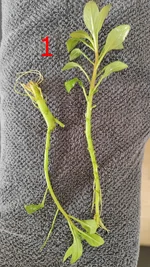
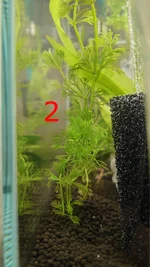
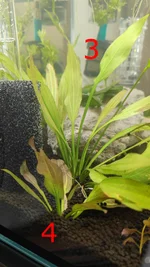
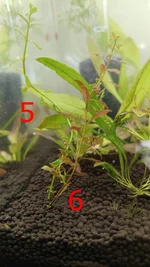
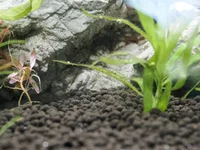
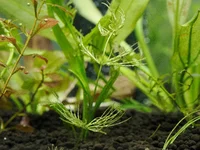
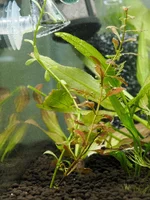
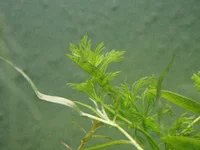
Added some (slightly) nicer pictures of the plants before heading out for work. Have a camera, might as well use it! Hopefully I can post pictures of good looking plants soon. Update update: Well they were nice until the webp compression got to them. Good thing to learn about early on!
I've been away for work for a few months, during which I got really into the idea of getting a nice aquarium. While I'd already begun planning out a 125 L / ~30 gal tank, expectations had to be tempered because I'll be gone again for a while soon, and my partner would have to take care of the tank alone during that time. So we chose to settle for a 45 L / 12 gal shrimp tank first to test the waters, with me getting to take care of the 125 L tank after returning from my last long trip some time next year. We already got some of the equipment for the larger tank, which is why some of the things here are somewhat oversized.
Things then happened quite quickly when I found a great deal on our shrimp-tank-to-be in a local group. Initially, we'd planned a dark start and to use that time to settle on a plant list, but this used tank came with some plants already, so I'd appreciate any help with plant IDs and input on how to go forward from here.
This tank is intended to be a medium energy setup that allows for some flexibility in care, such as reducing water changes to every two or three weeks when needed. We're looking at slow and medium speed growers, with only very few if any fast growers. We really like bucephalandra and want a few nice ones!
Equipment, flora, fauna
Tank: SuperFish Scaper 45 (45x32x32 cm)
Light: SuperFish Scaper LED 64 (24 W, 16100 Lux, 269 PAR) (I also have a Week Aqua Z400 Pro lying about...), 8 hours a day
Filter: Tetra Ex 1000 Plus (1150 L/h canister filter with 30 ppi foam and some filter wool), surfrace scimmer on intake
Substrate: Tropica Aquarium Soil
Fertilizer: APT 3/Complete, APTe and DIY micros/macros,. Currently dosing 15 mL APT 3 after 50% weekly water change, this should stabilize to 20 ppm NO3 without accounting for uptake
CO2: Injection from 2 kg bottle with JBL Proflora CO2 Taifun Spiral 5 (though this will likely become an in-line diffuser) and an Fzone regulator, starts 2 hours before lights
Hardscape: Mangrove roots and millenium stone, not set up yet
Parameters
- RO/DI remineralized to 6 dGH (4:1 Ca:Mg using CaSO4 and MgSO4), 0 dKH
- pH: 6.2
- CO2: To be measured, 1 bubble every 4 s for now, fair amount of surface agitation (gentle, visible waves)
- NH4: undetectable
- NO2: undetectable
- NO3: 20 ppm
Flora:
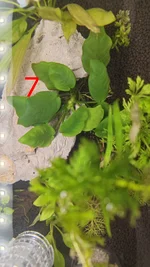
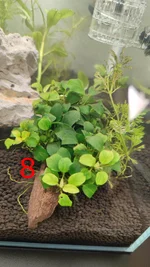
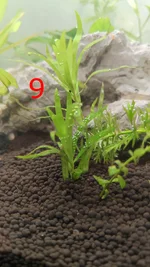
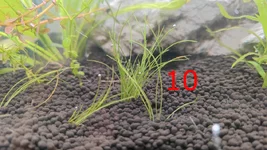
There are 10 species in here right now (I think), as well as some Amazon Frogbit and Salvinia minima on top. I think they might be:
- 1 - ???
- 2 - Limnophila sessiliflora
- 3 - Amazon Sword (Echinodorus amazonicus)
- 4 - Echinodorus ?
- 5 - Rotala ?
- 6 - Ludwigia repens
- 7 - Anubias nana
- 8 - Anubias mini coin
- 9 - Hygrophila salicifolia
- 10 - Dwarf Hairgrass
- Hopefully no Duckweed
Fauna (planned):
- Red Rili Blue Body Neocaridina
- Possibly a school of nano fish
Looking for advice
I really wanted this to be a journal about planning and setting up a tank and how well we eventually managed to translate our plan into reality, but thought it best to ask for advice on how to proceed from here first. Yesterday evening (it's now ~24 hours later), we got home with the aquarium and after a good cleaning, I filled it with aquasoil and water and planted the healthiest plants before heading to bed.
As you can see, these plants aren't doing too great, and some have quite a bit of algae on them. With live plants on our hands, we're skipping the originally planned dark start. I got the filter from the previous owner (asked him to not rinse it), and even though it's only a tiny HOB, we at least have some beneficial bacteria there. I'm running both filters right now in hopes of seeding the canister filter quickly.
I'd appreciate any help with plant IDs and care tips for the different species to help them grow in more healthy. Any recommended treatments to get rid of the algae? Especially the anubias have some small, black spots on them. The Amazon Sword has some pretty torn up leaves with brown and thin spots.
I'm considering hanging the Z400 Pro (rated at 120 W) quite high up, as it blinds surprisingly little for such a powerful light. Though I have noticed that its hue at the same RGB ratio changes quite drastically as you go down in power. Still, this would give me more control over the lighting, as the current light is fixed at 8 cm above the water surface and can't be adjusted.
Future plans
I'm really happy about finally getting into this hobby. We're already super excited and don't even have the shrimps in yet!
For now, I think we'll let the plants recuperate a bit and adjust to the new environment. I think they came from harder water and no CO2. Since we're gone in the weekend, we'll set up the hardscape next week and do a short replant, hopefully that won't bother the plants too much.
Then we'll finalize our personal plant list and begin assembling those, replacing some of the current plants. If you have any favorite plants that would suit this type of environment, I'd love to hear about them!
And last, when we have some nice biofilm developing, we'll add the tiny little shrimps!
Updates
Update 2026/07/09
Added some (slightly) nicer pictures of the plants before heading out for work. Have a camera, might as well use it! Hopefully I can post pictures of good looking plants soon. Update update: Well they were nice until the webp compression got to them. Good thing to learn about early on!

33 Replies
·
2141 views


Staff member
I Donated 2026
Founding Member
Hello Welcome, alexamorgan
Welcome to ScapeCrunch, @alexamorgan!
We would love to get to know you. Please tell us about yourself. What tank do you have?
We would love to get to know you. Please tell us about yourself. What tank do you have?
0 Replies
·
2 views
Staff member
I Donated 2026
Founding Member
Well, as this thread exists in a few places, I figured why not have it here also. Perhaps we can take up the baton and keep it active and bring some value to hobbyists.
For those of you that don't know, I got into thinking much more about my micros when I read this thread on another forum. It was started by our very own @GreggZ. It was spurred into existence because of our own @Burr740 and his work with micro fertilizers. Some really good discussion followed and a lot was learned.
I don't want to steal Gregg's thunder with this so I hope he posts his current thoughts on the subject and we can all take it from there.
All the best,
Art
For those of you that don't know, I got into thinking much more about my micros when I read this thread on another forum. It was started by our very own @GreggZ. It was spurred into existence because of our own @Burr740 and his work with micro fertilizers. Some really good discussion followed and a lot was learned.
I don't want to steal Gregg's thunder with this so I hope he posts his current thoughts on the subject and we can all take it from there.
All the best,
Art
86 Replies
·
16168 views

Supporting
I Donated 2026
Rockstar
When I was walking around Aquashella Chicago, I crossed paths multiple times with Logan Rando while he was filming. I was wondering if he had posted a video of the show yet so I checked out his channel. No video of Chicago yet, so I instead watched his video of New Jersey. About half way through the video, Father Fish rolls by on his scooter and announces he'll be making an announcement that will destroy the tropical fish industry. LOL! I didn't know Father Fish was actually a speaker at Aquashella. Seems funny that a guy who preaches about not giving money to the aquarium industry was invited to speak. I figured WTH, I'll bite and go to his channel to see what the big news was. I couldn't bring myself to watch the whole thing, but I did scan through it and still don't know what the big Earth shattering news was. Just the same ole preachy stuff and I regret destroying the brain cells. I have to be more careful of that, as I'm older and can't afford to lose many more. I'm sure glad my path into this hobby was seeing the work of Takashi Amano, other knowledgeable aquascapers, and all the great folks in this community.
25 Replies
·
1076 views


There are lots of baby fish in my 20 gallon. They are from two different broods. The first had 2 grow up and the second has about 8. It is not certain which fish they are, but based on tail fin structure I am confident they are platys. Now the funny thing is, I am fairly certain my platys are all female. This is based on a knowledgeable guy at the LFS and my research into distinguishing between the two sexes. I have had the platys for less than 3 months, so they must have been getting it on in the fish store.
Anyways, I feel I am at my max bioload for my 20g tank and definitely don’t need one of the babies being a male and reaching sexual maturity. I have always had a kind heart for animals and can’t bring myself to eliminate them. Soooooo…….
Excuse for me to get another tank. This will be a temporary housing until they get old enough for me to sell or give away. Also lets me practice a little more aquascaping.
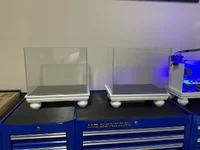
I started searching for smaller tanks on Prime Day, but ended up finding a great deal on Waterbox Clear Mini 6. So good I bought 2. My coral frag tank is getting an upgrade too! The Fzone nano light was on sale, and I thought for $60 it is worth a try. I set it up today. I really like the light. Very powerful, too powerful for my current needs. Very adjustable using a basic user friendly app.

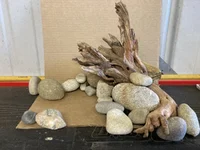
This is my tentative hardscape. Suggestions and recommendations would be greatly appreciated.

Plants will be ready next week. I am using a few new ones and a few from my 20g. The plan is to make this heavily planted so that there will be very little maintenance and eventually only monthly water changes (if any). It will have a tiny nicrew HOB filter, but that is mainly for a little water movement.
Things should start to come together quickly over the next week.
Anyways, I feel I am at my max bioload for my 20g tank and definitely don’t need one of the babies being a male and reaching sexual maturity. I have always had a kind heart for animals and can’t bring myself to eliminate them. Soooooo…….
Excuse for me to get another tank. This will be a temporary housing until they get old enough for me to sell or give away. Also lets me practice a little more aquascaping.
I started searching for smaller tanks on Prime Day, but ended up finding a great deal on Waterbox Clear Mini 6. So good I bought 2. My coral frag tank is getting an upgrade too! The Fzone nano light was on sale, and I thought for $60 it is worth a try. I set it up today. I really like the light. Very powerful, too powerful for my current needs. Very adjustable using a basic user friendly app.
This is my tentative hardscape. Suggestions and recommendations would be greatly appreciated.
Plants will be ready next week. I am using a few new ones and a few from my 20g. The plan is to make this heavily planted so that there will be very little maintenance and eventually only monthly water changes (if any). It will have a tiny nicrew HOB filter, but that is mainly for a little water movement.
Things should start to come together quickly over the next week.
2 Replies
·
40 views

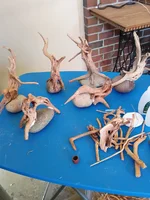
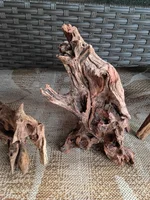
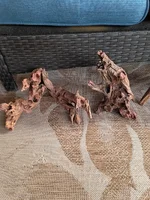
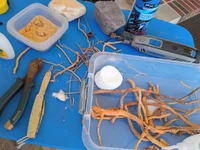
Got on the tree build kick in past 2 weeks to make somthing I like for 36g freebie build to replace the huge tree turd #2 in there. I got 6 stumps ready today to get built for smaller tanks, 3 done today 3 waiting. Built the larger 17 tall 16 wide tree pics added other day to journal but gonna a build 2-3 more larger trees and the 6 smaller. Sell the ones off on eBay and etsy I don't want.
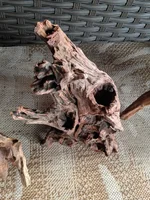
The larger stump 2nd post pic s 16" tall 15 wide plan to use in future scapes smaller. I've been using Amazon branch packs 15.00 for 25-35 pieces and amazon spiderwood 6-8" 5 for 12.00 for small trees. The large tree I made was a 10.99 piece I tore apart and used the 3 larger branches and built onto them to get the large tree in added pics cost me in end around 22.00 .... I have 10 pieces coming in mail Friday 5 large and 5 medium all spiderwood to make larger trees with this weekend.
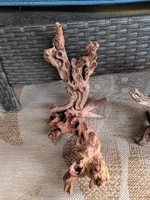
Bought a ton of Amazon wood on Amazon lol 2 for 17.00 10-14" so I glued some of them together for larger usable pieces. some came out cool and well worth the 17.00 for the pieces glued together.The 1 has natural plant pots on top. The v shape last 2 pics 12" deep and 16" wide
After literally glueing a finger to a rock today Imao I quit! I ended up used all the accelerator I had anyway so Friday or sat before I can finish my smaller trees. will update as it goes, It will be a forest of trees when its done.
The larger stump 2nd post pic s 16" tall 15 wide plan to use in future scapes smaller. I've been using Amazon branch packs 15.00 for 25-35 pieces and amazon spiderwood 6-8" 5 for 12.00 for small trees. The large tree I made was a 10.99 piece I tore apart and used the 3 larger branches and built onto them to get the large tree in added pics cost me in end around 22.00 .... I have 10 pieces coming in mail Friday 5 large and 5 medium all spiderwood to make larger trees with this weekend.
Bought a ton of Amazon wood on Amazon lol 2 for 17.00 10-14" so I glued some of them together for larger usable pieces. some came out cool and well worth the 17.00 for the pieces glued together.The 1 has natural plant pots on top. The v shape last 2 pics 12" deep and 16" wide
After literally glueing a finger to a rock today Imao I quit! I ended up used all the accelerator I had anyway so Friday or sat before I can finish my smaller trees. will update as it goes, It will be a forest of trees when its done.
19 Replies
·
611 views

Supporting
I Donated 2026
Rockstar
Article Contributor
Skip to the actual journal here.
I'm known here for high tech, high nutrient, inert substrate scapes -- but I also love NO tech, rich substrate scapes, too!
This thread is three-sided:
But there is a new modern kind of fish bowl, one where plants, substrate, bacteria, water changes, and proper inhabitant selection all work together to create healthy, mini ecosystem-worlds in our homes:

My first bowl attempt in 2020

My second bowl, a true "no tech" in 2021

My third bowl scape (no tech) in 2023, and by far my favorite and most successful!
The point is, these are smaller, affordable, beautiful little worlds of light to enliven our living spaces and create art, nature, and beauty -- often with very little maintenance and upkeep besides a partial water change and feeding the fish.

quano_aqua on Insta

waterplantslover on insta

hanahiyori1112 on insta


Sono aqua pfm on Insta and on Youtube is one of the pioneers of this method, and
deserves a TON of credit for popularizing this technique across many Japanese communities!

kazuaki387 on insta

qball_aquatics on insta has many small bowl scapes.
Nanoscape on insta

syo_aqua_plants on insta follows the "Sono" method.

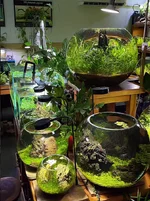
Aquadream in Vietnam on insta and on Youtube has TONS of no-tech bowl scapes.
Almost 20 bowls in his store/gallery. Lots of info on his youtube channel!

pokomama_medaka on insta

tinyecosystems_ on insta, also sells "kits" to make your own tiny ecosystem jars.

the_bettabowl_project on insta

MJ Aquascaping bowl on youtube, beautiful setup.

MJ Aquascaping vase on Youtube

MD Fishtanks on Youtube has done a few planted no tech bowls

aquashopuha on insta

jp72363 on insta

y0shi_n9 on Insta

kermitDE on Reddit

buiscape on insta has a tiny Fluval bowl scape with crabs!

nakayamachiyomi on insta

ichistarium on insta

chandan0616 on instagram

Few-Focus8050 on Reddit
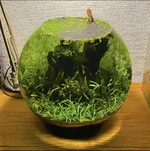
KrishTheBaker on Reddit and on Youtube

@HardeeParty here on Scape Crunch

@bradquade here on Scape Crunch

10-gal bowl featured on Tank Tested on Youtube
And that's just the ones I have found over the last few years! I have no doubt there are many, many more out there.
I'll add to this thread as I find them, and would love it if you would, too!
I'm known here for high tech, high nutrient, inert substrate scapes -- but I also love NO tech, rich substrate scapes, too!
This thread is three-sided:
- To act as a journal for my new No-Tech bowl scape, and
- To act as a discussion board for no/low tech bowl scapes, and
- To collect and share accounts and examples of bowl scapes from around the world!
But there is a new modern kind of fish bowl, one where plants, substrate, bacteria, water changes, and proper inhabitant selection all work together to create healthy, mini ecosystem-worlds in our homes:
My first bowl attempt in 2020
My second bowl, a true "no tech" in 2021
My third bowl scape (no tech) in 2023, and by far my favorite and most successful!
What does No Tech mean?
In general, it means that these scapes have:- No Filter
- No Heater
- No Air Pump
- No Skimmer
- No CO2
- No Circulation
- A Light (usually low to medium-powered)
- A Substrate (inert, aquasoil, or sand-capped soil like Walstad method)
- Plants (usually quite low-tech plants, though a surprising number will thrive in this method!)
- Inhabitants (Since these bowls are usually between 2-12 gallons on average, this limits selection to nano fish, shrimp, and snails).
The point is, these are smaller, affordable, beautiful little worlds of light to enliven our living spaces and create art, nature, and beauty -- often with very little maintenance and upkeep besides a partial water change and feeding the fish.
Gallery and Links to bowl scapers:
quano_aqua on Insta
waterplantslover on insta
hanahiyori1112 on insta
Sono aqua pfm on Insta and on Youtube is one of the pioneers of this method, and
deserves a TON of credit for popularizing this technique across many Japanese communities!
kazuaki387 on insta
qball_aquatics on insta has many small bowl scapes.
Nanoscape on insta
syo_aqua_plants on insta follows the "Sono" method.
Aquadream in Vietnam on insta and on Youtube has TONS of no-tech bowl scapes.
Almost 20 bowls in his store/gallery. Lots of info on his youtube channel!
pokomama_medaka on insta
tinyecosystems_ on insta, also sells "kits" to make your own tiny ecosystem jars.
the_bettabowl_project on insta
MJ Aquascaping bowl on youtube, beautiful setup.
MJ Aquascaping vase on Youtube
MD Fishtanks on Youtube has done a few planted no tech bowls
aquashopuha on insta
jp72363 on insta
y0shi_n9 on Insta
kermitDE on Reddit
buiscape on insta has a tiny Fluval bowl scape with crabs!
nakayamachiyomi on insta
ichistarium on insta
chandan0616 on instagram
Few-Focus8050 on Reddit
KrishTheBaker on Reddit and on Youtube
@HardeeParty here on Scape Crunch
@bradquade here on Scape Crunch
10-gal bowl featured on Tank Tested on Youtube
And that's just the ones I have found over the last few years! I have no doubt there are many, many more out there.
I'll add to this thread as I find them, and would love it if you would, too!
63 Replies
·
5951 views


Journal High-Tech 90P Build
Hi guys!
I'm new here, but not entirely new to planted tanks though I've been out of the hobby for the better part of the last decade between kids and moving a couple of times - but finally in a spot where I can do something again. I'm mostly going to be making things up as I go along, but plan on a lot of automation (I want to integrate everything into home assistant) and a lot of DIY as I love the challenge of building things out myself.
The starting point:
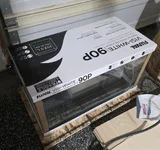
I picked up a 90P rimless, low-iron tank on a great deal.
I have a rough idea in my head for a stand to be built from plywood - just have a couple other house projects to finish off before starting that built.
Wife says I can only have one aquarium, so for this tank, I want to go all out with a sump to allow for auto top off, and auto water changes, auto fertilizer dosing etc. etc. I have half a plan in my mind.
I've also started on the light fixture which I've modeled up in CAD, and plan on making out of an 8020 extrusion, and some 3D printed bits.
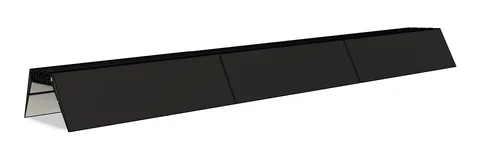
I'm using bridgelux gen 3 thrive CW (3000k) and WW (5000k) LED strips which have super high CRI at 98+ along with some specific XPE2 wavelengths that I'll solder onto some starboards. Far Red (730nm), Red (654nm), Cyan (495nm), Blue (455nm), Visible UV (415nm). Each segment of the white channels will be on its own driver so I can adjust left to right brightness in thirds, and each colour channel on its own driver so I can vary each channel on a time-based approach.
These will be run from a custom PCB board with Meanwell N-LDD drivers, and will run ESPHome on an ESP32 so it can link up with my Home Assistant installation.
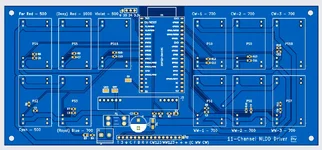
That's it for now, this will probably be a very slow build so be warned if you follow along!
I'm new here, but not entirely new to planted tanks though I've been out of the hobby for the better part of the last decade between kids and moving a couple of times - but finally in a spot where I can do something again. I'm mostly going to be making things up as I go along, but plan on a lot of automation (I want to integrate everything into home assistant) and a lot of DIY as I love the challenge of building things out myself.
The starting point:
I picked up a 90P rimless, low-iron tank on a great deal.
I have a rough idea in my head for a stand to be built from plywood - just have a couple other house projects to finish off before starting that built.
Wife says I can only have one aquarium, so for this tank, I want to go all out with a sump to allow for auto top off, and auto water changes, auto fertilizer dosing etc. etc. I have half a plan in my mind.
I've also started on the light fixture which I've modeled up in CAD, and plan on making out of an 8020 extrusion, and some 3D printed bits.
I'm using bridgelux gen 3 thrive CW (3000k) and WW (5000k) LED strips which have super high CRI at 98+ along with some specific XPE2 wavelengths that I'll solder onto some starboards. Far Red (730nm), Red (654nm), Cyan (495nm), Blue (455nm), Visible UV (415nm). Each segment of the white channels will be on its own driver so I can adjust left to right brightness in thirds, and each colour channel on its own driver so I can vary each channel on a time-based approach.
These will be run from a custom PCB board with Meanwell N-LDD drivers, and will run ESPHome on an ESP32 so it can link up with my Home Assistant installation.
That's it for now, this will probably be a very slow build so be warned if you follow along!
82 Replies
·
5784 views

Wrapped up my AGA submittal a few weeks ago, and I just can't seem to bring myself to take care of my tank right now  I think I'm experiencing burnout. I go through these cycles where my tank is all I can think about for a few weeks/months, and then I need a break, and I can't bring myself to do my usual water change and trim schedule. The good news is my tank has so much healthy plant mass that algae doesnt grow even after a few weeks of neglect.
Any tips on fighting this tendency? I think my first idea is to slow everything down, lower my nitrate to more of a zero-bound system and try to reduce my stem trimming frequency. My second idea is making my water change easier. Right now the hardest part is siphoning detritus into buckets that I walk to the toilet. After that I pump the tank down the rest of the way. How do you guys do this? I would siphon straight to the toilet but I'm bound to accidently send a shrimp to their doom that way.
I think I'm experiencing burnout. I go through these cycles where my tank is all I can think about for a few weeks/months, and then I need a break, and I can't bring myself to do my usual water change and trim schedule. The good news is my tank has so much healthy plant mass that algae doesnt grow even after a few weeks of neglect.Any tips on fighting this tendency? I think my first idea is to slow everything down, lower my nitrate to more of a zero-bound system and try to reduce my stem trimming frequency. My second idea is making my water change easier. Right now the hardest part is siphoning detritus into buckets that I walk to the toilet. After that I pump the tank down the rest of the way. How do you guys do this? I would siphon straight to the toilet but I'm bound to accidently send a shrimp to their doom that way.
35 Replies
·
554 views
Hello, can anyone running the ARC small acrylic reactor on a 40 breeder tell me what your outlet position is and what ph drop or co2 ppm you are getting?
12 Replies
·
366 views
I completed my first AGA contest photos for the Dutch category today!
What a PITA!!! It took me a lot longer than I thought it would. Removing the tank equipment, cleaning the resulting mess, figuring out how to use a bunch of random cardboard to keep the light bleed off the camera...it was like a 4.5 hour affair for me in my cramped, sweaty office.
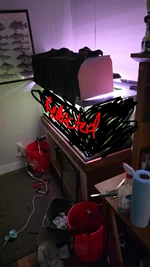
The other challenge was keeping the water clear with the filters off. Every time I thought I was ready to shoot I'd find one more leaf or stray piece of root hanging out somewhere on the surface or stuck in the moss or something. It's a lot more noticeable when the water is stagnant.
I'm glad to be done. I'm about 75% happy with how my tank turned out. Had a couple issues with plant selections but I think I made it work OK for my first entry. I'm really excited to see everyone else's tanks (and to finally start seeing them discussed on the forums). Good luck everyone!
What a PITA!!!
It took me a lot longer than I thought it would. Removing the tank equipment, cleaning the resulting mess, figuring out how to use a bunch of random cardboard to keep the light bleed off the camera...it was like a 4.5 hour affair for me in my cramped, sweaty office.The other challenge was keeping the water clear with the filters off. Every time I thought I was ready to shoot I'd find one more leaf or stray piece of root hanging out somewhere on the surface or stuck in the moss or something. It's a lot more noticeable when the water is stagnant.
I'm glad to be done. I'm about 75% happy with how my tank turned out. Had a couple issues with plant selections but I think I made it work OK for my first entry. I'm really excited to see everyone else's tanks (and to finally start seeing them discussed on the forums). Good luck everyone!
3 Replies
·
245 views