Welcome to ScapeCrunch

We are ScapeCrunch, the place where planted aquarium hobbyists come to build relationships and support each other. When you're tired of doom scrolling, you've found your home here.

Urea vs nitrates as N source. Effects on algae growth ?

  • Thread starter Thread starter hamfist
  • Start date Start date
  • Tagged users Tagged users None
Joined
Oct 5, 2025
Messages
171
Reaction score
361
Location
Southampton, UK
I've asked this elsewhere but with no help as yet so hope you guys might be able to add some clarity on this.

The nub of the question is whether urea dosing is more likely to stimulate alage growth compared to the equivalent nitrate dose ?

To add detail, my current macro dry salts premix has around 50% of its nitrogen as Urea.

Ever since I've had it set up as a planted tank, and then added injected CO2 shortly afterwards, my main 150 G tank has always had a tendency towards green dust and spot algae. In fact its a constant battle really.

I maintain measured 30 ppm CO2 throughout the lighting period, my PAR is only around 20 at the substrate (so barely even medium lighting) and is approching being heavily planted (around 80% substrate area is planted with plenty of fast growing stems). I dose macros daily to keep the maximum peaks as low as possible. Nitrates hover at around 5 ppm average so I'm hardly over fertilizing.
I am seriously considering moving to indivdual dry salt macros with nitrates as the sole nitrogen source. Hopefully to improve the alge situation.

Any thoughts, advice ?
 
Ever since I've had it set up as a planted tank
How long might that have been since you set it up?

I set up a 75 gallon tank at the end of April and within a month or two was dealing with green dust. Evetything else was free of algae but had to wipe glass every 4-5 days. Progressed to needing to wipe it down every other day…

Plant mass grew well, mostly algae free but Green Dust was annoying.. tried spraying peroxide on glass after wiping it and doing deep water changes, tried dialing down nitrates, KNO3 source, no urea, tried whole tank peroxide treatment followed by gluteraldehyde to knock it down… Nothing really helped, plants went into transition stress as a result….

Then I gave up.. and a month later it decreased and within 2 months reverted to just needing glass wiped during weekly water changes and. Just a dirty brown residue on melamine sponge now, no longer green.. and that isnt even a significant amount…

Pretty much it ran its course and resolved..
 
How long might that have been since you set it up?
Then I gave up.. and a month later it decreased

Well dust algae are individual organisms, so are particularly involved in competition with our (invisible) bacterial biofilm levels


Consensus seems to be that GDA breaks out when there hasn't been a a significant time period of cleanliness and stability to build up thriving bacterial biofilm.. Stable CO2 / stable nutrients / excellent flow and oxygenation / stable low DOC from super clean substrate and filter media / stable lights / vigorous pruning of all unhealthy leaves and stems, + time


I've also found that a couple of Mystery Snails make a huge difference, if you have high enough KH to keep them alive.. Likely a combination of their voracious appetite + their internal GI bacterial flora continuing to seed the biofilm assemblage in your tank 👍

Consensus is also that GDA is a real pain in the ass 😕 we definitely feel your pain here 💯💯
 
Last edited:
Thanks for your interest guys.

The tank, filters and most of the substrate have been set up for well over a decade, so I feel it should have a really good level of biological maturity, despite the changes since I converted it to a low tech planted tank in Oct '24. Then added injected CO2 in July '25 (so a very big change 3 months ago really ).

KH is zero so mystery snails are a no go. I do have a Siamese algae eater, around 8 x Otocinclus and a few amanos in there, but they seem to make minimal difference to the algae if I'm honest.

I have recently (Aug/Sept '25) been adding a fair bit of aquatic compost underneath the inert gravel/sand substrate (basically as a root tab substitute) to potentially help me reduce water column fert needs. The effects of this are positive so far I believe but its a bit early as yet to make any final conclusions. I've been able to "inject" the aquatic compost underneath the gravel/sand very effectively with virtually no contamination, so I have put quite a lot in over a 3-4 week period.

This tank has a very significant amount of fish stock including three bulky 4-6" fish (including one particularly chunky 6" blue acara), plus loads and loads of smaller 1.5"-4" ones so there will always be a good amount of slightly less controllable water column fertilization from fish and food waste and it could be a potentially important factor i guess. Despite being an experienced aquarist this is my first foray into CO2 injection so a lot of this is very new.

Water changes are 50% weekly and I feel I keep the substrate decently clean. I put a lot of effort into it but there is obviously a limit as to how much physical disturbance and trauma one can impose on the plants to remove all the debris.

The upshot of all this is that I still seem to be having to keep the lights ridiculously low to keep GDA and GSA to a minimum.

Most plants are still growing reasonably well with Limnophila heterophila, Pogostemon Helferi and Rotala colorata thriving particularly well. I have a very decent bush of the Rotala. however, the tank could certainly do with a lot more plant mass to help outcompete the algae. Plants I really seem to be struggling with are Alternanthera reineckii rosaefolia and Staurogene repens. Both of which grow incredibly slowly and old growth gets quickly algified.

I'm tempted to just bite the bullet and simply try the change to a fully nitrate source of water column Nitrogen, just to see if it makes a difference to the algae. No-one seems to be able to give me a confident answer about Urea vs nitrate and algae, so I may as well try the change and see how it goes. It won't cost a lot. The negative is that its yet another change, which might spark yet another period of instability (which I would want to avoid).

I'd love hearing even just educated guesses about Urea and algae.

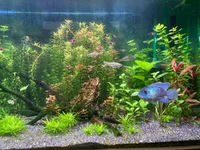
Here's pics for reference.
IMG_6800.webp
IMG_6801.webpIMG_6802.webp
 
Last edited:
Some interesting variables in there.. I believe GreggZ and Joe have the most experience using urea.

Paging @GreggZ and @Burr740 📱☎️🔊

Also is that a Blue Acara ? Gorgeous! And huge 😮
Yes, an electric blue acara. Believed male (despite female-looking dorsal and anal fins) because of "his" huge size. He's pushing 6" TL.
 
This is a very interesting question especially given the context of the situation. As Koan pointed out above gda has a close relationship with the bio-maturity of a tank, and as Pepere pointed out usually goes away on its own if things get right. Things being plant health, maturity of the system, and stability

GSA differs in that like most algae its universally tied to unhealthy plants, even with no obvious symptoms present. Low PO4 is said to cause it, more PO4 often cures it. But Ive seen tons of other things bring it on too. The root cause always goes back to the happiness of the plants

Back to urea. I have extensive exp using urea, tried it many different ways and had months long periods of using it regularly. All in fast high energy set ups. I came to the conclusion that it makes the easy fast stuff grow faster and bigger, more colorful even. But it never helped support sensitive difficult plants, which was my only reason for using it to begin with. Straight NO3 has always done better for me personally

Every time I started urea Id get GDA on the glass for 2-3 weeks. Then it would disappear on its own. I believe the addition of urea causes a shift in the bio-population, either in kind or density, and once it adjusts the algae goes away. Ive also seen it happen with a sudden increase of K. Id say its likely with a sudden increase of any macros. Ive also seen it pop up when plants arent entirely happy, often before any visible evidence. This is a key point to remember

@hamfist obviously your situation isnt a new tank with an immature bio-cycle, although you could be partially destroying it in some regular way, but it doesnt sound like it. And urea isnt a new addition. But the whole compost thing does give me pause. Its a disturbance, and a big addition of..who knows what exactly. That could definitely cause it, but if I understand correctly it was already happening before you tried that right?

My question is why are you so hesitant to put nutrients in the water? Do you think it would cause algae or something? Well...

looking at your plants its obvious you have a very lean water column. The fuzzy green Limno or whatever that is is real leggy with small sparse leaves. The Lud super red, same thing, leggy and gimpy, poor coloration. Nothing is stunted and first glance looks healthy, but all your plants are small and weak looking

Thats why you have algae. Remember the key point up there, this is a perfect example. Just because you have a few ppm of NO3 left doesnt mean thats enough. For reasons I wont go into here, macros along with Ca and Mg need to be present in certain concentration relative to each other to balance everything out

Now dont ask me what some magical ratio is because I dont know it and dont necessarily believe there is one. But take Ca for example. The fastest stem-packed tank in the world might only pull a couple ppm of Ca out of the water per week. But you cant run a planted tank with 1 or 2 ppm of Ca in the water

I believe you simply need more ferts in the water. Forget trying to juice the substrate, you dont need it and it wont help the really fast stuff anyway. Downoi dont need it either. I have 7 high energy farm tanks with straight blasting sand sub and zero root supplements. All but the most sensitive soft water loving plants grow in prize winning form

So Id just raise ferts, macros at least. Start slow, maybe double what you have now (thats still very low) and take it from there

Adding: Raise light back up a little bit too. Having it so low might deter the algae but its slowing the plants way down too. You want the plants thriving as much as possible and light is a big part of that. Dont worry about what happens in the first few days, say gda increses for a brief minute, etc. Just be patient and let everything adjust including the bio population
 
Last edited:
Back to urea. I have extensive exp using urea, tried it many different ways and had months long periods of using it regularly. All in fast high energy set ups. I came to the conclusion that it makes the easy fast stuff grow faster and bigger, more colorful even. But it never helped support sensitive difficult plants, which was my only reason for using it to begin with. Straight NO3 has always done better for me personally
While we're on the subject, I'll just ask something I've wanted to.

I've seen it suggested that it's difficult to start tc plants in a new tank with an inert substrate. Do you feel this is true? If so, do you think urea in that new tank would take the place of ammonia in aquasoils and do the trick?
 
While we're on the subject, I'll just ask something I've wanted to.

I've seen it suggested that it's difficult to start tc plants in a new tank with an inert substrate. Do you feel this is true? If so, do you think urea in that new tank would take the place of ammonia in aquasoils and do the trick?
Ive never heard that and aside from a usual diatom phase Ive never seen it either. I start a new sand tank with full dosing just like the rest of them. Smooth sailing from day one. Why would it not be?

Edit: I just realized you said tc plants specifically. Still I havent noticed a difference. Some tc are just hard converters. Some are old and weakend already when we get them. But Ive had that issue with soil tanks and sand too. So I dont believe adding urea would help, but cant say for sure because Ive never tried it. Its an interesting question
 
Last edited:
This is a very interesting question especially given the context of the situation. As Koan pointed out above gda has a close relationship with the bio-maturity of a tank, and as Pepere pointed out usually goes away on its own if things get right. Things being plant health, maturity of the system, and stability

GSA differs in that like most algae its universally tied to unhealthy plants, even with no obvious symptoms present. Low PO4 is said to cause it, more PO4 often cures it. But Ive seen tons of other things bring it on too. The root cause always goes back to the happiness of the plants

Back to urea. I have extensive exp using urea, tried it many different ways and had months long periods of using it regularly. All in fast high energy set ups. I came to the conclusion that it makes the easy fast stuff grow faster and bigger, more colorful even. But it never helped support sensitive difficult plants, which was my only reason for using it to begin with. Straight NO3 has always done better for me personally

Every time I started urea Id get GDA on the glass for 2-3 weeks. Then it would disappear on its own. I believe the addition of urea causes a shift in the bio-population, either in kind or density, and once it adjusts the algae goes away. Ive also seen it happen with a sudden increase of K. Id say its likely with a sudden increase of any macros. Ive also seen it pop up when plants arent entirely happy, often before any visible evidence. This is a key point to remember

@hamfist obviously your situation isnt a new tank with an immature bio-cycle, although you could be partially destroying it in some regular way, but it doesnt sound like it. And urea isnt a new addition. But the whole compost thing does give me pause. Its a disturbance, and a big addition of..who knows what exactly. That could definitely cause it, but if I understand correctly it was already happening before you tried that right?

My question is why are you so hesitant to put nutrients in the water? Do you think it would cause algae or something? Well...

looking at your plants its obvious you have a very lean water column. The fuzzy green Limno or whatever that is is real leggy with small sparse leaves. The Lud super red, same thing, leggy and gimpy, poor coloration. Nothing is stunted and first glance looks healthy, but all your plants are small and weak looking

Thats why you have algae. Remember the key point up there, this is a perfect example. Just because you have a few ppm of NO3 left doesnt mean thats enough. For reasons I wont go into here, macros along with Ca and Mg need to be present in certain concentration relative to each other to balance everything out

Now dont ask me what some magical ratio is because I dont know it and dont necessarily believe there is one. But take Ca for example. The fastest stem-packed tank in the world might only pull a couple ppm of Ca out of the water per week. But you cant run a planted tank with 1 or 2 ppm of Ca in the water

I believe you simply need more ferts in the water. Forget trying to juice the substrate, you dont need it and it wont help the really fast stuff anyway. Downoi dont need it either. I have 7 high energy farm tanks with straight blasting sand sub and zero root supplements. All but the most sensitive soft water loving plants grow in prize winning form

So Id just raise ferts, macros at least. Start slow, maybe double what you have now (thats still very low) and take it from there

Adding: Raise light back up a little bit too. Having it so low might deter the algae but its slowing the plants way down too. You want the plants thriving as much as possible and light is a big part of that. Dont worry about what happens in the first few days, say gda increses for a brief minute, etc. Just be patient and let everything adjust including the bio population

Wow, so much useful info here. Thanks so much for taking the time to help me. I shall re-read it a couple of times to get all the good stuff from it.

Your theory does make perfect sense, with a consistently too lean water column actually causing unhappy plants and thus allowing GDA to thrive.

You're also right in your assumption that the GDA problem was there before the aquatic compost addition. I have also been injecting this same compost undergravel in all my shrimp tanks and the effects on plant growth in these have been noticeable. There have been no ammonia problems with delicate shrimp either. The aquatic compost feels very "loamy" in my hands and not overly nutritious, so I think it was a good choice.

I had done my maths (hopefully correct) and had been adding 1.3g of the Solufeed macros into 450 litres of water daily. Weekly dose around 9.1g According to other's calculations on UKAPS my weekly "NO3 equivalent" dosing should be around 15 ppm. I am glad that your eye has picked out loads of visual clues in the plants that this is not enough though.

I have had a handful of years success with low tech planted shrimp tanks and I suspect this is the cause of my reticence in adding macros and my stubborn lack of acceptance that "ferts don't cause algae". Its in my head, but clearly not yet the heart ! I had been adding a lot more macros than in my low tech tanks but clearly still not enough.

My probable plan .........

1/ double my macro dose -this should theoretically add 30 ppm nitrate-equivalent (in urea and nitrate) per week, in smaller daily doses.

2/ Slowly increase light levels weekly

3/ Increase 50% water change frequency to twice weekly if algae problems flare up acutely.

4/ Wait a month then re-assess.
 
have also been injecting this same compost
So….. I have been hoping someone will bring this up but I have never heard of injecting compost or any soil into the substrate. Not to hijack this thread, but if you can elaborate on the technique that would be great. I am curious to see if it would work for aqua soil.
 
So….. I have been hoping someone will bring this up but I have never heard of injecting compost or any soil into the substrate. Not to hijack this thread, but if you can elaborate on the technique that would be great. I am curious to see if it would work for aqua soil.
I haven't found of anyone else doing it either. Its dead simple. I'm sure others have tried it but not got around to writing it up. I have documented it here ...... Novel undergravel nutrient soil injection method

I use the word "injecting" but that makes it sound more fancy than it is. I use the word mainly because I use a simply adapted syringe thats all.

Its worked so well I have done it in all my tanks. I have chosen a lower nutrient soil-like substrate but I think it would work as well with almost any soil or pelleted aquasoil.
 
I haven't found of anyone else doing it either. Its dead simple. I'm sure others have tried it but not got around to writing it up. I have documented it here ...... Novel undergravel nutrient soil injection method

I use the word "injecting" but that makes it sound more fancy than it is. I use the word mainly because I use a simply adapted syringe thats all.

Its worked so well I have done it in all my tanks. I have chosen a lower nutrient soil-like substrate but I think it would work as well with almost any soil or pelleted aquasoil.
This is super nice! I have been dreading to add aqua soil after all the ammonia spike I have had during the start. This seems very doable for aquasoil. Tagging along @Dennis Wong to see if he has tried something like this instead of just adding aquasoil on top.
 
This is super nice! I have been dreading to add aqua soil after all the ammonia spike I have had during the start. This seems very doable for aquasoil. Tagging along @Dennis Wong to see if he has tried something like this instead of just adding aquasoil on top.

I started doing it because I really wanted a nutrient layer underneath my gravel but just couldn't bear the thought of basically taking the whole tank down and putting it in. Its such a large tank for such an undertaking. Root tabs are very expensive indeed as an alternative and my experients with making my own clay-based root tabs were not ultimately successful. THis is a great alternative.
This technique works well with anything from 3mm grained gravel down to 1 mm grain gravel/sand, and anything inbetween. (as I have various substrates (but all inert)).
 
I started doing it because I really wanted a nutrient layer underneath my gravel but just couldn't bear the thought of basically taking the whole tank down and putting it in. Its such a large tank for such an undertaking. Root tabs are very expensive indeed as an alternative and my experients with making my own clay-based root tabs were not ultimately successful. THis is a great alternative.
This technique works well with anything from 3mm grained gravel down to 1 mm grain gravel/sand, and anything inbetween. (as I have various substrates (but all inert)).
It would be very helpful to others if you could add this as a resource section at Scapecrunch with pictures.
 
This is a very interesting question especially given the context of the situation. As Koan pointed out above gda has a close relationship with the bio-maturity of a tank, and as Pepere pointed out usually goes away on its own if things get right. Things being plant health, maturity of the system, and stability

GSA differs in that like most algae its universally tied to unhealthy plants, even with no obvious symptoms present. Low PO4 is said to cause it, more PO4 often cures it. But Ive seen tons of other things bring it on too. The root cause always goes back to the happiness of the plants

Back to urea. I have extensive exp using urea, tried it many different ways and had months long periods of using it regularly. All in fast high energy set ups. I came to the conclusion that it makes the easy fast stuff grow faster and bigger, more colorful even. But it never helped support sensitive difficult plants, which was my only reason for using it to begin with. Straight NO3 has always done better for me personally

Every time I started urea Id get GDA on the glass for 2-3 weeks. Then it would disappear on its own. I believe the addition of urea causes a shift in the bio-population, either in kind or density, and once it adjusts the algae goes away. Ive also seen it happen with a sudden increase of K. Id say its likely with a sudden increase of any macros. Ive also seen it pop up when plants arent entirely happy, often before any visible evidence. This is a key point to remember

@hamfist obviously your situation isnt a new tank with an immature bio-cycle, although you could be partially destroying it in some regular way, but it doesnt sound like it. And urea isnt a new addition. But the whole compost thing does give me pause. Its a disturbance, and a big addition of..who knows what exactly. That could definitely cause it, but if I understand correctly it was already happening before you tried that right?

My question is why are you so hesitant to put nutrients in the water? Do you think it would cause algae or something? Well...

looking at your plants its obvious you have a very lean water column. The fuzzy green Limno or whatever that is is real leggy with small sparse leaves. The Lud super red, same thing, leggy and gimpy, poor coloration. Nothing is stunted and first glance looks healthy, but all your plants are small and weak looking

Thats why you have algae. Remember the key point up there, this is a perfect example. Just because you have a few ppm of NO3 left doesnt mean thats enough. For reasons I wont go into here, macros along with Ca and Mg need to be present in certain concentration relative to each other to balance everything out

Now dont ask me what some magical ratio is because I dont know it and dont necessarily believe there is one. But take Ca for example. The fastest stem-packed tank in the world might only pull a couple ppm of Ca out of the water per week. But you cant run a planted tank with 1 or 2 ppm of Ca in the water

I believe you simply need more ferts in the water. Forget trying to juice the substrate, you dont need it and it wont help the really fast stuff anyway. Downoi dont need it either. I have 7 high energy farm tanks with straight blasting sand sub and zero root supplements. All but the most sensitive soft water loving plants grow in prize winning form

So Id just raise ferts, macros at least. Start slow, maybe double what you have now (thats still very low) and take it from there

Adding: Raise light back up a little bit too. Having it so low might deter the algae but its slowing the plants way down too. You want the plants thriving as much as possible and light is a big part of that. Dont worry about what happens in the first few days, say gda increses for a brief minute, etc. Just be patient and let everything adjust including the bio population

Hi Joe

How going? Whats your recommended ppm of urea to dose? Is it the same as nh4 where all u need is 1ppm max?
 
I dabbled with urea and ammonium chloride for a few months.

Had green dust algae as well. Mostly just in my high light tanks. EI vs lean dosing didn't seem to make a difference to it.

I lowered my light a lot and most algae species just stopped growing.

Keep in mind I only keep buce tanks with a few random stem plants as a canary plant.
 
I dabbled with urea and ammonium chloride for a few months.

Had green dust algae as well. Mostly just in my high light tanks. EI vs lean dosing didn't seem to make a difference to it.

I lowered my light a lot and most algae species just stopped growing.

Keep in mind I only keep buce tanks with a few random stem plants as a canary plant.

Interesting. I am now around 2 weeks after conversion from 50 : 50 Urea/NO3 to purely NO3 and I must say the GDA is reducing somewhat. Of course, plant mass has increased also in that time, so its not a completely fair test.
 

Top 10 Trending Threads

Back
Top