
Welcome to ScapeCrunch

We are ScapeCrunch, the place where planted aquarium hobbyists come to build relationships and support each other. When you're tired of doom scrolling, you've found your home here.

Journal Marcel's next experimental design - suggestions welcomed

Ha, I started a response on this thread a few days ago and got sidetracked. (My entire family is sick, ugh.) But the discussion has gotten interesting in the meantime! Good stuff.

@Marcel G, I understand your desire to pick apart all these different elements and understand how they interact and contribute to plant growth, but I think you need to be more realistic about what you can do with the resources you have and the strength of the conclusions you can draw. I hate to go back to this, but replication and randomization is as important as tightly controlling an experiment. Try as you might, we know that there are uncontrollable factors that may help or hinder growth between seemingly identical tanks and these factors can outweigh the effect of the independent variable you are testing. I'm not in plant research now, but in undergrad and grad school I worked on crop field studies, greenhouse studies, tissue culture studies and you would see that all the time. It's assumed that there will be some amount of error in an experiment (I mean in the statistical sense, not as in a mistake) and that's built into the design. Individual reps can be incongruous with the overall results of the study, but if there are enough of them it will come out in the wash.

So if you have four or eight totally different tanks you are comparing, you can't really know that any differences you observe are due to the independent variable rather than chance. If you take the results at face value, you will probably be right some of the time. But you'll be wrong some of the time too, and you'll never know which is which.

This gets to be even more of a problem the more complicated an experiment becomes - the more variables and levels of different variables, the more reps you need to separate the signal from the noise.

That's not to say that you should give up! Not at all! You are still doing what few people are in the hobby, and I want you to make the most of it. But I think you need to narrow down what you are testing and think of it more as gathering evidence rather than drawing sweeping conclusions. Yes, you won't be able to get all the answers you are looking for, but if you take an iterative approach you can probably find reasonable solutions to some eventually.
 
@Marcel G, I understand your desire to pick apart all these different elements and understand how they interact and contribute to plant growth, but ...
Honestly, I'm not sure you understand me, but I'll try to explain when you answer the following question: Let's say you have the following four types of plants: (1) Rotala wallichii, (2) Ammannia pedicellata 'Gold', (3) Hygrophila corymbosa, (4) Pogostemon deccanensis. Your goal is to find out under what conditions they will thrive. How would you do that? Please give me a specific suggestion for an appropriate course of action (experimental procedure).
 
Your goal is to find out under what conditions they will thrive. How would you do that? Please give me a specific suggestion for an appropriate course of action (experimental procedure).
Pick one species that leads what you do, how you set up the tanks and how you decide on changes going forward. You can plant multiple species in each tank, but the others are there for "curiosity", not for the main purpose of the experiment.

Suppose you pick Pedicallata, you also referred to the Ammannia Pedicatella 'Golden' thread on UKAPS, so start all tanks around one particular setup that gives a high degree of confidence that Pedicallata will thrive. Verify that all tanks indeed thrive, and observe if you see any variations between the tanks that were supposedly set up as equals. From there, decide what single parameter (perhaps CO2, or perhaps HCO3, perhaps a nutrient in water or substrate) you believe counts most to vary and see how it affects Pedicallata in a positive or negative sense by applying variations on that parameter to all tanks. Then bring all tanks to the same optimum, the tank that performed best, for that particular parameter and select a second tank parameter that you believe is important to test. From there repeat the process until you find an optimum for Pedicallata on all key parameters, and perhaps some surprises that you want to investigate further (perhaps some unexpected relevant parameter that was not included in your initial parameter set). You will learn more about other species as well, but that's just helpful if you want to focus on them in a next test sequence.
 
Last edited:
Honestly, I'm not sure you understand me, but I'll try to explain when you answer the following question: Let's say you have the following four types of plants: (1) Rotala wallichii, (2) Ammannia pedicellata 'Gold', (3) Hygrophila corymbosa, (4) Pogostemon deccanensis. Your goal is to find out under what conditions they will thrive. How would you do that? Please give me a specific suggestion for an appropriate course of action (experimental procedure).
Do we not already understand this? They will all thrive in a rich substrate with low KH and lean water column, which is what youd need for the pedicelatta. The other three are not so picky. They can thrive in a much wider range of conditions so in this case youd just cater to what the pedicelatta needs and the rest will be fine

Ammania isnt hard they just tend to not like rich water, and the lower the kh and the richer the sub is the better
 
Last edited:
Honestly, I'm not sure you understand me, but I'll try to explain when you answer the following question: Let's say you have the following four types of plants: (1) Rotala wallichii, (2) Ammannia pedicellata 'Gold', (3) Hygrophila corymbosa, (4) Pogostemon deccanensis. Your goal is to find out under what conditions they will thrive. How would you do that? Please give me a specific suggestion for an appropriate course of action (experimental procedure).

Alright, I'll take a different tack here.

I know you see it as a mandatory thing, but I think focusing on identifying the key parameters before you even start is not helpful right now. I appreciate that you haven't had the results you want and are trying to avoid further failure, but figuring all that out will require doing careful experiments that you aren't ready to begin because you can't grow the plants well enough to start. But you don't need the know the key parameters, you just need to trial and error your way to something that works for you, the same way other people do it.

You'd figure it out faster if you return to a beginner's mindset, find other people who have grown whatever species you're interested in successfully and copy them as completely as possible as a starting point. If you run into trouble, ask for help. Of course, you know you will get many different opinions about what you should do, often conflicting with each other. That's fine; take the advice of people you trust, or test out the conflicting opinions in your different tanks. (And always feel free to ignore anyone who you don't find helpful, not matter how right they feel they are. Your tank, your rules.) Observe and take notes. Allow yourself to change tactics in response to what your plants are doing (a big experimental no-no!). The species you've picked aren't impossible by any means, so this should be an achievable task without having to overthink it.
 
Pick one species ... start all tanks around one particular setup ... verify that all tanks indeed thrive ... decide what single parameter counts most to vary ... bring all tanks to the same optimum ... select a second tank parameter ... and repeat the process until you find an optimum on all key parameters.
Well, I don't even know where to start. I tried to just write out a model scenario of what such a process [that you suggest] might look like in practice, but then I gave up because it would be uninteresting, most people would get lost in it, and no one would probably finish it to the point. From your suggestions for a procedure so far, it's obvious that you @Yugang, @Burr740, @ElleDee] have probably never done any such experiments with plants of unknown preferences. I don't mean that as a criticism, just a statement. Because none of those suggestions take into account the incredible number of possibilities (combinations) that can occur. Let me just briefly give a few examples: If I test just one parameter (e.g. CO2), I find, for example, that a given plant grows best at 30 ppm CO2. But this conclusion will only be valid for the combination of parameters tested. As soon as I change anything in the next test, it may no longer be true. For example, if I increase the bicarbonate concentration, the plant will collapse, regardless of the amount of CO2. But if I also add more of another element, the plant may recover. So any single parameter can turn the results upside down in an unknown combination with other parameters. Not to mention the substrate. What substrate should I use? ADA Amazonia? And which ADA Amazonia? One that has a clay:silt:sand ratio = 15:25:60 and is low in most nutrients, or one with a clay:silt:sand ratio = 50:25:20 and satisfactory nutrient content, or even one with a clay:silt:sand ratio = 35:30:35 and good nutrient content? And how do I know it in the shop? ... So I have no choice but to choose a substrate with an unknown composition. And if a plant doesn't grow well in it, how will I know that some water parameter is to blame and not the substrate? Maybe I change some water parameter (e.g. HCO3), which will change the pH of not only the water, but as a consequence the soil solution, which in turn will affect the redox and species composition of the microbes, which in turn will affect the (un)availability of various nutrients. You have seen yourself that a dramatic increase in nutrients led to an immediate deterioration of R.wallichii, but the addition of HCO3 prevented this deterioration (for some reason). Some plants may need a combination of factors to grow well. But if I test them one at a time, I'll probably never figure it out. And if I actually test all possible combinations, then I probably won't live long enough to achieve the goal (= to find out under what conditions the plant will thrive). So I still stand by what I said: „I'm not sure you understand this issue.“
 
Last edited:
So I still stand by what I said: „I'm not sure you understand this issue.“
Please take this in the good spirit that it is being offered.

What is the "issue" and how would solving it lend itself to improving the hobby in general?

Most people who keep planted tanks are seeking to create a visually inspiring garden with a variety of plants. If you were to solve the mystery of how to grow Wallachii perfectly in a glass box, how would you extrapolate that to the hobby in general?

I am just not sure what the goal is here, but I am trying to understand.

In any event in makes for good interesting conversation that is for sure.
 
I understand what you are saying and thats why its so hard to gain any meaningful insight from some of these experiments - too many unknown factors having an influence

My point is, we already know how to grow ammania, and those other plants too. We may not understand exactly what happens on a molecular level under the substrate, inside the plant or even in the water. Any of those could be an interesting experiment and might shed more light on why something causes what it causes. But here again you'd need a solid control with the plants growing healthy to experiment on.

Well, we already know what parameters ammania thrives in. So set a few tanks up that way and go to town experimenting on them. You seem to be looking for some key factor that explains everything, like bicarbonates or whatever. All I can say to that is, cool? Probably be interesting but Im not sure how it would really help the hobby

Most hobbyist dont care to know the inner working of a television. They just want to know what buttons to push on the remote to make it do what they want

You want to advance the hobby? Show the importance of keeping a tank clean. Set up two and keep one clean with regular water changes and let the other one go. Or CO2, keep one rock steady and change the other one a little bit every day, or use irregular ferts in one and keep steady levels in the other one. Show something that hobbyists can take home with them and apply to their own tanks and make them better
 
From your suggestions for a procedure so far, it's obvious that you @Yugang, @Burr740, @ElleDee] have probably never done any such experiments with plants of unknown preferences. I don't mean that as a criticism, just a statement.
I am not super interested in growing picky species in the hobby and I have kept my advise general because of that, but you greatly underestimate my experience with plants generally. And you bet everyone from research scientists to commercial nurserymen seek out others for advice if they are getting started with plants they are unfamiliar with. My major professor is very, very good at his job, and one of the ways he got that way is that he's always asking knowledgeable people their experience with different plants. He doesn't necessarily act on any one thing, but sometimes several people will say things that seem related and bam, he's got a possible solution to a problem or an avenue of research. He's always got a library of tips to employ if he gets stuck, and a Rolodex of people to call. It's a valid and normal way to approach this issue!

And let's be real - none of the taxa you have mentioned are total mysteries across the board. Many people are growing them successfully. There is definitely enough of an answer out there to get started.

Because none of those suggestions take into account the incredible number of possibilities (combinations) that can occur. Let me just briefly give a few examples: If I test just one parameter (e.g. CO2), I find, for example, that a given plant grows best at 30 ppm CO2. But this conclusion will only be valid for the combination of parameters tested. As soon as I change anything in the next test, it may no longer be true.

You keep saying that you are trying to get the plants to grow at all, right? You need a starting point, a basic recipe, and then you can start worrying about what happens when you start tweaking variables. Don't put the car before the horse.

And I am fully aware of the existence of and implications of interactions. You can't test them all at one time, you have to pick the avenues of interest and hope something comes of it. And it's slow going. It sucks, but that's science.

But if I also add more of another element, the plant may recover. So any single parameter can turn the results upside down in an unknown combination with other parameters. Not to mention the substrate. What substrate should I use? ADA Amazonia? And which ADA Amazonia? One that has a clay:silt:sand ratio = 15:25:60 and is low in most nutrients, or one with a clay:silt:sand ratio = 50:25:20 and satisfactory nutrient content, or even one with a clay:silt:sand ratio = 35:30:35 and good nutrient content? And how do I know it in the shop? ... So I have no choice but to choose a substrate with an unknown composition.
Are these the actual different ratios measured? What was the organic fraction? A clay, a sandy loam, and a clay loam are quite different indeed.

But if there's that much variation, ideally you test the actual substrate you use in the experiment so it isn't unknown to you, report what it is in your materials, and move on. It may be tricky for other people because they don't know the composition of what they are using, but if they try to replicate your parameters and get a different result at least they are aware that that is one area that may be responsible. It might not matter that much.

And if a plant doesn't grow well in it, how will I know that some water parameter is to blame and not the substrate? Maybe I change some water parameter (e.g. HCO3), which will change the pH of not only the water, but as a consequence the soil solution, which in turn will affect the redox and species composition of the microbes, which in turn will affect the (un)availability of various nutrients.
This is why the result and discussion parts of academic papers are often separate sections. Your results are for reporting what you did and what happened (x amount of carbonate had y effect on the growth parameter). You can get into the why that might have happened in the discussion and you don't really have to know the exact answer. Did y effect happen from the carbonate directly or from its effects on nutrient availability? List the possibilities, state your thoughts. Use these ideas to make a follow up experiment if you are interested.

But if I test them one at a time, I'll probably never figure it out. And if I actually test all possible combinations, then I probably won't live long enough to achieve the goal (= to find out under what conditions the plant will thrive). So I still stand by what I said: „I'm not sure you understand this issue.“
You probably won't ever figure it all out! That doesn't mean you can't contribute - we're pretty desperate for data here and if you can elucidate even a couple factors that have major growth effects for tricky species I think it would be great. I do disagree with @GreggZ about the utility to the hobby. He might not personally benefit or see the potential benefit to others, but this kind of inquiry has the potential to be very powerful.

That said, I don't think I've been helpful to you in the way that you want and I'm sorry about that. As I said in my last post, you are the boss of your own tanks and you can take or leave anything I've said. No hard feelings. I think I'll bow out of this thread now, though I hope you stick around these parts and wish you well regardless.
 
I am not super interested in growing picky species in the hobby and I have kept my advise general because of that, but you greatly underestimate my experience with plants generally. And you bet everyone from research scientists to commercial nurserymen seek out others for advice if they are getting started with plants they are unfamiliar with. My major professor is very, very good at his job, and one of the ways he got that way is that he's always asking knowledgeable people their experience with different plants. He doesn't necessarily act on any one thing, but sometimes several people will say things that seem related and bam, he's got a possible solution to a problem or an avenue of research. He's always got a library of tips to employ if he gets stuck, and a Rolodex of people to call. It's a valid and normal way to approach this issue!

And let's be real - none of the taxa you have mentioned are total mysteries across the board. Many people are growing them successfully. There is definitely enough of an answer out there to get started.


You keep saying that you are trying to get the plants to grow at all, right? You need a starting point, a basic recipe, and then you can start worrying about what happens when you start tweaking variables. Don't put the car before the horse.

And I am fully aware of the existence of and implications of interactions. You can't test them all at one time, you have to pick the avenues of interest and hope something comes of it. And it's slow going. It sucks, but that's science.


Are these the actual different ratios measured? What was the organic fraction? A clay, a sandy loam, and a clay loam are quite different indeed.

But if there's that much variation, ideally you test the actual substrate you use in the experiment so it isn't unknown to you, report what it is in your materials, and move on. It may be tricky for other people because they don't know the composition of what they are using, but if they try to replicate your parameters and get a different result at least they are aware that that is one area that may be responsible. It might not matter that much.


This is why the result and discussion parts of academic papers are often separate sections. Your results are for reporting what you did and what happened (x amount of carbonate had y effect on the growth parameter). You can get into the why that might have happened in the discussion and you don't really have to know the exact answer. Did y effect happen from the carbonate directly or from its effects on nutrient availability? List the possibilities, state your thoughts. Use these ideas to make a follow up experiment if you are interested.


You probably won't ever figure it all out! That doesn't mean you can't contribute - we're pretty desperate for data here and if you can elucidate even a couple factors that have major growth effects for tricky species I think it would be great. I do disagree with @GreggZ about the utility to the hobby. He might not personally benefit or see the potential benefit to others, but this kind of inquiry has the potential to be very powerful.

That said, I don't think I've been helpful to you in the way that you want and I'm sorry about that. As I said in my last post, you are the boss of your own tanks and you can take or leave anything I've said. No hard feelings. I think I'll bow out of this thread now, though I hope you stick around these parts and wish you well regardless.
+1

I have tried to contribute, starting from the objectives that were set, yet would also concur with @Marcel G stating that the design of experiment that I proposed is a lot of work. That's why I hinted in an earlier post that if I had 8 tanks I would have a couple of ideas what to test and research, a bit less ambitious. However @Marcel G should do what he likes best for his hobby and scientific interests.

In any event in makes for good interesting conversation that is for sure.
Absolutely, and again thank you @Marcel G for starting this thread. You inspire a lot of thoughts.
 
On the one hand, many of you perceive (and make it clear) that drawing any meaningful conclusions from such experiments is problematic (and I fully agree with you on this from the beginning), but on the other hand, you do not hesitate to defend your own methods, from which you often draw general conclusions, for example about the importance of a nutritious substrate, extra CO2, low alkalinity, strong lighting, regular maintenance, etc. Even when you deny something (e.g. you claim that "it is not true that high nutrient concentrations are harmful in themselves"), this is a general conclusion. If you try to think about it honestly and dispassionately, you might agree with me that it at least sounds like a contradiction in terms (i.e. it carries a strong potential for contradiction, unfairness). You assert your own methods (opinions), but criticize the one who tries to subject those opinions to objective criticism in practice. I take no offense, nor am I setting myself up as a martyr here. I'm just trying to give you an idea of how I perceive your comments from my position. I acknowledge most of your objections. I am more sorry that you are not similarly critical of yourself or your mentors.

@GreggZ asks me how the results of my experiments could improve our hobby. In all honesty and seriousness, I can give you the benefit of the doubt that absolutely not. Not because they lack any meaningful and useful insights, but because most of you don't really care about those insights. Only those who realize that there is no other way to arrive at reliable knowledge will find meaning and usefulness in it. We can take @Yugang's redesigned CO2 bell for dissolving CO2 as an example here. This is basically nothing but physics applied in practice. For those who get it, it's an absolutely brilliant solution (the answer to all the moaning about achieving and maintaining stable CO2 levels). But I'm afraid that for most others it will just be some sort of unsightly DIY equivalent of the long dead "CO2 bell" concept. And so it is with everything. Most people prefer instant fruit (colorful and sweet); but only a handful of people try to pay attention to the laws of farming (and aren't afraid to get their hands dirty). And yes, it's pointless to ask people to be all good farmers. Most just want to be consumers who buy ripe/sweet fruit at the market.

@Burr740 writes that "we already know what parameters ammania thrives in". If I understood correctly, these are the parameters he mentions in post #64: "rich substrate with low KH and lean water column". But will this plant really thrive in any type of rich substrate? Does it really not depend on any of its properties, just the nutrient content? And did you know that, for example, ADA Amazonia substrates have a low (below average) content of most nutrients according to the agricultural tables? So rather than "rich" we should call them "poor" (I personally think aquarium substrates are made from depleted agricultural soil, maybe just leached in ammonia). And would you say that the thickness of the substrate also matters? Because the redox decreases with depth (and the lower the redox, the more oxidized nutrients you have dissolving in there). And should you periodically do a deep vacuuming of the substrate? Because this will disrupt the redox cascade (microbial activity), and as a result the nutrient cycle will be disrupted. This is just a small part of the things that can dramatically affect the result, and I'm just trying to show that it's not as simple as we often imagine with these parameters (which we supposedly already know well)... as we often imagine. If we are lucky, and the interplay of all those invisible factors that most people don't want to know about in our aquarium allows the desired result, we feel that we are "experienced growers" who can advise others. But if someone uses the same ingredients but it leads them to a different result, we start to convince them that they must have made a mistake somewhere. How many people have tried to emulate, say, Tom Barr in this way? And how many people have been told that they "didn't follow the recipe" (e.g. they got the CO2 wrong)? Sorry, but that's not really the way to go.

@ElleDee, my apologies. Honestly. I know I overreacted and I'm sorry. If I can add anything else [by way of explanation], we may not have quite understood each other. Yes, I think that in order to study a plant, I have to first and foremost come up with a "basic recipe" (with the help of others) in which it will grow at least somewhat decently. I can then "bounce off" from that and then change various parameters and refine its/her preferences (which is usually a very lengthy process given the number of those parameters and their possible combinations). But that is exactly what I am trying to do from the very beginning. I am trying to suggest about eight "basic recipes" that could cover the basic needs of as many aquarium plants as possible. Please don't see these recipes as final, but as "starters" (basic, general). One of those recipes might be @Burr740's "rich substrate + low alkalinity + low nutrient concentrations in the water" ... as a sort of "basic outline" (basic starting point). I'd like to be a bit more systematic in doing this though. That is, I don't want to piece together the eight most commonly used practices (recipes) from the internet, but I am trying to "stratify" or "polarize" them a bit. So if I have "rich substrate" on one bowl of the scale I want to put "no substrate" (or "nutrients in water-column only") on the other bowl. If I put "low concentrations of nutrients in water" on one pan of the scale, I want to put "high concentrations of nutrients in water" on the other pan of the scale ... carbon source = CO2 vs. HCO3, nitrogen source NO3 vs. NH4, Ca:Mg ratio = X vs. Y, etc. And all I was trying to coax out of you were suggestions on what to put on these "scales". Your insights and comments are much appreciated, and in retrospect I am always very sorry for sometimes expressing myself too harshly or exaggeratedly. This apology is, of course, to all involved.

It is difficult to have a meaningful discussion in an online space where we do not see each other face to face. Often we express an idea that the other person interprets differently, which very often leads to misunderstandings and sometimes even irritation. Sometimes we overreact. In the real world, we might come back to it the next day and apologise to the person concerned. And the experience that we want to work on ourselves and are willing to improve, may motivate him to continue the discussion with us ... sometimes. But in the online space, others immediately step in and "stir up the dust", making clarification and eventual improvement difficult to say the least. Sometimes a person is excluded from the collective and has no chance to come back and make amends. I have quite a lot of experience with this. I'm a naturally conflicted type (black sheep). And I'm afraid of that here. Since this forum is relatively small so far, I guess they are happy for every member here (including me). But once the base gets big enough, the wilder branches will start to get cut off without mercy. I, for one, am trying to learn from my mistakes. For example, I now know that it's not just the content that matters, but the form in which that content is presented is just as important. But in the online space, the possibility of change, improvement or learning is usually not allowed. If at a certain stage in your life you act in a socially (i.e. majority) undesirable way and you are excluded from the collective, you will never get the chance to try again. I mention all of this because I have had the opportunity in my lifetime to meet a number of exceptional people in the online space who quite often came across to others as oddballs or conflicted types. They have also hurt a number of people. And the vast majority of them ended up being ostracized, with no way to come back. This is also practiced in the Catholic Church, where it's called excommunication. And whenever a discussion heats up and there are signs of disagreement among the debaters, gradually growing into animosity, the noose begins to tighten. Most people don't have a problem with this, the more reasonable ones are able to withdraw (quieten down) in time, the unruly ones ... To calm the stormy emotions, to bring constructive comments into the discussion, to be able to self-reflect, few people can do that. I wish we all keep learning this.
 
Last edited:
I feel like I may have come across as too dismissive of the value some of the things youre trying to discover, ie the impact of bicarbonates. Any new discovery of factors that influence plants grown in aquariums is of course highly valuable and also very interesting to me personally. I did not mean to dismiss the value of such experiments

As for the parameters I mentioned that ammania does well in, specifically "rich" substrate. I realize rich is a blanket term that takes the science thereof down a few notches. By rich I mean aquasoil-types in general, whether its something like Controsoil that is known to pack less nutrients than other brands, specifically NH4, or the "hotter" brands like amazonia. I dont think that really matters. What matters is that the substrate can house nutrients. Whether it comes with them already or ad/absorbs them via cec

"Active" might be a better term for the substrate because ''rich'' implies certain levels that, as you pointed out, can vary greatly between brands or types. The important function is provide nutrients in the substrate instead of the water. Creating an acidic environment at the roots is likely an added bonus

Nutrients in the water, especially heavy nutrients in the water, is what ammania doesnt like. I take this as a fact, others may not. Ammania varieties have been around as long as the hobby itself. They werent even considered difficult 30 years ago. The only reason ammania is thought to be difficult today is because the hobby spent a decade frying them with EI.

They are not difficult, they just dont like much nutrients in the water. My first couple years in the hobby I grew very nice A gracilis using Seachem liquids, sand substrate, tap water KH 5-6, and either no CO2 just od'ing gluteraldehyde, or DIY co2. There were lot of plants I couldnt grow and really had no idea what I was doing. But Ammania plugged through the whole time looking pretty nice because there wasnt much nutrients in the water using the seachem liquids. I didnt understand this reason why until a few years later

So thats what I meant by we already know how to grow ammania. Because I feel like we do. Vin's Rotala Kill tank experiments painted a pretty clear picture if we didnt already know before that

I am honestly surprised we dont have more plants in the hobby that require unique parameters. Syn and Tonina of course we all know need a very low KH. And we also know that a low KH grows most plants better especially more difficult species. But Ammania in my opinion stands alone in the fact that high nutrients in the water actually bothers them. To me there is no mystery, its simple as that
 
I feel like I may have come across as too dismissive of the value some of the things youre trying to discover ...
My goal is nothing groundbreaking. I would just like to put together a few recipes that can distinguish the basic requirements (preferences) of individual plants. For example, I'll take those Ammannias, put them in eight different aquariums, where in one I'll have a rich substrate with zero alkalinity and low nutrient concentration in the water, in another I'll have no substrate (or just plain sand), in a third I'll have extra CO2, in a fourth I'll have "who knows what", etc. So I'll put the Ammnnias in and after a few months I'll be able to say that (1) yes, the Ammnnias do thrive in a tank with rich substrate, low alkalinity, and low nutrient concentration in the water, but (2) they thrive similarly well without substrate, (3) if I add more CO2 (or HCO3) to the water, and (4) if I provide them with enough XY, etc. I have no problem acknowledging that they thrive in a rich substrate with low alkalinity and low nutrient concentration in the water. But I am reluctant to admit that this is the environment they actually prefer (or the only environment where they thrive). Perhaps it is possible to grow Ammannias successfully without substrate at all (in water only = hydroponically, but completely submerged under water). But we don't know what they need to do that (or what specifically bothers them in our aquariums when we try). Maybe they are hypersensitive to a particular micro element (or some set of elements), and if they grow in substrate they can somehow control their uptake better, whereas in water they are pushed uncontrollably, and that bothers them. The fact is that without an organic substrate, they tend to be a problem. We don't know why. And more importantly, we don't know if they actually require the organic substrate => what is so important in it that is missing (or can't be) in the water? After all, the only thing plants need is nutrients (leaving aside solar energy for now). And all aquatic plants are able to take up nutrients both by roots from the substrate and by leaves from the water column. So as long as we provide all the nutrients in the water, they should be fine. If they are not, then it is more likely that there will be some problem with inappropriate amounts or ratios of individual nutrients, or perhaps a deficiency (because in oxygenated water, for example, phosphorus and iron oxidize and precipitate rapidly, whereas in the substrate it is the opposite). Do you understand? So my point is not only to find out under which conditions a given plant thrives, but also to understand why this is so. Until we understand that, we may be able to grow it successfully in rich substrate etc, but all the while we will live under the delusion that it is something that it requires (when it may not at all). Then someone will just come along and show us its thriving Ammannias in sand and we will be skeptical or just not believe it, but more importantly we won't understand it because we just don't understand what these plants actually prefer/require. [PS: The same thing happened with @sudiorca. When he first came with his aquariums without extra CO2, almost nobody believed him that he didn't really use any extra CO2. As far as I know, even Tom Barr doubted it. But nowadays it is slowly accepted.] That's why understanding is the key for me. So yes, this goal may be ambitious, but I don't see any other way for now, unfortunately (if I want to gain the understanding). My eight aquariums are definitely not meant to be some all-encompassing, all-embracing combination of factors. As I mentioned, this is just the first step (in a series of other steps) to help me gauge those key preferences => does the plant require a rich substrate, or can it do without; does it require extra CO2, or can it get by with a naturally low CO2 concentration (or will it grow well even if we provide enough carbon in the form of HCO3); does it require high concentrations of nutrients, or can it get by with little, or will it require higher concentrations of some other elements (e.g. calcium or potassium)? ... etc. Eight tanks is not much, but it could tell us a lot about the plant, if we allocate/stratify the parameters wisely. That's what I'm trying to do. Maybe I'll find that the Ammannias only grow well in that one aquarium where there is rich substrate + zero alkalinity + low nutrient concentrations in the water. But maybe it will also grow quite well in some other one with significantly different parameters, which may give us a clue of something important about it, and in the next step I might suggest another set of tests to check it out. But before we move on, I first need to appropriately design the first experimental set => the sorting (basic) one. Obviously, I won't discover many (most) things with that first set. But the better designed it is, the more things it can discover. I have used one such set suggested by _Maq_, but I didn't find it very useful. From my point of view, it was not very well designed because it was too narrow in scope and based on many assumptions that I don't share: (1) that most plants don't need a rich substrate, (2) that they can get by with naturally low concentrations of CO2 (and they can all get by without HCO3), (3) that low concentrations of nutrients are sufficient for good growth, and (4) that if a plant has trouble taking up micronutrients, it's related to their inability to extract them under higher pH. Although I tried to discuss this with _Maq_, there was no reasonable discussion with him on this point, so we parted ways. He continues to investigate plants in his minimalist, almost ascetic, narrowly focused way, I would like to go about it in a different way - i.e. not excluding any possibility a priori, and take it more broadly in the first step.
 
On the one hand, many of you perceive (and make it clear) that drawing any meaningful conclusions from such experiments is problematic (and I fully agree with you on this from the beginning), but on the other hand, you do not hesitate to defend your own methods, from which you often draw general conclusions, for example about the importance of a nutritious substrate, extra CO2, low alkalinity, strong lighting, regular maintenance, etc. Even when you deny something (e.g. you claim that "it is not true that high nutrient concentrations are harmful in themselves"), this is a general conclusion. If you try to think about it honestly and dispassionately, you might agree with me that it at least sounds like a contradiction in terms (i.e. it carries a strong potential for contradiction, unfairness). You assert your own methods (opinions), but criticize the one who tries to subject those opinions to objective criticism in practice. I take no offense, nor am I setting myself up as a martyr here. I'm just trying to give you an idea of how I perceive your comments from my position. I acknowledge most of your objections. I am more sorry that you are not similarly critical of yourself or your mentors.
Marcel the above statement would paint a lot of the people in this hobby as being dogmatic. Personally I have not found that to be true. In my experience most are open minded and always looking to learn more.

As you may know I had a long running journal on another site. It had over 4K posts and over 250 participants. A true collective effort. As that journey evolved my conclusions, or "opinions" as you said have changed many times over the years on many subjects. That was influenced by my own trial and error and that of numerous successful plant growers who shared theirs as well.

One thing I have found is that there are rarely any absolutes in our hobby. I have said numerous times that I can only really be sure of what I see happen in my own tank......................and even then my conclusions might be completely wrong half the time.

I also used to post disclaimers. One was "Whatever I said I believed to be true at the time I said it", and another one is "try this at your own risk, as your results may vary".

Personally I am constantly on the lookout for people who demonstrate success. I have said hundreds of times over the years that if you show me a healthy well presented planted tank, I am interested in learning more. In fact many times I reach out personally to those people to learn more about how they manage their tank. And many times I find something useful that I can then apply to my own tank. Then the trial and error process starts all over again. It's a never ending cycle, and to me is one of the things that keeps the hobby interesting. You never know everything, there is always room for improvement, and sometimes your conclusions were wrong.

IMO no one in the hobby has all the answers. My own journey has evolved greatly over time, and continues to this day.

Who knows maybe one of your experiments will lead me to more trial and error and new conclusions/opinions. If so that is how the hobby evolves and grows.
 
Last edited:
It’s great to see someone like @Marcel who has been conducting scientific experiments for a very long time. I highly appreciate the knowledge, research and the skills you have accumulated over the years. Most hobbyists, including myself, rely on observation due to our limitation with scientific tools. While observation can be useful, it doesn’t always answer all the questions. When you put the observation and scientific data together, you can get better answers.

For example, I have been growing so-called difficult plants for over 10+ years or even longer, including the ones listed below, except for Ammannia. The list of challenging plants is very long, but I will focus on Pogostemon deccanensis, Rotala wallichii, and Ammannia pedicellata 'Golden'. I agree that Ammannia pedicellata 'Golden' and other species from this family are difficult and challenging to grow. However, in my experiments, I found that if you can successfully grow any plant from this family, you are one step closer to growing most of them from that family.

I am always doing some sort of experiment whenever I have free time. When I was ready and felt more confident about whatever I had gathered from my experiments, I tested my hypothesis by selecting some members from various forums and social media. I greatly appreciate the contributions from the community. For instance, @plantnoobdude was struggling with some of these plants when we met, and we tested one of my hypotheses together. The results can be seen in his tank journal, where most of these plants were growing well under the same conditions. Despite previously having unlimited nutrients and the correct chelate (Fe EDTA for his pH, adding up to 1 ppm Fe), he had struggled. We purposely selected some of the most difficult plants that people normally fail with or are known to fail with and put them under the same settings/setup. In some scenarios, we even implemented Marcel and Maq’s findings, a kind of Mix/Hybrid. We had some members @macek.g who also tried similar recipes with some modifications by choosing different chemicals and the outcome was very similar.

Sometimes, minor factors that may seem insignificant can have a significant impact on plant growth. For example, something as simple as adding 0.5 ppm N from urea or 0.04 ppm Mn can make a big difference. In another case with @Hufsa, we conducted similar experiments, and the Fe/Mn ratios made a notable difference. Her water parameters were quite different from @Plantnoobdude’s, and consequently, the results differed as well. The same hypothesis did not fully work for @Hufsa as it did for @plantnoobdude or Me. @Hufsa was no longer active on that forum/thread, so there were no further updates. Other than the Fe/Mn Ratio, one of my hypothesis was that since Mn can block Potassium to some extent, the good results in her case could have been due to potassium being blocked to some degree and letting the Fe/Mn/Mg work properly in the leaves. This was just my hypothesis and should be taken with a grain of salt.

@KirstyF, another member of the forum, conducted experiments with iron (Fe) and observed significant differences when using different chelates (such as EDTA, DTPA, etc.) and non-chelate forms (like Fe Gluconate). Despite meeting the pH requirements with DTPA, she found that Fe Gluconate worked better for her plants, even though it did not meet the pH requirements as well. The plants thrived under Fe Gluconate, and Fe deficiency was corrected, whereas they did not perform as well under DTPA. Several other members, not listed here, have also conducted similar experiments and reported comparable results. Was this the result of easily available Fe in case of @KirstyF ? Could be and most likely but how do you explain the same good results by me and @plantnoobdude who used DTPA Fe only? And how do you explain @plantnoobdude struggle with EDTA Fe and Fe related deficiency symptoms while using 1 ppm Fe, even though he met that PH requirement for EDTA Fe? How would you explain @Husfa Results who simply changed the Fe/Mn ratios?

As you can see, each case was unique. However, in the cases of @plantnoobdude and me, our results were similar due to our comparable water parameters, dosing methods, and other factors. On the other hand, @plantnoobdude achieved better results in some cases, which I believe was likely due to his choice of inert sand. This choice may have promoted better or different types of bacteria growth, as similar to what @Sudipta has explained in some of his posts. While my belief is totally based on my hypothesis and I could be incorrect, it is the best explanation that I have been able to formulate. Even though these experiments are not related to @Sudipta in any way or form but I appreciate @Sudipta for using his skills and knowledge to explore sediment and bacteria. We truly needed someone to investigate this area and share their findings, as this kind of expertise is lacking in the hobby. sometime In the future, I would like to combine @Sudipta’s finding into some of my experiments.

Most hobbyists are now returning to lean dosing combined with rich substrates. Some people are switching over to Urea/NH4 dosing in some way or another, weather in liquid form or in the substrate. But These approaches were standard for many decades but had fallen out of favor as hobbyists explored other methods. One of these systems, were highly promoted by Takashi Amano and is well-known for its effectiveness. Furthermore, several brands added Urea/NH4 in their fertilizers for decade now, including ADA. Additionally, many hobbyists are revisiting the Diana Walstad system (organics/NH4), which reminds me of what @Sudipta is currently working on. While there are similarities, we may gain further insights into bacteria and other important factors from @Sudipta’s research, primarily about the substrate and bacteria. Urea/NH4 dosing has been my standard for decade because I was fully aware of its effectiveness, when properly implemented into liquid dosing, you may never have to change your soil/substrate, especially if its Clay/ADA based or high in CEC , most of these soils will attract the NH4+ and constantly recharge the soil.

Continue.....
 
I have used Urea for over a decade now, incorporating it into my high dosing regimen (even exceeding EI levels) during that time, and the results have been flawless for many difficult species, including those listed above. However, Ammannia pedicellata 'Golden', for example, never properly thrived under this dosing method. I began exploring other options, including Chelated, non-chelated micros/Fe, Macros, different kinds of chemicals etc. but Ammannia pedicellata 'Golden' still did not achieve the results I was seeking. Then I met Marcel, and I’m grateful I did. Marcel has been an excellent mentor to me ever since. Marcel shared some recipes with me which were based on Marschner's Mineral Nutrition of Higher Plants and I put the hypothesis to test, He already confirmed that it worked for him, the results can be seen on his website. It also worked for me, even Ammannia pedicellata 'Golden' grew great, but I combined this experiment with my old aqua soil during that time (no Fe deficiency). When I combined it with Silicia sand, the results were similar with some minor issues, the most common one appeared to be Fe deficiency related. My hypotheses were that this could be related to potassium because in this experiment K was much higher than Ca/Mg and may have had played some roles, since I was using Silicia sand, K has nowhere to go other than stay in the water, unlike in the previous setup where the aqua soil would have absorbed it. A few years later I met Maq and he was highly focused on the Ca/Mg/K ratios, I used the same setup/setting from the previous experiment and implemented it with Maq’s Ca/Mg/K ratio and Fe deficiency disappeared in Silica sand. The hypothesis was that Ca/Mg/K ratio likely made the differences, at least we could possibly say that the Fe deficiency was not really an Fe deficiency, but it was rather Mg deficiency caused by Excess/blocked by potassium. Some may argue that they add lot of potassium without issues, but they are either adding lot of Ca/Mg or either are adding lot of Micro/Fe to bring things in balance, or they use soils that are rich in CEC . I would also argue that I added lot of potassium too in my excess dosed tank with Urea 10+ years ago with great results, But that is not the point.

After conducting several experiments, I was able to grow Ammannia pedicellata 'Golden' and most of the plants from its family. Although I haven’t achieved the perfect growth, I am also working with it in inert silica sand, which presents an even greater challenge. In Aquasoil or acidic soil, this plant is relatively easy to grow; I had success with it using my recipes while using acidic soil. The same recipes were used by @plantnoobdude when he was using aquasoil, and these can be found in his journal.

I was able to grow these plants under both lean and high dosing regimes, using either chelated or non-chelated nutrients. However, it became clear that several factors influenced the results. The most significant factor appeared to be pH, along with the acidity of the water/soil, nutrient ratios, and the chemical composition of the nutrients. Particularly, altering the ratios and chemical composition of the nutrients alone led to varying responses from the plant. For example, @plantnoobdude used the exact same recipes under similar parameters, yet he achieved far superior results compared to mine. One hypothesis was that he used a different type of inert sand, which may have been accumulating detritus over time and allowing it to penetrate deeper into the substrate. In contrast, detritus in my setup tended to settle on the surface and did not reach deep into the substrate and I would suction them out.

Some may argue that Ammannia pedicellata 'Golden' only thrives in low KH, acidic water/soil, and with lean dosing. While this holds true for many plants, it's not overly complicated; most plants generally do well in acidic conditions. There is a common belief that Ammannia pedicellata 'Golden' only flourishes with lean dosing and not in high dosing and that it requires a rich substrate. However, this perspective doesn't fully capture the underlying reasons. The critical factors such as nutrient ratios and the chemical composition of the nutrients are usually ignored, when in fact they play crucial roles. For instance, dosing 5-10 ppm N from "Tropica Specialised Nutrition" typically will not cause Ammannia pedicellata 'Golden' to stunt. You can test this yourself. On the other hand, using simple salts like KNO3 to achieve the same 5-10 ppm N can present issues. KNO3 not only introduces a significant amount of NO3 but also a considerable amount of potassium, which can disrupt the nutrient ratios. Many people counteract this by lowering their KNO3 dosage (i.e., dosing lean), which helps mitigate these negative effects. When nutrient ratios are further reduced/adjusted by using a rich substrate and with minimal water column dosing, success with this plant or many others becomes more likely. If one chooses to rely heavily on the Soil/Substrate for the nutrients, I will still recommend mineralizing the water with Ca/Mg if you are using RO water and add some Micros/Fe in the water column.

Take @erwin123, for example. Inspired by @plantnoobdude, he believed that the success he experienced was due to using a lower dose of potassium from "Tropica Specialised Nutrition," whereas he found the potassium levels in "APT Complete" to be too high. While this observation is useful, it's important for him to also recognize the broader differences between the two products beyond just potassium content.

Through various experiments comparing lean versus high dosing for Ammannia pedicellata 'Golden' and other challenging plant species, I am confident that nutrient ratios and the chemical composition of nutrients play a crucial role under certain conditions. You should be able to grow most aquatic plants, including Ammannia pedicellata 'Golden,' in high doses. If you face difficulties, consider revising the nutrient ratios and the chemical composition of your dosing regimen. On the other hand, if unlimited nutrients and the correct chelate were the answer, growing plants would be straightforward for everyone. Some people claim that nutrient ratios don’t matter, yet they frequently adjust these ratios themselves without recognizing the potential impact. If these changes truly had no effect, why make them? If I were to revisit my approach from over 10+ years ago, it would be considered very rich dosing, exceeding EI levels. During that time, I successfully grew the most difficult plants (except for Ammannia). The primary change I made was adding Urea to my dosing, while everything else remained the same and consistent during that time. Should I conclude that this method of dosing is the best approach, given that it allowed me to grow most plants effectively?

Continue.....
 
Some members have suggested that just have a rich acidic soil and dose lean and Ammannia pedicellata 'Golden' will thrive. First of all, this plant can grow/thrive under both Lean or High dosing depending on the listed reasons above. Secondly, even if you met that low 5-6 PH, 0-1 KH requirements, this plant could still fail due to the listed reasons above. Just For example:

Tropica Specialised Nutrition dosed at 8 ppm N (35.4 ppm NO3 Equivalent) with following parameters:

PH 5.5
KH 0
GH 5

VS

KNO3/along with other needed nutrients dosed at 8 ppm N (35.4 ppm NO3 Equivalent) with following parameters:

PH 5.5
KH 0
GH 5

Ammannia pedicellata 'Golden' will not stunt with Tropica Specialised Nutrition dosed at 8 ppm N, but it will certainly stunt with KNO3/along with other needed nutrients dosed at 8 ppm N. not just Ammannia pedicellata 'Golden' but other difficult plant will show similar symptoms. Let’s say if you replace the KNO3 with KNO3+MgNO3+CaNO3 and the K is signifyingly lowered, the results start to get better, let’s say if you further replaced the KNO3+MgNO3+CaNO3+Urea/NH4 the results might be even more superior. Let’s say you still want to add KNO3 only but added lot of Ca/Mg in the water, the results will be much better, but not because you are dosing less KNO3 now, but because you are reducing the K to significant levels or it’s at the level where it is within close relationship with Ca and Mg. furthermore, you are also increasing the plants to Utilize the naturally produced NH4 in the aquarium.

Some argue that my good results are due to lean dosing, that’s when I realize that they are not truly reading everything that I post. The primary reason people may see it this way is because I usually advise using the lean approach. I usually recommend it because it already satisfies the plant needs and it’s also less work/hassle for the hobbyist, take @MichaelJ low tech for example.

My point is that I want to continue to dig further and deeper into aquatic plants, nutrients and this hobby, I don’t want to just settle at whatever I have learned and found so far, I know there is lot more to learn and more to explore. If I were to just dose few ppm of this or that, Chelated or Non chelated and call it good, then am not actually learning much from it even though it may grow most plants. I Would like to further explore why and which ppm are making a differences? Which chemicals are making the difference? What happens if I reduce or increase this or that ppm? What happens if I add CO3/HCO3? what happens if add Rich soil? What happens if I remove the rich soil? What happens if I use inert sand/gravel? What happens to bacteria under certain conditions and what role they play etc.? what happens if I use higher or lower PAR? I truly believe that is what Marcel is trying to highlight if I understand him correctly? I don’t think he is asking if you can grow Ammannia pedicellata 'Golden' in lean dosing.

Some might argue that many issues are related to pH, KH, or hard water. While it's true that these factors can affect nutrient availability, precipitation, and the effectiveness of chemicals and chelates, lowering the pH to 5.5 or reducing the KH to 0 isn't a universal solution either.

You can still grow plants with random nutrients or random guess work (similar to EI Method), but it will not provide anything useful other than that it can grow plants but will fail to highlight whatever I said above. If you fail with certain plant species, stunted plants, Nutrients related issues, fish/shrimp related issues etc. you can just ignore that and move on because you probably don’t care, have time to think about it or look for the reasons behind it. You cannot blame KH/PH for your plant issues either because the CO3/HCO3 in the water is at its lowest level if not 0. You can dose the following below and plant will grow, if not Ammannia species or other species but others will. You can even ignore ppm, numbers, or whatever from the nutrient perspective. You can use Chelated, Non chelated or whatever you could think of as long as it provides nutrients to the plants. for example:

PH 5-6 (use acids HCL, Sulfuric acid, phosphoric acid etc.)
KH 0-1 (KHCO3)
GH 2-5
Ca 10-30 (CaSO4, CaCl etc.)
Mg 4-10 (MgSo4, Mgcl etc.)
NO3 5-30 (KNO3, CaNO3, MgNO3 etc.)
K 5-30 (KNO3, KHCO3, K2SO4 etc.)
PO4 1-5 (Kh2PO4, phosphoric acid etc.)
Fe 0.1-0.5 (Fe Gluconate, Fe EDTA, Fe DTPA etc.)
Mn 0.02- 0.1 (Mn EDTA, MnSO4 etc.)
B 0.01 - 0.06 (Boric Acid, Borax etc.)
Zn 0.01 - 0.06 (Zn EDTA, ZnSO4 etc.)
Cu 0.002 – 0.02 (Cu EDTA, CuSO4 etc.)
Mo 0.001 -0.01 (Na2MoO4*2H2O, MoO3 etc.)
Ni 0.0001 - 0.001 (NiSo4, NiCl etc.)

Many people post recipes, including myself, but if you are that person who doesn’t really care too much about the nutrients or other related things. I don’t think its going to matter whether you dose 0.1 ppm Fe or 0.5 ppm Fe or 10 ppm NO3 or 30 ppm NO3. You don’t even have to copy or clone anyone’s Micros/Macro, otherwise you will be just copying their ratios. It’s easy to make fertilizers at home nowadays, tons of calculators out there, easy to buy dry chemicals, chelated or non-chelated. Easy to add 0.1 ppm Fe or 0.5 ppm Fe, 0.003 ppm Copper or 0.01 ppm copper etc. am always available if someone ever needs help with anything. If am free and have time, I will do my best to help. I usually get lots of messages and may not be able to reach out to everyone on time, So I apologize in advance. also, I have mentioned few Names/ID here, if I have made any errors please correct me. Thank you for reading this very long post, it almost felt like I was writing an article.

References:

90P High Light (Plants are happy, Algae are happy too)
Diorama - "Dutch style" (Mg>K experiment) Lean dosing
My 60p soft water
Plant deficiencies and the Fe Experiment
Consistency Deficiency

End
 
Last edited:
@Happi , I am taking a simplistic approach to ferts and water chemistry and can not comment on your posts, but what I can say is that I am blown away by the knowledge that you and a couple of others build up. Amazing. I now also understand @Marcel G perspective better, very knowledgeable, and why my posts did not resonate with his approach and objectives.
 
Last edited:
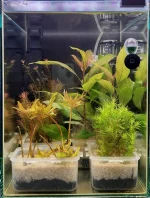
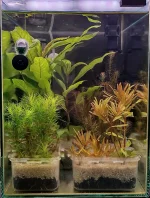
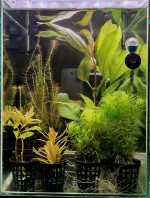
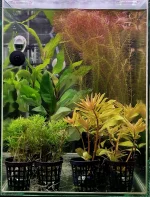
A SMALL TASTER OF THE EXPERIMENT IN PROGRESS

Main objective: Identify the basic physico-chemical preferences of selected plant species

Plants:
  • Ammannia pedicellata 'Gold' (formerly known as Nesaea …)
  • Hygrophila corymbosa
  • Pogostemon deccanensis
  • Rotala wallichii
Light: 100 µmol PAR (bottom), 230 µmol PAR (top) ... 8h/day
Substrate: 4 aquaria = organic substrate (= "agricultural" method), 4 aquaria = no substrate (= "hydroponic" method)
Water parameters: different for each aquarium

Video (as of 2024-11-02):


Pictures (as of 2024-11-02):

Aquariums 1-4 (first experimental set => "agricultural" method ... with organic sediment):

exp5_2024-11-02_day-29a.webp

Aquariums 5-8 (second experimental set => "hydroponic" method ... without sediment):

exp5_2024-11-02_day-29b.webp

Details:

Aquarium #1:

exp5---20241102---1.webp

Aquarium #2:

exp5---20241102---2.webp

Aquarium #3:

exp5---20241102---3.webp

Aquarium #4:

exp5---20241102---4.webp

Aquarium #5:

exp5---20241102---5.webp

Aquarium #6:

exp5---20241102---6.webp

Aquarium #7:

exp5---20241102---7.webp

Aquarium #8:

exp5---20241102---8.webp
 
Hey @Marcel G , thank you for posting this. Looks like an very well structured and executed test as always. Clean tanks and no signs of algae blooms to distract us ;)

It's very temptive to react with preliminary observations, and start debating about it... Best to wait for the test to come to an end and let you report about it.
Some questions though:
1. What about the length of the test you've planned? Is this 6 weeks from the beginning and half way there? Or...?
2. What happened to the Ammannia in aquarium#6, as it seems absent?
3. You are using skimmer pumps, which seems useful to me in these types of tests. Are you using foam cartriges in them to filter the water?

Happy testing!
 

Top 10 Trending Threads

Back
Top