Welcome to ScapeCrunch

We are ScapeCrunch, the place where planted aquarium hobbyists come to build relationships and support each other. When you're tired of doom scrolling, you've found your home here.

Horizontal CO2 Reactor - Yugang 鱼缸 Reactor

  • Thread starter Thread starter Yugang
  • Start date Start date
  • Tagged users Tagged users None
the inline atomizer's spring check valve thing was the culprit


Very minimal back pressure after pulling it out.

Just need to solve the issue of the reactor not having a pocket of co2 at the top half.

I'm pretty sure this is a pump speed issue and I'll have to order a slower/smaller pump lol. 515 gph is the lowest my current pump will go and that's too fast for this application.
 
the inline atomizer's spring check valve thing was the culprit


Very minimal back pressure after pulling it out.

Just need to solve the issue of the reactor not having a pocket of co2 at the top half.

I'm pretty sure this is a pump speed issue and I'll have to order a slower/smaller pump lol. 515 gph is the lowest my current pump will go and that's too fast for this application.
Could you make a bypass?


I tried a 317 GPH /1200 LPH pump and that was too much, it would fill up the reactor with water.
I tried a 50 GPH pump and that was too small to move the water in the reactor.

So I moved the ballvalve to the inlet of the CO2 pump, cranked it down some where under 50% i think (about 257.5 GPH or less) and now I have a nice gentle ripple through the reactor with a pocket of gas at the top. Tomorrow will be the real test.

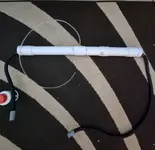
The area where Im injecting co2 is basically made up of

1x 3/4" Pipe Adapter Spigot X Barb
1x 3/4" Coupler Slip x Female Thread
1x 3/4" Nylon barb fitting
Some pvc pipe tape
Lee's Rigid PVC Air Line tubing

And this is how i built it:
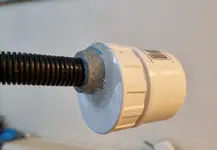
Step 1: Glue the 3/4" Pipe Adapter Spigot X Barb and 3/4" Coupler Slip x Female Thread and wait til it's dried.
Step 2: Drill a 3/16" Hole on the side of the coupler without threads
Step 3: Use a cotton swab to apply pvc glue to the 3/16" hole and around the PVC air line tubing and wait til it's dried.
Step 4: Apply pvc pipe tape to the nylon fitting and screw it on to the coupler.


I tried a 317 GPH /1200 LPH pump and that was too much, it would fill up the reactor with water.
I tried a 50 GPH pump and that was too small to move the water in the reactor.

So I moved the ballvalve to the inlet of the CO2 pump, cranked it down some where under 50% i think (about 257.5 GPH or less) and now I have a nice gentle ripple through the reactor with a pocket of gas at the top. Tomorrow will be the real test.

The area where Im injecting co2 is basically made up of

1x 3/4" Pipe Adapter Spigot X Barb
1x 3/4" Coupler Slip x Female Thread
1x 3/4" Nylon barb fitting
Some pvc pipe tape
Lee's Rigid PVC Air Line tubing

And this is how i built it:
Step 1: Glue the 3/4" Pipe Adapter Spigot X Barb and 3/4" Coupler Slip x Female Thread and wait til it's dried.
Step 2: Drill a 3/16" Hole on the side of the coupler without threads
Step 3: Use a cotton swab to apply pvc glue to the 3/16" hole and around the PVC air line tubing and wait til it's dried.
Step 4: Apply pvc pipe tape to the nylon fitting and screw it on to the coupler.

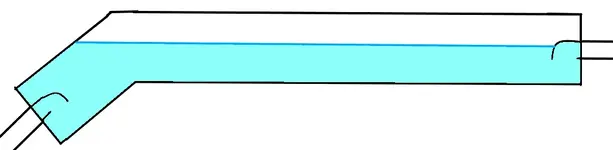
Just a thought, if anyone has issues with the gas pocket getting blown out the end, you can try just lowering that by say 10-20 degrees. That would keep the pocket away from the outlet of the reactor without sacrificing much, if any, surface area. I've considered putting a 45 on the reactor itself to create a little buffer zone. My reason for doing so is because I'm still interested in pushing for higher flow to see if that really has no (or little) impact on absorption rates, but higher flow runs the risk of the output sucking in a whirlpool. My plan is to use 90 degree elbows that I trim down for the internal portion of the inflow/outflow as well (more important on the output side).
yugang 45.png

Just things that have been bouncing around in my head, I've been too busy to make anything yet.
 
Last edited:
Just a thought, if anyone has issues with the gas pocket getting blown out the end, you can try just lowering that by say 10-20 degrees. That would keep the pocket away from the outlet of the reactor without sacrificing much, if any, surface area. I've considered putting a 45 on the reactor itself to create a little buffer zone. My reason for doing so is because I'm still interested in pushing for higher flow to see if that really has no (or little) impact on absorption rates, but higher flow runs the risk of the output sucking in a whirlpool. My plan is to use 90 degree elbows that I trim down for the internal portion of the inflow/outflow as well (more important on the output side).
View attachment 3115

Just things that have been bouncing around in my head, I've been too busy to make anything yet.
Really nice adaptation, especially for high water flow (y)
With this design you may want to keep the purging valve, as the gas pocket will not that easily purge through the exit. For use with a precision regulator or pH/CO2 controller it will be rock solid, and it will still have the safety feature that reactor capacity will have a natural limit.
This design is of course less suited to self purging or overflow mode (where we use the reactor geometry to stabilise CO2, rather than a precision regulator), as it will only start to purge when the reactor is full with CO2 and will probably make some noise in that situation.


I am also looking forward to see @Paul Chapman reactor work. With the in and outlet below the centre this is a design compromise that allows for higher water flows, as @CFassett , while still having the full self purging capacity, and possibility for overflow mode.
1695248464474.png
 
Really nice adaptation, especially for high water flow (y)
With this design you may want to keep the purging valve, as the gas pocket will not that easily purge through the exit. For use with a precision regulator or pH/CO2 controller it will be rock solid, and it will still have the safety feature that reactor capacity will have a natural limit.
This design is of course less suited to self purging or overflow mode (where we use the reactor geometry to stabilise CO2, rather than a precision regulator), as it will only start to purge when the reactor is full with CO2 and will probably make some noise in that situation.


I am also looking forward to see @Paul Chapman reactor work. With the in and outlet below the centre this is a design compromise that allows for higher water flows, as @CFassett , while still having the full self purging capacity, and possibility for overflow mode.
View attachment 3116
I will be testing it next weekend..will report back a few days after then.👍
 
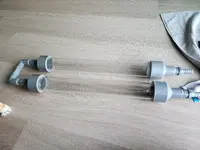
Trying it out with 500 mm X 60mm acrylic tubes. The prototype build I did worked nicely for my 120x50x50 tank.
Got to 1.3 pH drop in an hour. Couldnt quite get to 1.5 pH drop though. Hope this clear version would give me a better look at what actually goes on insude the reactor to further tune it. Also curious to see how more or less flow would affect the co2 dissolution rate.
20230922_190244.webp
 
Trying it out with 500 mm X 60mm acrylic tubes. The prototype build I did worked nicely for my 120x50x50 tank.
Ideally we would use 706 mm, for 42.000 mm2 reactor surface, but depending what pH drop you are targeting you may be close enough with 500 mm. If I misread, and you have a total of 2*500 mm, then of course the reactor is oversized and we should expect at least 1.5 pH drop.
Got to 1.3 pH drop in an hour. Couldnt quite get to 1.5 pH drop though
A quick checklist, based on the experience we have so far with trouble shooting
  • Did you correctly measure degassed tank water pH, and are pH values indeed as compared to fully degassed pH?
  • Your reactor has no gas purging valve, this should be no problem. Have you made sure that there is not too much air trapped that may reduce the reactor efficiency? Reactor can be purged by just letting all air out, or blowing some extra CO2 in it and let it purge itself with bubbles escaping through the exit.
  • Do you inject enough CO2 and do you see big CO2 bubbles entering the reactor that then rise and build the gas pocket? Quite a few users found that their CO2 flow was limited or obstructed. For the first tests you may want to blow more than enough CO2 (watch fish and watch pH), and when reactor is fine later dial back and optimise CO2 flow.
  • Do you see a gas pocket in your reactor that fills about half of the tube, or is the pocket much smaller? Your water inflow and outflow may limit the active reactor surface when the CO2 pocket would be less than half of the tube. For most users this is not an issue as the reactor is strong enough, but if one wants to push to the full 1.5 or 1.6 we may need the reactor surface optimised.
  • Do you have a gentle flow of water in your reactor? A relatively strong flow is not a problem, but will give some noise and perhaps some bubbles escaping through the exit. Low water flow is no problem either, but you don't want the water to be stagnant because then CO2 cannot be transported to your tank.
Looking forward to your test results @LouisXtan , and always happy to discuss further details and support as much as I can. You may send me a PM with further info and updates.
 
Last edited:
Found something cool for anyone building reactors with 3" pvc who needs to offset their input and outputs. It's abs though so keep that in mind when you're choosing your glues/solvent.
71HBLDzhSnL._AC_SL1500_.jpg

https://www.amazon.com/Eccentric-Reducer-Replaces-T1041-1-Fitting/dp/B0BKQZZM5B/
 
Ideally we would use 706 mm, for 42.000 mm2 reactor surface, but depending what pH drop you are targeting you may be close enough with 500 mm. If I misread, and you have a total of 2*500 mm, then of course the reactor is oversized and we should expect at least 1.5 pH drop.

A quick checklist, based on the experience we have so far with trouble shooting
  • Did you correctly measure degassed tank water pH, and are pH values indeed as compared to fully degassed pH?
  • Your reactor has no gas purging valve, this should be no problem. Have you made sure that there is not too much air trapped that may reduce the reactor efficiency? Reactor can be purged by just letting all air out, or blowing some extra CO2 in it and let it purge itself with bubbles escaping through the exit.
  • Do you inject enough CO2 and do you see big CO2 bubbles entering the reactor that then rise and build the gas pocket? Quite a few users found that their CO2 flow was limited or obstructed. For the first tests you may want to blow more than enough CO2 (watch fish and watch pH), and when reactor is fine later dial back and optimise CO2 flow.
  • Do you see a gas pocket in your reactor that fills about half of the tube, or is the pocket much smaller? Your water inflow and outflow may limit the active reactor surface when the CO2 pocket would be less than half of the tube. For most users this is not an issue as the reactor is strong enough, but if one wants to push to the full 1.5 or 1.6 we may need the reactor surface optimised.
  • Do you have a gentle flow of water in your reactor? A relatively strong flow is not a problem, but will give some noise and perhaps some bubbles escaping through the exit. Low water flow is no problem either, but you don't want the water to be stagnant because then CO2 cannot be transported to your tank.
Looking forward to your test results @LouisXtan , and always happy to discuss further details and support as much as I can. You may send me a PM with further info and updates.
I am using this tubing size because it is hard to get larger diameter acrylic pipes that are compatible with locally available fitting.
TIL 50mm PVC fitting is not the same as 50mm acrylic tubes lol.
Switching from an opaque PVC pipe to this clear one revealed to me the problem. the gas pocket is only filling up around 2/5 of the tubing before being purged through the outflow.
For now this would be enough as I am not gonna target that high of a pH drop for my scaped tank. 1.3 would be sufficient for this tank. I am planning to build another one for my plant collection tank. I would consider adding the 45 degree elbow on the insides as per shown in the previous replies in this thread. That should trap a large volume of air pocket in the reactor. But in the meantime I am happy with the results as it barely made any noise.

Side note, I did try to tweak the flow of my filter. Too much flow would push the air pocket out and too little will suffocate the fish, even at the same ph drop due to less air being sucked in at the lily pipe skimmer inlet..
Settled down at (by my rough estimates) 1100-1300 LPH for now.
 
But in the meantime I am happy with the results
(y)

consider adding the 45 degree elbow on the insides as per shown in the previous replies in this thread.
1695601802470.jpeg

The above will work well, I have this in my own reactor. The intake will allow quite high flow without making noise, and the outlet will start purging bubbles when the reactor capacity is at its maximum and half filled with CO2.

Unfortunately I am having second thoughts on the other design for high flow:
1695601897497.png
The potential issue that I see is that when the gas pocket grows to more than half of the reactor, the gas absorption surface will start to decrease, rather than increase, therefore less CO2 absorption in water and the gas pocket will grow faster and faster until the reactor is full with CO2 and has very little CO2 absorption capacity left. Nothing dramatic will happen, but it just means that the reactor is hardly effective anymore.
 
Hey all , i thought I would do an update on my reactor that I re made ..

My last reactor had no purge valve and my inlet and outlet was not set low down in the pipe, so I found I was getting some bubbles after a few hours of it running from day 1 plus I had some slight noise' and my pH drop took a while.. ( over 4 hours )

The new reactor has a purge valve and I've gone straight in to the side's with the fluval pipe so that there's no elbows on ethier ends as I found when the co2 bubbles hit the elbow on the input of the reactor this made some slight noise..

When I turned on the filter I opened up the valve with the reactor in position, the amount of air that came out was surprising and I waited till water came out of the valve and then let it run for 5 minutes with water flowing through the valve and reactor without co2 at this point.. this completely got all the air out..

I then set up co2 next morning and run the reactor.. I got a 0.8 pH drop in 2 hours at around 5 bubbles per second, that's all I need to get a 1.5ph drop in total.. I then monitored it and reduced it a little less to keep it at that ph drop which it did..

There is no noise from the reactor and it's been running for 4 days now and I haven't seen 1 bubble leave the output which is great as I didn't want it to do that as much as it was before..

I also have managed to increase the flow through the reactor by almost double as before I had the fluval ( 206 ) filter set to 50% flow now it's fully open putting in around 90 to 100 GPH. It says 200gph on the box but we all know that's lies..

I can only assume that there was an air pocket trapped in my last reactor which I cudent get out..

I've posted some pictures below.

really pleased with it ☺️

Its Much better than previous reactors and atomizers I've used in the past..

Tank is 130l 93cm long by 38cm wide 40cm tall

29inch long reactor 2inch diameter pipe..

0.8 pH drop in 2 hours and holding, cud probably do more if needed.

Hope this helps 🫡
 

Attachments

  • 20230902_151018.webp
    20230902_151018.webp
    856.3 KB · Views: 21
  • 20231002_195135.webp
    20231002_195135.webp
    560.9 KB · Views: 27
  • 20231003_195611.webp
    20231003_195611.webp
    313.6 KB · Views: 26
  • 20230930_153100.webp
    20230930_153100.webp
    191.4 KB · Views: 25
  • 20230930_153014.webp
    20230930_153014.webp
    202.6 KB · Views: 23
  • 20230915_180625.webp
    20230915_180625.webp
    214 KB · Views: 22
  • 20230915_180601.webp
    20230915_180601.webp
    266.5 KB · Views: 20
  • 20230915_175418.webp
    20230915_175418.webp
    225.7 KB · Views: 23
Last edited:
Context

As described earlier, we could operate the reactor in three different ways
  • Using a pH/CO2 controller for CO2 injection and stability
  • Using a precision CO2 regulator to precisely adjust CO2 injection
  • Overflow mode.
Most current users are either using a pH/CO2 controller or a precision CO2 regulator. There will be a reservoir of almost pure CO2 gas in the reactor, and the physics/chemistry of CO2 absorption into the water will be similar to any other reactor that may or may not use CO2 bubbles. As is also the case in bubble reactors, gradually we will see some oxygen and nitrogen outgas from the tank water into the pure CO2 pocket in the reactor (Henry’s law), but with an occasional manual purge this is not detrimental to the absorption of the injected CO2. The CO2 is stabilised by the pH/CO2 controller, or the regulator, so we’re all good. With the various users now having success with the reactor we might conclude that we understand it well enough, but doing so we may miss the opportunity to explore the pro’s and con’s of overflow mode.

My favourite mode of operation is the overflow mode, and I’ve been using it previously with CO2 Spray Bar as well. Even though I am generally a fan of pH/CO2 controllers, I decided to not buy a new one when my controller broke down a few months ago. I really like the simplicity of the reactor in overflow mode, no need to handle pH probes, calibration, dKH , and no need to invest in a pricey CO2 regulator. The future will tell if and when other users will buy in to it, or that for whatever reason we will stick with controllers and regulators and use the reactor in a more conventional way.

In this post in share some measurements and calculations to better understand overflow mode. This is not a forum for math, fortunately, but I do believe it is helpful to document insights, so that anyone interested can verify and perhaps build further on these ideas. Please accept my apology, and I hope it is appreciated that the most disturbing part with the calculations is hidden in the attached file :)

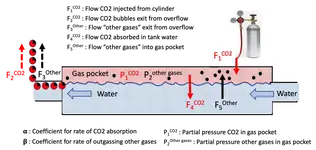
The model for the reactor in overflow mode

1696753425489.png

For the model we assume a ‘steady state’, i.e. all physical properties are stabilised and no longer changing in time.

We inject pure CO2 from the cylinder into the reactor, (F1), and each CO2 molecule is either absorbed into the water flow (F4), or exits in a bubble from the overflow (F2). We assume that the flow F4 is proportional to the partial pressure P1 of CO2 in the gas pocket: F4 = Alpha P1. The linear relationship is a reasonable assumption as the concentration of CO2 in the tank (typically 30 ppm) is far below the CO2 saturation level in pure water (>1000 ppm at room temperature)

“Other gases” (O2, N2, …) in the tank water will aim for equilibrium with the gas pocket in the reactor (Henry’s law). As we are injecting pure CO2 in the reactor, with atmospheric pressure, we can assume that the partial pressure P2 of “other gases” is low, and a linear relationship F5 = Beta P1. This flow F5 is much smaller than F4 (see below measurement) therefore the fraction of other gases in the pocket will slowly grow, until the upper half of the reactor is full and bubbles start to purge from the exit and the reactor can go to steady state overflow mode where F3 = F5

For all model calculations we scale the gas flows with Alpha, that is F1/Alpha, F2/Alpha, F3/Alpha, F4/Alpha, F5/Alpha, so that the conclusions can be applied to any size of reactor without further corrections.

F1/Alpha = 1 is an important reference point for the interpretation of the calculations. It corresponds to the CO2 flow into the reactor, when the reactor has just been purged, then fully filled with pure CO2, and the F1 flow maximized to the level where the overflow just starts to purge. In this case F1 = F4 = Alpha P1 = Alpha.

An important parameter in the model is the ratio Beta/Alpha, which tells us how the ‘other gases’ outgas from the water into the gas pocket, compared to the absorption of CO2 into the water.

Measurement of Beta/Alpha

A container (‘Horizontal reactor’) filled with 2 litre CO2, placed upside down in a bathtub. Gyre created some surface agitation and a waterflow under the CO2 gas pocket. 2/3 of the gas pocket was gone after 1 hour, and taken measurement after 2 hours when pocket seemed not to shrink much anymore. Used a pipette to suck the remaining gas from the container, and transferred it to a measurement cup that was held upside down under the water to have a precise measurement of the gas volume.

Estimated Beta/Alpha = 60 ml / 2000 ml = 3%.

1696753651777.jpeg

Model results

The mathematics to calculate the flows as a function of the CO2 injection are in the attached file. I will not elaborate on that, the interested reader (if any :)) will notice that the math is really basic, but I rather try to give an intuitive explanation what it all means.

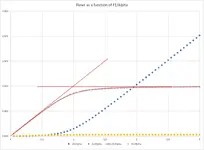
1696753750313.png

On the horizontal axis we have F1/Alpha, remember that F1/Alpha =1 corresponds to the flow when the reactor is full with pure CO2, and the overflow is just starting to show the first bubbles purging. The curves are F2/Alpha (CO2 purging as bubbles from the exit tube), F3/Alpha and F5/Alpha (the flows of other gases, which are relatively low), as well as F4/Alpha (the flow of CO2 being injected into the tank water).

At high F1/Alpha, we see that the F4/Alpha approaches 1 and does not change anymore. This corresponds to a reactor that is blown with plenty CO2, so that the gas pocket is nearly pure CO2 and the injection F4/Alpha is constant. In this situation any additional volume of CO2 that is pushed into the reactor goes straight out as losses with F2 purging – hence the blue curve approaching this straight line upwards. But, we have a nearly perfectly stable CO2 injection.

At really low F1/Alpha we see that the purging stops, but also that the CO2 injected into the water (F4/Alpha) is strongly dependent on the rate of injection (F1/Alpha), and indeed this is the situation where the reactor is not in overflow mode and would need a pH/CO2 controller or precision CO2 regulator to stabilise the tank.


Settings for overflow mode

Refer to this table

1696753866390.png

In case that we have plenty of CO2 available, and don’t care too much about CO2 losses, it could work to inject plenty of flow (perhaps at F1/Alpha = 2), and with that F4/Alpha will always be very close to 1. Variations in F1 injection (unstable, low quality CO2 regulator) will hardly have any effect on the CO2 injection.

When looking for a compromise between CO2 consumption and stability then a sweet spot could be at F1/Alpha = 1. We can read from the table that CO2 purging is then only 15%. When we then would apply variations of 10% up and 10% down on F1/Alpha, we see that this total 20% variation only gives 10% variation for the F4 flow that gets injected in the water.

If we want to trade more stability for more CO2 consumption, just increase the injected flow above F1/Alpha = 1.

In summary, how do I now set up my reactor in overflow mode?

After each weekly maintenance and water change I purge my reactor, and turn solenoid on. The reactor will fill with pure CO2, as the flow of other gases is just 3% of the CO2 flow. When the reactor is full, I slowly dial my injection down until the point that the reactor stops purging bubbles. This is my F1/Alpha =1 “sweet spot”. If later during the week my regulator will drift by X%, I know that my injected CO2 will only change by X/2%. I do not need a pH/CO2 controller, nor a really precision CO2 regulator for this, as it is my reactor geometry that helps me to stabilise my tank, and indeed at very limited CO2 consumption.


As I believe that CO2 stability matters more for the plants than the absolute level (30 or 40 ppm, what is really the impact), I consider to shorten my reactor a bit, have slightly less CO2 ppm but at an even higher CO2 stability than I have now.
 

Attachments

Last edited:
Context

As described earlier, we could operate the reactor in three different ways
  • Using a pH/CO2 controller for CO2 injection and stability
  • Using a precision CO2 regulator to precisely adjust CO2 injection
  • Overflow mode.
Most current users are either using a pH/CO2 controller or a precision CO2 regulator. There will be a reservoir of almost pure CO2 gas in the reactor, and the physics/chemistry of CO2 absorption into the water will be similar to any other reactor that may or may not use CO2 bubbles. As is also the case in bubble reactors, gradually we will see some oxygen and nitrogen outgas from the tank water into the pure CO2 pocket in the reactor (Henry’s law), but with an occasional manual purge this is not detrimental to the absorption of the injected CO2. The CO2 is stabilised by the pH/CO2 controller, or the regulator, so we’re all good. With the various users now having success with the reactor we might conclude that we understand it well enough, but doing so we may miss the opportunity to explore the pro’s and con’s of overflow mode.

My favourite mode of operation is the overflow mode, and I’ve been using it previously with CO2 Spray Bar as well. Even though I am generally a fan of pH/CO2 controllers, I decided to not buy a new one when my controller broke down a few months ago. I really like the simplicity of the reactor in overflow mode, no need to handle pH probes, calibration, dKH, and no need to invest in a pricey CO2 regulator. The future will tell if and when other users will buy in to it, or that for whatever reason we will stick with controllers and regulators and use the reactor in a more conventional way.

In this post in share some measurements and calculations to better understand overflow mode. This is not a forum for math, fortunately, but I do believe it is helpful to document insights, so that anyone interested can verify and perhaps build further on these ideas. Please accept my apology, and I hope it is appreciated that the most disturbing part with the calculations is hidden in the attached file :)

The model for the reactor in overflow mode

View attachment 3186

For the model we assume a ‘steady state’, i.e. all physical properties are stabilised and no longer changing in time.

We inject pure CO2 from the cylinder into the reactor, (F1), and each CO2 molecule is either absorbed into the water flow (F4), or exits in a bubble from the overflow (F2). We assume that the flow F4 is proportional to the partial pressure P1 of CO2 in the gas pocket: F4 = Alpha P1. The linear relationship is a reasonable assumption as the concentration of CO2 in the tank (typically 30 ppm) is far below the CO2 saturation level in pure water (>1000 ppm at room temperature)

“Other gases” (O2, N2, …) in the tank water will aim for equilibrium with the gas pocket in the reactor (Henry’s law). As we are injecting pure CO2 in the reactor, with atmospheric pressure, we can assume that the partial pressure P2 of “other gases” is low, and a linear relationship F5 = Beta P1. This flow F5 is much smaller than F4 (see below measurement) therefore the fraction of other gases in the pocket will slowly grow, until the upper half of the reactor is full and bubbles start to purge from the exit and the reactor can go to steady state overflow mode where F3 = F5

For all model calculations we scale the gas flows with Alpha, that is F1/Alpha, F2/Alpha, F3/Alpha, F4/Alpha, F5/Alpha, so that the conclusions can be applied to any size of reactor without further corrections.

F1/Alpha = 1 is an important reference point for the interpretation of the calculations. It corresponds to the CO2 flow into the reactor, when the reactor has just been purged, then fully filled with pure CO2, and the F1 flow maximized to the level where the overflow just starts to purge. In this case F1 = F4 = Alpha P1 = Alpha.

An important parameter in the model is the ratio Beta/Alpha, which tells us how the ‘other gases’ outgas from the water into the gas pocket, compared to the absorption of CO2 into the water.

Measurement of Beta/Alpha

A container (‘Horizontal reactor’) filled with 2 litre CO2, placed upside down in a bathtub. Gyre created some surface agitation and a waterflow under the CO2 gas pocket. 2/3 of the gas pocket was gone after 1 hour, and taken measurement after 2 hours when pocket seemed not to shrink much anymore. Used a pipette to suck the remaining gas from the container, and transferred it to a measurement cup that was held upside down under the water to have a precise measurement of the gas volume.

Estimated Beta/Alpha = 60 ml / 2000 ml = 3%.

View attachment 3188

Model results

The mathematics to calculate the flows as a function of the CO2 injection are in the attached file. I will not elaborate on that, the interested reader (if any :)) will notice that the math is really basic, but I rather try to give an intuitive explanation what it all means.

View attachment 3189

On the horizontal axis we have F1/Alpha, remember that F1/Alpha =1 corresponds to the flow when the reactor is full with pure CO2, and the overflow is just starting to show the first bubbles purging. The curves are F2/Alpha (CO2 purging as bubbles from the exit tube), F3/Alpha and F5/Alpha (the flows of other gases, which are relatively low), as well as F4/Alpha (the flow of CO2 being injected into the tank water).

At high F1/Alpha, we see that the F4/Alpha approaches 1 and does not change anymore. This corresponds to a reactor that is blown with plenty CO2, so that the gas pocket is nearly pure CO2 and the injection F4/Alpha is constant. In this situation any additional volume of CO2 that is pushed into the reactor goes straight out as losses with F2 purging – hence the blue curve approaching this straight line upwards. But, we have a nearly perfectly stable CO2 injection.

At really low F1/Alpha we see that the purging stops, but also that the CO2 injected into the water (F4/Alpha) is strongly dependent on the rate of injection (F1/Alpha), and indeed this is the situation where the reactor is not in overflow mode and would need a pH/CO2 controller or precision CO2 regulator to stabilise the tank.


Settings for overflow mode

Refer to this table

View attachment 3190

In case that we have plenty of CO2 available, and don’t care too much about CO2 losses, it could work to inject plenty of flow (perhaps at F1/Alpha = 2), and with that F4/Alpha will always be very close to 1. Variations in F1 injection (unstable, low quality CO2 regulator) will hardly have any effect on the CO2 injection.

When looking for a compromise between CO2 consumption and stability then a sweet spot could be at F1/Alpha = 1. We can read from the table that CO2 purging is then only 15%. When we then would apply variations of 10% up and 10% down on F1/Alpha, we see that this total 20% variation only gives 10% variation for the F4 flow that gets injected in the water.

If we want to trade more stability for more CO2 consumption, just increase the injected flow above F1/Alpha = 1.

In summary, how do I now set up my reactor in overflow mode?

After each weekly maintenance and water change I purge my reactor, and turn solenoid on. The reactor will fill with pure CO2, as the flow of other gases is just 3% of the CO2 flow. When the reactor is full, I slowly dial my injection down until the point that the reactor stops purging bubbles. This is my F1/Alpha =1 “sweet spot”. If later during the week my regulator will drift by X%, I know that my injected CO2 will only change by X/2%. I do not need a pH/CO2 controller, nor a really precision CO2 regulator for this, as it is my reactor geometry that helps me to stabilise my tank, and indeed at very limited CO2 consumption.


As I believe that CO2 stability matters more for the plants than the absolute level (30 or 40 ppm, what is really the impact), I consider to shorten my reactor a bit, have slightly less CO2 ppm but at an even higher CO2 stability than I have now.
Hi so after 8 days of running my reactor is starting to release some bubbles after around 3 hours of co2 on.
As I have a purge valve should I purge it once a week with the water change . ?

Would the reactor still give me the same level of co2 from the day i purge it 'as it would at the end of the week?

Am assuming if I did this once a week that would result in 0 bubbles escaping, as its taken 8 days for it to start doing that?

Thanks
 
Last edited:
When the reactor is not purging itself, the first 8 days @Paul Chapman , every bit of CO2 that gets injected can only be absorbed in the tank water, as there is nowhere else for the CO2 to go. So a quick manual purge after weekly maintenance, as is also needed with bubble reactors, makes everything really easy. The reactor will work with 100% efficiency until the next week’s manual purge.

When using the reactor with a pH/CO2 controller the situation is also very simple, as the controller will make the solenoid inject CO2 until target is achieved, and keep it there. We may decide to do a weekly manual purge, but there is no need, not much advantage in doing so.

Now for completeness of the analysis, what happens if we decide not to use a pH/CO2 controller, and not to purge manually? The CO2 flow is controlled by a precision CO2 regulator, and we let the reactor purge itself?

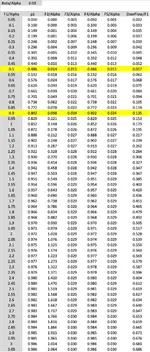
Let’s go back to the previous calculations, and list the data for a bit broader range of F1/Alpha:

1697068953011.png

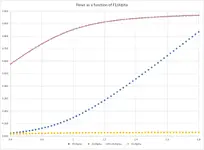
And in the graph:

1697069006741.png

When we operate the reactor at less than half of its maximum capacity (F1/Alpha <0.5) we see that the injected CO2 (F4/Alpha) follows nearly perfectly the straight line, and the CO2 losses through the overflow (F2/Alpha) are very close to zero. The reactor is virtually at 100% efficiency, and there is no compromise if we forego manual purging.

When we operate the reactor at 90% of its maximum capacity (F1/Alpha = 0.9), we see that the CO2 injected into the water (F4/Alpha) is still 0.802, i.e. 89% of the injected CO2. As the reactor purges itself, we now lose 11% of our CO2 in the bubbles that escape through the exit.

When we use the reactor at 90% of maximum capacity and above, F1/alpha > 0.9, we get into the overflow mode where we can use the purging to our benefit for limiting and stabilising the CO2 injection in the tank. I am currently reducing my reactor size (the opposite of what you would be doing if you like to use a precision regulator), and enjoying the simplicity and ease of mind that there is basically not much left to mess up with CO2 as the reactor is now fully in control of stability.
 
When the reactor is not purging itself, the first 8 days @Paul Chapman , every bit of CO2 that gets injected can only be absorbed in the tank water, as there is nowhere else for the CO2 to go. So a quick manual purge after weekly maintenance, as is also needed with bubble reactors, makes everything really easy. The reactor will work with 100% efficiency until the next week’s manual purge.

When using the reactor with a pH/CO2 controller the situation is also very simple, as the controller will make the solenoid inject CO2 until target is achieved, and keep it there. We may decide to do a weekly manual purge, but there is no need, not much advantage in doing so.

Now for completeness of the analysis, what happens if we decide not to use a pH/CO2 controller, and not to purge manually? The CO2 flow is controlled by a precision CO2 regulator, and we let the reactor purge itself?

Let’s go back to the previous calculations, and list the data for a bit broader range of F1/Alpha:

View attachment 3221

And in the graph:

View attachment 3222

When we operate the reactor at less than half of its maximum capacity (F1/Alpha <0.5) we see that the injected CO2 (F4/Alpha) follows nearly perfectly the straight line, and the CO2 losses through the overflow (F2/Alpha) are very close to zero. The reactor is virtually at 100% efficiency, and there is no compromise if we forego manual purging.

When we operate the reactor at 90% of its maximum capacity (F1/Alpha = 0.9), we see that the CO2 injected into the water (F4/Alpha) is still 0.802, i.e. 89% of the injected CO2. As the reactor purges itself, we now lose 11% of our CO2 in the bubbles that escape through the exit.

When we use the reactor at 90% of maximum capacity and above, F1/alpha > 0.9, we get into the overflow mode where we can use the purging to our benefit for limiting and stabilising the CO2 injection in the tank. I am currently reducing my reactor size (the opposite of what you would be doing if you like to use a precision regulator), and enjoying the simplicity and ease of mind that there is basically not much left to mess up with CO2 as the reactor is now fully in control of stability.
Hi that's great thanks for the info..

Yesterday I purged the reactor with my water change, it took 30 seconds to do..

Today the reactor run as normal with the same pH drop and 0 bubbles came out the end.

The reactor is working great 😃
 
Last edited:
decided to lower my inlet and outlet


3/4” Schedule 80 90° Elbow Barb x Female Thread
3/4" Schedule 80 Nipple
3/4” Schedule 80 Female Pipe Adapter
3/16" lee's pvc airline tubing
O rings I found laying round

had to use a nipple because the the threaded end wouldnt be long enough. I decided to go this route because I didnt want the inlet and outlets to be stuck with only 1 angle, I wanted something I could rotate. If I had more I probably would of went with union fittings.

the hole in the black pvc's purpose is to only allow me to screw the fitting into the barb.

the pvc air line tubing is for co2 injection, it doesnt make any contact with the water provided that the pump's flow rate is correct and doesnt fill the whole tube lol.

You'll notice that the inlet also has an o ring on the outside and inside, it's because I was unlucky and the spigot cap had a bit of a concave to it. The outlet side didnt have this issue so an o ring on the inside was enough to prevent leaks.

Surprisingly the ph drop is still the same even though I lowered the the water level in the reactor to the 1" mark. Previously it was about 1.25" or 1.375" when I was using the Schedule 80 Reducing Bushings 2” Spigot x 3/4” Female Thread. Injection rate is still the same. Only other changes were new co2 tubing and moving the check valve closer to the inlet.
 

Top 10 Trending Threads

Back
Top