Welcome to ScapeCrunch

We are ScapeCrunch, the place where planted aquarium hobbyists come to build relationships and support each other. When you're tired of doom scrolling, you've found your home here.

Horizontal CO2 Reactor - Yugang 鱼缸 Reactor

  • Thread starter Thread starter Yugang
  • Start date Start date
  • Tagged users Tagged users None
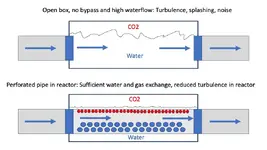
I have a clear reactor and there's no surface film, you just have to have enough flow which can take some dialing in. Too much flow and you might fill the whole tube with water instead of a water and a pocket of co2.

I do have a light coat of brown algae or maybe it's a abcterial build up on the bottom half of the reactor though but that's probably due to me screwing up and leaving the reactor pump running while cleaning the sump lol

I dont have any splashing sounds in the horizontal reactor with my inlet and outlet coming and going from the side.
3p2zA0n.jpeg


I can see how you can get a splashing sound if you have the inlet at the top and a flushing sound if you have the outlet at the bottom of the reactor though.

As for worrying about the build up of gasses, there's always the option of just attaching an airline tube at the outlet side and if you want to automate it just slap a solenoid on it. Personally I never saw the need to do that in a horizontal reactor.
 
Last edited:
As for worrying about the build up of gasses, there's always the option of just attaching an airline tube at the outlet side and if you want to automate it just slap a solenoid on it.
I have done this and it makes the reactor rock solid consistent from day to day. I chose this option to running it in overflow mode because it is dead silent now.
 
Hello 🙂 Do you think it is possible to build a horizontal reactor from a pipe, but with an internal bypass? I would like to avoid an external bypass, so that the reactor would be more compact. I wanted to use an internal bypass in the pipe like the author did in the box reactor
 
Hello 🙂 Do you think it is possible to build a horizontal reactor from a pipe, but with an internal bypass? I would like to avoid an external bypass, so that the reactor would be more compact. I wanted to use an internal bypass in the pipe like the author did in the box reactor
It's definitely possible. Just have the skills to do it 😆. All that's needed is the surface area and flow.
 
I think I have some skills 😉 I have already built several vertical reactors. I have only just read about your idea with a horizontal reactor and it seems very interesting to me. I have tools and materials, including transparent PVC pipes. I asked in the context of this whether there are any contraindications, because technically I will manage it
 
I think I have some skills 😉 I have already built several vertical reactors. I have only just read about your idea with a horizontal reactor and it seems very interesting to me. I have tools and materials, including transparent PVC pipes. I asked in the context of this whether there are any contraindications, because technically I will manage it
I cant see any reason it would. If there's no reduction of surface area needed for your specific tank, and can maintain a gentle flow through the reactor, all should function as calculated.
 
Hello 🙂 Do you think it is possible to build a horizontal reactor from a pipe, but with an internal bypass? I would like to avoid an external bypass, so that the reactor would be more compact. I wanted to use an internal bypass in the pipe like the author did in the box reactor
Let me first start by saying that the reactor can handle virtually every flow rate, as long as it is not stagnant and not flowing so fast that it starts to make water splashing noise. For many users an overflow would seem an unnecessary luxury.

An internal overflow can be made to work, as I did with the box reactor, but to be honest it has not been easy to optimise it for overflow mode. At least for me fluid dynamics is not an easy thing to visualise and my intuition does not always point in the right direction. I started with the concept that I posted on Feb 16 2024:

1747527340804.webp
Unfortunately, it did not work as intended ....

I then went on tho build this:
1747527430199.webp

And this:

1747527489108.webp

And this:

1747527623153.webp

Until I finally got an internal bypass with perfect overflow mode on March 7 2024:

1747527727663.webp
1747527757753.webp

It took me weeks, and sleepless nights trying to figure out how to do it, with several failed attempts.

Take aways from my experience:
  • consider if a bypass is really necessary, in most cases it is not.
  • and external bypass is easy to build, and will always work for overflow mode.
  • an internal bypass can be made to work, by replicating what I did and perhaps some optimisation
  • somebody who is smarter than I, with good knowledge or intuition of fluid dynamics, may find a concept for internal bypass with overflow mode that is more robust and easier to optimise than what I have done.
 
Thank you for all the answers :)

I thought of another solution, which would probably be the simplest. Currently, the filtration in my aquarium is an internal filter that I built myself. It has the shape of a cuboid and is made of PVC plates. It is placed in the corner of the aquarium on the back wall. Inside there is a fairly strong 5000L/h circulation pump. There are also sponges and ceramic filter media. The filter base is 15cm x 35cm. This base is constantly flowing with water. I thought about adding a "pocket" at the bottom, into which CO2 would be dosed. I have a pH controller that doses CO2. The principle of operation is the same as in a horizontal reactor from a pipe, but it would be much easier for me to make. What do you think about it? I am attaching a sample drawing
1000054945.webp
 
Last edited:
Thank you for all the answers :)

I thought of another solution, which would probably be the simplest. Currently, the filtration in my aquarium is an internal filter that I built myself. It has the shape of a cuboid and is made of PVC plates. It is placed in the corner of the aquarium on the back wall. Inside there is a fairly strong 5000L/h circulation pump. There are also sponges and ceramic filter media. The filter base is 15cm x 35cm. This base is constantly flowing with water. I thought about adding a "pocket" at the bottom, into which CO2 would be dosed. I have a pH controller that doses CO2. The principle of operation is the same as in a horizontal reactor from a pipe, but it would be much easier for me to make. What do you think about it? I am attaching a sample drawing
View attachment 8282
Integrating with the filter seems a very logical option, and as long as we have a flow of water under a CO2 pocket it should work. I also proposed this as an option option for manufacturers, for example the FX4 that I am using:


1747605075971.webp

Let me know if I can help with verification of details or calculations @apper
 
Last edited:
Hello all,
I have the same surface as tsing and going by this chart my reactor would be undersized with that being said is it safe to assume that I will always be chasing Co2 and any injection until I upsize would be a waste?
Thank you
The reactor surface area determines the drop, so an undersized reactor can not add additional CO2. Make sure to construct it correctly or go larger with the use of a controller or precision needle valve. Going larger eliminates overflow mode and is honestly one of the best features of the reactor (overflow mode).
 
The reactor surface area determines the drop, so an undersized reactor can not add additional CO2. Make sure to construct it correctly or go larger with the use of a controller or precision needle valve. Going larger eliminates overflow mode and is honestly one of the best features of the reactor (overflow mode).
Likely a silly question, but how does surface agitation affect the use of a horizontal reactor?

If you have a lot of surface agitation, I guess you just inject more CO2 to keep the gas pocket in the reactor where it needs to be (overflow mode)?
 
Likely a silly question, but how does surface agitation affect the use of a horizontal reactor?

If you have a lot of surface agitation, I guess you just inject more CO2 to keep the gas pocket in the reactor where it needs to be (overflow mode)?
You'll unfortunately hit overflow mode too early. The wave action will hit the return and the trough portion of the wave will cause a purge prematurely.
 
You'll unfortunately hit overflow mode too early. The wave action will hit the return and the trough portion of the wave will cause a purge prematurely.
I'm meaning surface agitation at the top of the actual aquarium, not inside the reactor.
 
I’m sure @Yugang will chime in but I can’t imagine the typical rippling on the surface will affect the reactors efficiency much. Excessive splashing in a sump is for sure a different story.
I believe what @Unexpected explained is that big waves in the reactor, which hardly ever happens, would push more CO2 out than when the surface in the reactor is smoother. The result would be that at high waves the CO2 pocket might be a little smaller as a result. Overall probably very little effect on efficiency and power.

The reason I like a nice small ripple in the reactor is that in overflow mode only very little CO2 escapes, so that losses are minimised. I like to see just a few tiny bubbles once or twice per minute in my tank, and not much more.
 
I believe what @Unexpected explained is that big waves in the reactor, which hardly ever happens, would push more CO2 out than when the surface in the reactor is smoother. The result would be that at high waves the CO2 pocket might be a little smaller as a result. Overall probably very little effect on efficiency and power.

The reason I like a nice small ripple in the reactor is that in overflow mode only very little CO2 escapes, so that losses are minimised. I like to see just a few tiny bubbles once or twice per minute in my tank, and not much more.
Affirm, I was referring to @Joel Armstrong questioning the tank surface agitation itself.
 
Affirm, I was referring to @Joel Armstrong questioning the tank surface agitation itself.
Sorry I missed that.

Only when water becomes stagnant will diffusion in the boundary layer between water and air sigificantly limit gas transport. With just a little turbulence on the surface, not necessarily much, gas losses at the surface will be mostly proportional to the surface area and CO2 ppm in the tank, but less so on the surface agitation. This is the reason we normally assume a rather fixed 17.7 ratio, which holds if both the reactor and tank have at least some turbulent agitation.

I hope this clarifies @Joel Armstrong ?
 
The reactor surface area determines the drop, so an undersized reactor can not add additional CO2. Make sure to construct it correctly or go larger with the use of a controller or precision needle valve. Going larger eliminates overflow mode and is honestly one of the best features of the reactor (overflow mode).
Thanks for the reply,
That's what I thought but just wanted to confirm before I go ripping things out.
I had purchased one from ARC before I had done my homework because their reactor stated "Suitable for tanks starting from 10 gallons, with no upper limit on tank size." Apparently there is an upper limit lol, also the range for the large unit states 190cm or more so that's a bit misleading too...
Anyway I'm going to demo this one out and just build one the correct size
I did pick up a flowmeter on bettatail's advice and am going to install that.
Again thank you for your insight, it's greatly appreciated!
 
Thanks for the reply,
That's what I thought but just wanted to confirm before I go ripping things out.
I had purchased one from ARC before I had done my homework because their reactor stated "Suitable for tanks starting from 10 gallons, with no upper limit on tank size." Apparently there is an upper limit lol, also the range for the large unit states 190cm or more so that's a bit misleading too...
Anyway I'm going to demo this one out and just build one the correct size
I did pick up a flowmeter on bettatail's advice and am going to install that.
Again thank you for your insight, it's greatly appreciated!
ARCs largest one was a bit shy with my sumped tank. I just extended the reactor by running a second DIY in parallel. This works quite well, still maintains overflow mode and was cheap. Just FYI.1000000995.webp
 

Top 10 Trending Threads

Back
Top