Welcome to ScapeCrunch

We are ScapeCrunch, the place where planted aquarium hobbyists come to build relationships and support each other. When you're tired of doom scrolling, you've found your home here.

Horizontal CO2 Reactor - Yugang 鱼缸 Reactor

  • Thread starter Thread starter Yugang
  • Start date Start date
  • Tagged users Tagged users None
Yugang can you share the name of that gray PVC fitting you are using for inflow and outflow caps?

I am not familiar with that fitting, very slick! Clearly (sic) beats the h*ll out of drilling holes in end caps!
Unfortunately I don't have more information. I took my acrylic pipe, explained what I needed, and after perhaps 10 tries found a tiny shop that could solve the problem with unconventional dimensions for the pipe and miraculously came back with this. (We don't have US style DIY outlets in HK, think of a street with 50 shops). The reactor may look nice, but I would have preferred a more compact design, a bigger tube diameter and indeed I would drill holes in the end caps.

Several members are building / have built horizontal reactors -- It would be great if someone could post a (online) shopping list.
 
Afterr poking around a bit, looks like a version of what we call a bell reducing coupling or reducing socket, sometimes a hot tub reducer. Still pretty slick if you have the horizontal room 👍
 

Attachments

  • Screenshot_20230806_201516_DuckDuckGo.webp
    Screenshot_20230806_201516_DuckDuckGo.webp
    77.8 KB · Views: 37
  • Screenshot_20230806_201504_DuckDuckGo.webp
    Screenshot_20230806_201504_DuckDuckGo.webp
    69.8 KB · Views: 26
Last edited:
This is true for smaller tanks too. I'm thinking about it.
Hi Art
@GreggZ is the person to guide you. Maybe an article in this forum about flowmeters would be useful for those who aren't aware of the immense benefits of one. I got to know of the flowmeter from Greggz's FB post in a planted tank group but those golden nuggets of information are now lost in the deep in the bowels FB's several post.
 
I believe that also for smaller tanks horizontal reactors will do a better job than bubble reactors, but it may take a bit more time as the hobbyists with smaller tanks in many cases are satisfied with their current solution and are less inclined to look for (new) alternatives.
I can attest to this. I have two small tanks (5 & 10G) and have read endless posts/articles about co2 reactors but have never considered actually investing in one. My simple setup is functioning great for my needs and is sufficiently stable. I’m not one to fix something that isn’t broken either. Plus my toddlers are almost equally fixated on watching the bubbles from the diffuser as they are the fish.
 
Please do for the benefit of the members here.

So let’s have a look at the estimated CO2 absorption power of a vertical bubble reactor, compared to a pipe with same dimensions but then used as a horizontal reactor. The key point is that it is very plausible that the horizontal reactor gives a higher CO2 absorption surface, and that a simplified model will suffice to illustrate that.

If we would like to make an accurate measurement of the absorption surface of a vertical bubble reactor, we could take a couple of photos and for each photo account for the number of bubbles and their size to calculate the accumulated surface area from CO2 bubble to water. We could compare that surface area to the length*width of the pipe, which would be the effective CO2 absorption area if the tube would be used in a horizontal configuration.

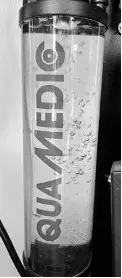
I dismantled my modified AquaMedic reactor a long time ago, when I had started using CO2 Spray Bar and more recently the horizontal reactor. Unfortunately I have no videos left, and just one poor quality photo – but it seems sufficient to make the point.
1691627823226.webp

The reactor dimension 3 inch diameter * 10 inch length and I would typically count 100-150 bubbles with an average size of about 3 mm diameter. This is by no means an accurate accounting of the bubbles, but I will illustrate that it is good enough to make our conclusion ‘plausible’ (rather than a ‘proof’ in the scientific sense).

So let’s calculate how many bubbles of 3 mm diameter we need, to provide the same surface area as the pipe used in its horizontal configuration:

1691627864557.webp

So if all bubbles would be 3 mm diameter, we would need 685 of them to provide the same CO2 to water absorption surface area as in a horizontal reactor. This is 5 times more than the bubbles I actually observe in my bubble reactor.

We can take it a bit further, and investigate what happens if bubbles are not all 3 mm diameter, but some a bit bigger and some a bit smaller:

1691627897975.webp

So if we have a mix of bubbles, ranging in size from 2.5 to 4 mm we will always need many more bubbles than the 100-150 that I actually counted in my vertical reactor, hence we expect the horizontal reactor to be significantly more powerful than the vertically oriented bubble reactor of the same dimensions.

When we are interested in the power / capacity of the reactor, we now also have some practical evidence what the horizontal reactor can deliver without much need for finetuning and optimizations as we would have to do with bubbles:
  • @RickyV ramps up CO2 on a 1000 gallon tank, achieves 1.0 pH drop in 38 minutes
  • @toofewfish ramps up CO2 on a 230 gallon tank, achieves 1.6 pH drop in 30 minutes
Try that with a vertical bubble reactor …

The above are of course much simplified estimations, and any other bubble reactor will of course be different from mine. But I hope I brought a convincing argument that horizontal reactors are likely to pack more punch than a vertical bubble reactor, both for large and small tanks.
 
But I hope I brought a convincing argument that horizontal reactors are likely to pack more punch than a vertical bubble reactor, both for large and small tanks.
Not to mention, the amount of energy needed to to produce those bubbles in a vertical reactor versus generating a gentle flow through a horizontal reactor.
 
Design #3

I needed to get the reactor out of the back chamber so I can access the area for maintenance. I over engineered the length to account for the return opening reducing the required diameter. This should allow the 1 pH drop before the CO2 layer reaches the opening. I’ll allow the paint to dry overnight and hopefully have it installed in the morning.IMG_0373.webp
 
Design #3

I needed to get the reactor out of the back chamber so I can access the area for maintenance. I over engineered the length to account for the return opening reducing the required diameter. This should allow the 1 pH drop before the CO2 layer reaches the opening. I’ll allow the paint to dry overnight and hopefully have it installed in the morning.
Good luck with yours. Mine has been well worth the time and effort. With what I learned from this I would not go in a different direction for future tanks.
 
Design #3

I needed to get the reactor out of the back chamber so I can access the area for maintenance. I over engineered the length to account for the return opening reducing the required diameter. This should allow the 1 pH drop before the CO2 layer reaches the opening. I’ll allow the paint to dry overnight and hopefully have it installed in the morning.

Looking cool. Black matt finishing. Will blend in nicely with the tank background and lights.
How long does this new build take to drop to 1 ph?
 
Looking cool. Black matt finishing. Will blend in nicely with the tank background and lights.
How long does this new build take to drop to 1 ph?
Thank you. Today was the first morning I could actually see how long it would take. I'm now a member of the 30 minutes club!
 
Good luck with yours. Mine has been well worth the time and effort. With what I learned from this I would not go in a different direction for future tanks.
100% with you here. It just works too well and is easy to implement.
 
Back
Top