Welcome to ScapeCrunch

We are ScapeCrunch, the place where planted aquarium hobbyists come to build relationships and support each other. When you're tired of doom scrolling, you've found your home here.

Journal High-Tech 90P Build

Small update-

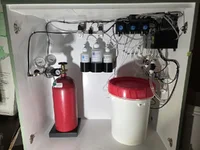
The basement mixing station is more or less complete. It's nice to work in here compared to the cramped sump cabinet.
1793974896651.webp

CO2:
  • Load Cell for Cylinder Weight
  • 2x Solenoids In Line
  • AFS01 Flow Sensor

ATO:
  • ATO Solenoid to Sump
  • Solenoid to Fill Tank + Float Valve as Backup

AWC Mixing Station:
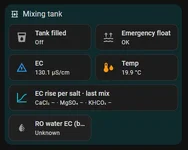
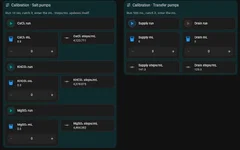
  • 3 Dosing Pumps for CaSO₄, K₂CO₃, and MgSO₄
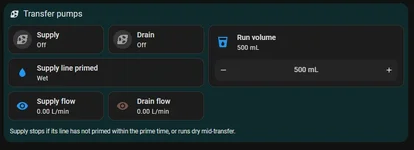
  • 2 Larger Pumps for draining the sump and supplying the water from the Mixing Bucket to the sump
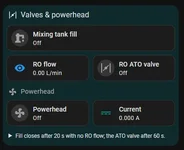
  • Flow sensors on Drain and Supply lines as well as the RO line to the bucket
  • Water Detect sensor on the Pickup tube in the bucket (to know when the bucket is empty)
  • EC (+ temp) Probe in the bucket, to monitor RO water quality - and verify the salt remin. doses added one by one.
  • Small powerhead in the mixing bucket + Current sensor to detect if pump is running with bucket empty, or if its jammed.
  • Emergency Float switch if bucket is overfilled.

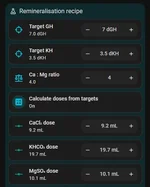
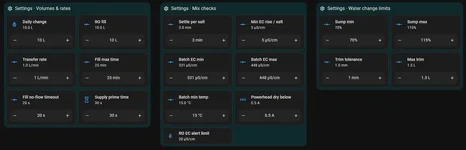
I've set it up in HA that I enter a target GH/KH and the dose is set from my stock concentrations - and the display will eventually drift towards the target. Volumes are tracked as well, and the overall ECs are trended over time for before salts, after each salt, and of course the final mix.
1793977008550.webp 1793977015621.webp

1793977034753.webp 1793977049737.webp
1793977110465.webp

I've primed the pumps, calibrated the flow meters, and set everything up - but of course I want to watch the first few changes to make sure everything runs as intended, after which it will run a ~10-11L change nightly. I calculated the volume in my display + sump as ~200L of actual water (by measuring EC before and after replacing exactly 10L with RO water) - so this works out to about a 5% change daily. I will do the first AWC this weekend!

The flow meters should keep the sump volume relatively steady during the change, but the system will also use the ToF sensor in the sump to trim the final level by adjusting the calibrations of the supply/drain pumps over time to keep it within 1mm.
1793977436292.webp
1793977448738.webp

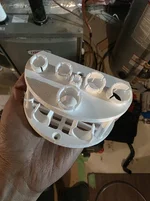
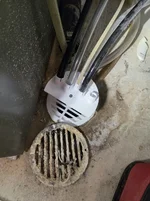
I also printed a new basement floor drain cover as the number of pipes ziptied to it was getting silly, and the mineral deposits were taking over. The AWC pump drains directly into here - but I'm considering setting up a quarantine tank down here where the AWC would drain into it instead, and an overflow bulkhead would drain overfill.
1793975390398.webp 1793975409922.webp

As for the display tank, I added 30 blue diamond shrimp in, day 1 they were exploring and all over, day 2 - could only see one or two at a time. Day 3 - found them all chilling in the overflow box. Enter the printer.
1793977813078.webp 1793977905240.webp
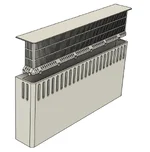
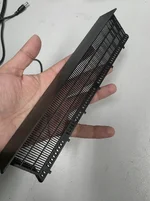
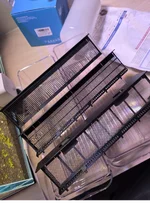
Designed this to drop into the weir box and printed 2, so I can occasionally lift it out to clear plant debris and rotate them - keeping the adults out of the overflow box. Smaller ones will still pass through and wind up in the fuge which is fine.
 
Not many pics this time, as its been mostly technical work.

The plants are starting to settle in, and seeing new growth now - photo period is still only at 6h at about 30% light intensity, as I've got some diatom, gda, and already clado (any tips?) in some spots that I've started removing when I see it.

The shrimps seem to be a bit suicidal, or instinct driven towards getting into the overflow - and I had a couple smaller males manage to squeeze through the grate I installed in the weir box in my previous post and completely scrape themselves up in the process where one died a few days later. So I closed up the gaps even more using 1x1mm mesh.

1794848168950.webp
Also some finger holes for easier removal/cleaning - made 2 so I can swap them out easy.

Otherwise, I've started my daily ~5% water changes and currently half doses of ferts via the dosing pumps.

The flow meters it turns out are not very useful for summing volumes accurately, especially with variable flow from the RO system.

The original thought was
1. RO fills bucket to 10.5L
2. Salt pumps bring it to GH ~ 8/ KH ~ 3.5
3. Mix
4. Run drain/supply pumps in parallel to empty until air is detected in the supply line

Issues:
1. The RO flow meter sometimes gives me 10.2L, sometimes 10.8L - and then I end up over or under-draining the sump, and then the ATO tops off with RO.
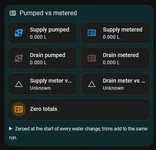
2. The flow meters on the AWC lines also have some variance, and don't always align with the calibrated values of the steppers.
3. Because the supply is in chamber 1 of the sump, and pickup in chamber 3, and close to the return pump - I end up losing about 10-20% of the new water with a simultaneous change, as it short circuits a bit. I can't swap supply/drain - because then drain will pickup from a 'dirty' chamber, potentially clogging lines, or picking up stranded shrimplets.

I first tried a drain then fill strategy - so pump drains out ~10L, then fills until mixing tank is empty, then drains the balance. The issue with this is that since I can't rely on the flow meters for an absolute count, mix/fills were inaccurate, and using the Time of Flight sensor in the sump (ToF) ended up not working either, as the drain meant the pump head was increased and the secondary drain in the display would run dry - so I was out by 1-2L... not a big deal for 1 fill, but adds up on the daily.

I then tried a multi-step process... so instead of all 10L at once, it goes like this:
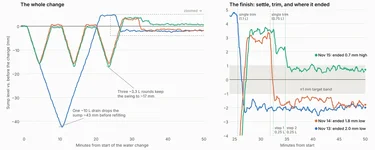
1. Drain 3L, fill 3L, let the ToF settle, Repeat
2. Drain 3L, Fill 3.5L, let the ToF settle
3. Drain 90% of the difference, let ToF settle, repeat up to 3x as needed.

This has gotten me into getting the water change done within ~1mm of sump level (1mm sump = ~200ml) after 2 trims.

1794849980999.webp

It's much much better, but I still don't like it since its fully reliant on one sensor. Long term, I'm going to put a load cell under the mixing bucket, and fill by weight instead. This will also help verify the salt dose as weight + EC rather than counting on EC alone. The flow meters just become more of a course verification check.

I'll wait for a while though since the above process is working, and take the opportunity to make any other changes to the basement controller board as a rev 2 - such as adding in the co2 flowmeter circuitry in properly, some better isolation on the solenoids, and anything else that comes up in the next bit.

I also had some salt creep in the RO tank, as the lines were slowly dripping into the bucket through the day, I put small check valves on each line and that has solved it, I believe its mostly due to the bottles and pumps being higher than the bucket. I put check valves on the fert pump lines inn the sump as well as precaution.

KH has been coming down since starting with tap water as 12º, so my CO2 pH targets have to be changed every couple of days now too. I should be around 9.5º now, but still some ways to go.

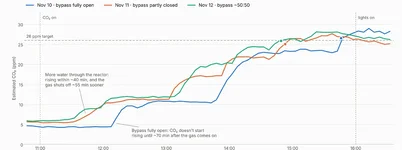
The other thing I've noticed with the reactor is that too slow flow is also not ideal.

1794851218404.webp

I was getting very large steps of CO2 rise, I think because more water would get pushed through on the reactor burping which would release concentrated co2 into the system in bursts rather than continuously. By closing my bypass (at first to about 25% closed, then 50% closed) to allow more flow through the reactor, I get a quicker rise, and while it still 'steps', its not by as large a proportion. I'm still tuning, and haven't shortened the reactor yet - so pH is controlling the solenoid on/off for now until I get to my KH target so I'm not aiming for a moving window.
 
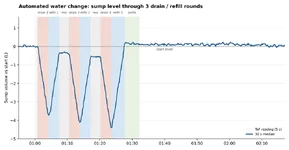
The first completely unmanaged, unwatched auto-water change is in the books! I scheduled it for 1am, while I was asleep and hoped for the best, it went about as smooth as I could hope for.

1795009089948.webp

Each round dipped a little further because each refill came a bit short until the last one, but evened out in the end. The trim adjustment wasn't necessary on this one since the sump ended about 0.6mm (~0.1L) above where it began within my set threshold of 1mm. I also expect about 100-150ml evaporated from the tank/sump during the change as I see about 2.5L loss per 24h typically.

From here on out - it will continue on its own nightly and only send an alert if something happens outside of threshold.

Warning Level:
  • The change itself fails or comes up short: “no water moved”, interrupted (with how many litres short; the top-off is held so it doesn’t make up the gap with plain RO), halted, didn’t complete, or supply was short.
  • The mix fails: the bucket powerhead stopped or drew no current, a salt didn’t raise conductivity enough (a pump or line problem), or the batch EC landed outside of the preset 360–460 window.
  • The refill fails: no RO flow, a timeout, or the flow stopped because the float valve closed.
  • The trim doesn’t add up: the sump didn’t move the way the trim pumped.
Critical Alarms:
  • The sump is losing water, the low float or high-water sensor trips, the emergency standpipe is wet, or a leak probe is wet.
  • The mix bucket’s emergency-high float trips.
  • The mixing station or sump controller goes offline for 5 minutes. The RO valves close on their own if the mixing station drops signal (watchdog circuit based on the ESP32 sending a 'kick' every few seconds) or power (N/C valves).
  • Return pump with no current, drain trickle lost or main drain blocked, and sump chamber 1 clogging (I have a sensor on the outside sump glass), which also pauses the change and the top-off.

If the change doesn't run for whatever reason - it will report that it skipped, and why based on the above conditions and would then require my intervention.
 

Top 10 Trending Threads

Back
Top