Welcome to ScapeCrunch

We are ScapeCrunch, the place where planted aquarium hobbyists come to build relationships and support each other. When you're tired of doom scrolling, you've found your home here.

Resource Are your test kits actually accurate? Testing test kits: Salifert Freshwater NO3, PO4, and K.

Naturescapes_Rocco

Rocco
Supporting
Rockstar
Article Contributor
Journal
Joined
Dec 19, 2024
Messages
513
Reaction score
1,288
Location
Denver, Colorado, USA

Results/summary will be near the bottom of this post!


I've tried API, Sera, and Salifert test kits for a while now, and I found that I "liked" using the Salifert kits the most. The test kits usually aligned with my observations of plant health and algae growth. Remember, healthy plants don't grow algae, and plants can't be healthy if they don't have every single element available to them in some form. If I have a decrease or issue with CO2 injection, I get staghorn/hair algae on my plants. If I bottom out on NO3, I get hair algae or cyanobacteria on the plants. If I bottom out on PO4, I get GSA (especially on the glass and large-leaved plants). If I bottom out on K, well, plants stop growing altogether, and I often get GDA or other algae on my plants.
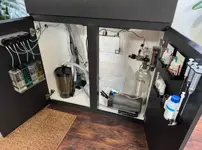
1752000889610.webp
You can see on the right door my little selection of different test kits that I use. Journal for this tank here.

Testing gives me an idea as to whether I'm in the "zone" for growing plants (which is basically anything greater than 0ppm). It's not foolproof, but it's one of the best tools and I've found it to be SERIOUSLY enlightening to help me understand what I'm observing. I'm now to the point that I can often guess correctly if a certain nutrient has bottomed out simply based on what changes my plants are going through. I usually test once every week or two, but these are high energy systems. If something is bottomed out/out of balance, I'll pay the price very quickly compared to low-tech, which I can imagine requires far less frequent testing to gain an understanding of the system.

Dry salt fertilizers aren't always the most pure. and even a little dissolved in some RO water massively increases the ppm beyond what these test kits use. For example, to increase 1 gallon of RO water to 50ppm NO3, you need to add 0.309g KNO3. That's WAY too small of an amount to be accurately measured (even by my precision 0.0001g lab scale), especially because there could happen to be some impurities in my powder sample that would have a massive effect at only 0.309g.
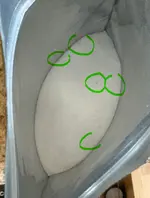
1752000333178.webp
You can see random dark spots, flecks of grey/black, and other potential impurities in my KNO3 from GLA ferts. This isn't a problem for the amounts we actually use in DIY fertilizer solutions, or dry fert dosing, but it is a problem for testing the accuracy of test kits.

So, I need to make a large enough "stock" concentrate solution that I'm using a "sizeable" amount of the dry salts to avoid impurity issues and measurement issues. Then , I'll mathematically dilute the concentrated stock to a known usable/testable solution.

This only works with pure RO water. My RO water is about 0-2TDS and should work fine. I'll be testing not just one test kit each, but two per nutrient! I bought 9 kits total, 3 of each lol

The math:

Formula is C1*V1=C2*V2, where:
C1= concentration of stock,
V1= volume of stock to be diluted in RO water later,
C2= desired concentration of diluted solution,
V2= desired volume of diluted solution.

Solve for V1:
V1=(C2*V2)/C1

Then: V2-V1= volume of pure RO water to add V1 to to make your diluted solution.

Example: Dilute some volume (V1) of a 300ppm unusable concentrate into 100mL of a usable 10ppm solution:
Dissolve 1.85g KNO3 in 3,785.4g (1gal) RO water to make a 300ppm concentrate stock.

V1 = (10ppm*100mL)/300ppm = 3.333mL concentrate

RO water needed for diluted solution: (100mL desired volume V2 ) - (3.333mL) = 96.667mL RO water needed

Answer:
Dilute 3.333mL of the 300ppm NO3 concentrate solution in 96.667mL RO water to create 100mL of a 10ppm NO3 solution.


The work:
1752000538528.webp
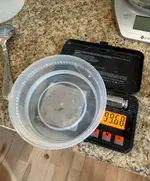
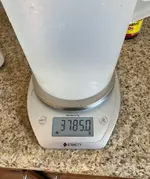
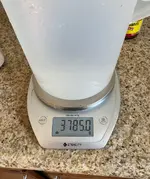
Start with 1 gallon of RO water (3,785.4g).
1752000600219.webp
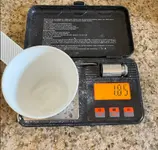
Into the 1 gallon RO water, dissolve 1.85g KNO3 and stir without splashing/removing water. You now have a 300ppm NO3 concentrate.
1752000678681.webp
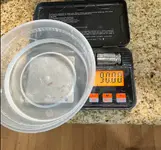
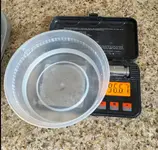
Measure 96.667mL pure RO water.

1752000800492.webp
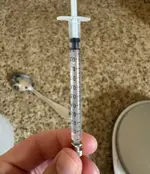
Using a precise syringe (like this 1.0mL syringe) add 3.33mL of the concentrate to the pure RO water to make 100mL total at 10ppm concentration.

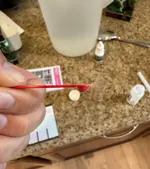
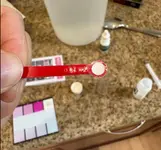
Now, follow the instructions for the Salifert Freshwater NO3 test kit: 2mL water sample in vial, 4 drops of NO3-1 (make sure you hold vertically when dropping, always!), swirl 10s+, then 1 level scoop of NO3-2. I use the soft sides of the container to compress the scoop into a very level scoop:
1752001113513.webp1752001128770.webp
Swirl for 30 seconds, then start the 3-minute timer:
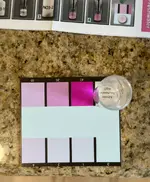
1752001252717.webp
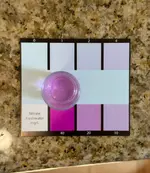
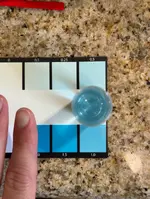
After 3 minutes, read top-down, ideally with natural light:
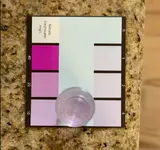
1752001300813.webp
That's pretty bang-on for 10ppm NO3!

I repeated the process a second time and got 10ppm. I had my partner come take a look, and she said 10ppm for both results.

I then tried it with a second kit as well:
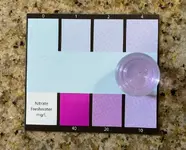
1752001419209.webp
Also got 10ppm (hard to see in this photo).

However, it's important to note with this salifert test kit (and many No3 test kits out there):
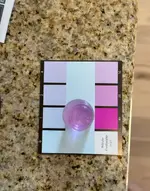
The results change if you let them sit for too long. I found that 3.5 minutes post-swirl had the most spot on results for 10ppm, but if I let the vial sit for even 6 or 10 minutes, the results changed quickly:
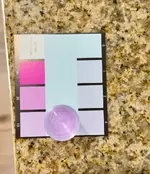
1752001516782.webp
After 6 minutes it looked like 20ppm.
1752001551347.webp
After 15 minutes, it looked like 40ppm.

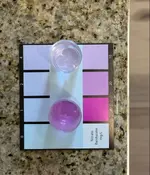
The instructions clearly state to take a reading after 3 minutes, but they don't emphasize this enough. You have approx 30-60 seconds after the 3-minute post-swirl timer to get a correct reading. Not a problem or even an issue at all, just something important to know. API nitrate also does this, btw.
1752001661243.webp
Here are two vials, both at 10ppm NO3. The top is fresh off the 3-minute timer, while the bottom sat for over 20 minutes. Again, super accurate @ 10ppm as long as you take the reading between 3-4 minutes post-swirl.

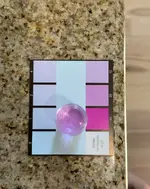
Then, I tried a 40ppm solution to test the high range of the solution. After 3 minutes with test kit 1, here's the results:
1752001749397.webp
Test kit 1 results @ 40ppm

1752001787825.webp
test kit 2 results @ 40ppm

Findings for Salifert Freshwater NO3:​

With known 10ppm solution:
Kit 1, #1: 10ppm
Kit 1, #2: 10ppm
Kit 2, #1: 10ppm
Kit 2, #2: 10ppm

With known 40ppm solution:
Kit 1, #1: 40ppm
Kit 1, #2: 40ppm (almost looked closer to 30ppm, but not by much)
Kit 2, #1: 40ppm
Kit 2, #2: 40ppm

I'd say that between these two different kits (all reagents within expiration date) this gets my seal of approval. That's very accurate for a liquid test kit.

Results:​

After testing two different NO3 test kits at two different NO3 concentrations (med-low and high) it appears to be very accurate (at least between 10-40ppm).
Make sure you are packing the NO3-2 mini spoon flat/level with powder. Swirl hard for 30 seconds and set a strict 3 minute timer.
Readings may be most accurate at 3.5 minutes. Read top down. Very accurate, 9/10 would recommend.
 
Last edited:
Salifert PO4 test kit testing:​


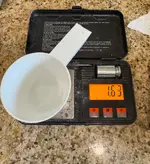
Dissolve 1.63g KH2PO4 in 3,785.4g RO water to make a 300ppm PO4 concentrate.
Add only 0.33mL of this concentrate to 99.667g RO water to make 100mL of a 1.0ppm solution for testing.

The work:
1752002476116.webp


1752002456223.webp

Follow PO4 directions: 10mL in vial, add four drops PO4-1 vertically, swirl 10s+, add 1 level scoop PO4-2, swirl 30s, take reading.

1752002444098.webp
A 1.0ppm known concentration looks closer to 1.5 in the dark light. I tested twice and got the same result.
I thought it was a mistake, so I dumped my concentrate and re-made the concentrate and diluted solution again.
I got the same results-- it looked darker than 1.0ppm in the indoor light.

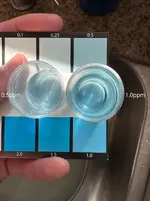
I diluted the sample by 50% (so only 0.5ppm PO4) and tested it against the 1.0ppm PO4 vial, but this time I did it in brighter light:

1752002745363.webp

In brighter natural light, the 1.0ppm vial actually looks like 1.0ppm, and the 0.5ppm actually looks like 0.5ppm. This might be because the vial requires 10mL, and needs a bit more light to actually penetrate it for proper readings?

Findings for Salifert Freshwater PO4:​

With known 1ppm solution:
Kit 1, #1: 1ppm (looks like 2.0ppm in dark light)
Kit 2, #1: 1ppm (looks like 2.0ppm in dark light)


With known 0.5ppm solution:
Kit 1, #1: 0.5ppm
Kit 1, #2: 0.5ppm
Kit 2, #1: 0.5ppm (looks like 1.0ppm in dark light)
Kit 2, #2: 0.5ppm (looks like 1.0ppm in dark light)

Results:​


This kit is faster than the NO3 and hasn't let me down in real world testing, but in the dark of my kitchen it was much harder to properly read than the NO3. I thought it was giving inaccurate (high) readings until I tried reading in brigher natural light, and the vials completely changed their color. Seriously, in brigher natural sunlight (direct or indirect) the readings were spot on, but in a dimmer room with artificial light it was high by nearly 2x.
I will for sure still use this kit, but I'll make sure to have bright light when reading. I often have more than 2.0ppm PO4 in my aquariums, so I usually dilute the sample with pure RO water and take a multiplied reading from there. 8/10 would recommend.
 

Salifert K testing:​

Dissolve 2.53g K2SO4 in 3,785.4g RO water to make a 300ppm K concentrate.
Add only 10mL of this concentrate to 90.0g RO water to make 100mL of a 30.0ppm solution for testing.

The work:

1752003306467.webp1752003283249.webp

Follow K directions:
5mL in vial, 0.5mL K-1, swirl 60s, add four drops K-2 vertically, then slowly add K-3 dropwise, counting drops and swirling 2s between each, until color goes from cream to blue:

1752003425349.webp
Uh oh. After 7 drops it still hasn't changed color, despite the solution being a known 30ppm K.

After 9 drops it changed:
1752003495639.webp

Findings for Salifert Freshwater K:​

@30ppm concentration, the results were:

Kit 1, #1: 9 drops = 20ppm K. ??? Not great.
Kit 2, #1: 9 drops = 200ppm K. Uh... well, at least it's repeatable!

Kit 1, #2: 9 drops
Kit 2, #2: 9 drops

Ok, maybe I ****** up the stock concentrate or dilutions? Let's dump it all out and start over:

1st try after remaking 300ppm concentrate and 30ppm stock:

Kit 1, #1: 10 drops=15ppm K. Maybe it could have been 9 drops, it was definitely close. What gives?!
Kit 2, #1 = 9 drops, 20ppm K.
Kit 1, #2: 9 drops, 20ppm K. Back to 9 drops this time for this kit.
Kit 2, #2: 9 drops, 20ppm K.

Ok, so it's repeatably off by about 10ppm K. We can work with that, but I should test this at a different concentration.

@50ppm concentration, the results were:

Kit 1, #1: 5 drops=40ppm K
Kit 2, #2: 5 drops=40ppm K
Kit 1, #2: 5 drops=40ppm K
Kit 2, #2: N/A (I got tired of this sh*t)

Seems to be off by about 10ppm again, the equivalent on this scale of about 2 drops.
This is consistent, spread across multiple tests with mulitple kits at different concentrations.

Remake the diluted solution one last time:

@20ppm concentration, the results were:

Kit 1, #1: 10 drops=15ppm K
Kit 2, #1: 10 drops=15ppm K
Kit 1, #2: 10 drops=15ppm K
Kit 2, #2: 10 drops=15ppm K

Results:​


This kit is the slowest, with multiple steps, and is a pain to clean. It's seems to be one of the only K test kits out there for freshwater, though.
It appears to be off on the scale. At least it's off quite repeatably. I'd wager that between these two different kits, I can safely say this kit usually under-reports K in your water by between 5-10ppm depending on the true value (more for higher, less for lower). Still useful, and we're limited on these test kits. Make sure to have vinegar on hand to clean the vials afterwards. I will definitely use for a rough estimation of the K in my aquariums, but not frequently. As long as I'm not near 0-5ppm in the water column, I'm adding enough K2SO4! 6.5/10 might not recommend to everyone. Let's hope someone makes a better K test kit for freshwater someday!
 
You're a chemist aren't you? I believe i saw you comment that before.
Yes, my undergrad was in biochemistry! I still had to use google to confirm I still knew how to solve C1V1=C2V2 dilution math lol
I know in reefing it's been realized that keeping the levels stable is more important than having the exact "right" level.
It's the same in planted tanks, as long as the level is never zero for any nutrients. That's exactly how I use these test kits -- I don't care what the level really is, as long as it's greater than zero. I'll keep it steadily above zero either through daily dosing or front loading. These kits have helped me out tremendously for making sure I'm not missing any critical nutrients.
 
I've been using these test kits for a few years and really appreciate the tips and thanks for sharing

PO4 in my aquarium is greater than the range of the test kit so I add 4 parts of RO water to 1 part aquarium water, test, and then multiply the results by 5...it pretty much comes up as expected

Good to know K test kit results may be 5-10ppm lower than actual...this is definitely a surprise!

As for iron I sprung for the Hannah low range kit...very accurate but definitely pricey
 
PO4 in my aquarium is greater than the range of the test kit so I add 4 parts of RO water to 1 part aquarium water, test, and then multiply the results by 5...it pretty much comes up as expected
After 5 hours of extensive testing I'd say all 3 are decent, but the NO3 and PO4 seem very reliable if you work with/around the caveats! My real-world testing also comes up as expected, too.
 
Thank you for the effort; you've helped with my testing anxiety. During the Dark Sart phase, I was testing daily with an API kit, and PO4 levels confounded me. One day 0.5, the next 10+. Picked up a Salifert kit, the results varied from API, but where API fluctuated greatly day to day, the Salifert was consistent.
 

Top 10 Trending Threads

Back
Top