Hi all,
I was recently inspired by @Naturescapes_Rocco and his testing of Salifert test kit accuracy [Linked here]. Since I have access to very high end lab equipment at work, I figured I'd give this a try with my API test kit for Nitrates.
My two main goals were: #1 Test accuracy of the test kit against known solutions #2 Create a more realistic reference for determining color.
My serial dilution breakdown was as follows, "H20" refers to lab grade RODI water.
Stock Solution: 1600ppm (500ml H2O + 1.30g KNO3) --> This gave me a reasonably large amount of KNO3 to measure with high grade lab equipment
Dilution 1: (5ml 1600ppm + 45ml H20) = 160ppm
Dilution 2: (25ml 160ppm + 25ml H20) = 80ppm
Dilution 3: (25ml 80ppm + 25ml H20) = 40 ppm
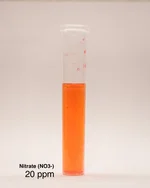
Dilution 4: (25ml 40ppm + 25ml H20) = 20 ppm
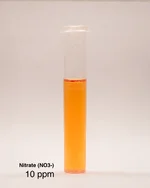
Dilution 5: (25ml 20ppm + 25ml H20) = 10pm
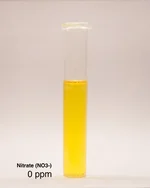
Control: (H20 Only) = 0 ppm
Dilutions were created using a high accuracy adjustable micropipette that could hold 10ml max.
Accuracy Results
Generally found that this particular test kit was accurate. It is VERY important to remember with the API Nitrate (NO3) Test kit that you have to shake Reagent #2 for 30 seconds prior to use in addition to shaking the vial for 1.5 minutes after adding reagents #1 and #2. I did not read the instructions the first month I was using this test kit and thoroughly confused myself regarding my dosing.
Color Photo References
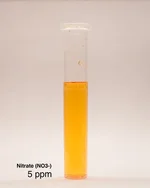
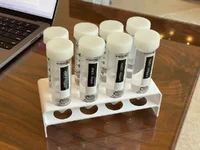
I found that it was considerably easier to determine my tank's actual concentration when I compared it to vials of known concentrations versus the color chart. Sadly, it's a bit too much work to make a round of reference solutions every time I test, so I opted to see if images of real solutions would be better than the color chart.
Using an image of the vials as reference seems to be a step up from just the color chart alone, but not quite as good as having reference solutions on hand. I figured I'd provide these images in a variety of forms for others to try out.



I was recently inspired by @Naturescapes_Rocco and his testing of Salifert test kit accuracy [Linked here]. Since I have access to very high end lab equipment at work, I figured I'd give this a try with my API test kit for Nitrates.
My two main goals were: #1 Test accuracy of the test kit against known solutions #2 Create a more realistic reference for determining color.
My serial dilution breakdown was as follows, "H20" refers to lab grade RODI water.
Stock Solution: 1600ppm (500ml H2O + 1.30g KNO3) --> This gave me a reasonably large amount of KNO3 to measure with high grade lab equipment
Dilution 1: (5ml 1600ppm + 45ml H20) = 160ppm
Dilution 2: (25ml 160ppm + 25ml H20) = 80ppm
Dilution 3: (25ml 80ppm + 25ml H20) = 40 ppm
Dilution 4: (25ml 40ppm + 25ml H20) = 20 ppm
Dilution 5: (25ml 20ppm + 25ml H20) = 10pm
Control: (H20 Only) = 0 ppm
Dilutions were created using a high accuracy adjustable micropipette that could hold 10ml max.
Accuracy Results
Generally found that this particular test kit was accurate. It is VERY important to remember with the API Nitrate (NO3) Test kit that you have to shake Reagent #2 for 30 seconds prior to use in addition to shaking the vial for 1.5 minutes after adding reagents #1 and #2. I did not read the instructions the first month I was using this test kit and thoroughly confused myself regarding my dosing.
Color Photo References
I found that it was considerably easier to determine my tank's actual concentration when I compared it to vials of known concentrations versus the color chart. Sadly, it's a bit too much work to make a round of reference solutions every time I test, so I opted to see if images of real solutions would be better than the color chart.
Using an image of the vials as reference seems to be a step up from just the color chart alone, but not quite as good as having reference solutions on hand. I figured I'd provide these images in a variety of forms for others to try out.
Last edited: