Welcome to ScapeCrunch

We are ScapeCrunch, the place where planted aquarium hobbyists come to build relationships and support each other. When you're tired of doom scrolling, you've found your home here.

Another Yugang post

  • Thread starter Thread starter Nlg1002
  • Start date Start date
  • Tagged users Tagged users None
Joined
Feb 18, 2026
Messages
7
Reaction score
3
Location
UT
Can someone verify my calculations? I'm struggling with my Yugang I got from aqua rocks colorado. I got the large acrylic one which is 4" diameter and 25.5" long.
Tank is 48.5" long, 18.5" wide, 16.25" deep.


Per my calculations, I need 50.7 sq in of surface area and with a pipe diameter of 4", I need 32.2" of length when using the 17.7 ratio. And that's why I can only get about 0.5 drop in pH. Which sucks because I paid over $100 for it. I want to make sure I've got the right calculations before I start looking for parts to build my own.
 
you need 12.67" of length with a 4" diameter pipe.

(Tank Surface Area + External Overflow Box Surface Area + External Sump Surface Area) / 17.7 = Diffusion Area Needed
Diffusion Area Needed / Pipe Diameter of your choice = Length of reactor needed

(897.25 + 0 + 0) / 17.7 = 50.69 sq in
50.69 / 4 = 12.67"
 
Okay, so currently I have a reactor that is twice as large as it needs to be. So why can't I get pH to drop 1 point? I am pumping in co2 like crazy.
Going strictly by your ph drop doesn't necessarily tell you how much dissolved CO2 you really have. Does your tank fully degass overnight? You need to know the degassed ph starting point to know what the ph drop is really telling you. A drop checker will help give you an idea of where you're at. If you're really pumping CO2 in, you may see that a drop checker is yellow and the fish might be starting to struggle, even though your ph drop is 0.5. Many of us here are using the Hanna CO2 test kit to get a more accurate reading. Check out this post.
 
Last edited:
How long has it been running?
2.5 weeks
Going strictly by your ph drop doesn't necessarily tell you how much dissolved CO2 you really have. Does your tank fully degass overnight? You need to know the degassed ph starting point to know what the ph drop is really telling you. A drop checker will help give you an idea of where you're at. If you're really pumping CO2 in, you may see that a drop checker is yellow and the fish might be starting to struggle, even though your ph drop is 0.5. Many of us here are using the Hanna CO2 test kit to get a more accurate reading. Check out this post.
The drop checker is dark bluish green. I saw the Hanna co2 test kit but it's like $20 just to ship it to me and that's if it's in stock.
My degassed starting point is 8.0. Running towards the end of the day, the pH is 7.5 at the lowest. kH is 4, gH is 8.
I checked for leaks in the CO2 line and regulator and no leaks. I've been running co2 for years and I'm pretty familiar with how my pH responds to co2. With the amount of flow I'm putting through, on a diffuser, my fish would be gassed out. Just trying to figure out what's wrong. Filter is an fx6 and has no problem running water through it with agitation.
 
An fx6 has very strong flow. I’m using an fx6 and the smaller version stainless steel Yugang reactor on my 68 gallon, and it works so well that I have to keep the outflow in a high position to only allow a small bubble in the reactor, and that still gets me 50 ppm of CO2 in the water. The inlet is low and the outlet is high, to minimize CO2 just being blown uselessly out of the reactor. In the acrylic version, you can’t adjust the inlet position because it’s in the dead center, right? You may need to keep the outlet in the position that allows the most surface area in the reactor, but lift that end a little so that the inflow is lower than the outflow and won’t immediately push the CO2 straight out of the reactor. Do you see tons of bubbles coming out of your lily pipe? Something else you could do is just use the fx6 for filtration, and get a 2nd weaker filter to run the reactor.
Also, you did purge the air out of the reactor when you set it up, right? If not, a lot of the bubble you see may just be air instead of CO2.
 
It sounds like you are either overflowing CO2 too much or otherwise losing CO2 straight through the reactor and out as bubbles rather than allowing it to diffuse into the water. Too strong flow through the reactor is a common problem. THese work so much better with nice slow flow - ideally minimal visible surface disturbance. I'm not sure how the Aqua ROcks Colorado ones plumb in, but putting an FX6 outflow through one of these sounds much too strong a flow without a bypass circuit built in to reduce actual flow through the reactor. I suspect you are blowing quite a lot of CO2 bubbles straight through the reactor without diffusing into the water.
Solutions would seem to be either building a bypass circuit to adjust the water flow through the reactor, or using a much slower pump for a separate reactor circuit

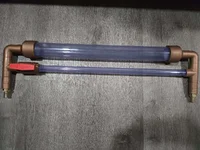
Here's my homemade reactor and bypass cicuit ......
 

Attachments

  • IMG_6769_edited-1.webp
    IMG_6769_edited-1.webp
    150.6 KB · Views: 6
So why can't I get pH to drop 1 point?

The way this reactor works, is that the CO2 <> water interface requires contact time.

Meaning, the water flowing through the reactor needs to be slow enough that the CO2 you are pumping into the reactor bubble has adequate time to absorb: from that bubble, across that water surface, and into your water flow 💯 💯

This means a very gentle flow through the reactor. When you are using a powerful, fast flowing filter moving your water around, you have two ways to slow your flow. You can either put the reactor on its own small pump, on a separate circuit, as @Kwyet does mentions 👍

or you can plumb a bypass section into your current filter circuit, like this one


so that most of your filtration power bypasses the reactor, and just a small portion of the circulating water meanders through the reactor, soaks up CO2, and takes that CO2 to your tank.

@markn2025 has had the same issue with running an FX4, the discussion is here 💯

Hanna co2 test kit but it's like $20 just to ship it to me

Yes the price of postage is super irritating 🙄 it has to do with the chemical components they have to ship. But they have free shipping events all the time, sign up for their email list and you will get notification 👍
 
Last edited:
Gentle flow through the reactor is key. Can you take a short video of the movement through the reactor and post it here? If you have a ton of flow, tilt the reactor so the out side is lower than the inlet side so you can get more dwelling time before overflow mode is achieved. ARC reactors have adjustable plates so the surface area can be reduced to lower CO2.
 
I don’t actually use a second pump. I was just putting that forth as a solution. I just tilt the reactor. I actually tilt it the opposite direction of @Unexpected, but it works very well anyway.
Tilting the reactor the other way speeds up the time overflow mode is achieved and reduces CO2.
 
Tilting the reactor the other way speeds up the time overflow mode is achieved and reduces CO2.
Okay, good to know! It’s working fine now though (almost too well), so I don’t want to mess with it. I want to get a regulator this year to serve both aquariums from the same CO2 tank, so when I do that then I’ll try it the other way.
 
The way this reactor works, is that the CO2 <> water interface requires contact time.

Meaning, the water flowing through the reactor needs to be slow enough that the CO2 you are pumping into the reactor bubble has adequate time to absorb: from that bubble, across that water surface, and into your water flow 💯 💯

This means a very gentle flow through the reactor. When you are using a powerful, fast flowing filter moving your water around, you have two ways to slow your flow. You can either put the reactor on its own small pump, on a separate circuit, as @Kwyet does 👍

or you can plumb a bypass section into your current filter circuit, like this one


so that most of your filtration power bypasses the reactor, and just a small portion of the circulating water meanders through the reactor, soaks up CO2, and takes that CO2 to your tank.

@markn2025 has had the same issue with running an FX4, the discussion is here 💯
Very informative post. Thanks for linking it.
I wonder, to make it more efficient, if I can shorten the acrylic ARC yugang to a more manageable size then add a bypass option. I've really cranked up the CO2 to the point that I feel like I'm going to run out of gas soon because the gas pocket is huge and maintaining it, perhaps, just takes a lot of CO2. And with a bypass, I can slow the flow down through the reactor but still have enough flow in the tank.
Alternatively, I could spin the outflow side to make a smaller pocket then rig a bypass to slow the flow through it.
Then I could still use it on a 120 gallon nicely. Maybe that's the ultimate fix...get a bigger tank lol.
 
@Unexpected If you tilt the reactor the other way, with the inlet high and the outlet low, does it make it much louder? I did it the other way because of @Yugang ’s diagrams that showed the inlet low, or at least in the center. I remembered wrong and actually have an fx4, not an fx6 (that is on the hillstream tank), but it’s still fairly strong.
 
@Unexpected If you tilt the reactor the other way, with the inlet high and the outlet low, does it make it much louder? I did it the other way because of @Yugang ’s diagrams that showed the inlet low, or at least in the center. I remembered wrong and actually have an fx4, not an fx6 (that is on the hillstream tank), but it’s still fairly strong.
Noise doesn't change. All tilting does is increase or decrease the time for overflow mode to kick in. In the case of having to much flow through the reactor, imagine the waves being created. The crest hits the end above the reactor outlet, the trough follows but now let's gas through the outlet causing a premature gas escape. So in essences, the interface barrier is not at the actual level to maintain the proper PH drop. By having the outlet lower than the wave trough, there would be more dwell time. This would just be a temporary fix until a bypass can be installed. Or slower pump ect.

The opposite works too. Let's say the reactor size exceeds the tank dimensions and overflow mode happens after the fish show signs of stress, raising the outlet side allows overflow mode sooner and corrects the over gas situation.
 
Noise doesn't change. All tilting does is increase or decrease the time for overflow mode to kick in. In the case of having to much flow through the reactor, imagine the waves being created. The crest hits the end above the reactor outlet, the trough follows but now let's gas through the outlet causing a premature gas escape. So in essences, the interface barrier is not at the actual level to maintain the proper PH drop. By having the outlet lower than the wave trough, there would be more dwell time. This would just be a temporary fix until a bypass can be installed. Or slower pump ect.

The opposite works too. Let's say the reactor size exceeds the tank dimensions and overflow mode happens after the fish show signs of stress, raising the outlet side allows overflow mode sooner and corrects the over gas situation.
Thank you! I think I can just leave mine as-is then. That’s good to know info though.
 
Gentle flow through the reactor is key. Can you take a short video of the movement through the reactor and post it here? If you have a ton of flow, tilt the reactor so the out side is lower than the inlet side so you can get more dwelling time before overflow mode is achieved. ARC reactors have adjustable plates so the surface area can be reduced to lower CO2.

How much lower should the outlet side be? Like 10 degrees or are you talking about something extreme like 45 degrees?

-B
 
How much lower should the outlet side be? Like 10 degrees or are you talking about something extreme like 45 degrees?

-B
Just a slight tilt. If waves are crashing into the outlet side, then just enough to stop the premature escape.
 
Back
Top