
Welcome to ScapeCrunch

We are ScapeCrunch, the place where planted aquarium hobbyists come to build relationships and support each other. When you're tired of doom scrolling, you've found your home here.

Help 90g, Dutch style, first try

  • Thread starter Thread starter riioKen
  • Start date Start date
  • Tagged users Tagged users None
Yeah fresh soil quickly sucks up all the po4 in the water and will do so for about a month then gradually slow down over another couple of months. In the very beginning Ive seen landen and ada zero out 10 ppm in two days. This action operates independently from the soils CEC since PO4 is an anion. Other nutrients that get ab/adsorbed are the cations which is natural. Ive seen the explanation why, somebody here may know, but I dont remember edxactly what happens

In my tanks this is a problem for probably half the species in there. Big leaved green plants are the first to show deficiencies. The first sign is pale splotches beginning on the 2nd or 3rd set of leaves down from the top. Other types of plants display their own weird responses.

Im not sure why its not a common practice to load PO4 with fresh aquasoils. Im pretty sure Dennis doesnt do that, although I havent read a lot of his articles so he may touch on the subject somewhere, idk. And some of these ferts with no NO3 or PO4 Im like how does that work?? I wouldnt for me.

Anyway what I do with a new soil tank is dose an extra 10 ppm PO4 after every water change, which are usually 2x week for a month or so for the ammonia. After 6-7 weeks of 10 ppm I'll give it an extra 5 for another month or so. I dont meticulously test the levels or anything these days, I just add extra approximately on that schedule

Other nutrients I just dose normal from the start, except I may go easy on NO3 for a month or two
Agreed. I have had the same experience.

Amazing I could dose 10 ppm PO4 and two days later not a trace.

And every time it bottomed out certain plants rebelled. The other thing when it bottomed out was that there was a bloom of hair algae. It was odd as hair algae is something I have never really had to deal with. But it was very repeatable. Zero PO4, hair algae. Toss a large dose in, it went away. It was a battle for the first month or two.
 
Ok, Sunday I do another WC (I did 1 yesterday). Tomorrow I dose 5ppm of po4, and watch how the tank react. Sunday, after the WC I'll dose 10ppm.

I could be wrong, but with more po4, the CO2 should be adjusted accordingly because, if I got it right, the P, increase CO2 absorption by plants, or at least is what I read somewhere, it wasn't a "true science" (in this hobby nothing it is) but on ukaps most of the time they go more technical due to some chemist and biologist on that forum, I'm a software developer, my skill is to understand other people code and adjust it to my need lol
 
CO2 should be good now and not need adjustment. There's already been a discussion on PH drop and all that right? The 1.2 drop (or whatever 1 or above)is plenty for plants using it fully. You already have enough for them to start using more. Its there now they just (hypothetically) arent using as much of it

Same goes for other nutrients. Dont start tweaking every little thing. PO4 is whats low, youre raising that
 
1 day after the 5ppm of po4, I have hair algae on quite few different plants, and the po4 test shows more than 2ppm remaining so not po4 deficiency.

I do a 60% today
Hair algae (staghorn too) in all my tanks (high and low tech) is always a sign of dirty filters and/or substrate. I cannot really say which one is the culprit because I always do a deep clean of both whenever I see those two algae start showing up. I try to keep the filters and substrate as clean as possible to avoid those conditions. Things tend to get worse fast once they show up, that’s been my experience at least.
 
1 day after the 5ppm of po4, I have hair algae on quite few different plants, and the po4 test shows more than 2ppm remaining so not po4 deficiency.

I do a 60% today
Need to wait 2-3 days to see the PO4 result after the 5 ppm dose. Hobby grade tests cant distinguish between 2 and 5. They'll show if you have some, none, or a bunch

Hair algae isnt from PO4 one day ago

It is not logical to abandon the extra Po4 dosing after one day. Stick to the script for a couple weeks anyway. Focus on keeping everything clean
 
Well it was the maintenance day that's why I did 60% WC. I've trimmed lots of plants (thanks to Vin's rotala kill tank, he often resolved problems with a good trim). In the next weeks I plan to create more space between groups, especially in the middle, where rotala macrandra, rotala blood red and ammania capitellata are placed, It's too crowded imo.

I've increased a bit more light (65 - 70%).

Considering the 60% should I dose again 5ppm? Or maybe 2-3ppm?


Hair algae (staghorn too) in all my tanks (high and low tech) is always a sign of dirty filters and/or substrate. I cannot really say which one is the culprit because I always do a deep clean of both whenever I see those two algae start showing up. I try to keep the filters and substrate as clean as possible to avoid those conditions. Things tend to get worse fast once they show up, that’s been my experience at least.
You could be definitely right, but I vacuum the substrate with turkey baster at every WC, and clean pre filter weekly (filter 1 time per month and it's always clean)

I did a new change, I've removed 250ml purigen from the tank, I read on your @Burr740 (but there are lots of case around the net) that is helpful not having it.
 
Id do 5 xtra ppm after every water change for a month, then see what the water column levels are doing. Your soil isnt brand new so dont expect it to zero 10 ppm in three days. But its new enough to still be sucking it up since youve just been regular dosing somewhat lean

And yes it is amazing what a good clean and trim can do
 
You could be definitely right, but I vacuum the substrate with turkey baster at every WC, and clean pre filter weekly (filter 1 time per month and it's always clean)
The filter internals is where your filter beneficial bacteria grow, the ones that convert DOC into ammonia and then ammonia through nitrate. There are a bunch in the tank and substrate too.

They create an amazing amount of slime (polysaccharides) to keep them in place and relatively protected. That slime coating is what builds up and sloughs off through the tank. It actually makes the filter more effective at removing stuff from the water since it’s sticky but there is a fine line between enough and too much. I’m not saying for certain that is where your hair algae is coming from but if you haven’t cleaned the filter internals in a few months, it’s a good place to start looking.
 
I’m not saying for certain that is where your hair algae is coming from but if you haven’t cleaned the filter internals in a few months, it’s a good place to start looking.
Well, next time i do wc is usually mid week, i'll do deep filter internals cleaning. Thanks
 
Ok guys, I have an update. My feelings are a bit mixed, but I can say that I'm more happy than sad/angry (with myself).

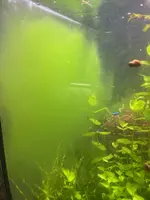
In the last few days, I had a little "algae bloom", to my eyes it looked like diatoms (or a different type of algae that can be easily "captured" with a toothbrush). Honestly at first I felt a bit stressed about it, because, idk, I really like this hobby (even though, it's less than a year that I'm in) and I truly wanna succeed in having a nice scape, for "calming" my sense, I went on Burr journal (I have just finished reading it, THANKS @Burr740 ) and I saw that he had an algae bloom due to lack of maintenance (how is possible that the king of AGA, the ones that always arrive in top 3 to every contest he has joined, has algae?), well joke aside, I read how he dealt, then I went here and I've reread my own journal.
Then what @FrankZ said few comments ago:

Hair algae (staghorn too) in all my tanks (high and low tech) is always a sign of dirty filters and/or substrate.
It made me think, maybe I'm too delicate with Turkey baster when I vacuum the soil?

Well, yes, I've used the turkey baster more vigorously, and lots of gunk and particles started showing in no time. I did a 60% wc, but I was able to vacuum only 1/3 of the tank. I plan to repeat the process in the weekend. Usually when I add the ro water (at 130-140ppm), the tank water ppm decrease from 270 to around 220, this time, after the WC, the tank water is 190, first time that is below 200ppm.

I've even recruited some sailors, I only had 1 amano in the tank (1 amano in a 90g, too much work for him) I've bought 9 more, honestly I don't even know If they are amanos, most of them yes, but 1 - 2 are more white/translucent. Anyway, this guys are very very small, around 1-1.5 cm, the ones in my tank is at least 5cm.

After the WC I've dosed 5ppm of po4 as script. Let see how evolves.
 
@Burr740 has a great journal because he’s honest and doesn’t hide the bad stuff that happens. He isn’t the only one. @GreggZ @fablau and Vin’s there are plenty of others that I’m forgetting that are just as honest and helpful.

If everything is perfect, you don’t learn anything from a journal. Well I don’t, I need to see and read how others failed and overcame to learn and grow. If you don’t try new or different things you don’t really get any better. For me this hobby is about doing things I can’t and learning along the way, coupled with a bunch of nerdy science stuff that I love.

It sounds like you might have figured out a flaw in your husbandry practices with the substrate being dirty which is great. You don’t need to get the substrate all clean in one go. Spreading it out over a few water changes won’t hurt at all.

Now I need to figure out the flaw in my husbandry and find the patience to wait out my GDA slime ball mess.
 
I have some GDA problems on glass, I don't mind it, but I have hair algae on glass too lol.
image.webpI’m trying the wait it out and leave it alone method for GDA this time. I’ve never had the patience before and not sure I will this time. It just screams scrape me off!!
 
I scrap and suction the GDA at the same time. Anyone else do that? You hold the scrapper in one hand and the hose in the other while slowly removing the GDA.

I don't have a choice of waiting it out. My wife would kill me LONG before that happens.
 
Ok guys, the "accident" with soil (dirty) made me think, I took a deep breath and decided to do a "back to the basics" check.

I've bought a "semi-professional" pH meter (bluelab pH pen, it's a double junction one, but I'm not using it due to refreshing phase that last 24h soaked in KCL solution and then it need to be calibrated) so I've checked the light, it's strong but not "too much strong", at full blast is 25lm x litres (considering 330L water volume. But idk if should subtract the 50L of Aquasoil, the 10mm of glass thickness and the fact that I leave 2.5cm) which is "medium" at most, and I'm using it at 70% of power.

The soil isn't clean as I thought, but it's not that much dirty.

Nutrient, I should have plenty and I'm dosing extra 5ppm po4 after wc (to my eyes it worsened the state but let explain it before doing assumption)

What is left? Yes I know, you know everyone here knows what is left (I never talked to Tom Barr directly, but I read his post on every forums, his journals) well, the CO2. Tom Barr probably as he would say "90% of the problems are CO2 related".

2 weeks ago (when the problems started) I changed the CO2 tank, it was empty, probably the needle valve moved or idk but happened, but I checked the pH with the shitty pen (I don't mind the pH, I was looking for the drop) after 5h of CO2 on, the pH is 6.2, I used the same water that I've checked, Shaked it vigorously for 15m (3 set of 5m each, I read it on Dennis Wong websites) the reading is stable at 6.9 pH, only 0.7 drop with yellow drop checker. For now I won't change anything, I wait for bluelab pen for more precise measurements, but probably I'm on the right path.
 
Last edited:
With this one sentence, you've explained the solution to 90% of people's problems with planted tanks.
+1.

When I got started I read a lot of Tom Barr and Vin Kutty (later Joe Harvey too!).

One thing I noticed. When they had an issue, they didn't start changing parameters like mad. They went back to basics. Get in there and get your sleeves wet and make sure tank is uber clean, practice good horticulture, and check and recheck CO2. If you don't have the basics right all of the other monkeying around rarely improves things much.
 
Yes, I agree with @GreggZ .

I would start thinking about the following and making sure they are consistent and coherent with each other:

1. Water (tap, distilled, etc)
2. Substrate (inert or Aquasoil kind...)
3. Light power and schedule
4. Co2 amount (pH drop) and consistency
5. Filtration (are the filters clean?)
6. Fertilization method and schedule
7. Water change amount and schedule

For example, make sure you have enough hard water, and not using just distilled water. It is worse for plants to give them distilled water than super hard water.

If you have an Aquasoil (nutrient-rich) kind of substrate, be careful not to disturb it too much, you might have ammonia spikes when tinkering with it.

Make sure the light your plants take is proportionate to the nutrients (ferts and Co2) you are giving them. For example, don't blast your plants with a full-power LED light strip 10 hours a day without giving them enough Co2 and nutrients. Also make sure plants get some rest (i.e. 8 hours of lights a day, then off). If you use Co2, make sure to have at least 1.0 pH drop.

Keep those filters clean! I am quoting Tom Barr here... and he's right. To avoid many algae issues, you need to keep those clean, which means not cleaning them every day or every week (and possibly NOT with chlorinated water!), but at least once every 1-2 months make sure you don't accumulate too much detritus. Similar concept for your tank's substrate if you have an inert substrate. Superficial vacuuming once a week goes a long way in preventing BBA and other algae nuisances.

Be consistent with your fertilization, and choose a method that follows Liebig's law In a few words, your plants need all nutrients in sufficient amounts. As soon as one of the nutrients runs out, you get deficiencies, plants stop growing, and algae take over. My recommendation is the Estimative Index wich is the easiest one (in my opinion and experience!). Also, very important, avoid using CSM for traces, mostly if you have an inert substrate. @Burr740 was the god helping us all to figure out that was NOT good for our tanks!

Finally, be consistent with water changes, and reasonable. For example, if you use the EI method, be consistent in changing at least 50% water once a week. If you have a low-tech tank, you can get away with a 50% water change every 1-2 months.

Please, to all experts here, let me know if I missed or miswrote anything. And let me know if you have any questions or need more info/help. In my experience, if you have the correct strategy and keep all of the above in check, the only algae that could give you trouble is BBA once in a while. Mostly when the tank is mature and substrate/filters are not that clean... ;)
 

Top 10 Trending Threads

Back
Top