Welcome to ScapeCrunch

We are ScapeCrunch, the place where planted aquarium hobbyists come to build relationships and support each other. When you're tired of doom scrolling, you've found your home here.

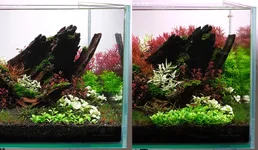
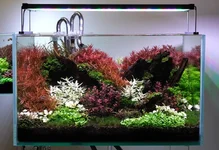
Journal 75L Hygrophila polysperma white display

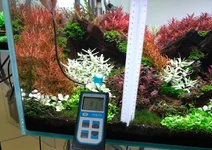
Took phots using the Twinstar S series and I think the aquarium actually looks better under it than my week aqua tuning. Interestingly the Twinstar also produces 300+ PAR, which is more than what I expected, putting it in similar levels to chichiros/weekaqua/net lea line-up.

2hrAquaristDSCF3535 Twinstar PAR.webp
2hrAquaristDSCF3521 Twinstar PAR.webp
 
I posted this on FB, and I thought it is important enough that I post it here also.
Large water changes during a new planted tank startup phase is something I have changed my mind about this year.

If dilution of organics, removal of detritus and algae spores is the goal of large water changes during the initial weeks is the goal, why stop at 50% or 80%? If new aquasoil release 10ppm of ammonia, an 80% water change still leaves 2ppm. So this year I have done 100% (or as near as I can) water changes for my new projects instead and all the tanks have settled in even faster than before, with faster plant adaptation, with the tank skipping diatoms/GDA phases entirely. I no longer expect to handle any form of diatoms in any new setup.

1st week: 100% water changes every 2 days
2-3nd week: 100% water changes twice a week, more if there is visible algae appearing.
4th week: back to 50-80% water change schedule once a week, but more if the tank has not settled in.

As per Tom barr; Periphyton is also lifted off plant leaves when water levels dip enough to expose the plants to air. The secondary effect of such large water changes is that it exposes plants to atmospheric air, which saturates their vacuoles with gaseous oxygen and carbon dioxide. This invigorates plant growth and allows plants to adapt faster to the new aquarium environment. Plants also channel the extra oxygen down to the rhizosphere, which in turn turbo-charges development of the microbial community in the substrate. These invisible interactions have an extremely strong anti-algae impact.

If something is good, is more of it better? When it comes to big water changes, it seems like the answer is yes.

Using APT Feast aquasoil - This approach also allows me to plant sensitive plants from day1 rather than waiting - Blood vomit, Bucephalandra, Varigated plants.

View attachment 17439
View attachment 17440

I'm ASSuming here, but I'll ask the question anyway: Does this approach also apply to tanks with inert substrates, such as BDBS ?

I'm waiting on my first tank (75G) to arrive in a few weeks!

-B
 
I'm ASSuming here, but I'll ask the question anyway: Does this approach also apply to tanks with inert substrates, such as BDBS?

I'm waiting on my first tank (75G) to arrive in a few weeks!

-B
Inert substrates do not face the same nutrient fluctuations that ammonia enriched aquasoils do. However, they face the same biological maturity cycles (like with diatoms/green dust algae management in new tanks for example) and the large water changes also helps plants settle in by exposing them to air, and removal of algae spores/detritus/decomposer microbes that can affect adapting plants.

A similar scenario can be seen when folks leave large clumps of plants floating in a bucket. Once a few plants start deteriorating, the rot/melts spreads quickly to other plants. This is largely because once a piece of plant start deteriorating, there will be a spike in the microbial populations responsible for decomposing decaying material - and these microbes spread easily to other plants in the vicinity when their populations spike. In matured aquariums, other microbes keep these microbes in check, so decaying plant material can be digested without the rot spreading so easily. This is the same reason why sensitive plants such as TC or difficult species, survive better in matured aquariums also. Large water changes in new aquariums not only removed organic detritus, but also remove excess populations of these decomposer microbes before the ecosystem that keeps them in check has developed.
 
Inert substrates do not face the same nutrient fluctuations that ammonia enriched aquasoils do. However, they face the same biological maturity cycles (like with diatoms/green dust algae management in new tanks for example) and the large water changes also helps plants settle in by exposing them to air, and removal of algae spores/detritus/decomposer microbes that can affect adapting plants.

A similar scenario can be seen when folks leave large clumps of plants floating in a bucket. Once a few plants start deteriorating, the rot/melts spreads quickly to other plants. This is largely because once a piece of plant start deteriorating, there will be a spike in the microbial populations responsible for decomposing decaying material - and these microbes spread easily to other plants in the vicinity when their populations spike. In matured aquariums, other microbes keep these microbes in check, so decaying plant material can be digested without the rot spreading so easily. This is the same reason why sensitive plants such as TC or difficult species, survive better in matured aquariums also. Large water changes in new aquariums not only removed organic detritus, but also remove excess populations of these decomposer microbes before the ecosystem that keeps them in check has developed.
Do you think the spreading from one plant to another also happens in aquariums?


What I mean is, if a plant is affected by algae and we don’t remove all of it, can it then spread to other plants in the tank as well?
 
Do you think the spreading from one plant to another also happens in aquariums?


What I mean is, if a plant is affected by algae and we don’t remove all of it, can it then spread to other plants in the tank as well

Of course it does. But there are conditions of course. Everyone knows that healthy plants are more algae resistant and unhealthy plants are algae magnets. However, both plants and hardscape are affected by the environment around them. Difficult weaker species show this scenario more often. If you grow Ludwigia white, or white pearlweed/ Micranthemum umbrosum white, they are generally quite weak, especially on older growth, and it makes a huge difference whether you grow it in an algae free environment or algae infested environment - in an algae infested environment they get algae on their older leaves more easily. The same applies for hardscape - if you have deteriorating plants with algae nearby, the hardscape is more likely to be affected than hardscape in a pristine tank.
 
Of course it does. But there are conditions of course. Everyone knows that healthy plants are more algae resistant and unhealthy plants are algae magnets. However, both plants and hardscape are affected by the environment around them. Difficult weaker species show this scenario more often. If you grow Ludwigia white, or white pearlweed/ Micranthemum umbrosum white, they are generally quite weak, especially on older growth, and it makes a huge difference whether you grow it in an algae free environment or algae infested environment - in an algae infested environment they get algae on their older leaves more easily. The same applies for hardscape - if you have deteriorating plants with algae nearby, the hardscape is more likely to be affected than hardscape in a pristine tank.
So, wouldn’t the best course of action still be to kill all the algae chemically after fixing the root cause, of course?


My concern is that with manual removal alone, we might miss some algae, and then it could continue to spread afterwards.


Or is that the wrong way of thinking about it?
 
I posted this on FB, and I thought it is important enough that I post it here also.
Large water changes during a new planted tank startup phase is something I have changed my mind about this year.

If dilution of organics, removal of detritus and algae spores is the goal of large water changes during the initial weeks is the goal, why stop at 50% or 80%? If new aquasoil release 10ppm of ammonia, an 80% water change still leaves 2ppm. So this year I have done 100% (or as near as I can) water changes for my new projects instead and all the tanks have settled in even faster than before, with faster plant adaptation, with the tank skipping diatoms/GDA phases entirely. I no longer expect to handle any form of diatoms in any new setup.

1st week: 100% water changes every 2 days
2-3nd week: 100% water changes twice a week, more if there is visible algae appearing.
4th week: back to 50-80% water change schedule once a week, but more if the tank has not settled in.

As per Tom barr; Periphyton is also lifted off plant leaves when water levels dip enough to expose the plants to air. The secondary effect of such large water changes is that it exposes plants to atmospheric air, which saturates their vacuoles with gaseous oxygen and carbon dioxide. This invigorates plant growth and allows plants to adapt faster to the new aquarium environment. Plants also channel the extra oxygen down to the rhizosphere, which in turn turbo-charges development of the microbial community in the substrate. These invisible interactions have an extremely strong anti-algae impact.

If something is good, is more of it better? When it comes to big water changes, it seems like the answer is yes.

Using APT Feast aquasoil - This approach also allows me to plant sensitive plants from day1 rather than waiting - Blood vomit, Bucephalandra, Varigated plants.

View attachment 17439
View attachment 17440
Have you tried doing larger water changes (up to 80%) on your tanks with shrimps? Since caridinas can't tolerate huge parameter swings, I wonder whether it's possible to pull off an 80% water change with them
 

Top 10 Trending Threads

Back
Top