We are ScapeCrunch, the place where planted aquarium hobbyists come to build relationships and support each other. When you're tired of doom scrolling, you've found your home here.
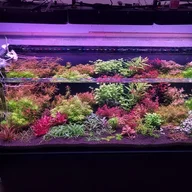
I started keeping plants typically referred to as soft water back in Dallas, TX where the tap water is fairly hard with a KH of ~4-5 degrees. The picture below is from one of my tanks setup with sand, not soil, and you can see theres reasonably healthy ball type Eriocaulons, Syngonanthus macrocaulon, and some Tonina. The ease of growth in higher KH strongly depends on the plant that you're trying to grow. Eriocaulons like Eriocaulon lineare, Eriocaulon parkeri, Eriocaulon 'Feather Duster', and Eriocaulon 'Vietnam' seem completely insensitive to KH within the normal range despite being in the classic softwater plant genus. Syngonanthus macrocaulon, Tonina fluviatilis, and many ball type Eriocaulons seem to do okay in good conditions at 4 dKH and will grow fine after an adaptation period. Eriocaulon quinquangulare, Syngonanthus Rio Negro giant, Centrolepsis drummundiana (not an Erio but often lumped into that category), and Syngonanthus 'Vichada' did not grow well under these conditions and I was only only able to successfully grow these plants once I lowered KH and switched to soil. Who knows if the key was soil or KH though, but I imagine it was a mix of both that made a big difference.
If you want to grow softwater plants and have high KH, it's possible to lower the KH with hydrochloric acid. I dosed HCl into my tanks after water changes for multiple years with no adverse effects on plants and was also able to breed shrimp in these tanks during that time frame. I would do a standard water change with tap water and add 10% HCl slowly into the highest flow area of the tank. I didn't measure KH week to week and instead identified a suitable volume that would bring the KH between 1 and 2 for my standard water change volume. This strategy worked very, very well and is the approach is used in the tank below along with a few other high tech tanks.
It's been a few years since I did this and I don't recall the specifics on dosage. I remember using one of those dosing bottles that you squeeze and it fills the bulb up to ~30 mls, so not a huge amount for a 40B. Figuring out the right dose is fairly easy though. Measure the KH in tank with a drop test. I used the API test, but with 10 ml water instead of 5 ml to get 0.5 dKH resolution. Then add HCl in small increments, wait some time, and check the KH again. You can find a couple other specific recommendations below.
1) If your tank has soil, I recommend doing the first tests a day or two after water change so you're not mixing up the carbonate buffering from the soil and the drop from HCl. This will give you a rough estimate for the HCl dose required to reach your target KH, but this is most likely a lower limit because of the carbonate binding from the soil.
2) In subsequent weeks, dose immediately after water change so the soil doesn't start absorbing the KH. I remember starting to dose HCl as soon as the water volume was over the powerhead that I used for circulation and before the tank was completely full.
3) Check KH before and after HCl addition for a few water changes to make sure there aren't dramatic KH fluctuations in your input water that would make this method unreliable and to identify the appropriate volume for KH depletion immediately after water change. You will need to adjust upwards from the initial value identified if your soil has appreciable carbonate buffering.
4) Target 1-2 dKH. This gives you some room for week to week fluctuations in input water KH as well as small differences in water change volume. It's really important to target some remaining KH because you don't want to overshoot the dose and completely eliminate all KH from the water. If you do that, the HCl will dramatically decrease the pH in the tank and I don't think that would be good.
5) Be cautious about doing this with livestock in the tank. I've never kept fish, so my methods are generally a bit harsher than recommended for people keeping fish and plants together. You should probably have an intermediate container to do the HCl treatment if you have fish you care about and don't want to risk stressing out.
Back in the day I was able to grow Syn macrocaulon (fka S belem) and Tonina fluviatilis, fairly well not great, in blasting sand with dkh around 5. That was along with high light, heavy water column ferts, and stable, moderately high CO2. Those two plants specifically did alright. I never tried any other Syn or Tonina in that particular set up
Did try Blood vomit and Erio quin, they woudnt grow. Later on Ive been able to grow both of those in the same blasting sand set ups with the KH dropped to 0-1. Along with just about every other Syn, Tonina, Erio. As long as KH is near zero and the water column dosed heavily, most of these "soft water" do just fine in my tanks
So my personal experience with how low KH needs to be for these plants. I consider 5 barely doable, really too high. 3-4 is likely ok, 2 and below is ideal
I dont really have an opinion on 0 dKH. Currently I drop 7 tanks 0-1 and not too exact about it. Half probably sit at zero at any given time. Cant say Ive ever noticed and issue with zero. But on paper the possibility of a few issues with that certainly exists. And I will say that I dont trust PH readings when the KH is zero. Aiming for 1-2 is probably the ideal way to do it
I also do the HCL method Brad mentioned. Id follow his advice for dropping it initially and finding how much works. Speaking very generally, I find that 15 ml will drop a 75 gal tank by 1 degree
I add it straight to the tank but you have to be careful not to fry the plants. HCL is heavier than water and will sink to the bottom and stay there if you dont hit some current with it. THIS POST in my journal describes how I do it
@bradquade and @Burr740 in addition to low KH, with the few of these that I've grown, I'm finding that they don't need super high light as they seem to be always associated with. Yeah, maybe higher light, but not the crazy PARs that some people have. Do you find this to be the case also? My PAR is 124 and they do fine.
I agree. Most of the soft water plants I've grown don't require that high of light. The first tank pic I posted above was running a 4 bulb T5HO on a 75 and it was right around 100 PAR if I remember correctly. That's decent lighting, but nothing too crazy. I did find that Erio quin and Centrolepsis drummundiana grew better with brighter lights and were more prone to splitting. They did fine at 100 PAR though.
This site uses cookies to help personalise content, tailor your experience and to keep you logged in if you register.
By continuing to use this site, you are consenting to our use of cookies.