Welcome to ScapeCrunch

We are ScapeCrunch, the place where planted aquarium hobbyists come to build relationships and support each other. When you're tired of doom scrolling, you've found your home here.

Help Resting ph of 5.7 during dark start

  • Thread starter Thread starter flex
  • Start date Start date
  • Tagged users Tagged users None
Joined
May 2, 2026
Messages
4
Reaction score
7
Location
sweden
Hej,

I have been in the hobby since 2006, recently I got a co2 reactor with an inline ph probe for the first time.

I am doing a dark start on this tank, using the full ada substrate system and the object this time is a dutch scape. I have never really paid any attention to ph during a dark start, but this time I have the probe and controller so I can see it has gone from 5.9 to 5.7 in 2 weeks with no co2 being added. I am using ro water with kh0 dk3 30tds.

If I go for 1ph drop to get 30ppm dissolved co2 but thats going to be super acidic. Maybe the ph will swing back to a normal level when the tank is cycled? Should I add some kh buffer to bring i up to 3kh? Any advice?
 
1777742338199.webp
I ran this tank with ADA Amazonia, 0KH, and a lowest CO2-injected pH of ~5.2pH every day for about a year. Up to ~6.2pH every morning, then back down to 5.2pH every midmorning for the entire photoperiod.

pH, especially with aquasoil-based tanks, is just not that big of a deal. Your pH of 5.9 is totally fine. Let the cycle do it's thing, you should be fine!
 
using the full ada substrate system

Welcome!

ADA Aqua soil is famous for releasing extremely large amounts of ammonia into the water column for quite a while. This will have the effect of lowering your pH significantly.

As @Naturescapes_Rocco says, your plants will not care 👍👍 More info here


If you do want to mitigate this pH drop, to benefit livestock for example, potassium carbonate is a good way to buffer this effect.

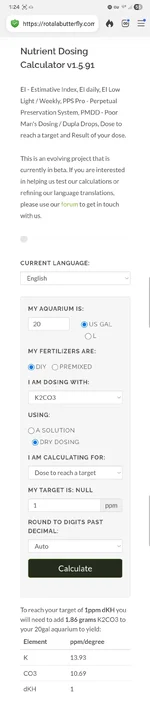
You can calculate how many degrees KH° a given quantity of potassium carbonate will raise your tank using the calculator here 💯💯

1000050176.webp
 
Thanks for all the responses, I appreciate greatly the level of experience available on here, it reminds me of the old days on APC and plantedtank forums!

I was planning to run my co2 24hrs per day since I have the controller on there, does that sound like a good idea?

I do have a timer plug I can put between the gate from the controller and the powerstrip but I am wary of having multiple levels of plug plugged in is there any fire risk?
 
was planning to run my co2 24hrs per day since I have the controller on there, does that sound like a good idea?

Well, adding co2 when the lights are off is going to cost money on CO2 that isnt doing any benefit for the plants. The plants are not going to use any co2 with the lights off…
 
Well, adding co2 when the lights are off is going to cost money on CO2 that isnt doing any benefit for the plants. The plants are not going to use any co2 with the lights off…
Wont the ph controller just shut off the co2 as the plants will not be using any co2 the ph should remain stable? I suppose there will be some offgassing so the co2 might go on but probably not for long?
 
If no co2 was lost during the night, there would be no need to turn the solenoid back on 2-3 hours before photoperiod in the morning. Ie the ph would be the exact same before photoperiod in period starts than when it shut off the night before…

In my tanks that is not the case. In my tanks despite the plants not using co2 during photoperiod being off and in fact releasing co2 back to the water, the relentless and continual offgassing to atmosphere at the waters surface throughout the. Night means my ph inexorably rises over the coarse of the night.

Leaving the co2 running 24/7 with a ph controller will result in ph remaining the same…. The fact it remains the same, means co2 was released into the reactor for periods of time overnight…

This of course begs the perennial question of whether a setback thermometer in a house saves any heating costs over just leaving it set at the same temperature all of the time…. I am pretty sure that the answer is yes, both in terms of heating savings and co2 savings because the rate of transfer or loss is dependent on the difference in concentrations between the two mediums…

Reasonably one can decide to not have a setback feauture, but in my mind it involves little benefit and a minor to moderate increase in cost..
 

Top 10 Trending Threads

Back
Top