Welcome to ScapeCrunch

We are ScapeCrunch, the place where planted aquarium hobbyists come to build relationships and support each other. When you're tired of doom scrolling, you've found your home here.

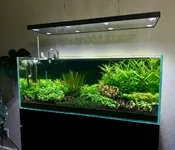
Journal Experiment Tank || 90x50x36cm, 39gal, Horizontal Reactor High-energy Aquascape Journal

Hi Rocco, i am planning for a potential future tank for my basement (when it gets completed). Curious to know what size skylight hyperspot do you use for this tank. I currently have a 60 x 40 x 40 and want to try something a little bigger and want to see which size hyperspot i should be planning to have. Secondly, do you think there is a way to hide the power cable from the hyperspot ? I could potentially have a poweroutlet made in the ceiling if that would help. Thank you!
 
Curious to know what size skylight hyperspot do you use for this tank.
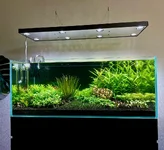
This is the Hyperspot FL, the 90cm long light. It is the exact size of the tank, but I actually plan to move this light to a future 120cm long tank, and instead use one of my existing 60cm Hyperspot FM lights on this tank.

If your tank is 60cm, Skylight recommends a Hyperspot FS:

1772647244640.webp

Secondly, do you think there is a way to hide the power cable from the hyperspot ? I could potentially have a poweroutlet made in the ceiling if that would help. Thank you!
You'd have to run the power cable up the hanging cable, which would remove it from your vision at the tank's level, but would leave a thicker power cable going up the hanging cable.

Green Aqua uses Hyperspot F's for many of their tanks. In this video at 2:41, you can see how they have the power cable going upwards towards the ceiling:

 
Curious to know what size skylight hyperspot do you use for this tank. I currently have a 60 x 40 x 40 and want to try something a little bigger and want to see which size hyperspot i should be planning to have
Speaking of which: Nature Design Studio has the Hyperspots back in stock, but the price went up, way up! :eek: Thanks a lot tariffs!
 

Spring 2026 update: Demystifying Micros (for me!)​


It's been quite some time since the last update, and I've had so many ups and downs because of my experimenting that I don't even know where to start to catch you all up!

I've now been experimenting with micros for 5-ish months now, and I guarantee I'm belatedly finding some of the same things that legends like Burr and GreggZ already discovered years ago. I got to "Version 8" of my micros, but nowhere near Burr's version 63 micros!

I could tell you about messing with the ratios of Fe:Mn:Zn, waiting 3 weeks for results, then trying something new. I tried quadruple Boron, I tried quintuple Molybdenum, I tried reducing Fe Gluconate, or switching to DTPA 11% Fe exclusively.

I also analyzed recipes from ALL major Micros/AIO ferts, and compared and contrasted the data for weeks. I also did it all in the context of dosing frequency, water change %, etc.

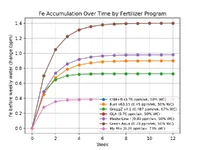
I compared CSM+B, @Burr740 Micros v63, @GreggZ Micros v4.1, GLA Micromix, Masterline I, and Green Aqua trace mix. I also later analyzed APT and Tropica Specialized, too. All scaled to the same Fe per dose (0.1ppm Fe), here's what I found:
1774304586429.webp

Type 1: "Lean" micros​

CSM+B, GLA Micromix

These are pretty "normal" with Mn, but low in Zn, Cu, Mo. Fairly "lean" when compared at Fe, though GLA is the leanest. Probably best for use with aquasoils.

Type 2: "Balanced" micros​

Burr and GreggZ mixes

Moderate Mn, higher Zn than half of the mixes comparatively, modest Mo, similar B. They are super similar (and if you've read all the original "lore" threads from these users, you'd understand why -- they found mixes that were tuned specifically to our uses!).

Type 3: "Heavy" micros (containing more traces-per-iron than the others)​

Masterline I and Green Aqua Micros mixes:
  • MasterLine I is high in:
    • Zn
    • Cu
    • Mo
    • fairly high B
    • fairly high Mn
  • Green Aqua is especially high in:
    • Mn
    • B
    • Mo
    • moderate-high Zn
    • but surprisingly very low Cu


Rankings by element at 0.100 ppm Fe

Manganese​

Highest to lowest:
  1. Green Aqua — 0.0500
  2. MasterLine I — 0.0333
  3. CSM+B — 0.0286
  4. GLA — 0.0286
  5. Burr — 0.0167
  6. GreggZ — 0.0144

Zinc​

  1. MasterLine I — 0.0238
  2. Burr — 0.0167
  3. Green Aqua — 0.0145
  4. GreggZ — 0.0144
  5. CSM+B — 0.00571
  6. GLA — 0.00500

Copper​

  1. MasterLine I — 0.00429
  2. CSM+B — 0.00143
  3. Burr — 0.00140
  4. GreggZ — 0.00129
  5. Green Aqua — 0.000260
  6. GLA<0.00025

Boron​


  1. Green Aqua — 0.0200
  2. MasterLine I — 0.0190
  3. Burr — 0.0153
  4. GreggZ — 0.0144
  5. CSM+B — 0.0114
  6. GLA — 0.0100

Molybdenum​


  1. Green Aqua — 0.00375
  2. MasterLine I — 0.00286
  3. CSM+B — 0.000857
  4. Burr — 0.000733
  5. GLA — 0.0000257
  6. GreggZ — similar to Burr


Dosing Schedules:​

1774304993663.webp

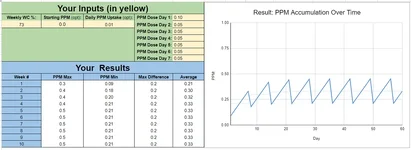
Interesting to see that many recommend daily dosing, even with large WC %.


I decided to check my Micros accumulation compared to the "recommended" dosing schedules (Mine is in pink):

1774305062024.webp

WHAT. I'm WAY underdosing my micros comparatively. The biggest finding was that I was seriously under-dosing micros, simple as that. I was getting stunting not from micros over-dosing, but under dosing -- but here's the weird kicker:

When I dosed practically no micros, (0.15ppm Fe/week) I didn't get stunting, but I did get algae. Hair algae and GDA. My theory is that the plants couldn't even grow without micros, so they didn't even have the energy to put out stunted new growth. I knew I had deficiencies due to pale growth, but here's what happened next:

When I increased my micros to 0.30ppm/week, I had less algae and more pearling -- but I began to see stunting. I continued this cycle for MONTHS trying to tweak small ratios within the micros. It was clear that what was happening was stunting with "increased" micros (still only 0.3ppm Fe/week, btw) was related somehow to increasing micros. Hence why I had public comments of "how do you guys have high light tanks with 0.45ppm Fe/week?". I was in genuine disbelief, because every time I increased micros for 1-2 weeks, I got new stunted growth.

BUT THAT'S THE KEY. It was still new growth; previously, with little-to-no micros, I had NO growth AND algae. Now with 0.3ppm Fe/week, I had less algae, but new growth was coming out stunted. Particularly Hygro 53b, despite 40ppm K in the water. Because this happened when I "increased" micros, I believed it was too much micros dosing time and time again. My theory is that, with some increased micros, plants could finally grow -- even if the new growth didn't still have all it needed to prevent stunting. I was falsely thinking this new stunted growth was due to over-dosing micros, but the reality was that plants were finally given a little "gas", despite missing all the other micros they needed.

After 6 months, I was about ready to throw in the towel, when I decided to try upping micros. Now, I also increased Mg from 6 to 9ppm, too, but the biggest change was micros. I went from dosing:

Previous: <0.3ppm Fe via an initial 0.1ppm dose, and 0.2 remaining spread daily via auto doser through the week, to

New: 0.6ppm Fe via an initial 0.25ppm dose, and 0.05ppm daily for 7 days per week. all with 73% water change.

I started dosing TWICE as much micros per week. Within the first 2 days, I knew I was onto something. Plants were PEARLING again. By the end of week 1, the relief I felt was amazing. S Repens was putting out flat, healthy leaves again. Hygro 53b was still a bit stunted, but the hair algae that had plagued the tank was no longer growing. In fact, it was slowly disappearing.

The point is this:

  • When I dosed practically no micros, I didn't get any stunting -- but plant growth stalled (due to Liebig's Law) and algae appeared quickly. This is an inert sand tank; if I don't provide it, IT'S NOT THERE. I have to dose micros, there is no soil to provide these trace elements at all.

  • When I dosed very little micros with large WC %, I got stunting -- but the type of stunting that's caused from too little micros, not too much. I didn't believe that, because this happened when I increased my micros (from nothing to something), I assumed the increase caused the stunting -- but no, it only allowed the plants to even grow a bit at all, albeit stunted from too little micros.

  • When I started dosing moderately strong micros, algae began disappearing. I'm now dosing 0.6ppm Fe as proxy per week total, and the tank is finally reaching a truly algae-free state. Pearling is at an all-time high again.

Does that make sense? It's part of what makes this hobby so difficult -- everything is nuanced, interconnected, and dependent on many other variables. When I dosed no micros, stunting went away, but plants suffered. When I dosed just enough for plants to grow, they could grow a bit -- albeit stunted. I thought this stunting was caused by too much micros, but it turns out it was caused by too few!

I'm still keen on messing with ratios a bit, though I doubt my findings will ever beat what Burr and GreggZ have already discovered.

I'm just happy to be back on track with it all again. Update pics soon!
 

Attachments

  • 1774304525272.webp
    1774304525272.webp
    29.5 KB · Views: 5
Last edited:

Spring 2026 update: Demystifying Micros (for me!)​


It's been quite some time since the last update, and I've had so many ups and downs because of my experimenting that I don't even know where to start to catch you all up!

I've now been experimenting with micros for 5-ish months now, and I guarantee I'm belatedly finding some of the same things that legends like Burr and GreggZ already discovered years ago. I got to "Version 8" of my micros, but nowhere near Burr's version 63 micros!

I could tell you about messing with the ratios of Fe:Mn:Zn, waiting 3 weeks for results, then trying something new. I tried quadruple Boron, I tried quintuple Molybdenum, I tried reducing Fe Gluconate, or switching to DTPA 11% Fe exclusively.

I also analyzed recipes from ALL major Micros/AIO ferts, and compared and contrasted the data for weeks. I also did it all in the context of dosing frequency, water change %, etc.

I compared CSM+B, @Burr740 Micros v63, @GreggZ Micros v4.1, GLA Micromix, Masterline I, and Green Aqua trace mix. I also later analyzed APT and Tropica Specialized, too. All scaled to the same Fe per dose (0.1ppm Fe), here's what I found:
View attachment 15393

Type 1: "Lean" micros​

CSM+B, GLA Micromix

These are pretty "normal" with Mn, but low in Zn, Cu, Mo. Fairly "lean" when compared at Fe, though GLA is the leanest. Probably best for use with aquasoils.

Type 2: "Balanced" micros​

Burr and GreggZ mixes

Moderate Mn, higher Zn than half of the mixes comparatively, modest Mo, similar B. They are super similar (and if you've read all the original "lore" threads from these users, you'd understand why -- they found mixes that were tuned specifically to our uses!).

Type 3: "Heavy" micros (containing more traces-per-iron than the others)​

Burr and GreggZ mixes
  • MasterLine I is high in:
    • Zn
    • Cu
    • Mo
    • fairly high B
    • fairly high Mn
  • Green Aqua is especially high in:
    • Mn
    • B
    • Mo
    • moderate-high Zn
    • but surprisingly very low Cu

Rankings by element at 0.100 ppm Fe

Manganese​

Highest to lowest:
  1. Green Aqua — 0.0500
  2. MasterLine I — 0.0333
  3. CSM+B — 0.0286
  4. GLA — 0.0286
  5. Burr — 0.0167
  6. GreggZ — 0.0144

Zinc​

  1. MasterLine I — 0.0238
  2. Burr — 0.0167
  3. Green Aqua — 0.0145
  4. GreggZ — 0.0144
  5. CSM+B — 0.00571
  6. GLA — 0.00500

Copper​

  1. MasterLine I — 0.00429
  2. CSM+B — 0.00143
  3. Burr — 0.00140
  4. GreggZ — 0.00129
  5. Green Aqua — 0.000260
  6. GLA<0.00025

Boron​


  1. Green Aqua — 0.0200
  2. MasterLine I — 0.0190
  3. Burr — 0.0153
  4. GreggZ — 0.0144
  5. CSM+B — 0.0114
  6. GLA — 0.0100

Molybdenum​


  1. Green Aqua — 0.00375
  2. MasterLine I — 0.00286
  3. CSM+B — 0.000857
  4. Burr — 0.000733
  5. GLA — 0.0000257
  6. GreggZ — similar to Burr

Dosing Schedules:​

View attachment 15394

Interesting to see that many recommend daily dosing, even with large WC %.


I decided to check my Micros accumulation compared to the "recommended" dosing schedules (Mine is in pink):

View attachment 15395

WHAT. I'm WAY underdosing my micros comparatively. The biggest finding was that I was seriously under-dosing micros, simple as that. I was getting stunting not from micros over-dosing, but under dosing -- but here's the weird kicker:

When I dosed practically no micros, (0.15ppm Fe/week) I didn't get stunting, but I did get algae. Hair algae and GDA. My theory is that the plants couldn't even grow without micros, so they didn't even have the energy to put out stunted new growth. I knew I had deficiencies due to pale growth, but here's what happened next:

When I increased my micros to 0.30ppm/week, I had less algae and more pearling -- but I began to see stunting. I continued this cycle for MONTHS trying to tweak small ratios within the micros. It was clear that what was happening was stunting with "increased" micros (still only 0.3ppm Fe/week, btw) was related somehow to increasing micros. Hence why I had public comments of "how do you guys have high light tanks with 0.45ppm Fe/week?". I was in genuine disbelief, because every time I increased micros for 1-2 weeks, I got new stunted growth.

BUT THAT'S THE KEY. It was still new growth; previously, with little-to-no micros, I had NO growth AND algae. Now with 0.3ppm Fe/week, I had less algae, but new growth was coming out stunted. Particularly Hygro 53b, despite 40ppm K in the water. Because this happened when I "increased" micros, I believed it was too much micros dosing time and time again. My theory is that, with some increased micros, plants could finally grow -- even if the new growth didn't still have all it needed to prevent stunting. I was falsely thinking this new stunted growth was due to over-dosing micros, but the reality was that plants were finally given a little "gas", despite missing all the other micros they needed.

After 6 months, I was about ready to throw in the towel, when I decided to try upping micros. Now, I also increased Mg from 6 to 9ppm, too, but the biggest change was micros. I went from dosing:

Previous: <0.3ppm Fe via an initial 0.1ppm dose, and 0.2 remaining spread daily via auto doser through the week, to

New: 0.6ppm Fe via an initial 0.25ppm dose, and 0.05ppm daily for 7 days per week. all with 73% water change.

I started dosing TWICE as much micros per week. Within the first 2 days, I knew I was onto something. Plants were PEARLING again. By the end of week 1, the relief I felt was amazing. S Repens was putting out flat, healthy leaves again. Hygro 53b was still a bit stunted, but the hair algae that had plagued the tank was no longer growing. In fact, it was slowly disappearing.

The point is this:

  • When I dosed practically no micros, I didn't get any stunting -- but plant growth stalled (due to Liebig's Law) and algae appeared quickly. This is an inert sand tank; if I don't provide it, IT'S NOT THERE. I have to dose micros, there is no soil to provide these trace elements at all.

  • When I dosed very little micros with large WC %, I got stunting -- but the type of stunting that's caused from too little micros, not too much. I didn't believe that, because this happened when I increased my micros (from nothing to something), I assumed the increase caused the stunting -- but no, it only allowed the plants to even grow a bit at all, albeit stunted from too little micros.

  • When I started dosing moderately strong micros, algae began disappearing. I'm now dosing 0.6ppm Fe as proxy per week total, and the tank is finally reaching a truly algae-free state. Pearling is at an all-time high again.

Does that make sense? It's part of what makes this hobby so difficult -- everything is nuanced, interconnected, and dependent on many other variables. When I dosed no micros, stunting went away, but plants suffered. When I dosed just enough for plants to grow, they could grow a bit -- albeit stunted. I thought this stunting was caused by too much micros, but it turns out it was caused by too few!

I'm still keen on messing with ratios a bit, though I doubt my findings will ever beat what Burr and GreggZ have already discovered.

I'm just happy to be back on track with it all again. Update pics soon!
LOL this has to be one of my favorite posts of all time! And yes it does make sense.

You are perfect example of how observing and "listening" to the plants is an important part of the hobby. If you watch closely enough you can pick up on even subtle changes.

And I can concur that too little micros can bring on algae. I had a period shortly after I moved where I was so busy I never got around to making a new batch of micros for a few weeks. Plants suffered and algae appeared pretty quickly. Weak unhealthy plants are a natural magnet for it.

So once again really love this post. Reminds me of me over the years banging my head against the wall until I had some aha moments. Funny thing is after all this time I am STILL having them. There is always something new to learn which is one of things I love about the hobby.
 

Spring 2026 update: Demystifying Micros (for me!)​


It's been quite some time since the last update, and I've had so many ups and downs because of my experimenting that I don't even know where to start to catch you all up!

I've now been experimenting with micros for 5-ish months now, and I guarantee I'm belatedly finding some of the same things that legends like Burr and GreggZ already discovered years ago. I got to "Version 8" of my micros, but nowhere near Burr's version 63 micros!

I could tell you about messing with the ratios of Fe:Mn:Zn, waiting 3 weeks for results, then trying something new. I tried quadruple Boron, I tried quintuple Molybdenum, I tried reducing Fe Gluconate, or switching to DTPA 11% Fe exclusively.

I also analyzed recipes from ALL major Micros/AIO ferts, and compared and contrasted the data for weeks. I also did it all in the context of dosing frequency, water change %, etc.

I compared CSM+B, @Burr740 Micros v63, @GreggZ Micros v4.1, GLA Micromix, Masterline I, and Green Aqua trace mix. I also later analyzed APT and Tropica Specialized, too. All scaled to the same Fe per dose (0.1ppm Fe), here's what I found:
View attachment 15393

Type 1: "Lean" micros​

CSM+B, GLA Micromix

These are pretty "normal" with Mn, but low in Zn, Cu, Mo. Fairly "lean" when compared at Fe, though GLA is the leanest. Probably best for use with aquasoils.

Type 2: "Balanced" micros​

Burr and GreggZ mixes

Moderate Mn, higher Zn than half of the mixes comparatively, modest Mo, similar B. They are super similar (and if you've read all the original "lore" threads from these users, you'd understand why -- they found mixes that were tuned specifically to our uses!).

Type 3: "Heavy" micros (containing more traces-per-iron than the others)​

Masterline I and Green Aqua Micros mixes:
  • MasterLine I is high in:
    • Zn
    • Cu
    • Mo
    • fairly high B
    • fairly high Mn
  • Green Aqua is especially high in:
    • Mn
    • B
    • Mo
    • moderate-high Zn
    • but surprisingly very low Cu


Rankings by element at 0.100 ppm Fe

Manganese​

Highest to lowest:
  1. Green Aqua — 0.0500
  2. MasterLine I — 0.0333
  3. CSM+B — 0.0286
  4. GLA — 0.0286
  5. Burr — 0.0167
  6. GreggZ — 0.0144

Zinc​

  1. MasterLine I — 0.0238
  2. Burr — 0.0167
  3. Green Aqua — 0.0145
  4. GreggZ — 0.0144
  5. CSM+B — 0.00571
  6. GLA — 0.00500

Copper​

  1. MasterLine I — 0.00429
  2. CSM+B — 0.00143
  3. Burr — 0.00140
  4. GreggZ — 0.00129
  5. Green Aqua — 0.000260
  6. GLA<0.00025

Boron​


  1. Green Aqua — 0.0200
  2. MasterLine I — 0.0190
  3. Burr — 0.0153
  4. GreggZ — 0.0144
  5. CSM+B — 0.0114
  6. GLA — 0.0100

Molybdenum​


  1. Green Aqua — 0.00375
  2. MasterLine I — 0.00286
  3. CSM+B — 0.000857
  4. Burr — 0.000733
  5. GLA — 0.0000257
  6. GreggZ — similar to Burr


Dosing Schedules:​

View attachment 15394

Interesting to see that many recommend daily dosing, even with large WC %.


I decided to check my Micros accumulation compared to the "recommended" dosing schedules (Mine is in pink):

View attachment 15395

WHAT. I'm WAY underdosing my micros comparatively. The biggest finding was that I was seriously under-dosing micros, simple as that. I was getting stunting not from micros over-dosing, but under dosing -- but here's the weird kicker:

When I dosed practically no micros, (0.15ppm Fe/week) I didn't get stunting, but I did get algae. Hair algae and GDA. My theory is that the plants couldn't even grow without micros, so they didn't even have the energy to put out stunted new growth. I knew I had deficiencies due to pale growth, but here's what happened next:

When I increased my micros to 0.30ppm/week, I had less algae and more pearling -- but I began to see stunting. I continued this cycle for MONTHS trying to tweak small ratios within the micros. It was clear that what was happening was stunting with "increased" micros (still only 0.3ppm Fe/week, btw) was related somehow to increasing micros. Hence why I had public comments of "how do you guys have high light tanks with 0.45ppm Fe/week?". I was in genuine disbelief, because every time I increased micros for 1-2 weeks, I got new stunted growth.

BUT THAT'S THE KEY. It was still new growth; previously, with little-to-no micros, I had NO growth AND algae. Now with 0.3ppm Fe/week, I had less algae, but new growth was coming out stunted. Particularly Hygro 53b, despite 40ppm K in the water. Because this happened when I "increased" micros, I believed it was too much micros dosing time and time again. My theory is that, with some increased micros, plants could finally grow -- even if the new growth didn't still have all it needed to prevent stunting. I was falsely thinking this new stunted growth was due to over-dosing micros, but the reality was that plants were finally given a little "gas", despite missing all the other micros they needed.

After 6 months, I was about ready to throw in the towel, when I decided to try upping micros. Now, I also increased Mg from 6 to 9ppm, too, but the biggest change was micros. I went from dosing:

Previous: <0.3ppm Fe via an initial 0.1ppm dose, and 0.2 remaining spread daily via auto doser through the week, to

New: 0.6ppm Fe via an initial 0.25ppm dose, and 0.05ppm daily for 7 days per week. all with 73% water change.

I started dosing TWICE as much micros per week. Within the first 2 days, I knew I was onto something. Plants were PEARLING again. By the end of week 1, the relief I felt was amazing. S Repens was putting out flat, healthy leaves again. Hygro 53b was still a bit stunted, but the hair algae that had plagued the tank was no longer growing. In fact, it was slowly disappearing.

The point is this:

  • When I dosed practically no micros, I didn't get any stunting -- but plant growth stalled (due to Liebig's Law) and algae appeared quickly. This is an inert sand tank; if I don't provide it, IT'S NOT THERE. I have to dose micros, there is no soil to provide these trace elements at all.

  • When I dosed very little micros with large WC %, I got stunting -- but the type of stunting that's caused from too little micros, not too much. I didn't believe that, because this happened when I increased my micros (from nothing to something), I assumed the increase caused the stunting -- but no, it only allowed the plants to even grow a bit at all, albeit stunted from too little micros.

  • When I started dosing moderately strong micros, algae began disappearing. I'm now dosing 0.6ppm Fe as proxy per week total, and the tank is finally reaching a truly algae-free state. Pearling is at an all-time high again.

Does that make sense? It's part of what makes this hobby so difficult -- everything is nuanced, interconnected, and dependent on many other variables. When I dosed no micros, stunting went away, but plants suffered. When I dosed just enough for plants to grow, they could grow a bit -- albeit stunted. I thought this stunting was caused by too much micros, but it turns out it was caused by too few!

I'm still keen on messing with ratios a bit, though I doubt my findings will ever beat what Burr and GreggZ have already discovered.

I'm just happy to be back on track with it all again. Update pics soon!
Funny you should mention this. I was just away for a week, so didn't dose micros but did a big dose of macros in advance. When I got back, I had algae. Seems in line with what you found!
 
Some End of March updates:

1774549785397.webp
Lots of changes and growth! It's been a hard recovery after my constant dosing experiments, but algae is on the way out and healthy new growth is here.

I removed the Lysimachia parvifolia (Samolus parviflorus red) from the right midground. I liked it ok, but I think I prefer AR mini for providing that midground, large-leaf pop of color. It was more pink than red, too. Planted some new AR Mini in it's place.

Blyxa octandra (the large grass plant) is finally taking off. It really does take forever to get established, but once established, it's awesome! Worried it will get too big for this tank.


1774550130012.webp
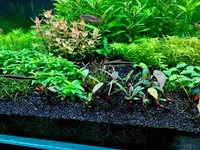
Buces were planted willy-nilly in the foreground. They all have new growth.

1774550038381.webp
The Crypt wendtii 'bronze' in front of the blyxa is a great plant, but in this tank it lies completely flat against the sand. Almost a foreground plant at this point, so I might switch it out for Lagenandra meeboldii 'red' for a similar dark, large-leaved midground plant to contrast with the blyxa.

1774550116803.webp
Bacopa colorata. Love this plant, beats the algae easily!

Had to reset the stem plants in the back left:
1774550167546.webp
I'm growing 3 red Ludwigias:

Ludwigia super red
Ludwigia palustris
Ludwigia glandulosa

I'll report the findings here!

Finally found some Syngonanthus 'Lago Grande' in the US! Bought a bunch of stems from Dennis @mrmoss . Not only did he hook it up for what I paid, he sent a TON of extras:

1774550287099.webp
Including some eriocaulon agumbey, a pretty rare plant with those awesome flower stalks.

In the small cup, he also provided Syngonanthus rio uaupes as a challenge, and I'm afraid that I'm failing the challenge! It's not doing so well transitioning to this tank's conditions.

1774550376081.webp
The Syngonanthus in the middle-back are a few weeks old now. Some algae, but they look ok. They're pearling which is a good sign. It'll be interesting to see if I can grow this plant species or not! It's such a beautiful plant for a green background plant. Larger and easier than Rotala sp green, but smaller and more true-green than Pogostemon deccanensis. I really hope I can pull it off!

1774550020452.webp
Thanks for reading! This is still an "experiment" tank, where I'm just trying to grow (and learn about) as many species as possible. The goal isn't for it to look great, just to grow plants. I'm hoping to set up another tank this year to be an actual showcase "try-hard" tank for all of these species I'm testing!
 
The Crypt wendtii 'bronze' in front of the blyxa is a great plant, but in this tank it lies completely flat against the sand. Almost a foreground plant at this point, so I might switch it out for Lagenandra meeboldii 'red' for a similar dark, large-leaved midground plant to contrast with the blyxa.
Looks great! Might I recommend some Crypt Flamingo in place of the bronze? I have it in front of Blyxa Japonica in my farm tank and I think they go really well together.

And can we just have a big round of applause for the Blyxa genus in general, Blyxas are awesome!
 
I also forgot to include the current stats (something I want to do after every update post):

Water Change: 73% weekly water changes with pure RO water (I remove 25Gal out of the actual 34Gal of water volume).

Lighting+CO2: ~110 PAR at the substrate level for ~8 hours a day. CO2 on at 5am, lights reach full 9am. CO2 sits about 40ppm for entire photoperiod. CO2 turns off 1 hour before lights off.

Temp: 73F via Chihiros Inline Heater Pro.

GH: I remineralize the GH of the incoming RO water to 30ppm Ca, 10ppm Mg via CaSO4*2H2O (Gypsum) and MgCl2*6H2O.

KH: I currently raise the dKH of the incoming water to 1.6dKH via KHCO3 (also adds K for Macros).

Macros: After the 73% WC, I dose 16-4.8-28.5 as NO3-PO4-K via a Macros solution of KNO3 and KH2PO4. I also include the K added from KHCO3 (KH riser). I then dose 2-0.6-0.75 ppm every morning via GHL Doser 3. Total weekly Macros dosed are 30-9-39, with 73% WC.

Micros
: Running a solution of modified Burr V63 micros (no Fe gluconate). After the 73% WC, I dose 0.2ppm Fe-worth Micros. I then dose 0.05ppm Fe every morning via GHL Doser 3. Total weekly Micros are 0.55ppm Fe, with 73% WC.
 
Looks amazing and healthy! I've never tried AR mini, but thinking I might give it a go. Is that hygrophila in back right corner?
Thanks! I'd highly recommend giving AR Mini a try. Super easy to grow, stays red under all conditions, and a good indicator for over-dosing micros.

Yes, that's Hygro Siamensis 53b from @Burr740 in the back right. Older growth has algae from the experiments, but new growth is looking good. Awesome plant, super easy to trim and shape.
What's you favorite ludwigia of the 3 you have?
I don't know just yet!

1774554741381.webp
The only one I've actually grown so far is the Super Red. The left is glandulosa I believe, and the right side is Rubin. I have all 3 growing together so I can compare them, but obviously the super red mini has a massive headstart. The other two were emersed-grown, and are only just now (after a week or so) putting out new submerged leaves. I'll have a comparison in the next month, I'm sure!
 
Thanks! I'd highly recommend giving AR Mini a try. Super easy to grow, stays red under all conditions, and a good indicator for over-dosing micros.

Yes, that's Hygro Siamensis 53b from @Burr740 in the back right. Older growth has algae from the experiments, but new growth is looking good. Awesome plant, super easy to trim and shape.

I don't know just yet!

View attachment 15468
The only one I've actually grown so far is the Super Red. The left is glandulosa I believe, and the right side is Rubin. I have all 3 growing together so I can compare them, but obviously the super red mini has a massive headstart. The other two were emersed-grown, and are only just now (after a week or so) putting out new submerged leaves. I'll have a comparison in the next month, I'm sure!
Wow, I didn't know 53B got the big. I have a few stems of 53B I got from Joe, but they aren't the big yet. You can see it front and center below.

See the lisimachia in the right corner? I don't know why, but the leaves keep curling under. Is that normal or caused by something it doesn't like? I'm debating trying some AR mini there now after reading your post.

Keep posting updates about your findings. They are very helpful!

IMG_20260322_192000380_HDR_AE.webp
 
Tank is looking incredible! Love the colors, seriously. Just awesome. Your tank was the reason I went from 27ppm Ca /6ppm Mg to 30ppm Ca/10ppm Mg!

Re: Curling Lysimachia parvifolia: With that much plant mass, you might need more than 0.45ppm Fe/week of micros; I've found that leaves curling under like that are usually some kind of micros under-dosing, but not always. I had badly curling LP leaves, and increasing my micros dose helped create straighter new leavles.

You could try to replace it with AR mini for sure, it would work great there -- but I'm surprised at how much I like the pink color in that corner! Red might change the vibe, but it's worth a try. AR mini is easier to trim, propogate, and maintain IMO than Lysimachia parvifolia, but it has a true red color, not pinkish.
 
Really good read. I've gone through it twice now and planning on going back and picking out a couple things I've been thinking about.

If you keep working on this and want to expand your tables, so many people use Thrive and/or Nilocg trace. It would be a good one to add to the list of how the micros repair. Probably the list of products could get long, APT, etc. You might not want to go down that rabbit hole.

I really like the Blyxa. It grows straight up and works great in this spot as opposed to something that would lean over.

You're pushing me more and more to get the Burr DIY micro kit. We'll see. 😉
 
@TRyan Here's some AR Mini in a previous version:
1774562869349.webp
And of course from the big 150p:
1774562895452.webp
It's a really versatile plant. You can let it get massive or trim it hard to the substrate, it always comes back.

Medium growth speed, so fast enough for growing algae-free leaves, but slow enough to only need trimming once every few months if you want.
 
Back
Top