Welcome to ScapeCrunch

We are ScapeCrunch, the place where planted aquarium hobbyists come to build relationships and support each other. When you're tired of doom scrolling, you've found your home here.

Experiment: Finding optimal conditions for growing aquarium plants 2

Chapter 2: Growing plants with lean fertilisation in the water column

Introduction


See Chapter 1 for an introduction and more general information about this experiment.
More detailed information and further experiments can be found [if interested] on my website: golias.net/akvaristika/.

Plants

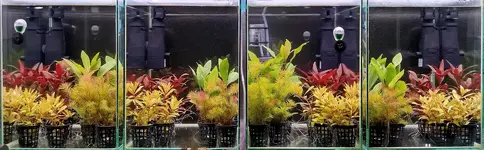
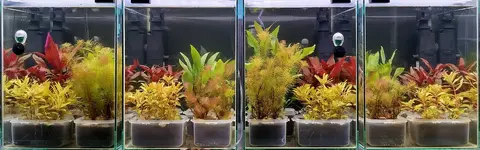
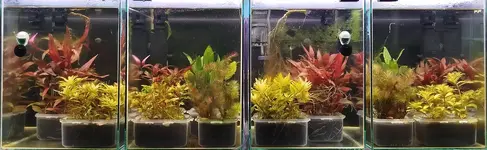
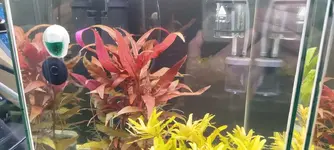
In this experiment I decided to use the following emersion plants (i.e. plants grown in a greenhouse):

  • Alternanthera reineckii 'Mini'
  • Ammannia pedicellata 'Gold' (formerly known as Nesaea sp. Gold)
  • Hygrophila corymbosa
  • Rotala wallichii & Rotala sp. 'Vietnam'

Diagram of plant placement in individual aquariums ↓
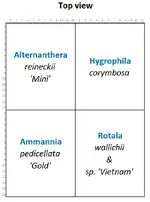
1737293943706.png

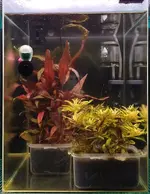
Picture of the fifth aquarium (few days old) ↓

1737294055644.png

Light

Lighting interval:
8h/day
Light intensity (PAR) in individual aquariums: 100-230 µM/m2·s (bottom to top)

Substrate

While in the first set (aquaria #1 to #4) a soil substrate was used, in the second set (aquaria #5 to #8) no substrate was used.

1st set → nutrient-rich substrate

1737294442925.png
  • I used the ADA Aquasoil Amazonia substrate (in powder version), which I soaked in tap water for two weeks before starting the experiment.
2nd set → no substrate

1737294488720.png
  • In aquariums with no substrate, I used M16 stainless steel hex nuts inserted into small size (2") hydroponic net pots to anchor (secure) the plants.
Water

Note: The recipes below were prepared using pure (demineralized/deionized) reverse osmosis water.

1737294781840.png
  • Water flow ensured by a surface skimmer (Jingye JY-350)
    • no filtration used
  • Water changes done once a week (with 50% of the water changed) with macro-nutrients replenishment
  • Micro-nutrientsadded every other day
    • Weekly amount of microelements (divided into three doses):
      • Fe/DTPA = 0.04 ppm (+ 0.02 ppm Fe/gluconate)
      • Mn/DTPA = 0.02 ppm
      • B = 0.01 ppm
      • Zn/DTPA = 0.006 ppm
      • Cu/DTPA = 0.002 ppm
      • Co/DTPA = 0.00002 ppm
      • Mo = not added
  • Carbon dioxide:
    • Extra CO₂added to aquaria #1, #3, #5 and #7 using a simple glass diffuser, the function and parameters of which are described in more detail in a separate article
      • CO₂ concentration in these aquaria: ~11 ppm
    • No extra CO₂added to aquaria #2, #4, #6 and #8
      • CO₂ concentration in these aquaria: ~4 ppm
    • CO₂ concentration measured by Carbon Dioxide Chemical Test Kit (Hanna HI3818), which should give similar results to a professional CO₂ meter (OxyGuard) → see 2hraquarist.com.
    • 1737295185480.png
    • Hanna CO2 chemical test kit HI3818
Documentation

planting: 2024-12-18

1737295745357.png

1737295784401.png

week #1: 2024-12-21

1737295856187.png

1737295883029.png

week #2: 2024-12-28

1737295923022.png

1737295942111.png

week #3: 2025-01-04

1737295980992.png

1737296005089.png
  • Some fully grown or dying plants have been removed (so you may not see them in the following pictures).
week #4: 2025-01-10

1737296034756.png

1737296062255.png

week #5: 2025-01-18
1737296110533.png
1737296135300.png

To be continued ...
 
Last edited:
Documentation

Details

Week #5

Ammannia pedicellata 'Gold'


Aquarium #1

1737296838382.png

Aquarium #2

1737296941861.png

Aquarium #3

1737296983222.png

Aquarium #4

1737297010249.png

Aquarium #5

1737297040512.png

Aquarium #6

1737297060345.png

Aquarium #7

1737297090106.png

Aquarium #8

1737297119498.png


To be continued ...
 
Last edited:
Documentation

Details

Week #3


Aquarium #1

1737353587546.png

Aquarium #2

1737353648172.png

Aquarium #3

1737353673404.png

Aquarium #4

1737353697758.png

Aquarium #5

1737353727387.png

Aquarium #6

1737353754057.png

Aquarium #7

1737353776822.png

Aquarium #8

1737353802324.png


To be continued ...
 
Documentation

Details

Week #4

Alternanthera reineckii 'Mini'


Aquarium #1

1737356046904.png

Aquarium #3

1737356074685.png

Aquarium #5

1737356094876.png

1737356116647.png

To be continued ...
 
Last edited:
Documentation

Details

Week #4

Rotala sp. 'Vietnam' (R. wallichii)

  • plants with green stems and red leaves are Rotala wallichii
  • plants with red stems and green leaves are Rotala sp. 'Vietnam'
Aquarium #2

1737356357217.png

Aquarium #4

1737356381029.png

Aquarium #5

1737356404566.png

Aquarium #6

1737356422985.png

Aquarium #8

1737356444926.png

To be continued ...
 
Last edited:
Documentation

Details

Week #5

Dropchecker


Aquarium #1 → 11.0 ppm CO2

1737356748708.png

Aquarium #3 → 13.5 ppm CO2 (outlier)


1737356789519.png

Aquarium #5 → 11.5 ppm CO2

1737356807657.png

Aquarium #7 → 11.0 ppm CO2

1737356827102.png

To be continued ...
 
Last edited:
Documentation

Details

Week #5


Aquarium #1

1737358032470.webp

Aquarium #2

1737358057478.webp

Aquarium #3

1737358086037.webp

Aquarium #4

1737358109303.webp

Aquarium #5

1737358130302.webp

Aquarium #6

1737358150735.webp

Aquarium #7

1737358170247.webp

Aquarium #8

1737358191143.webp

To be continued ...
 
Results

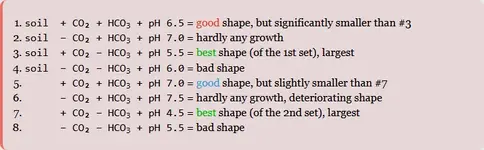
The following data is a brief description of the visual condition of the plants in each aquarium (1 to 8). Green indicates best condition, blue indicates good condition and red indicates fair condition.

Alternanthera reineckii 'Mini'

1737375537877.png

Ammannia pedicellata 'Gold'

1737359929303.png

Hygrophila corymbosa

1737359940048.png

Rotala sp. 'Vietnam' (R. wallichii)

1737375946581.png

To be continued ...
 
Last edited:
Evaluation

1737378234848.png

Probable characteristics:

Alternanthera reineckii 'Mini'

The results of this plant seem ambiguous to me. Further tests are definitely needed to verify the following characteristics.

1737378312920.png

Ammannia pedicellata 'Gold'

1737378323605.png

Hygrophila corymbosa

1737378333599.png

Rotala sp. 'Vietnam'

1737378345075.png

[End of the article]
 
Really clearly laid out experiment Marcel. And great illustrating images.

I'd also be interested in the importance of light intensity, and how much it compensates for lower CO2 conc. and therefore improved plant growth and phytomorphology. That is grows the more compact forms that most find more attractive, and that are typically achieved at 20 -30 ppm CO2 conc.
And how relatively higher light intensity can be achieved without injected CO2 or at lower CO2 conc. without algae infestation. Perhaps using lean dosing, and/or fertile substrate.
 
Last edited:
I sincerely regret publishing these articles on this forum.
Despite this, I wish all the users here all the best.
 
I assume its OK to continue to discuss these experiments even in OP's absence. They really do bring up some interesting trains of thought

One reason I dont feel like they offer much that can be actually applied to a real aquarium full of plants is there's what, maybe 15-20 total stems in these little experiment tanks

So lets say one set of tanks shows the one that got 4 ppm of (whatever nutrient) grew plants the best. And 15 ppm proved to be way too much. How do we extrapolate that data to apply to a full size heavily planted tank? There's only a few stems here pulling from that 4 ppm. Each stem pulling x amount

What about a real tank with 200 or 300 stems? How do we scale that to apply to 10 or 20x more stems, each pulling what they need?

Same deal if 15 ppm was too much. It may have been too much for those 15-20 stems, but would it be too much for 200 stems? Logic say no. Mathematics alone says probably wouldnt even be enough

I greatly respect the effort and meticulous detail the OP goes through, incredible time and effort spent here. And its fascinating to see what happened at various levels. But I struggle to believe we can take the numbers from the best one and think those same numbers would be ideal, or even adequate in a real aquarium with 20x more plants

Does anyone see a flaw in that logic? I mean no disrespect to the OP at all. Just pointing out a glaring issue I see trying to relate these results to an actual planted aquarium
 
I really don’t know enough to be able to debate about specifics. I would just think whatever the results of these small-scale experiments, they could be used to point the way for further experimentation, possibly show some general trends, and lead to more knowledge. Usually you need a lot of repeatable experiments to prove something anyway, unless it’s extremely basic. Preliminary experiments are still useful though, because who knows what new knowledge they’ll lead to?
 
NOTICE: Given my severely limited ability to communicate with others via social media in today's world in a way that is mutually agreeable and does not lead to conflict (I've tried many times and always failed), I prefer not to participate in any online discussion. If you have any questions or would like to discuss other matters with me, please use the mail channel: golias.net/akvaristika/contact.php.
 
Last edited:
What about a real tank with 200 or 300 stems? How do we scale that to apply to 10 or 20x more stems, each pulling what they need?
Theoretically, I think it’s perhaps not impossible to achieve with steady state dosing, it just becomes more work to keep a tank healthy. It possibly precludes a few dosing methods that make life a little easier. For instance, front loading, perhaps EI if it remains untailored.

But I guess the real issue is different species we like to keep together will more likely than not have different exacting requirements, even those that are sympatric species. However, for the most part aquatic plants exhibit huge phenotypic plasticity, and tolerate a wide range of conditions often remarkably well. Which is just as well for us as hobbyists.

It doesn’t mean Marcel’s experiments are without merit. It’s always good to know preferred environmental parameters of a given species. It can be useful for informing horticultural or husbandry decisions, for instance. And just for the heck of the endeavour itself, scientific type enquiry satisfying curiosity.
 
Last edited:
Theoretically, I think it’s perhaps not impossible to achieve with steady state dosing, it just becomes more work to keep a tank healthy. It possibly precludes a few dosing methods that make life a little easier. For instance, front loading, perhaps EI if it remains untailored.

But I guess the real issue is different species we like to keep together will more likely than not have different exacting requirements, even those that are sympatric species. However, for the most part aquatic plants exhibit huge phenotypic plasticity, and tolerate a wide range of conditions often remarkably well. Which is just as well for us as hobbyists.

It doesn’t mean Marcel’s experiments are without merit. It’s always good to know preferred environmental parameters of a given species. It can be useful for informing horticultural or husbandry decisions, for instance. And just for the heck of the endeavour itself, scientific type enquiry satisfying curiosity.
Oh absolutely. In no way was I discounting the value of personal endeavors like this. Our hobby doesnt have the luxury of dedicated research like there has been for terrestrial plants. Experiments like this and user trial-and-error are where most advancements originate

My only point was it would not be correct to come away thinking ok wallichii grows best with x/x/x dosing. Because Ive seen that happen before, and Im sure you know what Im talking about. As if these brief trial runs actually prove or establish something concrete. I wasnt knocking the experiments, just pointing out a few reasons why that isnt the case

But its always interesting to see the responses to various factors and he does a great job of documenting things
 
Last edited:
Back
Top