We are ScapeCrunch, the place where planted aquarium hobbyists come to build relationships and support each other. When you're tired of doom scrolling, you've found your home here.
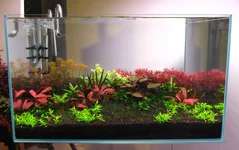
Started a new tank with the idea of show casing Lagenandra meeboldii which I have not showcased before. Wanted to feature Hygrophila lower Hlaingbwe, but I removed it later as I think it would be too large for this tank.
New substrate, new filter, squeezed filter mulm from the other matured tank, then ran the tank one week day before planting. 100% water change after planting, then 100% water change every other day since then. Dosing 1ml APT3 after water change day, and remineralizing to 5dGH using APT Sky. Trying out the low water column dosing approach for the initial period.
Was going to Journal about startup issues, however, it seems like the tank has already stabilized, skipping diatoms and green dust phase.
Freshly planted for a couple of days:
13/2/2026
Replanted the tops for Myriophyllum roraima, Cut and replanted Rotala blood red to begin building up the bush form. Trimmed old leaves
Foreground seems a bit blocky for now, so I think I'lll move stuff round again. Probably when the BV grows out some more.
Pic on 23/2/2026
Readings at this stage:
Potassium: 2.3ppm
Ammonia: 0.1ppm
Thanks for starting this. I am amazed that the ammonia is 0.1 ppm so quickly. Assuming this is Apt feast ? What is your process for the 1 week prior to planting ? I know that many discuss about phosphorous bottoming out and causing issues, I think it would be helpful to document the phosphorus levels in your tanks during this phase.
Could you also post a top and side view during this phase.
Thanks for starting this. I am amazed that the ammonia is 0.1 ppm so quickly. Assuming this is Apt feast ? What is your process for the 1 week prior to planting ? I know that many discuss about phosphorous bottoming out and causing issues, I think it would be helpful to document the phosphorus levels in your tanks during this phase.
Could you also post a top and side view during this phase.
Yep, at beginning of dark start, I squeeze filter sponges from aged filter and run the new filter. No water changes for that week.
Then after the first week, I do a 100% water change every 2 days, so that's around 5? or 6? 100% water changes, and that's why the ammonia levels are low.
I'll measure the water column PO4. I'm quite sure it'll measure <0.5ppm. However, this doesn't account for PO4 availability in the substrate, so I don't think the water column reading matters much.
Thanks for starting this. I am amazed that the ammonia is 0.1 ppm so quickly. Assuming this is Apt feast ? What is your process for the 1 week prior to planting ? I know that many discuss about phosphorous bottoming out and causing issues, I think it would be helpful to document the phosphorus levels in your tanks during this phase.
Could you also post a top and side view during this phase.
It would seem that the substrate leaches ammonia?, and the microbial mix has managed to convert it to nitrates, as my tap doesn't contain NO3.
The plants are settling in smoothly, but I can see some plant adaptation changes, so I'm predicting that some of the leaves will get hit by algae in the next couple of weeks.
I thought as a fun exercise, I've labelled the leaves so that folks can guess which of the leaves will get hit by algae in the coming weeks. If you can see problems coming early, then preventing it becomes easy
Dennis, do you feel that your tanks are more easily stabilized than others because you are able to start with plants from your own tanks, that are definitively very healthy and already adapted to your water parameters, soil, and water column fertilization? I'm amazed at the size of your tank in conjunction to PAR at the substrate, yet you don't have any GDA.
Additionally, do you find algae upon startup to be more prevalent in a high light driftwood-heavy hardscape, even with healthy plant mass to start? I'm wondering if that is a contributing factor that is not so often thought of or talked about. Even if one were to use Purigen to help polish off tannins and other organically produced waste from fresh wood, wood seems to be an algae magnet regardless until it's been submerged for quite a while.
Seems like folks here have good eyes/experience. And yes, generally I think that if the tank goes through some shaking, the older leaves are the ones that will be attacked first, which is what everyone selected.
There are a few angles to this question. I do dose ferts after water change, and it could be that the plants uptake there after was sufficient to prevent PO4 related growth issues. While I already have more expensive testing equipment compared to others, a 0ppm reading does not indicate that plants have no PO4 to up take. I'm not exactly sure if the test kits can read PO4 if its binded to iron or some other stuff - so I cannot say for sure whether a 0ppm reading really means 0ppm PO4 available in the water column.
When approaching plant growth I like to look at the broader statistics. ADA never dose extra PO4 when starting up their tanks, and I've seen years of such tanks grow in smoothly for the first few months. I do dose some APT3 after water change - so PO4 is introduced, even if the reading hits 0ppm on the test kits after 24 hours. Even with this light touch approach I've grown in plenty of tanks in record time without issues and with good growth forms/color. At the end of the day, the goal/target is achieved, regardless of what we think PO4 readings should be. Plant outcomes direct my actions, not test kit readings. Folks that analyze their test kits better than their plants tend to not grow plants well, and that is not a direction I'm interested in. As long as the plants grow in smoothly, I'm not bothered by low nutrient readings. I have plenty of tanks with 0ppm NO3 all the time, and in many tanks, my residual water column PO4 readings are eventually higher than my NO3 readings. It seems to not matter much.
Dennis, do you feel that your tanks are more easily stabilized than others because you are able to start with plants from your own tanks, that are definitively very healthy and already adapted to your water parameters, soil, and water column fertilization? I'm amazed at the size of your tank in conjunction to PAR at the substrate, yet you don't have any GDA.
Additionally, do you find algae upon startup to be more prevalent in a high light driftwood-heavy hardscape, even with healthy plant mass to start? I'm wondering if that is a contributing factor that is not so often thought of or talked about. Even if one were to use Purigen to help polish off tannins and other organically produced waste from fresh wood, wood seems to be an algae magnet regardless until it's been submerged for quite a while.
I think having non crappy plants helps, but I've started tanks with mostly TC plants and it works out similarly. If plants are grown in quite different conditions, there is more action needed to cut deteriorating leaves, replant new growth. If this is managed well, I don't think outcomes will be that different
I think having substantial amounts of deteriorating growth at the start definitely trips many hobbyists up and also makes the plants more vulnerable to diatoms. But I would say this is because many folks don't do enough remedial action at the start.
The two biggest factors I think are helpful are the microbial seed from matured, well running tanks and large water changes. To get enough microbial starting culture I squeeze an entire filter's sponge worth of mulm directly into the new tank and allow it to circulate for a few days. I think 100% water changes, i.e. flushing the system also works extremely well against algae as it removes most of the algae spores and truly reset water parameters. I know that APT feast for example, can spike ammonia to more than 10ppm in the first couple of days. Say you do just an 80% water change, taking into account the water from filter chamber, maybe your water change is only 70% of the total water circulating - that's 3ppm of ammonia remaining if you started at 10ppm, and 30% of algae spores are still about if you extrapolate this concept to water borne stuff. This accumulation adds up over many days - and as we know, stuff like diatoms multiply exponentially if they are around.
We will see whether GDA still comes eventually for this tank, as it has not yet fully grown in yet. I've increased the PAR at substrate to around 200umols though, since it seems relatively stable now.
On the topic of wood - its not a uniform product, so some pieces will cause various issues while others don't present problems at all. Hard to determine before it happen I think. Some pieces are hot spots for BBA regardless of how well the rest of the tank is run.
Moved some of the Elatine triandra to get a better arrangement. It feels like too foreground, so I'll looking to add maybe some Bucephalandra or Erios to breakup the large Blood vomit patches.
This site uses cookies to help personalise content, tailor your experience and to keep you logged in if you register.
By continuing to use this site, you are consenting to our use of cookies.