Welcome to ScapeCrunch

We are ScapeCrunch, the place where planted aquarium hobbyists come to build relationships and support each other. When you're tired of doom scrolling, you've found your home here.

Journal 20 gallon Rotala florida tank

  • Thread starter Thread starter Dennis Wong
  • Start date Start date
  • Featured
  • Tagged users Tagged users None
That makes sense. For Rotalas in the background. THank you.
Yea I cut them much lower to have secondary heads that will become primary heads later on when the top heads are cut off. The cut is 3 to 4 inches lower than the current canopy height.

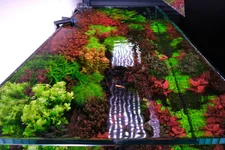
2hrAquaristDSCF7951E top view.webp

Rotala blood red has recovered fully from the trimming cycle 2 weeks back, Ludwigia arcuata was slightly slower, missing christmas by a week as per by previous estimations.

2hrAquaristDSCF7943E.webp
 
Out of curiosity, how do you keep your stems healthy below the top of the horizon lines. It seems the over crowding issue doesn’t affect your tanks health at all. Unless thats just because we can’t see below the canopies, just curious what it looks like under the hood.
 
I saw a video of a top view of this tank, and curious if that is at full flow or you reduce it for the shot ? I am currently using a Oase 350 on a 24 gallon - 60x40x40 and wanted to know if this is too much flow.

View attachment 12620
I did not reduce the flow, it is what you saw in the video. I think your tank above has decent flow. I wouldn't think it is too much. Signs of too much flow: plants that don't stay rooted easily, stems bending over when one does not want them to bend, persistent BBA in high flow spots, fish getting pushed around,

Flow, nutrients, even CO2 to some extent - being in the ball park range works well enough, and over-optimization isn't necessary. Other factors (mostly horticulture decisions) make a far greater impact on the overall tank.
 
Out of curiosity, how do you keep your stems healthy below the top of the horizon lines. It seems the over crowding issue doesn’t affect your tanks health at all. Unless thats just because we can’t see below the canopies, just curious what it looks like under the hood.
What goes into having healthy plants is the entirely endless debate which fills forums. There are many other small factors that stack up synergistically. For example some folks are alright with inert substrates and pure water column fertilization. I don't agree with is approach at all. I find that with rich substrates, I get away with more robust plants that I can grow to higher density, and delay deteriorating lower stems even with frequent pruning. Other big factors will be things like horticulture approaches - trimming techniques, plant placement, knowing which plants can be over-crowded (and when to prune them) or move them into locations that work better for them.

All my choices for the tank above from light amount, to CO2 levels, to fertilization approaches are summarized in on this page:

I think the difficult part for most folks working on optimizing plant growth is getting caught in nutrient/parameter tunnel vision. Thinking that most plant responses are due to nutrient/parameter issues and being unable to differentiate nutrient/parameter issues from other causes of poor plant growth. I think 90% of folks will be stuck at this stage unfortunately. These folks will endlessly tweak their NPK ratios and keep excel sheets on their parameters, but if you look at their tanks over the years, the tanks don't really improve - its equally important to stay away from such crowds in one's own journey for refinement.

I think plant handling/trimming/placement has huge impact on outcomes, but it is something difficult to discuss online - much easier done in person/in practical terms.

2hrAquaristDSCF7594E Tulun bg2011.webp
 
You’ve mentioned before that AS and raw terrestrial dirt grow plants best. Do you have a tried and true dirt regime when you’ve done it in the past? Have you used commercially available garden/potting soil or dirt from your local area? I know you also aren’t as big of a fan anymore because it’s not a controlled substrate like AS or something inert.
 
You’ve mentioned before that AS and raw terrestrial dirt grow plants best. Do you have a tried and true dirt regime when you’ve done it in the past? Have you used commercially available garden/potting soil or dirt from your local area? I know you also aren’t as big of a fan anymore because it’s not a controlled substrate like AS or something inert.
I have tons of such tanks as it was the default method that I used in my tanks in the past, such as the one below. You are right I stopped talking about it as raw soil is not a uniform product and it was difficult to describe what worked.

2hrAquaristDSCF1679 Show .webp
 
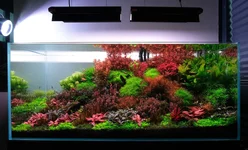
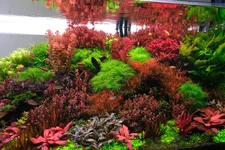
I have always liked Rotala florida as plant due to its strongly colored leaves, but realized that I haven't actually aquascaped much with it - meaning to integrate it as part of a layout and not just growing a bunch of it in farm/collector style tank. Using plants in a layout in tighter bunches, and in competition with surrounding plants/hardscape is much harder than growing it farm style in a single patch - it also means be able to shape/trim the bushes to match the overall curves of the layout.

Back in 2016 or so when I first received Rotala florida samples from north america, I could only grow it in sparser bunches. It looked nice in macro photographs but I could not envision using it an bush that would show off well as part of a layout unless I can grow it much denser. In the recent years, there were two main discoveries that I found in my experimentation, the first is that it grows better in moderate GH (5 dGH+) compared to super soft water (say <3dGH), and that it grew better in certain soil mixes (I experimented with different garden soil mixes when engineering the composition of APT Feast). Eventually I integrated some of the soil data into APT Feast's composition, and paired with the higher power lights readily available today, I find that I could finally grow the plant the way I envisioned as part of overall layout. I could prune it dense, as the base stems were healthy enough to sprout dense side shoots after trimming - and the secondary/tertiary shoot tips were as fully colored and sized similar to a primary shoot tip that hasn't been subjected to topping yet.

As a midground stem, it works very well due to its slower growth rate vs other colored stem plants.

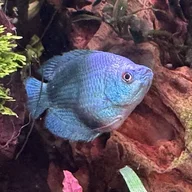
Against the deep purple of Rotala florida, I found that Golden white clouds worked quite well. So now they are the main inhabitants of the tank.

Tank this week (25/6/2025)
View attachment 8867
View attachment 8888View attachment 8886

Tank started out like this:
View attachment 8868
A week or 2 after initial planting (5/5/2025). I reused old aquasoil from the previous scape, so I planted all plants up front rather than waiting more time for the tank to stabilize, with the idea that I could out-grow any algae issues. Initially wanted to add H. Chai but it really didn't fit the overall color scheme, and the bushes by the side were too invasive to be compatible with having a chai patch I think.

Since it was going to contain Rotala florida, I thought I might as well throw in other high demand troublesome species such as the Red Eriocaulon quinguangulare, blood vomit. I settled on Rotala tulunadensis for the background as I wanted something dense and shapeable.

Tank specs:
60x36x36cm
Filter: Oase biomaster 250, all sponge media
CO2 injected through inline atomizer
Substrate: APT Feast
Water column: APT Sky to raise GH to 5dGH, 2ml of APTe per day.

View attachment 8887
Light distance. Interestingly, not crazy high PAR - just around 200-250 umols PAR at the substrate level.

View attachment 8869

Trimming and shaping: Most bushes were shaped by cutting individual outlier shoots one by one. Only Rotala blood red and the Rotala tulunadensis was straight trimmed across the entire top once.

View attachment 8870
This is how the Rotala tulunadensis looked like after a straight trim on 29/5/2025. About 3 weeks from when the top picture at top of this page was taken. It took the plant a whole week + to show new shoots. It seems straight trimming slows down the plant quite a bit, but allows for a very dense & neat canopy afterwards.


View attachment 8871
There are some interesting plants stuffed here and there. Some Eriocaulon caulescens? bolivia? that local hobbyists passed on to me. Carved out a patch for Syngonanthus vichada - slow grower, but the couple of babies that came have doubled in size so I think they should be alright. I think I will move them to a larger tank with more space.

View attachment 8872

View attachment 8874
View attachment 8875
View attachment 8876
View attachment 8877
View attachment 8878

Only discovered the color combination with the Golden white clouds when the tank matured, but its one of my favourite fish-plant combinations now. I think that while some of the species are a bit picky about growth conditions, one thing I really like about this tank is that most things have moderate/slow growth rates, which makes maintenance with regards to removing excess growth less tedious.
Elatine triandra is used as a low growing green filler plant - it does this role well. As it does not root very deeply, I can easily cut and pull off excess growth easily. Its the fasting growing plant in the layout that requires frequent removal of excess growth.

Some more close-ups.
View attachment 8879
View attachment 8880
View attachment 8881
View attachment 8882
View attachment 8883
View attachment 8884
View attachment 8885

I'm trying to replicate concepts of this layout (slowing growing bushes) into my 4ft tank.
You have the luckiest fish ever! They have such a beautiful home!
 
Ludwigia arcuata and background stems have recovered mostly from the previous trimming cycle. However, the fish damage on the Rotala florida has compromised some of its color as many of the top leaves are damaged.

HMm, the fish biting plant issue is quite wide spread. The thin leaves of Eriocaulon san benedito and Blood vomit are also bitten off, along with the tips of Syngonanthus lago grande. Keeping the fish well fed seems to reduce the damage. However, missing feeding even for 2 days seem to incur alot of bites on leaves.

2hrAquaristDSCF8006E Full tank.webp

2hrAquaristDSCF7985E .webp
 

Top 10 Trending Threads

Back
Top