
Welcome to ScapeCrunch
We are ScapeCrunch, the place where planted aquarium hobbyists come to build relationships and support each other. When you're tired of doom scrolling, you've found your home here.
Social Feed

Supporting
I Donated 2026
Rockstar
I'll bet @Naturescapes_Rocco has an answer for this, but I thought I'd ask the community. For a new tank with an inert substrate, have you began dosing in advance of planting to build nutrients in the system. If so, how many days prior and at full dosage or a smaller level. All plants going in are fully transitioned mature plants/cuttings.
3 Replies
·
67 views


Supporting
Expert in Residence
Rockstar
Article Contributor
I want to thank @Unexpected for introducing me to this new forum, but most importantly for him being the first ever to build the Horizontal CO2 Reactor. I feel honored that "Yugang Reactor" as he calls it (Yugang 鱼缸 means fish tank) is introduced in @Unexpected journal, but it would be a pity if that journal gets cluttered with too much reactor talk. So let me open a dedicated thread for discussions, questions and help on this Horizontal Reactor.
I have been experimenting for years with CO2, and at some time I took videos of my (modified) Aquamedic reactor to watch the bubbles in slow motion. To my surprise I found that the combined surface area of the bubbles was not very high for achieving a 1.5 pH drop in my 250 liter tank, and that CO2 absorbs so fast in water that the lifetime of bubbles is quite short. So .... we don't need to juggle bubbles at all, we can just create a very simple absorption interface between flowing water and a pocket of CO2 above it. The Horizontal reactor is surprisingly simple, and has some benefits that we won't find in diffusers or conventional Cerges / Griggs bubble reactors:

Or a multi stage version ...

A detailed thread can be found on UKAPS, linked with the kind permission from Scapecrunch forum moderators #1
I am happy to help new users to verify the calculations on reactor dimensions for their tank, please send me a PM.
I have been experimenting for years with CO2, and at some time I took videos of my (modified) Aquamedic reactor to watch the bubbles in slow motion. To my surprise I found that the combined surface area of the bubbles was not very high for achieving a 1.5 pH drop in my 250 liter tank, and that CO2 absorbs so fast in water that the lifetime of bubbles is quite short. So .... we don't need to juggle bubbles at all, we can just create a very simple absorption interface between flowing water and a pocket of CO2 above it. The Horizontal reactor is surprisingly simple, and has some benefits that we won't find in diffusers or conventional Cerges / Griggs bubble reactors:
- Simple rules to find the correct dimensions for any tank, a small nano tank or a huge tank the size of a swimming pool.
- Very easy and cheap to build with plumbing materials. No fragile parts, low risk of leakage or malfunction.
- 100% CO2 absorption efficiency
- No need to experiment with vortices, venturis, diffusers, needles wheels, impellers / rotors, multi stage reactors - it is just a pipe with a gentle flow of water.
- No noise
- No mist in the tank
- No maintenance, and stable performance over time
- Virtually no reduction of flow from pump
- A purging valve is optional, as the reactor will purge itself from excessive trapped air.
- The reactor can be configured so that in the event of a failure, CO2 injection will not exceed a limit and fish cannot be gassed. Inherently safe.
- The reactor can be configured so that we do not need a precision regulator, because the reactor controls the CO2 injection rate
Or a multi stage version ...
A detailed thread can be found on UKAPS, linked with the kind permission from Scapecrunch forum moderators #1
I am happy to help new users to verify the calculations on reactor dimensions for their tank, please send me a PM.
513 Replies
·
86057 views

Supporting
I Donated 2026
Rockstar
While perusing images of Dutch scapes online for inspiration, one in particular, caught my eye. I was sure I'd seen it before. Clicked on the link to the website featuring it (AquascapingLove.com) and sure enough, @Burr740 (Joe Harvey) was getting some love, whether he knows it or not.
Dutch Aquarium Aquascape: A style from the 1930s
Dutch Aquarium Aquascape: A style from the 1930s
4 Replies
·
85 views


Hello,
This is my first post here.
This is my 25cm aquarium, you've probably seen it before if you’re on UKAPS, I wanted to try using mud I dug up from the garden without capping. The reason I dislike capping is that I hate it when the substrates mix together and create a mess.
The substrate was set up up on 7/7/26. It took me days to figure out what I wanted to plant, but on 8/7/26 I ended up planting Micranthemum sp (probably M. glomeratum.) using the dry start method, because I already have it cultivated as emersed plant.
7/7/26
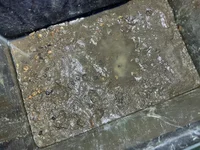
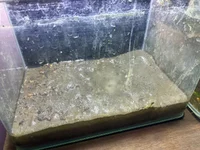
This is my first post here.
This is my 25cm aquarium, you've probably seen it before if you’re on UKAPS, I wanted to try using mud I dug up from the garden without capping. The reason I dislike capping is that I hate it when the substrates mix together and create a mess.
The substrate was set up up on 7/7/26. It took me days to figure out what I wanted to plant, but on 8/7/26 I ended up planting Micranthemum sp (probably M. glomeratum.) using the dry start method, because I already have it cultivated as emersed plant.
7/7/26
8 Replies
·
94 views
My confidence in answers obtained by AI is vanishingly small.
I tried several of them last night asking
Does Father Fish teach that water has memory…
All of them asserted no. None of them displayed any uncertainty.
Here is one typical response.
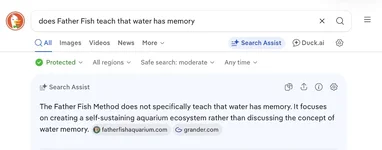
I then proceeded to supply a section of transcript from a video. And asked it to evaluate the transcript.. in essence it agreed that in the video Father Fish was claiming that water has memory.
I asked if going forward if asked if Father Fish taught water has memory would its initial response be different. It stated know because the transcript I provided, had Father fish state it was sort of like memory, not that it was memory…
By golly talk about wiggle room…
The above screenshot was asking the same question this morning and it is the same answer I initially got last night, so A+ for confidently giving incorrect answers consistently.
I then followed up asking if there are any Father Fish videos where be states that water has memory and I got the following reply.
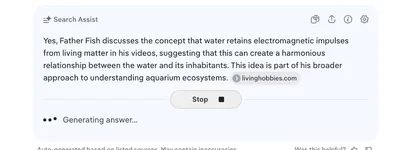
So, the answer you get will be highlydependent on exactly how you ask..
Its like nailing jello to the wall..
I have had similar experiences with AI over many questions in areas that I have deep knowledge base in. I have vanishingly little confidence in its ability to give correct answers with nuance.
I tried several of them last night asking
Does Father Fish teach that water has memory…
All of them asserted no. None of them displayed any uncertainty.
Here is one typical response.
I then proceeded to supply a section of transcript from a video. And asked it to evaluate the transcript.. in essence it agreed that in the video Father Fish was claiming that water has memory.
I asked if going forward if asked if Father Fish taught water has memory would its initial response be different. It stated know because the transcript I provided, had Father fish state it was sort of like memory, not that it was memory…
By golly talk about wiggle room…
The above screenshot was asking the same question this morning and it is the same answer I initially got last night, so A+ for confidently giving incorrect answers consistently.
I then followed up asking if there are any Father Fish videos where be states that water has memory and I got the following reply.
So, the answer you get will be highlydependent on exactly how you ask..
Its like nailing jello to the wall..
I have had similar experiences with AI over many questions in areas that I have deep knowledge base in. I have vanishingly little confidence in its ability to give correct answers with nuance.
22 Replies
·
182 views
Here are some photos of Cryptocoryne ciliata var. ciliata in its natural habitat in southern Thailand. It grows in tidal, brackish water where the plants are submerged daily during high tide. Substrate is mud. Fully grown plant is around 50cm+ tall.
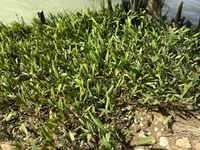
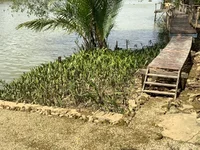
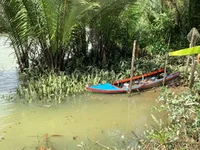
3 Replies
·
73 views
Today somebody gave me a brand new never been used wifi enabled toaster oven.
It left me scratching my head wondering why I would want wifi capabilities on a toaster oven..
It works just like a standard toaster oven without using the wifi feature..
So what does wifi get you?
It is specifically a toaster oven to use with the companies meal subscription service.
You buy pre prepared meals, scan the bar code with the oven and it sets the temperature, time and cooking mode…
For this convenience the tv dinners costs between $10-14 each…
In all fairness you do get more food per meal then most store bought frozen dinners. Calorie counts are in the 400 - 800 calorie range with about 35 grams of protein…. Store bought meals are typically around 250-350 calories and 10-15 grams of protein…
But by golly convenience costs….
I seriously doubt I will connect to wifi and download the app, and I know I wont be buying any meals…. But, it is a free toaster oven…
It left me scratching my head wondering why I would want wifi capabilities on a toaster oven..
It works just like a standard toaster oven without using the wifi feature..
So what does wifi get you?
It is specifically a toaster oven to use with the companies meal subscription service.
You buy pre prepared meals, scan the bar code with the oven and it sets the temperature, time and cooking mode…
For this convenience the tv dinners costs between $10-14 each…
In all fairness you do get more food per meal then most store bought frozen dinners. Calorie counts are in the 400 - 800 calorie range with about 35 grams of protein…. Store bought meals are typically around 250-350 calories and 10-15 grams of protein…
But by golly convenience costs….
I seriously doubt I will connect to wifi and download the app, and I know I wont be buying any meals…. But, it is a free toaster oven…
10 Replies
·
115 views


I Donated 2026
I wanted to share my experience so far with a cheap flow meter from Aliexpress.
I am generally a “you get what you pay for” aquarist, but I have taken a gamble due to circumstances. It is still early days, but it feels like it may have paid off.
Looking to add a flow meter to help tune my CO2 in a newly set up 130L tank, I searched far and wide for the different options. They were few and far between, most were for far larger flows than I needed and those that were appropriate were ridiculously expensive to get to Australia. So I went searching on the various Chinese discount sites and came across the LZB-3WB flow meters. They are cheap… real cheap. Less than $30 Australian landed, which made me nervous, but felt it was worth a shot at that price.
Not knowing what flow ranges I would need I ordered a 6-60ml/minute model.
After installing it, it was clearly too high of a range for my tank, but it did allow for some visibility while adjusting CO2. It was certainly better than a bubble counter.
Here is a picture of it action:

As you can see, the reading is below the scale of the meter, but with a marker I could at least set a starting point as I adjusted my CO2 higher. Also the adjustment valve was useless, a tiny turn would shut the flow off or open it to max out the meter.
I ordered the below as a replacement:

2.5-25ml/minute seems like a good range for my tank.
As a bonus the valve is better than most standard regulator needle valves. I can adjust the flow in increments of about 1ml/minute.
Below is the valve in action:

They have been in service for 2 months total now, 1 month each, so still an early review. It has been a solid upgrade though and was an easy install. They come with big 8mm barbed fittings but they can be unscrewed to reveal 1/8 female threads that standard needle valves for aquariums fit. I have also got some 1/8 to push fit fittings that I am yet to install as I am heading away on holiday for 2 weeks soon and don’t want to make any changes for the house-sitters to potentially have to fix!
Pros: adjusting my CO2 was made so much easier by being able to see exactly how much of an increase I was making with each adjustment. Monitoring that the valve isn’t drifting has been easy also, a quick check of the meter tells me it is steady.
Cons: I doubt that the reading is accurate. This means little to me, as I am not using it for a calculation or comparison between tanks. As long as the reading is consistent, even if it is wrong, I am fine with that. Also, the max pressure is listed as 40psi. I am unsure if that is a failure or accuracy maximum. Again, it doesn’t affect me as I run a low regulator pressure due to using a reactor. If I were using a diffuser that needed a high pressure, it may make me nervous.
As always, with any cheap gear, your mileage may vary. But, I thought it was worth sharing as it may help those with limited access to flow meters of appropriate sizes. So far it is proving to be the second best $25 I have spent on this tank, second only to the super red bristlenose I have in the tank.
I am generally a “you get what you pay for” aquarist, but I have taken a gamble due to circumstances. It is still early days, but it feels like it may have paid off.
Looking to add a flow meter to help tune my CO2 in a newly set up 130L tank, I searched far and wide for the different options. They were few and far between, most were for far larger flows than I needed and those that were appropriate were ridiculously expensive to get to Australia. So I went searching on the various Chinese discount sites and came across the LZB-3WB flow meters. They are cheap… real cheap. Less than $30 Australian landed, which made me nervous, but felt it was worth a shot at that price.
Not knowing what flow ranges I would need I ordered a 6-60ml/minute model.
After installing it, it was clearly too high of a range for my tank, but it did allow for some visibility while adjusting CO2. It was certainly better than a bubble counter.
Here is a picture of it action:
As you can see, the reading is below the scale of the meter, but with a marker I could at least set a starting point as I adjusted my CO2 higher. Also the adjustment valve was useless, a tiny turn would shut the flow off or open it to max out the meter.
I ordered the below as a replacement:
2.5-25ml/minute seems like a good range for my tank.
As a bonus the valve is better than most standard regulator needle valves. I can adjust the flow in increments of about 1ml/minute.
Below is the valve in action:
They have been in service for 2 months total now, 1 month each, so still an early review. It has been a solid upgrade though and was an easy install. They come with big 8mm barbed fittings but they can be unscrewed to reveal 1/8 female threads that standard needle valves for aquariums fit. I have also got some 1/8 to push fit fittings that I am yet to install as I am heading away on holiday for 2 weeks soon and don’t want to make any changes for the house-sitters to potentially have to fix!
Pros: adjusting my CO2 was made so much easier by being able to see exactly how much of an increase I was making with each adjustment. Monitoring that the valve isn’t drifting has been easy also, a quick check of the meter tells me it is steady.
Cons: I doubt that the reading is accurate. This means little to me, as I am not using it for a calculation or comparison between tanks. As long as the reading is consistent, even if it is wrong, I am fine with that. Also, the max pressure is listed as 40psi. I am unsure if that is a failure or accuracy maximum. Again, it doesn’t affect me as I run a low regulator pressure due to using a reactor. If I were using a diffuser that needed a high pressure, it may make me nervous.
As always, with any cheap gear, your mileage may vary. But, I thought it was worth sharing as it may help those with limited access to flow meters of appropriate sizes. So far it is proving to be the second best $25 I have spent on this tank, second only to the super red bristlenose I have in the tank.
18 Replies
·
1076 views


Rockstar
Journal 62G AIO Dirty Soil Lagoon

Well I’m done talking about it, it’s time to get this journal started.
I have been really out of it the last year or so in terms of maintaining my own tank, mainly out of frustration with time constraints and inconsistency with dosing etc. However, I have now acquired a dream tank, rimless and with low iron glass like I’ve always wanted. While I loved having a sump and prided myself on putting it together, I’m past that desire. The AIO allows the same benefits with hiding equipment, and overall easier maintenance without climbing in and out of cabinets. Now onto the details of this build.
Tank: Planet Aquariums Tideline 62 Gallon AIO Lagoon
Filtration: (2) 250gph pumps on either side of the tank with center overflow into socks (I’m going to punch holes in the socks for now and stuff with polyfill, reviews state the socks clog way too quickly and there is no replacement sock as the insert is not the common round style). The baffles will be stuffed with the poret foam I have already from my sump for extra mechanical/biological.
Substrate: The bottom layer will comprise of bagged pond soil/peat/earthworm castings/ STS. This will be a thin layer and will mainly act as filler to raise up the cap of APT Feast. This is similar to a substrate setup I did when I first started back up in 2020, And that tank did very well. While capping with sand and relying on the dirt to feed the stems worked well, it did require a little more effort on my end with dosing. I don’t trust myself to be as diligent as some members on here are with their inert subs, so I’m taking the mulligan and using aquasoil as a cap, hence, “dirty soil.” This will be another island style layout, and the surrounding substrate will be comprised of Caribsea Carolina Creek Sand.
Hardscape: River rock (local hardscape center sourced) and malaysian driftwood. I have recently acquired another large piece of wood and I’m sourcing new stone this week, as what I have just isn’t meshing with my current vision for the tank.
Plants: …. I have not solidified my vision of what this scape will look like just yet as I haven’t been able to setup the hardscape to outline the island. The plan is to use a good amount of colorful stems, epiphytes, and potentially moss.
Lighting: I will be ordering the Week Aqua Z400 this week and am excited to test it out.
That’s all for now, more pictures and details to come. I should hopefully have the hardscape setup by the end of this coming week after acquiring more stone and wood.
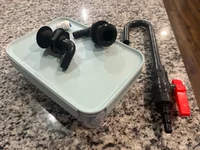
CO2: Almost forgot, for Co2 injection I have made a DIY Yugang with a locking food storage container. It will be stored in the cabinet and the hook will feed into the return pump chamber on the right. I initially was bummed that I had to sacrifice storage to fit a 5lb CO2 tank under the stand, which also meant getting rid of of the 20lb tank I’ve only been having to fill twice a year. @GreggZ Will appreciate this, my awesome father in law suggested that I hide the co2 tank in the pantry closet which is directly behind that wall and just drill a hole for the co2 line. Since my father in laws word is pure gold in my wife’s eyes, that suggestion was approved! He’s just as much my dad too so I appreciated him supporting the project

52 Replies
·
3010 views

Staff member
I Donated 2026
Founding Member
Hello Welcome, sootshe
Welcome to ScapeCrunch, @sootshe!
We would love to get to know you. Please tell us about yourself. What tank do you have?
We would love to get to know you. Please tell us about yourself. What tank do you have?
1 Replies
·
11 views

I Donated 2026
Expert in Residence
MOTM Winner
Journal 20 gallon Rotala florida tank
I have always liked Rotala florida as plant due to its strongly colored leaves, but realized that I haven't actually aquascaped much with it - meaning to integrate it as part of a layout and not just growing a bunch of it in farm/collector style tank. Using plants in a layout in tighter bunches, and in competition with surrounding plants/hardscape is much harder than growing it farm style in a single patch - it also means be able to shape/trim the bushes to match the overall curves of the layout.
Back in 2016 or so when I first received Rotala florida samples from north america, I could only grow it in sparser bunches. It looked nice in macro photographs but I could not envision using it an bush that would show off well as part of a layout unless I can grow it much denser. In the recent years, there were two main discoveries that I found in my experimentation, the first is that it grows better in moderate GH (5 dGH+) compared to super soft water (say <3dGH), and that it grew better in certain soil mixes (I experimented with different garden soil mixes when engineering the composition of APT Feast). Eventually I integrated some of the soil data into APT Feast's composition, and paired with the higher power lights readily available today, I find that I could finally grow the plant the way I envisioned as part of overall layout. I could prune it dense, as the base stems were healthy enough to sprout dense side shoots after trimming - and the secondary/tertiary shoot tips were as fully colored and sized similar to a primary shoot tip that hasn't been subjected to topping yet.
As a midground stem, it works very well due to its slower growth rate vs other colored stem plants.
Against the deep purple of Rotala florida, I found that Golden white clouds worked quite well. So now they are the main inhabitants of the tank.
Tank this week (25/6/2025)


Tank started out like this:

A week or 2 after initial planting (5/5/2025). I reused old aquasoil from the previous scape, so I planted all plants up front rather than waiting more time for the tank to stabilize, with the idea that I could out-grow any algae issues. Initially wanted to add H. Chai but it really didn't fit the overall color scheme, and the bushes by the side were too invasive to be compatible with having a chai patch I think.
Since it was going to contain Rotala florida, I thought I might as well throw in other high demand troublesome species such as the Red Eriocaulon quinguangulare, blood vomit. I settled on Rotala tulunadensis for the background as I wanted something dense and shapeable.
Tank specs:
60x36x36cm
Filter: Oase biomaster 250, all sponge media
CO2 injected through inline atomizer
Substrate: APT Feast
Water column: APT Sky to raise GH to 5dGH, 2ml of APTe per day.

Light distance. Interestingly, not crazy high PAR - just around 200-250 umols PAR at the substrate level.

Trimming and shaping: Most bushes were shaped by cutting individual outlier shoots one by one. Only Rotala blood red and the Rotala tulunadensis was straight trimmed across the entire top once.

This is how the Rotala tulunadensis looked like after a straight trim on 29/5/2025. About 3 weeks from when the top picture at top of this page was taken. It took the plant a whole week + to show new shoots. It seems straight trimming slows down the plant quite a bit, but allows for a very dense & neat canopy afterwards.

There are some interesting plants stuffed here and there. Some Eriocaulon caulescens? bolivia? that local hobbyists passed on to me. Carved out a patch for Syngonanthus vichada - slow grower, but the couple of babies that came have doubled in size so I think they should be alright. I think I will move them to a larger tank with more space.


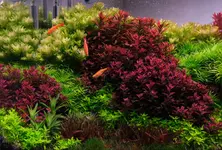
Only discovered the color combination with the Golden white clouds when the tank matured, but its one of my favourite fish-plant combinations now. I think that while some of the species are a bit picky about growth conditions, one thing I really like about this tank is that most things have moderate/slow growth rates, which makes maintenance with regards to removing excess growth less tedious.
Elatine triandra is used as a low growing green filler plant - it does this role well. As it does not root very deeply, I can easily cut and pull off excess growth easily. Its the fasting growing plant in the layout that requires frequent removal of excess growth.
Some more close-ups.


I'm trying to replicate concepts of this layout (slowing growing bushes) into my 4ft tank.
Back in 2016 or so when I first received Rotala florida samples from north america, I could only grow it in sparser bunches. It looked nice in macro photographs but I could not envision using it an bush that would show off well as part of a layout unless I can grow it much denser. In the recent years, there were two main discoveries that I found in my experimentation, the first is that it grows better in moderate GH (5 dGH+) compared to super soft water (say <3dGH), and that it grew better in certain soil mixes (I experimented with different garden soil mixes when engineering the composition of APT Feast). Eventually I integrated some of the soil data into APT Feast's composition, and paired with the higher power lights readily available today, I find that I could finally grow the plant the way I envisioned as part of overall layout. I could prune it dense, as the base stems were healthy enough to sprout dense side shoots after trimming - and the secondary/tertiary shoot tips were as fully colored and sized similar to a primary shoot tip that hasn't been subjected to topping yet.
As a midground stem, it works very well due to its slower growth rate vs other colored stem plants.
Against the deep purple of Rotala florida, I found that Golden white clouds worked quite well. So now they are the main inhabitants of the tank.
Tank this week (25/6/2025)
Tank started out like this:
A week or 2 after initial planting (5/5/2025). I reused old aquasoil from the previous scape, so I planted all plants up front rather than waiting more time for the tank to stabilize, with the idea that I could out-grow any algae issues. Initially wanted to add H. Chai but it really didn't fit the overall color scheme, and the bushes by the side were too invasive to be compatible with having a chai patch I think.
Since it was going to contain Rotala florida, I thought I might as well throw in other high demand troublesome species such as the Red Eriocaulon quinguangulare, blood vomit. I settled on Rotala tulunadensis for the background as I wanted something dense and shapeable.
Tank specs:
60x36x36cm
Filter: Oase biomaster 250, all sponge media
CO2 injected through inline atomizer
Substrate: APT Feast
Water column: APT Sky to raise GH to 5dGH, 2ml of APTe per day.
Light distance. Interestingly, not crazy high PAR - just around 200-250 umols PAR at the substrate level.
Trimming and shaping: Most bushes were shaped by cutting individual outlier shoots one by one. Only Rotala blood red and the Rotala tulunadensis was straight trimmed across the entire top once.
This is how the Rotala tulunadensis looked like after a straight trim on 29/5/2025. About 3 weeks from when the top picture at top of this page was taken. It took the plant a whole week + to show new shoots. It seems straight trimming slows down the plant quite a bit, but allows for a very dense & neat canopy afterwards.
There are some interesting plants stuffed here and there. Some Eriocaulon caulescens? bolivia? that local hobbyists passed on to me. Carved out a patch for Syngonanthus vichada - slow grower, but the couple of babies that came have doubled in size so I think they should be alright. I think I will move them to a larger tank with more space.
Only discovered the color combination with the Golden white clouds when the tank matured, but its one of my favourite fish-plant combinations now. I think that while some of the species are a bit picky about growth conditions, one thing I really like about this tank is that most things have moderate/slow growth rates, which makes maintenance with regards to removing excess growth less tedious.
Elatine triandra is used as a low growing green filler plant - it does this role well. As it does not root very deeply, I can easily cut and pull off excess growth easily. Its the fasting growing plant in the layout that requires frequent removal of excess growth.
Some more close-ups.
I'm trying to replicate concepts of this layout (slowing growing bushes) into my 4ft tank.
229 Replies
·
27641 views