
Welcome to ScapeCrunch
We are ScapeCrunch, the place where planted aquarium hobbyists come to build relationships and support each other. When you're tired of doom scrolling, you've found your home here.
Social Feed

I Donated 2026
Been meaning to write this up for a while, so here it is. Over the last few months I've built a full custom controller setup for my 130L planted, CO2 injected tank, running on three ESP32 boards working together. It replaced an ageing Up Aqua CO2/pH controller and turned into a genuinely complete automation system for water changes, dosing, CO2, top-off, and reservoir monitoring. Sharing the overview here in case it's useful or interesting to anyone else down a similar rabbit hole.
Three boards, each with its own job:
They talk to each other over WiFi and three deliberate hardwired links for the communications that genuinely shouldn't depend on the network as they are safety critical.
Weekly, fully automated. Connect a line from the WaterDrop filter, a drain line that goes outside to the garden or lawn (both with quick connects and manual valves for safety), choose your water change volume in litres, press start and it then:
- runs through safety prompts to ensure everything is connected and safety valves are set correctly.
-prompts to clean prefilters
-prompts to measure remineralisers (calculated on screen, based on your water change volume selection).
-it then drains and refills with RO water. It also turns off/ on smart plugs so skimmers, co2, heaters ect are off for draining then start to turn them on as water fill reaches certain thresholds.
- It doses potassium bicarbonate for KH, calcium and magnesium sulfate for GH, and boosts macros (nitrate, phosphate, potassium, micros), again, all scaled to my actual water change volume.
Everything's logged, every step confirmed before moving to the next, with a wizard-style setup so I can adjust the fill amount, KH target, and anything else on the fly.
I also get phone updates, the fill solenoid is connected with a flow rate sensor, temperature probe and TDS sensor. So every 10L I get an update on the flow rate, tds and temperature of that 10L fill and average so far, so I can spot any issues. It will also abort the water change, stop filter.
I have also put a weight sensor under my CO2 bottle so it tells me how full/empty my co2 bottle is and predicts refill date based on useage (this is untested as it's still so new, I don't have the data for it to be accurate.)
Four channel dosing pump, fully scripted daily doses plus automatic post-water-change boosts, calculated from my actual verified nutrient targets rather than rough guesses. Doses are triggered automatically the moment a water change finishes.
For now, the auto top-off unit itself does the actual work, but the controller now watches the reservoir independently, a proper pressure-based level sensor for the real litre count, plus a simple mechanical float as a dumb, sensor-agnostic backup. If the float ever trips, ATO shuts down immediately and I get a notification, worded differently depending on whether the pressure sensor agrees with the float or not, since a disagreement between the two usually points at the pressure sensor itself needing a look rather than a genuinely empty reservoir. I have some optical sensors on the way, and hopefully by next week the controller is running the ATO independently.
A small but genuinely nice touch. Feeding pauses CO2 injection, filter and skimmer automatically, it's voice activated or you can use a unit mounted button, and the front panel readouts switch to a simple "feeding" display while the filter's off, since the normal sensor numbers would be meaningless with no flow through the lines anyway.
Everything logs to a Grafana dashboard, I have pH, temperature, TDS, reservoir level se sors, it also logs CO2 state, with history of all controller actions that I can actually look back through rather than just a live snapshot. Genuinely useful for spotting slow trends, not just catching sudden problems.
If there's one thing I'd want someone building something similar to take away, it's this. Every automated system that can act on its own needs to fail toward safe, not just work correctly when everything's fine.
A few of the principles that ended up running through the whole build:
The short version
Three boards, each with its own job:
- Water change controller — drains, refills, remineralises, and doses the tank automatically, sitting mostly idle between weekly changes.
- Tank controller — the brains of day-to-day operation, running CO2/pH control, top-off monitoring, the reservoir, and a small front panel with live readouts.
- Alexa bridge — ties the whole thing into Alexa for voice control and equipment scenes, and handles the feeding routine.
They talk to each other over WiFi and three deliberate hardwired links for the communications that genuinely shouldn't depend on the network as they are safety critical.
Water changes
Weekly, fully automated. Connect a line from the WaterDrop filter, a drain line that goes outside to the garden or lawn (both with quick connects and manual valves for safety), choose your water change volume in litres, press start and it then:
- runs through safety prompts to ensure everything is connected and safety valves are set correctly.
-prompts to clean prefilters
-prompts to measure remineralisers (calculated on screen, based on your water change volume selection).
-it then drains and refills with RO water. It also turns off/ on smart plugs so skimmers, co2, heaters ect are off for draining then start to turn them on as water fill reaches certain thresholds.
- during refil it remineralises to target GH and KH from a container with a magnetic stirrer with a perialstatic dosing pump that fires at set percentages of fill.
- it then connects to my Chihiros dosing pumps and fires the dosing boosts to preload nutrients (again these doses are scaled with selected water change volume)
- It doses potassium bicarbonate for KH, calcium and magnesium sulfate for GH, and boosts macros (nitrate, phosphate, potassium, micros), again, all scaled to my actual water change volume.
Everything's logged, every step confirmed before moving to the next, with a wizard-style setup so I can adjust the fill amount, KH target, and anything else on the fly.
I also get phone updates, the fill solenoid is connected with a flow rate sensor, temperature probe and TDS sensor. So every 10L I get an update on the flow rate, tds and temperature of that 10L fill and average so far, so I can spot any issues. It will also abort the water change, stop filter.
CO2 and pH
This was the original reason the whole project started. My old analogue controller had a pretty coarse hysteresis, and in low KH water even small CO2 swings move pH more than I'd like. The new controller runs a proper pH probe on a scheduled window, targets a specific pH with a tight, tunable hysteresis, and logs everything continuously. It also catches things a dumb timer never could, a sudden pH crash with the solenoid already closed pointed straight at a CO2 regulator dumping its tank, something I'd never have caught otherwise until it was a much bigger problem. The Atlas Ezo ph sensor setup is elite and far more accurate than my previous setup. I can also see live updates, get phone alerts for certain events and have set safety alets and shutoffs for events like rapid changes in ph.I have also put a weight sensor under my CO2 bottle so it tells me how full/empty my co2 bottle is and predicts refill date based on useage (this is untested as it's still so new, I don't have the data for it to be accurate.)
Dosing
Being sick of the Chihiros app occasionally being unavailable this year, I have given over control of the scheduling and setup to my controller. I have my own dashboard and phone app that does this now and can send schedules and settings to the Chihiros pumps. It has taken some trial error and bluetooth sniffing apps to work this out but it is rock solid now.Four channel dosing pump, fully scripted daily doses plus automatic post-water-change boosts, calculated from my actual verified nutrient targets rather than rough guesses. Doses are triggered automatically the moment a water change finishes.
Top-off and reservoir
For now, the auto top-off unit itself does the actual work, but the controller now watches the reservoir independently, a proper pressure-based level sensor for the real litre count, plus a simple mechanical float as a dumb, sensor-agnostic backup. If the float ever trips, ATO shuts down immediately and I get a notification, worded differently depending on whether the pressure sensor agrees with the float or not, since a disagreement between the two usually points at the pressure sensor itself needing a look rather than a genuinely empty reservoir. I have some optical sensors on the way, and hopefully by next week the controller is running the ATO independently.
Feeding
A small but genuinely nice touch. Feeding pauses CO2 injection, filter and skimmer automatically, it's voice activated or you can use a unit mounted button, and the front panel readouts switch to a simple "feeding" display while the filter's off, since the normal sensor numbers would be meaningless with no flow through the lines anyway.
Remote monitoring
Everything logs to a Grafana dashboard, I have pH, temperature, TDS, reservoir level se sors, it also logs CO2 state, with history of all controller actions that I can actually look back through rather than just a live snapshot. Genuinely useful for spotting slow trends, not just catching sudden problems.
Alexa integration
Voice control for scenes around water changes, changing settings and feeding, equipment turning off and on automatically at the right points in each process, and a physical feed button that fires the exact same routine as the voice command.Safety, and why it mattered more than any single feature
If there's one thing I'd want someone building something similar to take away, it's this. Every automated system that can act on its own needs to fail toward safe, not just work correctly when everything's fine.
A few of the principles that ended up running through the whole build:
- Solenoids fail closed. Power loss means CO2 and water stay off, never on, by hardware design, not firmware logic that could have a bug in it.
- A tripped safety condition can't be quietly dismissed. If something raises an alert, like the backup float, you can acknowledge it, but the system won't let you clear it while the actual problem is still physically present. No accidentally waving away a real fault.
- The one link that has to work regardless of WiFi, does. CO2 and ATO pausing during a water change runs over a direct hardwired connection between boards, not the network. Everything else can be a bit more relaxed about connectivity; that one thing can't be.
- A backup sensor's only job is to disagree usefully. The float switch isn't there to be a second source of truth, it's there to catch the primary sensor being wrong. When they disagree, the alert tells me which one to actually go check.
- Never power anything from two sources at once. Learned that one the hard way, destroyed a board's regulator early on doing exactly that. So it now has wifi firmware updates for each board, to save the USB input power when updating by PC
None of this was designed perfectly the first time either, more caught through actually running it and paying attention than getting it right on paper up front. A few genuine bugs this build taught me: features that were fully coded but sitting behind a switch I'd forgotten to flip on, so they looked complete but never actually ran; a menu screen that could lose progress if you walked away at the wrong moment during a slow calibration step. Both fixed once they showed up in real use, which is really the whole point of building it in stages rather than all at once and hoping. I have spent weeks finding and squashing bugs before I have given over control of the tank to it.
Next on the list:
Heater/fan control, full ATO control, uninteruptable power unit uninterruptible that alerts me to power outages and turns on air pumps.
It is also in a pretty basic case and the cutouts are purposely oversized. I have ordered smoked acrylic to 'wrap' it in so it appears to be black rectangular box, with only the LED parameter readouts (temp, pH, TDS and ATO reservoir litres) visible through the smoke tinted acrylic and the two black control knobs that wake sleeping OLED screens, all other controls will be behind hinged flaps. I want to make sure all the sensors etc are wired correctly though before I wrap and anchor wiring.
The great thing is, every time I think of something I want to add, it is a coding session with the help of AI and finding the sensors or equipement required. I can wake up with an idea and genuinely have it implemented with an hour or two of soldering and coding. It fits my tank like a glove and is infinitely adaptable. menu setup and setting options all added as I think of them!
I will add some pictures below of the in progress build! I wanted to share in case anyone is thinking of doing the same, with the prices of ESP32s and the sensors (except for the Atlas Ezo chips! which are expensive but well worth it!) it is definitely a project in reach of anyone with a basic idea of code and soldering.
27 Replies
·
285 views


I Donated 2026
Expert in Residence
MOTM Winner
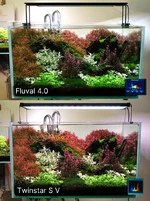
Same camera settings, with a tiny bit of ambient light.
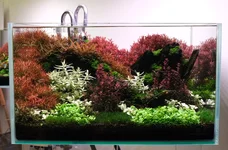
Under week aqua a430
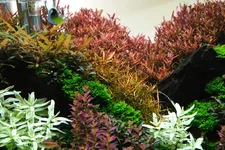
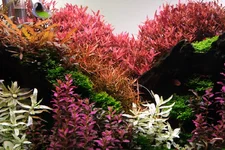
Couple of close-ups:
Fluval 4.0
Twinstar S V
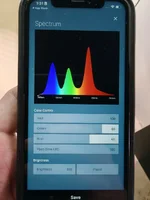
Although Fluval 4.0 is spectrum tunable, it does not have enough red diodes to balance out its spectrum curves and tends to be red deficient.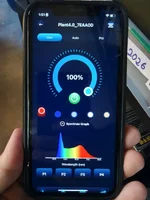
Twinstar has spectrum curves similar to Netlea/Chihiros/Week aqua, much easier to tune to a range of attractive visual colors.
In short, while Twinstar has improved in the last couple of generations to match the chinese LEDs, while Fluval has not.
Under week aqua a430
Couple of close-ups:
Fluval 4.0
Twinstar S V
Although Fluval 4.0 is spectrum tunable, it does not have enough red diodes to balance out its spectrum curves and tends to be red deficient.
Twinstar has spectrum curves similar to Netlea/Chihiros/Week aqua, much easier to tune to a range of attractive visual colors.
In short, while Twinstar has improved in the last couple of generations to match the chinese LEDs, while Fluval has not.
3 Replies
·
44 views

I Donated 2026
Hello, starting up a journal for the second tank. It's totally for my fiance because she wants a betta fish, it's definitely not just a thinly veiled excuse to get a 2nd tank going. No way.
Originally this was planned on being a low tech tank. However I ended up receiving some money from family, so I decided to upgrade it to more of a mid tech.
Equipment:
Plants:
Fertilizing:
I wanted to make this a sort of island-ish setup, where the main focus would be the elephant stones and the large anubias. I knew that my other tank would be right next to this one, so I focused the stems on that side since they would be getting the higher light. I did have some challenges getting the stones and aquasoil into a proper shape, and fitting the huge anubias was an obstacle.
Overall I think it's in a good state, starting to get a few diatoms but not much, and I just added the CO2 today, so the tank is officially fully setup. Now, just waiting to cycle and mature a bit before I add in some shrimps, and then a month later, the betta.
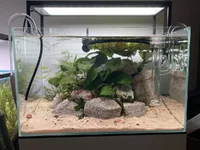
Also, if anyone has advice on the placement of the Poppy Pipe + CO2 diffuser, that is appreciated. Part of the problem is that the Poppy doesn't send water in a straight current, it's just a flurry around it, so I cant just place it on the opposite side of the diffuser like I normally would. Where I have it now, it forms a current that manages to draw some of the CO2 bubbles in, but not all.
Final ask, if anyone has better fertilizer recommendations that is appreciated, specifically how much APT3 would be appropriate for this. So far I've been doing 1 pump/day.
Originally this was planned on being a low tech tank. However I ended up receiving some money from family, so I decided to upgrade it to more of a mid tech.
Equipment:
- UNS 45U rimless tank
- Oase 100 Filtosmart Thermo, with an extra valve stop
- Chihiros WRGB Slim, set to roughly 33% overall power
- A poppy lily pipe and an inlet skimmer
- CO2Art Regulator & Solenoid
Plants:
- Anubia broadleaf
- Anubia (no clue what other kinds, small ones)
- Various Crypts of various types and sizes (I'll dig later in my email receipts to find the types)
- Creeping Jenny
- Limnophilia Heterophylia
- Hygrophila Angustifolia
- Red Root Floaters
Fertilizing:
- 1 pump of APT 3 daily
- Root tabs from Aquarium Co-Op
I wanted to make this a sort of island-ish setup, where the main focus would be the elephant stones and the large anubias. I knew that my other tank would be right next to this one, so I focused the stems on that side since they would be getting the higher light. I did have some challenges getting the stones and aquasoil into a proper shape, and fitting the huge anubias was an obstacle.
Overall I think it's in a good state, starting to get a few diatoms but not much, and I just added the CO2 today, so the tank is officially fully setup. Now, just waiting to cycle and mature a bit before I add in some shrimps, and then a month later, the betta.
Also, if anyone has advice on the placement of the Poppy Pipe + CO2 diffuser, that is appreciated. Part of the problem is that the Poppy doesn't send water in a straight current, it's just a flurry around it, so I cant just place it on the opposite side of the diffuser like I normally would. Where I have it now, it forms a current that manages to draw some of the CO2 bubbles in, but not all.
Final ask, if anyone has better fertilizer recommendations that is appreciated, specifically how much APT3 would be appropriate for this. So far I've been doing 1 pump/day.
9 Replies
·
546 views


Rockstar
Journal Ben's Plant Pharm 2.0
I am working on my mistakes…. The next one will be huge.
Instead of continuing the old build thread, I wanted to make a new one. This build might go just as terrible, but I want to put the old one behind me. I really wish I had given myself a month or two break because I feel like I have algae PTSD. I’m pretty burned out, and I sort of dread trying again. Oh well, too late now.
I wanted to try 2Hr Aquarist stuff, but already had the Controlsoil. I bought it a year prior (see previous journal) and decided to go ahead and use it. Hopefully I’ll make a successful transition to nutrient depleted aquasoil, and then restart with the 2Hr stuff later.
I didn't plan on starting a new journal until about a month in, but since my aquasoil is already starting to give out of ammonia, I need to get it going to get help making the transition to full NPK dosing.
With that said…..
Ben’s Plant Pharm 2.0
(BTW, in case you were wondering, I’m a pharmacist. Hence the pharm)
Setup Date
8-11-25 (Day 0)
Goals
Enjoying some farming.
Successfully navigate the different stages of aqusoil nutrient release and subsequent depletion.
Tank
ADA 60p
Light
Chihiros WRGB Pro II
Starting out at 40% of the Fish setting
Red 53, Blue 34, Green 55, White 23
PAR 105 under the light (estimated)
Substrate
UNS Extra Fine Black 1 x 10L bag
Plants
From Previous Build
Xiris Red from S21 Aquatics
Eriocaulon quinguangulare from Cherries Nature Aquarium
TC plants from Buce Plant
Cryptocoryne parva, Pogostemon helferi, Rotala Sunset
Came in in questionable shape despite paying extra for insulated box. Were very jumbled.
TC from The Fish Room
Alternanthera reineckii ‘Mini’, Rotala macrandra, Gratiola viscidula, Rotala wallichi, Lobelia Cardinalis ‘Mini’
From S21 Aquatics
Synogonthas Vichada, Centrolepis drummondiana (Blood Vomit)
From Aquatic Plants Factory
Pogostemon stellatus Dassen and Rotala Florida? (TBD)
Fertilizer
Micros: Burr Aquatic Trace (BurrFertz)
Macros: DIY- dosages to be determined
PO, K, Mg at the beginning. Been adding about 2-3ppm PO4 daily
Transition to the addition of NO3 as aquasoil depletes
Filter
Oase HOB BioStyle
CO2
Injected via GLA regulator
Bar type diffuser placed inside the HOB filter
Livestock
None
Notes
Day 0


Day 1

Week 1

Week 2

Week 3


Here you can see the older Rotala Sunset on the left. On the right is supposed to be Rotala Florida, but it is looking a lot like the Sunset did at the same stage. Argh!

Pogostemon stellatas Dassen changing from emersed to submersed form

Syn Vichada is doing pretty good. It is growing slow. The new growth is all green and the old growth is dying off. I want to cut old leaves and clean it up a little, but right now, I don't really want to disturb it. I watch it every minute. I loving having it.

Instead of continuing the old build thread, I wanted to make a new one. This build might go just as terrible, but I want to put the old one behind me. I really wish I had given myself a month or two break because I feel like I have algae PTSD. I’m pretty burned out, and I sort of dread trying again. Oh well, too late now.
I wanted to try 2Hr Aquarist stuff, but already had the Controlsoil. I bought it a year prior (see previous journal) and decided to go ahead and use it. Hopefully I’ll make a successful transition to nutrient depleted aquasoil, and then restart with the 2Hr stuff later.
I didn't plan on starting a new journal until about a month in, but since my aquasoil is already starting to give out of ammonia, I need to get it going to get help making the transition to full NPK dosing.
With that said…..
Ben’s Plant Pharm 2.0
(BTW, in case you were wondering, I’m a pharmacist. Hence the pharm)
Setup Date
8-11-25 (Day 0)
Goals
Enjoying some farming.
Successfully navigate the different stages of aqusoil nutrient release and subsequent depletion.
Tank
ADA 60p
Light
Chihiros WRGB Pro II
Starting out at 40% of the Fish setting
Red 53, Blue 34, Green 55, White 23
PAR 105 under the light (estimated)
Substrate
UNS Extra Fine Black 1 x 10L bag
Plants
From Previous Build
Xiris Red from S21 Aquatics
Eriocaulon quinguangulare from Cherries Nature Aquarium
TC plants from Buce Plant
Cryptocoryne parva, Pogostemon helferi, Rotala Sunset
Came in in questionable shape despite paying extra for insulated box. Were very jumbled.
TC from The Fish Room
Alternanthera reineckii ‘Mini’, Rotala macrandra, Gratiola viscidula, Rotala wallichi, Lobelia Cardinalis ‘Mini’
From S21 Aquatics
Synogonthas Vichada, Centrolepis drummondiana (Blood Vomit)
From Aquatic Plants Factory
Pogostemon stellatus Dassen and Rotala Florida? (TBD)
Fertilizer
Micros: Burr Aquatic Trace (BurrFertz)
Macros: DIY- dosages to be determined
PO, K, Mg at the beginning. Been adding about 2-3ppm PO4 daily
Transition to the addition of NO3 as aquasoil depletes
Filter
Oase HOB BioStyle
CO2
Injected via GLA regulator
Bar type diffuser placed inside the HOB filter
Livestock
None
Notes
- The Alternanthera reineckii ‘Mini’ was in bad shape when I opened the container. Might have been bad when I got it and then it was a week before I used it.
- 8-15-25: Added Synogonthas Vichada and Blood Vomit. Checked NO3 for the first time. It was 40. Started making twice weekly water changes.
- 8-18-25: Increased light to 45% of the full “Fish” setting. PAR should be just about 114
- 8-23-25: Pogostemon stellatus Dassen and Rotala Florida added
- 8-29-25: Discovered my NO3 was 0. Aquasoil is giving out way earlier than I expected
- Had a short diatom period, but it seems to be resolving
- I had planned to increase my light to 50% of full "Fish" setting which would be a (tested) PAR of 126, but right now, things are going so good, I don't want to mess it up. We'll hold off for now.
- 8-31-25: Starting to dose my own mixture of NPK and Mg. I really need to determine my actual water volume. What I am trying to dose, and what it tests as after I dose it are a good bit off.
Day 0
Day 1
Week 1
Week 2
Week 3
Here you can see the older Rotala Sunset on the left. On the right is supposed to be Rotala Florida, but it is looking a lot like the Sunset did at the same stage. Argh!
Pogostemon stellatas Dassen changing from emersed to submersed form
Syn Vichada is doing pretty good. It is growing slow. The new growth is all green and the old growth is dying off. I want to cut old leaves and clean it up a little, but right now, I don't really want to disturb it. I watch it every minute. I loving having it.

143 Replies
·
10869 views

I Donated 2026
(I hope this is acceptable as the start of a journal, new here).
Greetings, I’m Alec and this will be my third aquascape. I plan on rescaping my 60p (current scape pic below). The first time I did it, I sort of winged it in the moment. The second time, I came in with a design but it wasn’t strong enough and slowly was buried by aquasoil and plants.
So this time I’m coming in with those learnings and trying to design with intention.
Second pic below is my potential new hardscaping.
I have never done an island composition, and usually I am not a fan of them visually. But while messing around with my rocks I found this tower layout impressive.
My idea is to have the right side be a lower sandy area with some smaller rocks (not shown in pic) along with my big ass Anubias and the various crypts as well. Floaters would be above this area.
Front middle and left would be the Monte Carlo carpet, along with some Ludwigia or other stems tucked along the rocks to become bushes.
Tucked into the cracks of the rocks would be Monte Carlo & Java moss to accent it, along with my Hygrophilia.
Back-left would be stem-city. Big Rotala area with some Bacopa and Ludwigia in front of it, especially towards the center.
The middle area surrounding the top tower rock itself would be Cardamine Lyrata, as it grows naturally well in vertical bushes.
Focal point to the right of the top of the tower stone would be Ludwigia Diamond, which gets decently red.
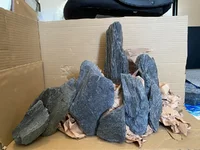

Looking for potential feedback from those with more experience! Some of my concerns:
1. My Anubias are massive, at least for the small. I’m mostly saving them for my fiancés betta tank we hope to setup later this year. I’m a bit worried they won’t fit well into the right side area.
2. The tower is very central, which is the point of island compositions, but I worry my plants might detract from the island look, especially with my plans for the left side.
3. A commenter on my Reddit thread suggested I remove the left side “slope cliff”, instead do another smaller tower there with a sand path. Thoughts?
Thank you for reading. I will probably update this journal with other composition ideas & tweaks as I go, and of course progress pics once I actually rescape it.
Greetings, I’m Alec and this will be my third aquascape. I plan on rescaping my 60p (current scape pic below). The first time I did it, I sort of winged it in the moment. The second time, I came in with a design but it wasn’t strong enough and slowly was buried by aquasoil and plants.
So this time I’m coming in with those learnings and trying to design with intention.
Second pic below is my potential new hardscaping.
I have never done an island composition, and usually I am not a fan of them visually. But while messing around with my rocks I found this tower layout impressive.
My idea is to have the right side be a lower sandy area with some smaller rocks (not shown in pic) along with my big ass Anubias and the various crypts as well. Floaters would be above this area.
Front middle and left would be the Monte Carlo carpet, along with some Ludwigia or other stems tucked along the rocks to become bushes.
Tucked into the cracks of the rocks would be Monte Carlo & Java moss to accent it, along with my Hygrophilia.
Back-left would be stem-city. Big Rotala area with some Bacopa and Ludwigia in front of it, especially towards the center.
The middle area surrounding the top tower rock itself would be Cardamine Lyrata, as it grows naturally well in vertical bushes.
Focal point to the right of the top of the tower stone would be Ludwigia Diamond, which gets decently red.
Looking for potential feedback from those with more experience! Some of my concerns:
1. My Anubias are massive, at least for the small. I’m mostly saving them for my fiancés betta tank we hope to setup later this year. I’m a bit worried they won’t fit well into the right side area.
2. The tower is very central, which is the point of island compositions, but I worry my plants might detract from the island look, especially with my plans for the left side.
3. A commenter on my Reddit thread suggested I remove the left side “slope cliff”, instead do another smaller tower there with a sand path. Thoughts?
Thank you for reading. I will probably update this journal with other composition ideas & tweaks as I go, and of course progress pics once I actually rescape it.
12 Replies
·
827 views

Staff member
I Donated 2026
Founding Member

Sorry about the dramatic title but I think this topic deserves something monumental as it has and continues to be a persistent pain in the neck for aquarists of all skill levels. Let’s face it, BBA is a tough algae to get rid of once it settles in. This thread is dedicated to its eradication by showing real life treatments and their effects. The hope is that we, collectively, arrive at a process that works.
This is important because there is just SO MUCH bad information out there. It’s inconsistent and all over the place. It is based on what someone heard or read but not on first hand experience.
For example, I just saw a BBA help question posed in one of the Facebook groups. Within 4 hours, there were 85 comments. People suggesting everything under the sun. Here is a sampling:
- reducing phosphates
- Ottos and amano shrimp
- Siamese Algae Eaters (SAE)
- American Flag Fish
- Hydrogen peroxide
- The One Two Punch
- Algae Fix
So, with this background in mind, I present to you the present state of my aquarium on the left. BBA has taken over and is now firmly entrenched on the plants, the AquaSoil, the circulation pump and even on the internal UV filter in the back. You can just make out on the lower left that it is now also growing as a lawn on the AquaSoil.
Let’s not get lost looking backwards, although some background as to how we got here is important and helpful. The tank was neglected for about two months. It’s an automated tank but the CO2 ran out and the light and fertilizer stayed the same.
Format
This post is in the form of an article. This means that I will be able to take good discussions from posts below and update the article with them as needed. Feel free to let me know if you feel something from the article merits changing.Background on BBA - what we know to be true
To be continued…
17 Replies
·
1649 views

Supporting
I Donated 2026
Went to Amazon to order a few more of the Kasa Smart Wi-Fi Power Strip, 6-Outlets | HS300, only to find they are not there anymore. Only the 3-outlet strip is available. Using the link in the previous order, the no longer available message appeared. Snooping around, it appears the line is possibly transitioning to the Tapo brand, with its own app. Kasa products are supported in the Tapo app.
The Tapo Smart Wi-Fi Power Strip appears to be the same as the Kasa with different branding, a different app, and a higher price.
I expect that over time the entire line will transition.
The Tapo Smart Wi-Fi Power Strip appears to be the same as the Kasa with different branding, a different app, and a higher price.
I expect that over time the entire line will transition.
7 Replies
·
99 views

Hey Scapecrunch! I posted a journal of this tank on UKAPS but I wanted to share this tank here as well as I think this is a pretty cool build.
I got an amazing opportunity to turn a 1000 gallon tank into a high tech planted tank. I am in the planning phase right now so I wanted to share what I am thinking.

This is the tank currently. The turtle and the all of the fish will be moved to a different setup and a new stocking will be picked for this tank. Someone else will be in charge of fixing up the rock work to make it look nicer and cover the exposed/damaged areas. The tank is 96 in in length, 48 in front to back, and 48 in deep. The filtration on the tank is a sump that is about 200 gallons but it is only halfway full so it contributes about 100 gallons.
I am not sure on what to choose for lighting, but I am leaning towards 4 Chihiro's WRGB II 90 pro. 2 Rows of lights to cover the middle section (Maybe 3 rows of 2?). I wont be having plants near the front, mostly the back half to leave room for a diver to do maintenance. Would this be enough light with how deep the tank is? I am planning to elevate the back half of the substrate pretty high to make sure enough light gets to the plants.
The tank will be having CO2. I am thinking of doing 2 20lb tanks and dual CO2 reactors. I am just not sure how big I will need to make them. I'm aware it will be difficult to get 100% dissolution with how much CO2 I will be needing to inject, so I am okay with having a light mist. I'm sure it will be beneficial for the plants anyways as that's what I see in a lot of ADA tanks. Anyone have an idea of how big I should make these reactors for such a massive tank?
I will use lava rock in the bottom with gravel on top to create the height for the back half of the tank that will have the plants. It will be like a terraced island. The gravel will have a layer of aqua soil on top for the plants (probably ADA or tropica). Outside of the island will be a layer of sand since there wont be plants outside of the island.
Fertilization will be EI dosing, but not full EI because of how much fertilizer that would require. Likely half or a third EI, especially with the aqua soil releasing lots of nutrients anyways for the first months.
I'm working on some sketches of how the layout will be. I am really excited for this project!
I got an amazing opportunity to turn a 1000 gallon tank into a high tech planted tank. I am in the planning phase right now so I wanted to share what I am thinking.
This is the tank currently. The turtle and the all of the fish will be moved to a different setup and a new stocking will be picked for this tank. Someone else will be in charge of fixing up the rock work to make it look nicer and cover the exposed/damaged areas. The tank is 96 in in length, 48 in front to back, and 48 in deep. The filtration on the tank is a sump that is about 200 gallons but it is only halfway full so it contributes about 100 gallons.
I am not sure on what to choose for lighting, but I am leaning towards 4 Chihiro's WRGB II 90 pro. 2 Rows of lights to cover the middle section (Maybe 3 rows of 2?). I wont be having plants near the front, mostly the back half to leave room for a diver to do maintenance. Would this be enough light with how deep the tank is? I am planning to elevate the back half of the substrate pretty high to make sure enough light gets to the plants.
The tank will be having CO2. I am thinking of doing 2 20lb tanks and dual CO2 reactors. I am just not sure how big I will need to make them. I'm aware it will be difficult to get 100% dissolution with how much CO2 I will be needing to inject, so I am okay with having a light mist. I'm sure it will be beneficial for the plants anyways as that's what I see in a lot of ADA tanks. Anyone have an idea of how big I should make these reactors for such a massive tank?
I will use lava rock in the bottom with gravel on top to create the height for the back half of the tank that will have the plants. It will be like a terraced island. The gravel will have a layer of aqua soil on top for the plants (probably ADA or tropica). Outside of the island will be a layer of sand since there wont be plants outside of the island.
Fertilization will be EI dosing, but not full EI because of how much fertilizer that would require. Likely half or a third EI, especially with the aqua soil releasing lots of nutrients anyways for the first months.
I'm working on some sketches of how the layout will be. I am really excited for this project!
173 Replies
·
22816 views

Rockstar
Journal 62G AIO Dirty Soil Lagoon

Well I’m done talking about it, it’s time to get this journal started.
I have been really out of it the last year or so in terms of maintaining my own tank, mainly out of frustration with time constraints and inconsistency with dosing etc. However, I have now acquired a dream tank, rimless and with low iron glass like I’ve always wanted. While I loved having a sump and prided myself on putting it together, I’m past that desire. The AIO allows the same benefits with hiding equipment, and overall easier maintenance without climbing in and out of cabinets. Now onto the details of this build.
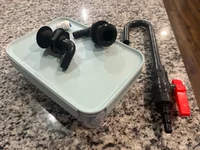
Tank: Planet Aquariums Tideline 62 Gallon AIO Lagoon
Filtration: (2) 250gph pumps on either side of the tank with center overflow into socks (I’m going to punch holes in the socks for now and stuff with polyfill, reviews state the socks clog way too quickly and there is no replacement sock as the insert is not the common round style). The baffles will be stuffed with the poret foam I have already from my sump for extra mechanical/biological.
Substrate: The bottom layer will comprise of bagged pond soil/peat/earthworm castings/ STS. This will be a thin layer and will mainly act as filler to raise up the cap of APT Feast. This is similar to a substrate setup I did when I first started back up in 2020, And that tank did very well. While capping with sand and relying on the dirt to feed the stems worked well, it did require a little more effort on my end with dosing. I don’t trust myself to be as diligent as some members on here are with their inert subs, so I’m taking the mulligan and using aquasoil as a cap, hence, “dirty soil.” This will be another island style layout, and the surrounding substrate will be comprised of Caribsea Carolina Creek Sand.
Hardscape: River rock (local hardscape center sourced) and malaysian driftwood. I have recently acquired another large piece of wood and I’m sourcing new stone this week, as what I have just isn’t meshing with my current vision for the tank.
Plants: …. I have not solidified my vision of what this scape will look like just yet as I haven’t been able to setup the hardscape to outline the island. The plan is to use a good amount of colorful stems, epiphytes, and potentially moss.
Lighting: I will be ordering the Week Aqua Z400 this week and am excited to test it out.
That’s all for now, more pictures and details to come. I should hopefully have the hardscape setup by the end of this coming week after acquiring more stone and wood.
CO2: Almost forgot, for Co2 injection I have made a DIY Yugang with a locking food storage container. It will be stored in the cabinet and the hook will feed into the return pump chamber on the right. I initially was bummed that I had to sacrifice storage to fit a 5lb CO2 tank under the stand, which also meant getting rid of of the 20lb tank I’ve only been having to fill twice a year. @GreggZ Will appreciate this, my awesome father in law suggested that I hide the co2 tank in the pantry closet which is directly behind that wall and just drill a hole for the co2 line. Since my father in laws word is pure gold in my wife’s eyes, that suggestion was approved! He’s just as much my dad too so I appreciated him supporting the project

51 Replies
·
2956 views
It finally happened!
I've been away for work for a few months, during which I got really into the idea of getting a nice aquarium. While I'd already begun planning out a 125 L / ~30 gal tank, expectations had to be tempered because I'll be gone again for a while soon, and my partner would have to take care of the tank alone during that time. So we chose to settle for a 45 L / 12 gal shrimp tank first to test the waters, with me getting to take care of the 125 L tank after returning from my last long trip some time next year. We already got some of the equipment for the larger tank, which is why some of the things here are somewhat oversized.
Things then happened quite quickly when I found a great deal on our shrimp-tank-to-be in a local group. Initially, we'd planned a dark start and to use that time to settle on a plant list, but this used tank came with some plants already, so I'd appreciate any help with plant IDs and input on how to go forward from here.
This tank is intended to be a medium energy setup that allows for some flexibility in care, such as reducing water changes to every two or three weeks when needed. We're looking at slow and medium speed growers, with only very few if any fast growers. We really like bucephalandra and want a few nice ones!
Equipment, flora, fauna
Tank: SuperFish Scaper 45 (45x32x32 cm)
Light: SuperFish Scaper LED 64 (24 W, 16100 Lux, 269 PAR) (I also have a Week Aqua Z400 Pro lying about...), 8 hours a day
Filter: Tetra Ex 1000 Plus (1150 L/h canister filter with 30 ppi foam and some filter wool), surfrace scimmer on intake
Substrate: Tropica Aquarium Soil
Fertilizer: APT 3/Complete, APTe and DIY micros/macros,. Currently dosing 15 mL APT 3 after 50% weekly water change, this should stabilize to 20 ppm NO3 without accounting for uptake
CO2: Injection from 2 kg bottle with JBL Proflora CO2 Taifun Spiral 5 (though this will likely become an in-line diffuser) and an Fzone regulator, starts 2 hours before lights
Hardscape: Mangrove roots and millenium stone, not set up yet
Parameters
Flora:
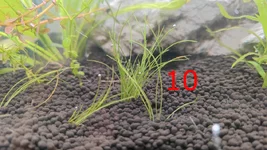
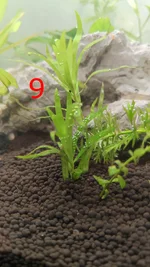
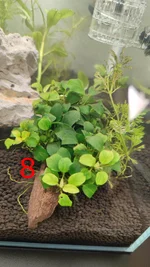
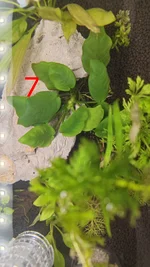
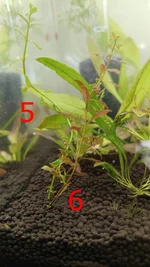
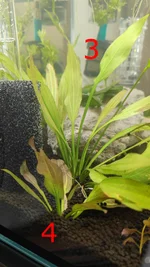
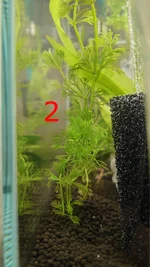
There are 10 species in here right now (I think), as well as some Amazon Frogbit and Salvinia minima on top. I think they might be:
Fauna (planned):
Looking for advice
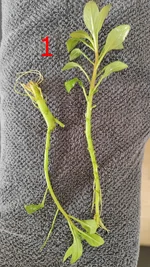
I really wanted this to be a journal about planning and setting up a tank and how well we eventually managed to translate our plan into reality, but thought it best to ask for advice on how to proceed from here first. Yesterday evening (it's now ~24 hours later), we got home with the aquarium and after a good cleaning, I filled it with aquasoil and water and planted the healthiest plants before heading to bed.
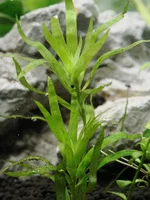
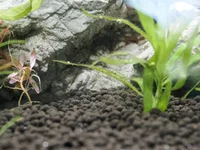
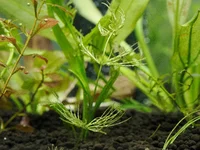
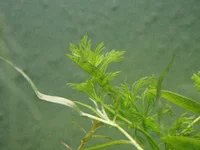
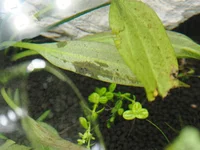
As you can see, these plants aren't doing too great, and some have quite a bit of algae on them. With live plants on our hands, we're skipping the originally planned dark start. I got the filter from the previous owner (asked him to not rinse it), and even though it's only a tiny HOB, we at least have some beneficial bacteria there. I'm running both filters right now in hopes of seeding the canister filter quickly.
I'd appreciate any help with plant IDs and care tips for the different species to help them grow in more healthy. Any recommended treatments to get rid of the algae? Especially the anubias have some small, black spots on them. The Amazon Sword has some pretty torn up leaves with brown and thin spots.
I'm considering hanging the Z400 Pro (rated at 120 W) quite high up, as it blinds surprisingly little for such a powerful light. Though I have noticed that its hue at the same RGB ratio changes quite drastically as you go down in power. Still, this would give me more control over the lighting, as the current light is fixed at 8 cm above the water surface and can't be adjusted.
Future plans
I'm really happy about finally getting into this hobby. We're already super excited and don't even have the shrimps in yet!
For now, I think we'll let the plants recuperate a bit and adjust to the new environment. I think they came from harder water and no CO2. Since we're gone in the weekend, we'll set up the hardscape next week and do a short replant, hopefully that won't bother the plants too much.
Then we'll finalize our personal plant list and begin assembling those, replacing some of the current plants. If you have any favorite plants that would suit this type of environment, I'd love to hear about them!
And last, when we have some nice biofilm developing, we'll add the tiny little shrimps!
Updates
Update 2026/07/09
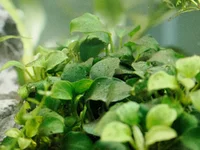
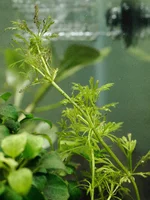
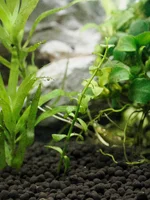
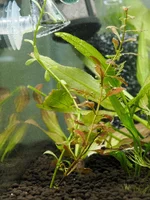
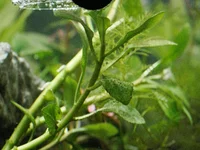
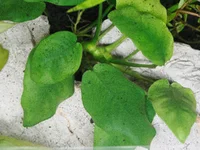
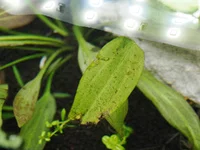
Added some (slightly) nicer pictures of the plants before heading out for work. Have a camera, might as well use it! Hopefully I can post pictures of good looking plants soon. Update update: Well they were nice until the webp compression got to them. Good thing to learn about early on!
I've been away for work for a few months, during which I got really into the idea of getting a nice aquarium. While I'd already begun planning out a 125 L / ~30 gal tank, expectations had to be tempered because I'll be gone again for a while soon, and my partner would have to take care of the tank alone during that time. So we chose to settle for a 45 L / 12 gal shrimp tank first to test the waters, with me getting to take care of the 125 L tank after returning from my last long trip some time next year. We already got some of the equipment for the larger tank, which is why some of the things here are somewhat oversized.
Things then happened quite quickly when I found a great deal on our shrimp-tank-to-be in a local group. Initially, we'd planned a dark start and to use that time to settle on a plant list, but this used tank came with some plants already, so I'd appreciate any help with plant IDs and input on how to go forward from here.
This tank is intended to be a medium energy setup that allows for some flexibility in care, such as reducing water changes to every two or three weeks when needed. We're looking at slow and medium speed growers, with only very few if any fast growers. We really like bucephalandra and want a few nice ones!
Equipment, flora, fauna
Tank: SuperFish Scaper 45 (45x32x32 cm)
Light: SuperFish Scaper LED 64 (24 W, 16100 Lux, 269 PAR) (I also have a Week Aqua Z400 Pro lying about...), 8 hours a day
Filter: Tetra Ex 1000 Plus (1150 L/h canister filter with 30 ppi foam and some filter wool), surfrace scimmer on intake
Substrate: Tropica Aquarium Soil
Fertilizer: APT 3/Complete, APTe and DIY micros/macros,. Currently dosing 15 mL APT 3 after 50% weekly water change, this should stabilize to 20 ppm NO3 without accounting for uptake
CO2: Injection from 2 kg bottle with JBL Proflora CO2 Taifun Spiral 5 (though this will likely become an in-line diffuser) and an Fzone regulator, starts 2 hours before lights
Hardscape: Mangrove roots and millenium stone, not set up yet
Parameters
- RO/DI remineralized to 6 dGH (4:1 Ca:Mg using CaSO4 and MgSO4), 0 dKH
- pH: 6.2
- CO2: To be measured, 1 bubble every 4 s for now, fair amount of surface agitation (gentle, visible waves)
- NH4: undetectable
- NO2: undetectable
- NO3: 20 ppm
Flora:
There are 10 species in here right now (I think), as well as some Amazon Frogbit and Salvinia minima on top. I think they might be:
- 1 - ???
- 2 - Limnophila sessiliflora
- 3 - Amazon Sword (Echinodorus amazonicus)
- 4 - Echinodorus ?
- 5 - Rotala ?
- 6 - Ludwigia repens
- 7 - Anubias nana
- 8 - Anubias mini coin
- 9 - Hygrophila salicifolia
- 10 - Dwarf Hairgrass
- Hopefully no Duckweed
Fauna (planned):
- Red Rili Blue Body Neocaridina
- Possibly a school of nano fish
Looking for advice
I really wanted this to be a journal about planning and setting up a tank and how well we eventually managed to translate our plan into reality, but thought it best to ask for advice on how to proceed from here first. Yesterday evening (it's now ~24 hours later), we got home with the aquarium and after a good cleaning, I filled it with aquasoil and water and planted the healthiest plants before heading to bed.
As you can see, these plants aren't doing too great, and some have quite a bit of algae on them. With live plants on our hands, we're skipping the originally planned dark start. I got the filter from the previous owner (asked him to not rinse it), and even though it's only a tiny HOB, we at least have some beneficial bacteria there. I'm running both filters right now in hopes of seeding the canister filter quickly.
I'd appreciate any help with plant IDs and care tips for the different species to help them grow in more healthy. Any recommended treatments to get rid of the algae? Especially the anubias have some small, black spots on them. The Amazon Sword has some pretty torn up leaves with brown and thin spots.
I'm considering hanging the Z400 Pro (rated at 120 W) quite high up, as it blinds surprisingly little for such a powerful light. Though I have noticed that its hue at the same RGB ratio changes quite drastically as you go down in power. Still, this would give me more control over the lighting, as the current light is fixed at 8 cm above the water surface and can't be adjusted.
Future plans
I'm really happy about finally getting into this hobby. We're already super excited and don't even have the shrimps in yet!
For now, I think we'll let the plants recuperate a bit and adjust to the new environment. I think they came from harder water and no CO2. Since we're gone in the weekend, we'll set up the hardscape next week and do a short replant, hopefully that won't bother the plants too much.
Then we'll finalize our personal plant list and begin assembling those, replacing some of the current plants. If you have any favorite plants that would suit this type of environment, I'd love to hear about them!
And last, when we have some nice biofilm developing, we'll add the tiny little shrimps!
Updates
Update 2026/07/09
Added some (slightly) nicer pictures of the plants before heading out for work. Have a camera, might as well use it! Hopefully I can post pictures of good looking plants soon. Update update: Well they were nice until the webp compression got to them. Good thing to learn about early on!

27 Replies
·
426 views


Hi all,
Recently I planted my 17L low tech nano. This is the second tank that I have, so I'm a bit anxious but I hope to learn a lot (from you too!).
Specs:
Soil: ADA Amazonia V2 (with Bacter 100) + La plata sand
Stones: WIO Titan stone
Filter: Oase filtosmart 100 thermo
Light: Chihiros CII RGB
Fertilizer: roottabs with NKP, none in watercolumn
Water: RO with Glasgarten GH+ (GH~6)
Plants (all in vitro):
Anubias mini coin
Buce kedagang
Buce needle leaf
Buce pygmaea
Crypt parva
Lileaopsis brasiliensis
Marsilea hirsuta
Monte carlo
Start up:
One month dark start with 2 weeks of large water changes followed by 2 weeks of no WC.
After plants were planted I did a 90% WC. Light is currently on R20, G20, B17 for 6 hours. I will continue with 50% WC 3 times a week coming weeks. TDS is stable around 130ppm.
The par layout with current setting are visualized in the drawing below, the height difference is quite challenging. MC receives par around 100, crypt and lileaopsis around 30-50 par. Anubias and Buce targeted between 20-30 par.


The wood is there for biofilm, not for aesthetics, so maybe I will remove it of keep smaller pieces of it since I noticed it makes cleaning more difficult.
I would love to hear your opinions and feedback, as I am highly inspired by aquascaping (my 35L is a high tech tank to practice on). Would you do anything different with this nano tank (fertilization, light etc)? I'm tempted to add potassium in the watercolumn. Also, does someone have experience with keeping clithon snails in KH<1?
Recently I planted my 17L low tech nano. This is the second tank that I have, so I'm a bit anxious but I hope to learn a lot (from you too!).
Specs:
Soil: ADA Amazonia V2 (with Bacter 100) + La plata sand
Stones: WIO Titan stone
Filter: Oase filtosmart 100 thermo
Light: Chihiros CII RGB
Fertilizer: roottabs with NKP, none in watercolumn
Water: RO with Glasgarten GH+ (GH~6)
Plants (all in vitro):
Anubias mini coin
Buce kedagang
Buce needle leaf
Buce pygmaea
Crypt parva
Lileaopsis brasiliensis
Marsilea hirsuta
Monte carlo
Start up:
One month dark start with 2 weeks of large water changes followed by 2 weeks of no WC.
After plants were planted I did a 90% WC. Light is currently on R20, G20, B17 for 6 hours. I will continue with 50% WC 3 times a week coming weeks. TDS is stable around 130ppm.
The par layout with current setting are visualized in the drawing below, the height difference is quite challenging. MC receives par around 100, crypt and lileaopsis around 30-50 par. Anubias and Buce targeted between 20-30 par.
The wood is there for biofilm, not for aesthetics, so maybe I will remove it of keep smaller pieces of it since I noticed it makes cleaning more difficult.
I would love to hear your opinions and feedback, as I am highly inspired by aquascaping (my 35L is a high tech tank to practice on). Would you do anything different with this nano tank (fertilization, light etc)? I'm tempted to add potassium in the watercolumn. Also, does someone have experience with keeping clithon snails in KH<1?
32 Replies
·
2684 views