
Welcome to ScapeCrunch
We are ScapeCrunch, the place where planted aquarium hobbyists come to build relationships and support each other. When you're tired of doom scrolling, you've found your home here.
Social Feed

Supporting
Expert in Residence
Rockstar
Article Contributor
The most common method for measuring CO2 flow in our hobby is the CO2 bubble counter. It is cheap and reliable but has a few disadvantages. We can count the bubbles, but the size of the bubble may vary from one product to another, so we don’t really have an accurate measure of the CO2 volume per minute. Furthermore, for larger aquariums the number of bubbles may exceed 5-10 per second and may be hard to measure without taking videos that can be replayed slow motion.
An alternative would be a professional gas flow meter. Not cheap, needs some corrections for a.o. gas pressures, and user experience for correct use.
I have been thinking some time ago how we could simplify flow measurement for CO2 in our tank, but lost interest as I am using a reactor in overflow mode and therefore do not care anymore about stabilizing my CO2 flow. My reactor stabilizes CO2 injection, irrespective of CO2 flow.
I’d like to share here a concept that I came up with, that may be interesting for a hobbyist or manufacturer to test and develop into a product. I have no plan to take it further but will be happy to put it here in public domain for anyone who sees an opportunity.

The working principle would be in the above graph. We start on the left, where an inverted cup collects injected bubbles in our flow meter. This cup may have a scale printed on it, so that we can read the volume of the gas bubble. Going from 1 to 2, we see that the cup fills, while also the ‘syphon’ fills as pressures equilibrate. When we continue to fill the inverted cup, the ‘syphon’ will start to release gas to the gas pocket in the top of the device, 3, until the cup is empty, 4, and the process repeats itself starting with 1.
The user now times the cycles from 1 to 4, while noting the gas volume when the cup starts releasing.
This will give an accurate volume per minute, in a product that can be really cheap, has no moving parts or complicated technology and should be very reliable for the mainstream hobbyist.
This is a basic working principle but needs further optimization and testing as a proof of concept and development into a product. There will be some challenges in the practical implementation but am quite confident it can be made to work.
Anyone who is interested to run with it and bring something new (as far as I know) to the hobby, feel free.
P.S. I do also have a more radical idea that may be even cheaper, but has probably a few more challenges and risks with proof of concept. I may post that later.
An alternative would be a professional gas flow meter. Not cheap, needs some corrections for a.o. gas pressures, and user experience for correct use.
I have been thinking some time ago how we could simplify flow measurement for CO2 in our tank, but lost interest as I am using a reactor in overflow mode and therefore do not care anymore about stabilizing my CO2 flow. My reactor stabilizes CO2 injection, irrespective of CO2 flow.
I’d like to share here a concept that I came up with, that may be interesting for a hobbyist or manufacturer to test and develop into a product. I have no plan to take it further but will be happy to put it here in public domain for anyone who sees an opportunity.
The working principle would be in the above graph. We start on the left, where an inverted cup collects injected bubbles in our flow meter. This cup may have a scale printed on it, so that we can read the volume of the gas bubble. Going from 1 to 2, we see that the cup fills, while also the ‘syphon’ fills as pressures equilibrate. When we continue to fill the inverted cup, the ‘syphon’ will start to release gas to the gas pocket in the top of the device, 3, until the cup is empty, 4, and the process repeats itself starting with 1.
The user now times the cycles from 1 to 4, while noting the gas volume when the cup starts releasing.
This will give an accurate volume per minute, in a product that can be really cheap, has no moving parts or complicated technology and should be very reliable for the mainstream hobbyist.
This is a basic working principle but needs further optimization and testing as a proof of concept and development into a product. There will be some challenges in the practical implementation but am quite confident it can be made to work.
Anyone who is interested to run with it and bring something new (as far as I know) to the hobby, feel free.
P.S. I do also have a more radical idea that may be even cheaper, but has probably a few more challenges and risks with proof of concept. I may post that later.
6 Replies
·
1529 views


Hi guys,
I'm planning to do a switch, but I would like to know if it makes sense before buying anything.
My actual tank is a 110x50x60h, this is my first bigger tank and it's the tank where I started to truly love this hobby.
This tanks gave me joy, anxiety and satisfaction.
I bought it for relatively cheap (around 130€), but know I was thinking to buy a standard 120p.
I plan to reuse my old tropica aquasoil (I'll remove the First 1-2cm and topping It with apt feast).
What do you think? It's a waste of time/money or you'll think that is a change that make sense?
I always felt strange about this tanks proportion.
I plan to do it with 3 buckets (fish, plants and soil). The water is fully ro.
Any suggestions for doing it? Is worth it? Or it's just late and I'm overthinking?
4 Replies
·
82 views

Rockstar
I mention this plant on occasion, but no one ever comments. So I thought I'd make a post for others and me for future reference.
It is my favorite Erio. It is a darker green, doesn't get too big, and for me it has never sent up any seed stalks.
I find it easy to grow. I have high light but nothing crazy at 124PAR and high CO2, 50+ppm. It gets about max 3-4" and makes side daughter plants when large. I'm not sure my dosing scheme is. Sort of an EI daily dosing kind of thing.
What gets me is every autumn, it starts to melt. I'm not sure how it knows it's autumn with consistent light and a heater, but it must get a little cooler in the tank or something. The plant starts to turn brown and sends up (I'm not sure of the correct term) vegetative stalks with little plantlets on the ends. I've found you can plant these stalks into the substrate with the plantlet on top, and it will grow into a new plant. They've been easy to grow. This is the third year this has happened to me.
Pic of plantlets below. I'll try to get a better one sometime. All I had time for tonight was a crappy phone pic.
This year I divided one of the mother plants in hopes that it wouldn't fully melt and would regrow. That is still in progress.
Anyone else's experiences are welcome.
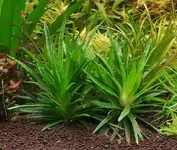
This plant is the same plant as the one on the right above.

It is my favorite Erio. It is a darker green, doesn't get too big, and for me it has never sent up any seed stalks.
I find it easy to grow. I have high light but nothing crazy at 124PAR and high CO2, 50+ppm. It gets about max 3-4" and makes side daughter plants when large. I'm not sure my dosing scheme is. Sort of an EI daily dosing kind of thing.
What gets me is every autumn, it starts to melt. I'm not sure how it knows it's autumn with consistent light and a heater, but it must get a little cooler in the tank or something. The plant starts to turn brown and sends up (I'm not sure of the correct term) vegetative stalks with little plantlets on the ends. I've found you can plant these stalks into the substrate with the plantlet on top, and it will grow into a new plant. They've been easy to grow. This is the third year this has happened to me.
Pic of plantlets below. I'll try to get a better one sometime. All I had time for tonight was a crappy phone pic.
This year I divided one of the mother plants in hopes that it wouldn't fully melt and would regrow. That is still in progress.
Anyone else's experiences are welcome.
This plant is the same plant as the one on the right above.
13 Replies
·
688 views


Sounds like a joke question but for reasons unknown I cant get moss to grow period, Got a huge baseball of moss for free from shrimp breeder. I put some in 5g shrimp tank, low light no heater around 74 its dead. 3 other tanks 76 degree low to medium light its all dead or looks dead its grey color I'd say it's dead. water parms are pretty spot on no big shifts or other plants would have issues imo.
what do I need to do to grow java moss ? grew it for years no issues would take over now im lost! I can grow anything but moss?
what do I need to do to grow java moss
? grew it for years no issues would take over now im lost! I can grow anything but moss?
7 Replies
·
578 views

Rockstar
I’m often out and about working in the field and stumble upon breathtaking examples of often overlooked and under appreciated slices of nature that Florida has to offer.
My neck of the woods is filled with marsh/wetlands ripe with both native and invasive wildlife of all flavors; I want to start a thread where I can document and share.
I’ll update this thread whenever I capture something noteworthy. Much of what catches my eye is aquatic flora, but I try and document anything captivating. I hope you find this as beautiful and fascinating as I do.
141 Replies
·
11653 views


Supporting
I Donated 2026
Rockstar
I hadn't seen it mentioned by others that attended Aquashella, but if you hadn't already heard about it or seen it in Aquashella videos, ADA has come out with Amazonia Pro. It's not a replacement for Version 2, but an addition. It is essentially Version 2 on steroids with higher nutrients and of course the negative side effect of potentially higher initial ammonia leaching and, if your not prepared and skilled, more chance of algae. That's even from the mouth of Homma-san himself. The scaping competitors were using it in the competition and AFA was selling 9l bags at the show. They said it would be available on the website within the next couple weeks.
46 Replies
·
2130 views

Supporting
I Donated 2026
Rockstar
With all the talk on Amazonia pro, I wanted to get some basic understanding of rich aquasoil.
- everyone seems to agree that the richer the aquasoil is, the more the amount of water changes you would have to do initially. Basically meaning that aquasoil leaches its contents into the water and you replace the water. Now….. doesn’t that just mean that you are throwing away what you paid for ? Even if one does a dark start, and minimize the number of water changes one still has to do a water change after the dark start and still end up wasting the nitrate/phosphate?
—— trying to ask then does that mean the only person who benefits from a super rich aquasoil is someone like an insta or YouTube person who wants a quick burst of growth with the initial leaching of nutrition. For everyone else wanting a stable long term system, a not so rich aquasoil which might help the plants a little bit in the beginning but being used more for long term stability and buffering capacity?
- do the plants actually get the boost initially from the root zone or is it more from the leaching that happens and ultimately from the WC? The later makes sense since their roots have not yet developed.
- if one has the whole substrate inside a container with water, wouldn’t water touch all aspects of the substrate regardless of it being capped or not ? How does capping a aquasoil actually help? Green aqua stated that ada recommends capping the Amazonia pro with Amazonia 2.
Curious on people’s thoughts on this.
18 Replies
·
313 views

Hey guys, needing some expert insight on my 90P build regarding the Yugang reactor. I’d like a sanity check on sizing.
System
What I measured

View attachment y2.mp4
System
- Display: 90 × 45 cm outside, 10 mm glass, so ~88 × 43 cm inside (~3,780 cm²), rimless, lidless.
- Sump: 20-gallon long (76 × 30 cm, ~2,280 cm²), 3 chambers, loose lid.
- About 220 L total water.
- Return enters below the surface; no deliberate surface agitation.
- BeanAnimal overflow, with the main draining underwater (no cascade).
- Currently cycling on tap water: KH 13, GH 12. The plan is RO remineralised to KH 3–4.
- Horizontal Yugang, 3" Sch40 PVC (ID 77.9 mm), 46 cm long.
- Outlet rotated to near the limit of what my plumbing allows, so the pocket is much smaller than half-full.
- CO₂ flow meter at about 9 mL/min. That’s slightly over what it dissolves, so it gives small occasional burps.
What I measured
- Plateau: pH 6.80 at KH 13 ~ 60 ppm (pH/KH estimate). Degassed baseline pH at 8.2.
- Overnight decay after CO₂ off: k ≈ 0.12/h (half-life ~5.7 h). That implies a CO₂ exchange rate of ~4–7 cm/h, i.e. a calm surface.
- Working the 1/17.7 rule backwards from my reactor area (~180–358 cm² depending on rotation), my effective loss area is ~1,100–2,200 cm², against ~6,060 cm² of real water surface (display + sump).
View attachment y2.mp4
30 Replies
·
622 views

Staff member
I Donated 2026
Founding Member
Hello Welcome, Bruce Lau
Welcome to ScapeCrunch, @Bruce Lau!
We would love to get to know you. Please tell us about yourself. What tank do you have?
We would love to get to know you. Please tell us about yourself. What tank do you have?
0 Replies
·
26 views

Supporting
I Donated 2026
Rockstar
Article Contributor

I've really been digging pearlweed in my low tech tank, and thinking of growing a shaped pearlweed bush in my high tech experiment tank.
But I came across this listing for a white/platinum variety of pearlweed. Can't find any info on it anywhere. So I ordered 5 stems, the most expensive pearlweed stems on earth!
Think it'll actually survive/be platinum or light colored?
We really need some lighter colored plants in this hobby. Myrio 'Golden' is one I've successfully used, but it grows too crazy and the trimmings drove me nuts so I ditched it. What other white/platinum plants are there?
15 Replies
·
939 views
Staff member
I Donated 2026
Founding Member
This is the future home for the announcements when someone obtains an achievement badge. Let the games begin!
2055 Replies
·
77485 views